
天津医药 ›› 2025, Vol. 53 ›› Issue (12): 1263-1270.doi: 10.11958/20252693
张梦洁( ), 宁冰雪, 苏楠, 腊晓琳()
收稿日期:2025-08-13
修回日期:2025-09-28
出版日期:2025-12-15
发布日期:2025-12-08
通讯作者:
△E-mail:作者简介:张梦洁(1994),女,医师,主要从事生殖医学相关研究。E-mail:基金资助:
ZHANG Mengjie(), NING Bingxue, SU Nan, LA Xiaolin()
Received:2025-08-13
Revised:2025-09-28
Published:2025-12-15
Online:2025-12-08
Contact:
△E-mail:张梦洁, 宁冰雪, 苏楠, 腊晓琳. RIF患者子宫内膜微生物组特征与后续移植结局的关联性分析[J]. 天津医药, 2025, 53(12): 1263-1270.
ZHANG Mengjie, NING Bingxue, SU Nan, LA Xiaolin. Association analysis of endometrial microbiome characteristics in RIF patients with subsequent transplantation outcomes[J]. Tianjin Medical Journal, 2025, 53(12): 1263-1270.
摘要:
目的 探究反复种植失败(RIF)患者子宫内膜微生物组特征与后续移植结局的相关性。方法 回顾性选取再次接受胚胎移植的438例RIF患者,根据胚胎移植后8周的妊娠情况将患者分为妊娠组(n=85)与未妊娠组(n=353),比较2组临床资料与子宫内膜微生物组特征以及组成情况;二分类Logistic回归分析影响因素并采用受试者工作特征(ROC)曲线预测影响因素效能;进一步分析上述危险因素与Shannon指数在RIF患者后续移植结局中的交互作用。结果 未妊娠组患者基础雌二醇(E2)、空腹胰岛素(Fins)、总胆固醇(TC)、三酰甘油(TG)水平高于妊娠组(均P<0.05);2组梭杆菌门丰度、芽孢杆菌属丰度及Alpha多样性(Chao1、Shannon、Simpson)指数差异均有统计学意义(均P<0.05);二分类Logistic回归分析显示,梭杆菌门丰度升高(OR=1.628,95%CI:1.416~1.841)、芽孢杆菌属丰度降低(OR=0.725,95%CI:0.557~0.934)、E2升高(OR=1.654,95%CI:1.343~1.965)、Fins升高(OR=1.691,95%CI:1.393~1.980)和Shannon指数降低(OR=0.388,95%CI:0.075~0.697)是后续移植失败的独立危险因素。ROC曲线分析显示,Shannon指数的曲线下面积为0.836(95%CI:0.782~0.890),预测效能最高;亚组梭杆菌门、芽孢杆菌属、E2、Fins在Shannon指数对RIF患者后续移植结局中存在显著交互作用。结论 RIF患者后续移植失败的独立危险因素可作为预测RIF患者后续移植结局的敏感指标,且Shannon指数临床预测价值更高。
中图分类号:
| 组别 | n | 不孕 年限/年 | 不孕类型 | 自然 流产史 | 女方 吸烟 | 女方 饮酒 | 年龄/岁 | 不孕 时间/年 | 流产 次数/次 | |||||||||||||||||||||||
|---|---|---|---|---|---|---|---|---|---|---|---|---|---|---|---|---|---|---|---|---|---|---|---|---|---|---|---|---|---|---|---|---|
| 原发 | 继发 | 男 | 女 | |||||||||||||||||||||||||||||
| 妊娠组 | 85 | 3.27±2.56 | 45(52.9) | 40(47.1) | 8(9.4) | 2(2.4) | 0(0.0) | 30.66±1.43 | 29.01±1.65 | 2.21±0.42 | 1.33±0.22 | |||||||||||||||||||||
| 未妊娠组 | 353 | 2.87±1.98 | 193(54.7) | 160(45.3) | 45(12.8) | 5(1.4) | 5(1.4) | 31.09±2.13 | 28.69±1.57 | 2.26±0.39 | 1.36±0.18 | |||||||||||||||||||||
| t或χ2 | 1.573 | 0.083 | 0.717 | 0.019 | 0.588▲ | 1.767 | 1.670 | 1.045 | 1.318 | |||||||||||||||||||||||
| 组别 | BMI/ (kg/m2) | FSH/ (mIU/L) | LH/ (mIU/L) | E2/ (pmol/L) | P/ (nmol/L) | FPG/ (mmol/L) | Fins/ (mU/L) | Alb/ (g/L) | TC/ (mmol/L) | TG/ (mmol/L) | ||||||||||||||||||||||
| 妊娠组 | 21.30±1.28 | 6.83±0.71 | 4.34±0.93 | 137.02±35.08 | 1.56±0.32 | 5.24±0.18 | 8.59±0.94 | 46.65±1.33 | 4.31±0.36 | 0.91±0.11 | ||||||||||||||||||||||
| 未妊娠组 | 22.13±2.40 | 6.79±0.96 | 4.21±0.82 | 156.53±20.50 | 1.65±0.43 | 5.26±0.13 | 11.00±3.04 | 46.35±1.74 | 4.67±0.48 | 1.25±0.13 | ||||||||||||||||||||||
| t | 0.051 | 0.718 | 0.202 | 4.929** | 0.071 | 0.241 | 12.601** | 0.138 | 7.715** | 24.651** | ||||||||||||||||||||||
| 组别 | HDL-C/ (mmol/L) | 获卵 数/个 | MII/ 个 | 受精数/ 个 | 2PN/ 个 | 移植日内膜 厚度/mm | 内膜准备方式 | 胚胎体外培养天数 | 优质 囊胚 | |||||||||||||||||||||||
| 人工周期 | 自然周期 | 5 d | 6 d | |||||||||||||||||||||||||||||
| 妊娠组 | 1.38±0.14 | 11.25±2.36 | 9.58±2.04 | 7.62±1.83 | 5.49±1.42 | 10.66±0.59 | 69(81.2) | 16(18.8) | 61(71.8) | 24(28.2) | 75(88.2) | |||||||||||||||||||||
| 未妊娠组 | 1.35±0.13 | 10.87±2.18 | 9.36±1.87 | 7.41±1.62 | 5.30±1.26 | 10.51±1.04 | 284(80.5) | 69(19.6) | 233(66.0) | 120(34.0) | 319(90.4) | |||||||||||||||||||||
| t或χ2 | 0.061 | 1.419 | 0.956 | 1.045 | 1.217 | 0.201 | 0.023 | 1.030 | 0.345 | |||||||||||||||||||||||
表1 2组患者临床资料比较
Tab.1 Comparison of clinical data between the two groups of patients
| 组别 | n | 不孕 年限/年 | 不孕类型 | 自然 流产史 | 女方 吸烟 | 女方 饮酒 | 年龄/岁 | 不孕 时间/年 | 流产 次数/次 | |||||||||||||||||||||||
|---|---|---|---|---|---|---|---|---|---|---|---|---|---|---|---|---|---|---|---|---|---|---|---|---|---|---|---|---|---|---|---|---|
| 原发 | 继发 | 男 | 女 | |||||||||||||||||||||||||||||
| 妊娠组 | 85 | 3.27±2.56 | 45(52.9) | 40(47.1) | 8(9.4) | 2(2.4) | 0(0.0) | 30.66±1.43 | 29.01±1.65 | 2.21±0.42 | 1.33±0.22 | |||||||||||||||||||||
| 未妊娠组 | 353 | 2.87±1.98 | 193(54.7) | 160(45.3) | 45(12.8) | 5(1.4) | 5(1.4) | 31.09±2.13 | 28.69±1.57 | 2.26±0.39 | 1.36±0.18 | |||||||||||||||||||||
| t或χ2 | 1.573 | 0.083 | 0.717 | 0.019 | 0.588▲ | 1.767 | 1.670 | 1.045 | 1.318 | |||||||||||||||||||||||
| 组别 | BMI/ (kg/m2) | FSH/ (mIU/L) | LH/ (mIU/L) | E2/ (pmol/L) | P/ (nmol/L) | FPG/ (mmol/L) | Fins/ (mU/L) | Alb/ (g/L) | TC/ (mmol/L) | TG/ (mmol/L) | ||||||||||||||||||||||
| 妊娠组 | 21.30±1.28 | 6.83±0.71 | 4.34±0.93 | 137.02±35.08 | 1.56±0.32 | 5.24±0.18 | 8.59±0.94 | 46.65±1.33 | 4.31±0.36 | 0.91±0.11 | ||||||||||||||||||||||
| 未妊娠组 | 22.13±2.40 | 6.79±0.96 | 4.21±0.82 | 156.53±20.50 | 1.65±0.43 | 5.26±0.13 | 11.00±3.04 | 46.35±1.74 | 4.67±0.48 | 1.25±0.13 | ||||||||||||||||||||||
| t | 0.051 | 0.718 | 0.202 | 4.929** | 0.071 | 0.241 | 12.601** | 0.138 | 7.715** | 24.651** | ||||||||||||||||||||||
| 组别 | HDL-C/ (mmol/L) | 获卵 数/个 | MII/ 个 | 受精数/ 个 | 2PN/ 个 | 移植日内膜 厚度/mm | 内膜准备方式 | 胚胎体外培养天数 | 优质 囊胚 | |||||||||||||||||||||||
| 人工周期 | 自然周期 | 5 d | 6 d | |||||||||||||||||||||||||||||
| 妊娠组 | 1.38±0.14 | 11.25±2.36 | 9.58±2.04 | 7.62±1.83 | 5.49±1.42 | 10.66±0.59 | 69(81.2) | 16(18.8) | 61(71.8) | 24(28.2) | 75(88.2) | |||||||||||||||||||||
| 未妊娠组 | 1.35±0.13 | 10.87±2.18 | 9.36±1.87 | 7.41±1.62 | 5.30±1.26 | 10.51±1.04 | 284(80.5) | 69(19.6) | 233(66.0) | 120(34.0) | 319(90.4) | |||||||||||||||||||||
| t或χ2 | 0.061 | 1.419 | 0.956 | 1.045 | 1.217 | 0.201 | 0.023 | 1.030 | 0.345 | |||||||||||||||||||||||
| 组别 | n | 厚壁菌门 | 变形菌门 | 拟杆菌门 | 放线菌门 | 蓝藻门 | |||||
|---|---|---|---|---|---|---|---|---|---|---|---|
| 妊娠组 | 85 | 0.592(0.569,0.615) | 0.267(0.203,0.331) | 0.093(0.085,0.101) | 0.046(0.033,0.059) | 0.027(0.025,0.029) | |||||
| 未妊娠组 | 353 | 0.496(0.471,0.521) | 0.304(0.283,0.325) | 0.056(0.049,0.063) | 0.087(0.082,0.92) | 0.079(0.075,0.083) | |||||
| Z | 1.637 | 1.215 | 1.502 | 1.294 | 1.633 | ||||||
| 组别 | 梭杆菌门 | 弯曲杆菌门 | 脱硫菌门 | 疣微菌门 | 其他细菌门 | ||||||
| 妊娠组 | 0.006(0.003,0.009) | 0.018(0.017,0.019) | 0.009(0.008,0.010) | 0.003(0.002,0.004) | 0.007(0.006,0.008) | ||||||
| 未妊娠组 | 0.031(0.029,0.033) | 0.032(0.023,0.041) | 0.007(0.006,0.008) | 0.009(0.008,0.010) | 0.004(0.003,0.005) | ||||||
| Z | 2.518* | 1.217 | 1.352 | 1.691 | 0.544 | ||||||
表2 2组在门分类水平物种的相对丰度
Tab.2 Relative abundance of species at the phylum classification level in the two groups [M(P25,P75)]
| 组别 | n | 厚壁菌门 | 变形菌门 | 拟杆菌门 | 放线菌门 | 蓝藻门 | |||||
|---|---|---|---|---|---|---|---|---|---|---|---|
| 妊娠组 | 85 | 0.592(0.569,0.615) | 0.267(0.203,0.331) | 0.093(0.085,0.101) | 0.046(0.033,0.059) | 0.027(0.025,0.029) | |||||
| 未妊娠组 | 353 | 0.496(0.471,0.521) | 0.304(0.283,0.325) | 0.056(0.049,0.063) | 0.087(0.082,0.92) | 0.079(0.075,0.083) | |||||
| Z | 1.637 | 1.215 | 1.502 | 1.294 | 1.633 | ||||||
| 组别 | 梭杆菌门 | 弯曲杆菌门 | 脱硫菌门 | 疣微菌门 | 其他细菌门 | ||||||
| 妊娠组 | 0.006(0.003,0.009) | 0.018(0.017,0.019) | 0.009(0.008,0.010) | 0.003(0.002,0.004) | 0.007(0.006,0.008) | ||||||
| 未妊娠组 | 0.031(0.029,0.033) | 0.032(0.023,0.041) | 0.007(0.006,0.008) | 0.009(0.008,0.010) | 0.004(0.003,0.005) | ||||||
| Z | 2.518* | 1.217 | 1.352 | 1.691 | 0.544 | ||||||
| 组别 | n | 乳酸杆菌属 | 假单胞菌属 | 未分类细菌属 | 芽孢杆菌属 | 拟杆菌属 | |||||
|---|---|---|---|---|---|---|---|---|---|---|---|
| 妊娠组 | 85 | 0.154(0.133,0.175) | 0.147(0.135,0.159) | 0.043(0.041,0.045) | 0.044(0.042,0.046) | 0.017(0.016,0.018) | |||||
| 未妊娠组 | 353 | 0.241(0.217,0.265) | 0.182(0.163,0.201) | 0.041(0.039,0.043) | 0.019(0.018,0.020) | 0.032(0.030,0.034) | |||||
| Z | 1.528 | 0.134 | 0.622 | 3.574** | 0.638 | ||||||
| 组别 | 粪杆菌属 | 加德纳菌属 | 普雷沃氏菌属 | Hungatella | 其他细菌属 | ||||||
| 妊娠组 | 0.023(0.022,0.024) | 0.034(0.032,0.036) | 0.060(0.059,0.061) | 0.014(0.013,0.015) | 0.384(0.355,0.413) | ||||||
| 未妊娠组 | 0.022(0.020,0.026) | 0.008(0.007,0.009) | 0.016(0.015,0.017) | 0.018(0.017,0.019) | 0.405(0.367,0.443) | ||||||
| Z | 0.981 | 1.425 | 1.189 | 0.937 | 1.256 | ||||||
表3 2组在属分类水平物种的相对丰度
Tab.3 Relative abundance of species at the genus classification level in the two groups [M(P25,P75)]
| 组别 | n | 乳酸杆菌属 | 假单胞菌属 | 未分类细菌属 | 芽孢杆菌属 | 拟杆菌属 | |||||
|---|---|---|---|---|---|---|---|---|---|---|---|
| 妊娠组 | 85 | 0.154(0.133,0.175) | 0.147(0.135,0.159) | 0.043(0.041,0.045) | 0.044(0.042,0.046) | 0.017(0.016,0.018) | |||||
| 未妊娠组 | 353 | 0.241(0.217,0.265) | 0.182(0.163,0.201) | 0.041(0.039,0.043) | 0.019(0.018,0.020) | 0.032(0.030,0.034) | |||||
| Z | 1.528 | 0.134 | 0.622 | 3.574** | 0.638 | ||||||
| 组别 | 粪杆菌属 | 加德纳菌属 | 普雷沃氏菌属 | Hungatella | 其他细菌属 | ||||||
| 妊娠组 | 0.023(0.022,0.024) | 0.034(0.032,0.036) | 0.060(0.059,0.061) | 0.014(0.013,0.015) | 0.384(0.355,0.413) | ||||||
| 未妊娠组 | 0.022(0.020,0.026) | 0.008(0.007,0.009) | 0.016(0.015,0.017) | 0.018(0.017,0.019) | 0.405(0.367,0.443) | ||||||
| Z | 0.981 | 1.425 | 1.189 | 0.937 | 1.256 | ||||||

图1 微生物组水平热图 A:门分类水平热图;B:属分类水平热图。
Fig.1 Microbiome horizontal heat map
| 组别 | n | Chao1 | Shannon | Simpson |
|---|---|---|---|---|
| 妊娠组 | 85 | 903.07±52.28 | 5.97±1.37 | 0.93±0.22 |
| 未妊娠组 | 353 | 811.43±50.26 | 4.79±1.42 | 0.85±0.19 |
| t | 14.973** | 6.924** | 3.376** |
表4 2组患者子宫内膜微生物组成Alpha多样性分析
Tab.4 Alpha diversity analysis of endometrial microbial composition in the two groups of patients
| 组别 | n | Chao1 | Shannon | Simpson |
|---|---|---|---|---|
| 妊娠组 | 85 | 903.07±52.28 | 5.97±1.37 | 0.93±0.22 |
| 未妊娠组 | 353 | 811.43±50.26 | 4.79±1.42 | 0.85±0.19 |
| t | 14.973** | 6.924** | 3.376** |
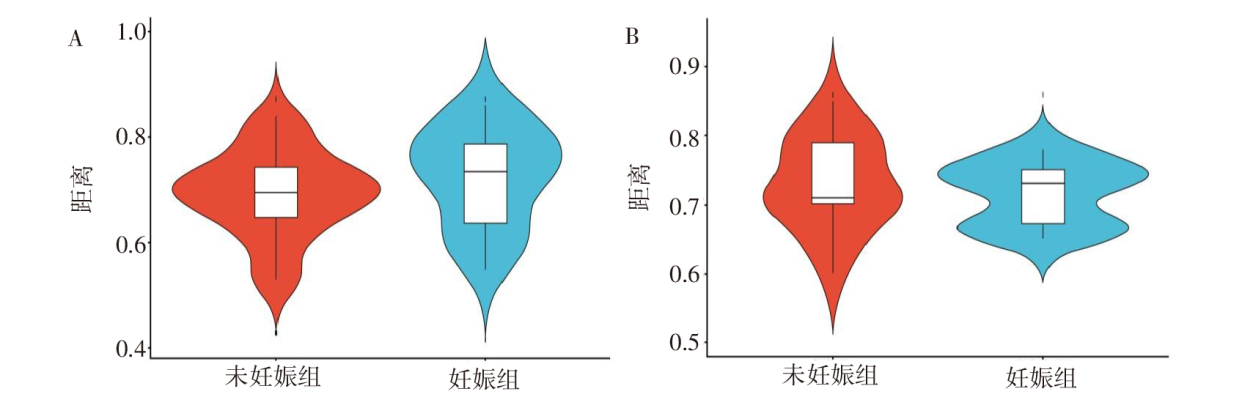
图2 2组患者子宫内膜微生物组成Beta多样性分析 A:PERMANOVA方法比较2组患者微生物组成结构;B:ANOSIM方法比较2组患者微生物组成结构。
Fig.2 Beta diversity analysis of endometrial microbial composition in the two groups of patients
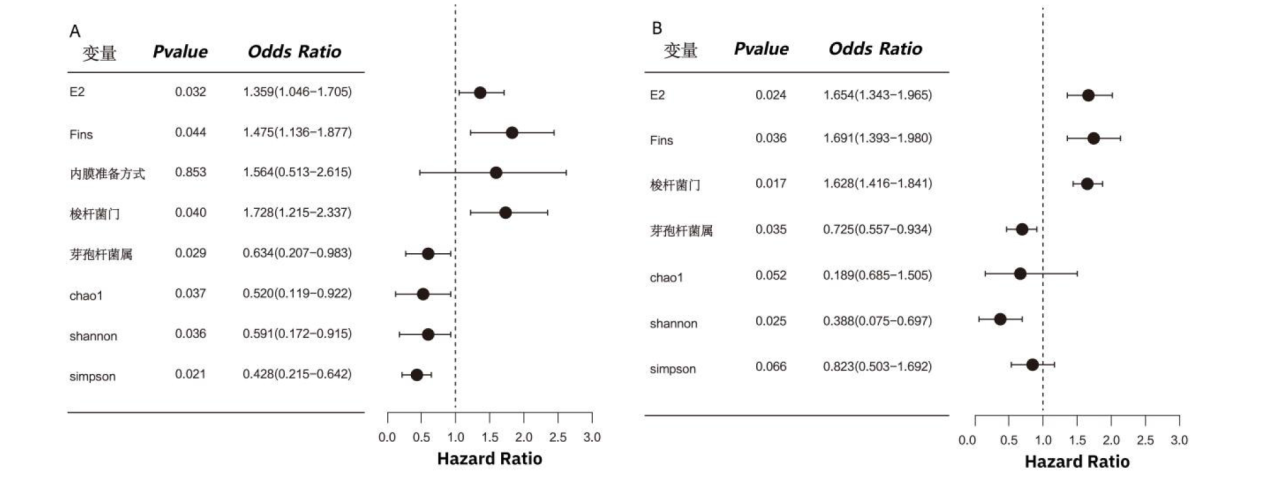
图3 二分类Logistic回归分析RIF患者后续移植失败影响因素的森林图 A:单因素森林图;B:多因素森林图。
Fig.3 Binary Logistic regression analysis of the forest plot of influencing factors for subsequent transplantation failure in RIF patients
| 指标 | AUC | 95%CI | 敏感度 | 特异度 | 约登指数 |
|---|---|---|---|---|---|
| 梭杆菌门 | 0.590 | 0.512~0.668 | 0.628 | 0.633 | 0.717 |
| 芽孢杆菌属 | 0.625 | 0.548~0.702 | 0.704 | 0.591 | 0.682 |
| E2 | 0.624 | 0.545~0.703 | 0.683 | 0.627 | 0.544 |
| Fins | 0.581 | 0.503~0.659 | 0.714 | 0.762 | 0.627 |
| Shannon指数 | 0.836 | 0.782~0.890 | 0.935 | 0.837 | 0.765 |
表5 影响因素对RIF患者后续结局的预测效能
Tab.5 The predictive efficacy of influencing factors for the subsequent outcome of RIF patients
| 指标 | AUC | 95%CI | 敏感度 | 特异度 | 约登指数 |
|---|---|---|---|---|---|
| 梭杆菌门 | 0.590 | 0.512~0.668 | 0.628 | 0.633 | 0.717 |
| 芽孢杆菌属 | 0.625 | 0.548~0.702 | 0.704 | 0.591 | 0.682 |
| E2 | 0.624 | 0.545~0.703 | 0.683 | 0.627 | 0.544 |
| Fins | 0.581 | 0.503~0.659 | 0.714 | 0.762 | 0.627 |
| Shannon指数 | 0.836 | 0.782~0.890 | 0.935 | 0.837 | 0.765 |
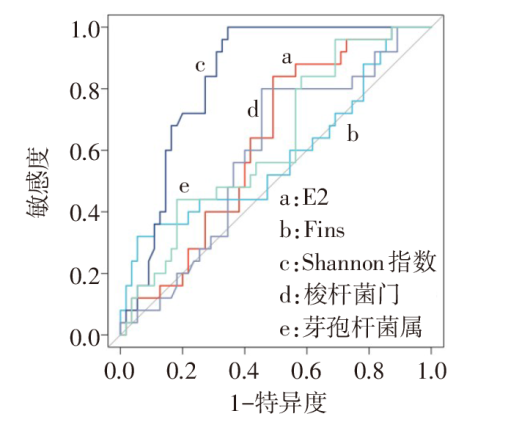
图4 影响因素预测RIF患者后续结局的ROC曲线
Fig.4 The ROC curve of the influencing factors for predicting the subsequent outcome of RIF patients

图5 其他影响因素与Shannon指数在RIF患者后续移植结局的交互作用
Fig.5 The interaction between other influencing factors and the Shannon index in the subsequent transplantation outcome of RIF patients
| [1] | MA J, GAO W, LI D. Recurrent implantation failure:A comprehensive summary from etiology to treatment[J]. Front Endocrinol(Lausanne), 2023,13:1061766. doi:10.3389/fendo.2022.1061766. |
| [2] | 梁婷, 杨静雅, 梁沁, 等. 输卵管积水性不孕症患者子宫内膜形态及容受性评估IVF-ET妊娠结局的临床研究[J]. 天津医药, 2023, 51(1):81-85. |
| LIANG T, YANG J Y, LIANG Q, et al. Clinical study on the evaluation of dynamic endometrial morphology and receptivity for IVF-ET pregnancy outcomes of patients with hydrosalpinx infertility[J]. Tianjin Med J, 2023, 51(1):81-85. doi:10.11958/20220414. | |
| [3] | WANG C, LU Y, OU M, et al. Risk factors for recurrent implantation failure as defined by the European Society for Human Reproduction and Embryology[J]. Hum Reprod, 2025, 40(6):1138-1147. doi:10.1093/humrep/deaf042. |
| [4] | 王莉, 丁锦. 微生物组学在子宫内膜异位症中的研究进展[J]. 现代妇产科进展, 2024, 33(11):865-867,872. |
| WANG L, DING J. Research progress of microbiome in endometriosis[J]. Prog Obstet Gynecol, 2024, 33(11):865-867,872. doi:10.13283/j.cnki.xdfckjz.2024.11.011. | |
| [5] | LIANG J, LI M, ZHANG L, et al. Analysis of the microbiota composition in the genital tract of infertile patients with chronic endometritis or endometrial polyps[J]. Front Cell Infect Microbiol, 2023,13:1125640. doi:10.3389/fcimb.2023.1125640. |
| [6] | RESCHINI M, BENAGLIA L, CERIOTTI F, et al. Endometrial microbiome:sampling,assessment,and possible impact on embryo implantation[J]. Sci Rep, 2022, 12(1):8467. doi:10.1038/s41598-022-12095-7. |
| [7] | 中国医师协会生殖医学专业委员会, 中国女医师协会生殖医学专业委员会. 反复种植失败临床诊治中国专家共识[J]. 中华医学杂志, 2023, 103(2):89-100. |
| Chinese Association of Reproductive Medicine;Professional Committee of Reproductive Medicine, China Medical Women′s Association. Expert consensus on diagnosis and treatment of recurrent implantation failure[J]. Natl Med J China, 2023, 103(2):89-100. doi:10.3760/cma.j.cn112137-20221105-02317. | |
| [8] | 谢幸, 孔北华, 段涛. 妇产科学[M]. 9版. 北京: 人民卫生出版社,2018:70-74. |
| XIE X, KONG B H, DUAN T. Obstetrics and Gynecology.[M] 9th ed. Beijing: People's Medical Publishing House,2018:70-74. | |
| [9] | NAZARI L, SALEHPOUR S, HOSSEINI S, et al. The effects of autologous platelet-rich plasma on pregnancy outcomes in repeated implantation failure patients undergoing frozen embryo transfer:A randomized controlled trial[J]. Reprod Sci, 2022, 29(3):993-1000. doi:10.1007/s43032-021-00669-1. |
| [10] | 张文燕, 姜波, 李晓荣, 等. 不孕症患者冻胚移植周期中移植日血清雌二醇水平对妊娠结局的影响[J]. 山东医药, 2025, 65(3):17-21. |
| ZHANG W Y, JIANG B, LI X R, et al. Effect of estrogen levels on the day of embryo transfer in FET cycle on pregnancy outcome in patients with infertility[J]. Shandong Medical Journal, 2025, 65(3):17-21. doi:10.3969/j.issn.1002-266X.2025.03.004. | |
| [11] | 李淑欣, 徐珉. 不同子宫内膜准备方案和辅助生殖治疗前手术情况对子宫内膜异位症相关性不孕患者冻融胚胎移植后妊娠结局的影响[J]. 广西医学, 2023, 45(4):396-402. |
| LI S X, XU M. Effect of different endometrial preparation regimens and operation status before adjuvant reproductive therapy on pregnancy outcomes after frozen-thawed embryo transfer in patients with endometriosis associated infertility[J]. Guangxi Medical Journal, 2023, 45(4):396-402. doi:10.11675/j.issn.0253-4304.2023.04.05. | |
| [12] | GLUJOVSKY D, PESCE R, SUELDO C, et al. Endometrial preparation for women undergoing embryo transfer with frozen embryos or embryos derived from donor oocytes[J]. Cochrane Database Syst Rev, 2020, 10(10):CD006359. doi:10.1002/14651858.CD006359.pub3. |
| [13] | MULDER J W C M, KUSTERS D M, ROETERS VAN LENNEP J E, et al. Lipid metabolism during pregnancy:consequences for mother and child[J]. Curr Opin Lipidol, 2024, 35(3):133-140. doi:10.1097/MOL.0000000000000927. |
| [14] | BUDIHASTUTI U R, DASUKI D, SADEWA A H, et al. Endometrial receptivity defects MUC-1 and COX-2 polymorphisms in endometriosis[J]. J Med Life, 2023, 16(10):1503-1507. doi:10.25122/JML-2023-0192. |
| [15] | 采丽, 吴萍, 唐海旭, 等. 巨噬细胞来源SHP2通过PI3K/PTEN通路促进氧化应激和血管生成对子宫内膜异位症凋亡表型的影响[J]. 临床误诊误治, 2024, 37(16):80-87. |
| CAI L, WU P, TANG H X, et al. Effect of macrophages-derived SHP2 on the apoptotic phenotype of endometriosis by promoting oxidative stress and angiogenesis via the PI3K/PTEN pathway[J]. Clinical Misdiagnosis & Mistherapy, 2024, 37(16):80-87. doi:10.3969/j.issn.1002-3429.2024.16.015. | |
| [16] | ZHANG J, CHEN H, DOU X, et al. Association between gestational blood lipids and TSH levels and pregnancy outcome of patients with subclinical hypothyroidism[J]. Pak J Med Sci, 2023, 39(3):721-725. doi:10.12669/pjms.39.3.7150. |
| [17] | 撒沙威, 马黔红. 子宫内膜种植窗口期及内膜微生物组与个体化胚胎移植的研究现状[J]. 中华妇幼临床医学杂志(电子版), 2025, 21(2):140-144. |
| SA S W, MA Q H. Current research status on window of implantation and endometrial microbiota in personalized embryotransfer[J]. Chin J Obstet Gynecol Pediatr(Electron Ed), 2025, 21(2):140-144. doi:10.3877/cma.j.issn.1673-5250.2025.02.003. | |
| [18] | STABILE G, DORIA A, BRUNO M, et al. The role of the endometrial microbiota in endometrial cancer:A systematic review of the literature[J]. J Clin Med, 2024, 13(23):7135. doi:10.3390/jcm13237135. |
| [19] | LIAN J, ADILIJIANG M, CHANG C, et al. Neonatal outcomes after neuraminidase inhibitor use during pregnancy:A meta-analysis of cohort studies[J]. Br J Clin Pharmacol, 2022, 88(3):911-918. doi:10.1111/bcp.15033. |
| [20] | 詹光忠. 新疆某牛场奶牛不孕症调查及其子宫细菌多样性分析[D]. 乌鲁木齐: 新疆农业大学, 2023. |
| ZHAN G Z. Investigation of infertility in dairy cows and Analysis of Uterine Bacterial Diversity in A Cattle Farm in Xinjiang Investigation of cow infertility and analysis of uterine bacterial diversity in a Xinjiang cattle farm[D]. Urumqi: Xinjiang Agricultural University, 2023. | |
| [21] | 盛群英, 林雅真, 崔晓洁, 等. 细菌16S rDNA测序分析妊娠晚期孕妇感染B族链球菌对阴道微生态及母婴结局的影响[J]. 国际检验医学杂志, 2020, 41(20):2528-2532. |
| SHENG Q Y, LIN Y Z, CUI X J, et al. Effects of group B Streptococcus infection in late pregnancy on vaginal microecology and maternal-neonatal outcomes analyzed by bacterial 16S rDNA sequencing[J]. Int J Lab Med, 2020, 41(20):2528-2532. doi:10.3969/j.issn.1673-4130.2020.20.024. | |
| [22] | SHANG Y, HAN D, DENG K, et al. Quercetin boosts pulsatile gonadotropin-releasing hormone release to improve luteal function via inhibiting NF-κB/NLRP3-Mediated neuron pyroptosis[J]. Mol Nutr Food Res, 2024, 68(22):e2400649. doi:10.1002/mnfr.202400649. |
| [23] | YANG X, XIAOPING W, NAN D, et al. Proteomic and bioinformatic analysis of human endometrium from polycystic ovarian syndrome with and without insulin resistance[J]. Gynecol Endocrinol, 2023, 39(1):2173948. doi:10.1080/09513590.2023.2173948. |
| [24] | WEI S Y, ZHANG J L, GUAN H Q, et al. High androgen level during controlled ovarian stimulation cycle impairs endometrial receptivity in PCOS patients[J]. Sci Rep, 2024, 14(1):23100. doi:10.1038/s41598-024-74295-7. |
| [25] | 张虎, 冯巧, 朱展鹏, 等. 子宫内膜样癌患者的阴道菌群特征及其功能预测[J]. 上海医学, 2023, 46(1):8-12. |
| ZHANG H, FENG Q, ZHU Z P, et al. Characteristics and functional prediction of vaginal microbicme in patients with endometrioid carcinoma[J]. Shanghai Med J, 2023, 46(1):8-12. doi:10.19842/j.cnki.issn.0253-9934.2023.01.002. | |
| [26] | WESSELS J M, DOMÍNGUEZ M A, LEYLAND N A, et al. Endometrial microbiota is more diverse in people with endometriosis than symptomatic controls[J]. Sci Rep, 2021, 11(1):18877. doi:10.1038/s41598-021-98380-3. |
| [27] | MONSIVAIS D, NAGASHIMA T, PRUNSKAITE-HYYRYLÄINEN R, et al. Endometrial receptivity and implantation require uterine BMP signaling through an ACVR2A-SMAD1/SMAD5 axis[J]. Nat Commun, 2021, 12(1):3386. doi:10.1038/s41467-021-23571-5. |
| [28] | 侯爱画, 戴玲玲, 孟鹏, 等. 益肠散结颗粒对结肠癌小鼠肠道菌群及免疫功能的调节作用及机制研究[J]. 广州中医药大学学报, 2024, 41(3):719-728. |
| HOU A H, DAI L L, MENG P, et al. Regulatory effects and mechanisms of Yichang Sanjie Granules on intestinal flora and immune function in mice with colon cancer[J]. Journal of Guangzhou University of Traditional Chinese Medicine, 2024, 41(3):719-728. doi:10.13359/j.cnki.gzxbtcm.2024.03.029. |
| [1] | 张国双, 排黑尔丁·凯赛尔, 王从辉. 抑郁症共病牙周炎患者口腔唾液微生物组学特征分析[J]. 天津医药, 2026, 54(8): 834-841. |
| [2] | 肖凡, 黄会萍, 张冬梅, 李莉, 杨玉侠. 妊娠期糖尿病患者B族链球菌定植风险因素及围产结局分析[J]. 天津医药, 2026, 54(8): 848-853. |
| [3] | 冯小艳, 张文倩, 方自红, 张广辉. NRP-1和CXCR4对卵巢子宫内膜异位囊肿患者妊娠结局的预测价值[J]. 天津医药, 2026, 54(4): 402-406. |
| [4] | 于洋, 谷梦青. 女性生殖健康调控机制与研究进展[J]. 天津医药, 2026, 54(2): 113-116. |
| [5] | 曾中虹, 磨丹, 杨一华, 于洋, 李蓉, 马文红. 泼尼松改善外周血NK细胞水平升高的不明原因反复种植失败患者妊娠结局的疗效分析[J]. 天津医药, 2026, 54(2): 122-126. |
| [6] | 董昀澍, 潘恒, 牛红娟. 子宫内膜疾病与生殖道菌群及肠道菌群串扰的研究进展[J]. 天津医药, 2026, 54(2): 127-131. |
| [7] | 王婷, 王丹, 李瑛. 血清自身抗体变化对不明原因复发性流产患者妊娠结局的影响及预测模型构建[J]. 天津医药, 2025, 53(8): 831-835. |
| [8] | 崔欢, 高颖, 杨俊娟, 郭莹, 叶青. 胎儿生长受限患者血清与胎盘miR-1227-3p、miR-212-3p的表达水平及其临床意义[J]. 天津医药, 2025, 53(7): 709-713. |
| [9] | 杨敬敬, 闫康禄, 孟洁, 杨春丽. 妊娠期糖尿病患者血清Spexin、FoxO1水平与胰岛素抵抗及预后的关系[J]. 天津医药, 2025, 53(6): 610-614. |
| [10] | 沙亚娟, 赵莹琰, 李海燕. 那不勒斯预后评分和预后营养指数对子宫内膜癌患者术后复发的预测价值[J]. 天津医药, 2025, 53(6): 634-639. |
| [11] | 王欣欣, 许慧, 吴晓. 妊娠期肝内胆汁淤积症合并GDM孕妇不良妊娠结局的影响因素及预测模型构建[J]. 天津医药, 2025, 53(5): 503-508. |
| [12] | 邓海娟, 权永娟, 李芳. 妊娠期糖尿病患者血清GPER1、CFH水平与妊娠结局的关系[J]. 天津医药, 2025, 53(4): 369-373. |
| [13] | 曹启轩, 杨悦, 沈军. 口腔鳞状细胞癌患者口腔微生物群的Meta分析[J]. 天津医药, 2025, 53(12): 1295-1303. |
| [14] | 王吕, 卢红. 血浆ET-1、NO水平联合评估妊娠期高血压疾病患者母婴结局的价值[J]. 天津医药, 2025, 53(11): 1185-1190. |
| [15] | 金彩凤, 吴玮, 吴轲. B族链球菌感染及阴道微生态变化与不良妊娠结局的关系[J]. 天津医药, 2024, 52(8): 858-861. |
| 阅读次数 | ||||||
|
全文 |
|
|||||
|
摘要 |
|
|||||
