
天津医药 ›› 2026, Vol. 54 ›› Issue (11): 1177-1182.doi: 10.11958/20260799
高兴( ), 李辰, 葛爽爽, 苗耐英△()
收稿日期:2026-04-01
修回日期:2026-06-30
出版日期:2026-11-15
发布日期:2026-11-10
通讯作者:
苗耐英
E-mail:245789762@qq.com;44242278@qq.com
作者简介:高兴(1991),女,主治医师,主要从事新生儿科方面研究。E-mail:245789762@qq.com
基金资助:
GAO Xing(), LI Chen, GE Shuangshuang, MIAO Naiying△()
Received:2026-04-01
Revised:2026-06-30
Published:2026-11-15
Online:2026-11-10
Contact:
MIAO Naiying
E-mail:245789762@qq.com;44242278@qq.com
高兴, 李辰, 葛爽爽, 苗耐英. 血清MCP-1、TRAIL、CRP/ALb水平与新生儿坏死性小肠结肠炎患儿预后的关系[J]. 天津医药, 2026, 54(11): 1177-1182.
GAO Xing, LI Chen, GE Shuangshuang, MIAO Naiying. The relationship between serum MCP-1, TRAIL, CRP/ALb levels and the prognosis of neonates with necrotizing enterocolitis[J]. Tianjin Medical Journal, 2026, 54(11): 1177-1182.
摘要:
目的 探究血清单核细胞趋化蛋白-1(MCP-1)、肿瘤坏死因子相关凋亡诱导配体(TRAIL)、C反应蛋白/白蛋白比值(CRP/ALb)水平与新生儿坏死性小肠结肠炎(NEC)患儿预后的关系。方法 纳入2022年8月—2024年12月于该院确诊的127例NEC新生儿作为NEC组,并根据预后情况分为预后良好组(89例)和预后不良组(38例);选取同期于该院出生的127例健康新生儿作为对照组。检测血清MCP-1、TRAIL、CRP及ALb水平,计算CRP/ALb。采用多因素Logistic回归分析筛选影响NEC预后的因素;采用受试者工作特征(ROC)曲线评估血清MCP-1、TRAIL、CRP/ALb单独及联合检测对NEC预后的预测价值,并以决策曲线分析(DCA)评估预测模型的临床价值。结果 与对照组相比,NEC组血清MCP-1、TRAIL、CRP/ALb水平升高(P<0.05)。与预后良好组相比,预后不良组患儿血清中MCP-1、TRAIL、CRP/ALb水平及Bell分期为Ⅱ—Ⅲ期比例升高,且上述指标均为NEC患儿预后的独立影响因素(P<0.05)。血清MCP-1、TRAIL、CRP/ALb单独预测NEC患儿预后的曲线下面积(AUC)分别为0.874(95%CI:0.804~0.926)、0.865(95%CI:0.793~0.919)、0.897(95%CI:0.831~0.944),三者联合预测的AUC为0.963(95%CI:0.914~0.989),显著优于单一指标(P<0.05);DCA显示,在0.04~0.96阈值范围内联合预测的临床净获益更高。外部验证结果显示,三者单独预测的AUC为0.798(95%CI:0.688~0.883)、0.841(95%CI:0.737~0.916)、0.878(95%CI:0.781~0.943),联合预测AUC为0.957(95%CI:0.881~0.990),显著优于单独检测(P<0.05);在0.06~0.96的阈值概率范围内,联合预测的临床净获益高于单独检测。结论 血清MCP-1、TRAIL、CRP/ALb联合检测对NEC患儿预后不良具有较高的预测效能,该预测模型具有良好的临床实用性。
中图分类号:
| 组别 | 性别(男/女) | 胎龄/周 | 分娩方式(剖宫产/顺产) | ||
|---|---|---|---|---|---|
| 对照组 | 64/63 | 32.21±4.69 | 61/66 | ||
| NEC组 | 66/61 | 31.16±4.25 | 73/54 | ||
| t或χ2 | 0.063 | 1.870 | 2.275 | ||
| 组别 | 出生 体质量/kg | 喂养方式 (配方奶/混合/母乳) | Apgar 评分/分 | ||
| 对照组 | 2.06±0.49 | 37/28/62 | 8.26±1.31 | ||
| NEC组 | 1.95±0.42 | 32/40/55 | 7.99±1.25 | ||
| t或χ2 | 1.902 | 2.899 | 1.680 | ||
表1 NEC组与对照组基线资料比较(n=127)
Tab.1 Comparison of baseline data between the two groups
| 组别 | 性别(男/女) | 胎龄/周 | 分娩方式(剖宫产/顺产) | ||
|---|---|---|---|---|---|
| 对照组 | 64/63 | 32.21±4.69 | 61/66 | ||
| NEC组 | 66/61 | 31.16±4.25 | 73/54 | ||
| t或χ2 | 0.063 | 1.870 | 2.275 | ||
| 组别 | 出生 体质量/kg | 喂养方式 (配方奶/混合/母乳) | Apgar 评分/分 | ||
| 对照组 | 2.06±0.49 | 37/28/62 | 8.26±1.31 | ||
| NEC组 | 1.95±0.42 | 32/40/55 | 7.99±1.25 | ||
| t或χ2 | 1.902 | 2.899 | 1.680 | ||
| 组别 | MCP-1/(ng/L) | TRAIL/(ng/L) | |||
|---|---|---|---|---|---|
| 对照组 | 116.34±13.28 | 109.63±12.85 | |||
| NEC组 | 158.07±22.86 | 149.97±19.34 | |||
| t | 17.788** | 19.579** | |||
| 组别 | CRP/(mg/L) | ALb/(g/L) | CRP/ALb/(mg/g) | ||
| 对照组 | 2.30±0.39 | 38.05±2.86 | 0.060±0.010 | ||
| NEC组 | 8.23±1.74 | 32.01±3.05 | 0.258±0.054 | ||
| t | 37.477** | 16.280** | 40.108** | ||
表2 NEC组与对照组血清MCP-1、TRAIL、CRP/ALb水平比较(n=127,$\bar{x}±s$)
Tab.2 Comparison of serum MCP-1,TRAIL and CRP/ALb levels between the NC group and the NEC group
| 组别 | MCP-1/(ng/L) | TRAIL/(ng/L) | |||
|---|---|---|---|---|---|
| 对照组 | 116.34±13.28 | 109.63±12.85 | |||
| NEC组 | 158.07±22.86 | 149.97±19.34 | |||
| t | 17.788** | 19.579** | |||
| 组别 | CRP/(mg/L) | ALb/(g/L) | CRP/ALb/(mg/g) | ||
| 对照组 | 2.30±0.39 | 38.05±2.86 | 0.060±0.010 | ||
| NEC组 | 8.23±1.74 | 32.01±3.05 | 0.258±0.054 | ||
| t | 37.477** | 16.280** | 40.108** | ||
| 组别 | n | 性别 (男/女) | 日龄/d | 胎龄/周 | 出生 体质量/kg | |||||
|---|---|---|---|---|---|---|---|---|---|---|
| 预后良好组 | 89 | 47/42 | 7.92±0.96 | 31.29±3.05 | 1.99±0.31 | |||||
| 预后不良组 | 38 | 19/19 | 7.83±0.89 | 30.84±2.93 | 1.87±0.42 | |||||
| t或χ2 | 0.084 | 0.494 | 0.770 | 1.789 | ||||||
| 组别 | 分娩方式 (剖宫产/顺产) | Bell分期 (Ⅰ期/Ⅱ—Ⅲ期) | 产时窒息 (是/否) | |||||||
| 预后良好组 | 51/38 | 55/34 | 16/73 | |||||||
| 预后不良组 | 22/16 | 12/26 | 8/30 | |||||||
| χ2 | 0.004 | 9.757** | 0.164 | |||||||
| 组别 | 呼吸衰竭 (是/否) | 喂养方式 (配方奶/混合/母乳) | 门静脉 积气(是/否) | |||||||
| 预后良好组 | 10/79 | 23/26/40 | 31/58 | |||||||
| 预后不良组 | 3/35 | 9/14/15 | 16/22 | |||||||
| χ2 | 0.062 | 0.725 | 0.604 | |||||||
表3 不同预后组患者一般资料比较
Tab.3 Comparison of general information of patients with different prognoses groups
| 组别 | n | 性别 (男/女) | 日龄/d | 胎龄/周 | 出生 体质量/kg | |||||
|---|---|---|---|---|---|---|---|---|---|---|
| 预后良好组 | 89 | 47/42 | 7.92±0.96 | 31.29±3.05 | 1.99±0.31 | |||||
| 预后不良组 | 38 | 19/19 | 7.83±0.89 | 30.84±2.93 | 1.87±0.42 | |||||
| t或χ2 | 0.084 | 0.494 | 0.770 | 1.789 | ||||||
| 组别 | 分娩方式 (剖宫产/顺产) | Bell分期 (Ⅰ期/Ⅱ—Ⅲ期) | 产时窒息 (是/否) | |||||||
| 预后良好组 | 51/38 | 55/34 | 16/73 | |||||||
| 预后不良组 | 22/16 | 12/26 | 8/30 | |||||||
| χ2 | 0.004 | 9.757** | 0.164 | |||||||
| 组别 | 呼吸衰竭 (是/否) | 喂养方式 (配方奶/混合/母乳) | 门静脉 积气(是/否) | |||||||
| 预后良好组 | 10/79 | 23/26/40 | 31/58 | |||||||
| 预后不良组 | 3/35 | 9/14/15 | 16/22 | |||||||
| χ2 | 0.062 | 0.725 | 0.604 | |||||||
| 组别 | n | MCP-1/(ng/L) | TRAIL/(ng/L) | |||
|---|---|---|---|---|---|---|
| 预后良好组 | 89 | 148.47±19.89 | 140.58±18.96 | |||
| 预后不良组 | 38 | 180.56±25.57 | 171.95±24.72 | |||
| t | 7.622** | 7.771** | ||||
| 组别 | CRP/(mg/L) | ALb/(g/L) | CRP/ALb/(mg/g) | |||
| 预后良好组 | 7.61±1.51 | 32.56±3.22 | 0.234±0.046 | |||
| 预后不良组 | 9.28±1.80 | 29.75±2.95 | 0.311±0.060 | |||
| t | 5.382** | 4.614** | 7.926** | |||
表4 不同预后组血清MCP-1、TRAIL、CRP/ALb水平比较($\bar{x}±s$)
Tab.4 Comparison of serum MCP-1,TRAIL and CRP/ALb levels between different prognoses groups
| 组别 | n | MCP-1/(ng/L) | TRAIL/(ng/L) | |||
|---|---|---|---|---|---|---|
| 预后良好组 | 89 | 148.47±19.89 | 140.58±18.96 | |||
| 预后不良组 | 38 | 180.56±25.57 | 171.95±24.72 | |||
| t | 7.622** | 7.771** | ||||
| 组别 | CRP/(mg/L) | ALb/(g/L) | CRP/ALb/(mg/g) | |||
| 预后良好组 | 7.61±1.51 | 32.56±3.22 | 0.234±0.046 | |||
| 预后不良组 | 9.28±1.80 | 29.75±2.95 | 0.311±0.060 | |||
| t | 5.382** | 4.614** | 7.926** | |||
| 指标 | β | SE | Wald χ2 | P | OR | OR 95%CI |
|---|---|---|---|---|---|---|
| MCP-1 | 1.179 | 0.421 | 7.846 | 0.005 | 3.252 | 1.425~7.422 |
| TRAIL | 0.853 | 0.298 | 8.196 | 0.004 | 2.347 | 1.309~4.209 |
| CRP/ALb | 1.023 | 0.375 | 7.439 | 0.006 | 2.781 | 1.334~5.800 |
| Bell分期 | 0.945 | 0.351 | 7.254 | 0.007 | 2.572 | 1.293~5.117 |
| 常数项 | -41.569 | 9.225 | 20.303 | <0.001 | 0.000 |
表5 多因素Logistic回归分析NEC患儿预后不良的影响因素
Tab.5 Multivariate Logistic regression analysis of factors influencing poor prognosis in children with NEC
| 指标 | β | SE | Wald χ2 | P | OR | OR 95%CI |
|---|---|---|---|---|---|---|
| MCP-1 | 1.179 | 0.421 | 7.846 | 0.005 | 3.252 | 1.425~7.422 |
| TRAIL | 0.853 | 0.298 | 8.196 | 0.004 | 2.347 | 1.309~4.209 |
| CRP/ALb | 1.023 | 0.375 | 7.439 | 0.006 | 2.781 | 1.334~5.800 |
| Bell分期 | 0.945 | 0.351 | 7.254 | 0.007 | 2.572 | 1.293~5.117 |
| 常数项 | -41.569 | 9.225 | 20.303 | <0.001 | 0.000 |
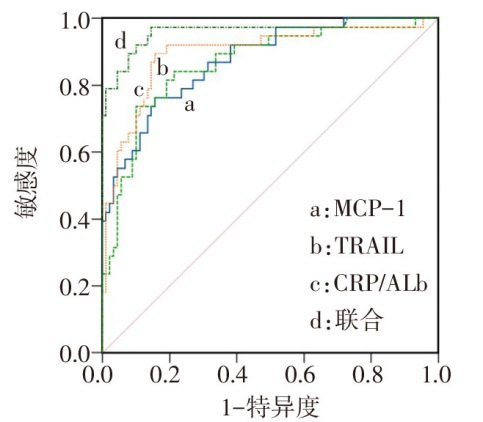
图1 血清MCP-1、TRAIL、CRP/ALb单独及联合预测NEC患儿预后不良的ROC曲线
Fig.1 ROC curves of serum MCP-1,TRAIL,CRP/ALb single and combined detection for predicting poor prognosis in children with NEC
| 指标 | AUC | 95%CI | 截断值 | 敏感度/ % | 特异度/ % | 约登 指数 |
|---|---|---|---|---|---|---|
| MCP-1 | 0.874 | 0.804~0.926 | 163.26 ng/L | 76.32 | 84.27 | 0.606 |
| TRAIL | 0.865 | 0.793~0.919 | 163.12 ng/L | 73.68 | 89.89 | 0.636 |
| CRP/ALb | 0.897 | 0.831~0.944 | 0.263 mg/g | 89.47 | 84.27 | 0.737 |
| 联合 | 0.963 | 0.914~0.989 | - | 97.37 | 85.39 | 0.828 |
表6 血清MCP-1、TRAIL、CRP/ALb单独及联合检测对NEC患儿预后不良的预测价值
Tab.6 Predictive value of serum MCP-1,TRAIL and CRP/ALb levels,individually and in combination,for adverse prognosis in neonates with NEC
| 指标 | AUC | 95%CI | 截断值 | 敏感度/ % | 特异度/ % | 约登 指数 |
|---|---|---|---|---|---|---|
| MCP-1 | 0.874 | 0.804~0.926 | 163.26 ng/L | 76.32 | 84.27 | 0.606 |
| TRAIL | 0.865 | 0.793~0.919 | 163.12 ng/L | 73.68 | 89.89 | 0.636 |
| CRP/ALb | 0.897 | 0.831~0.944 | 0.263 mg/g | 89.47 | 84.27 | 0.737 |
| 联合 | 0.963 | 0.914~0.989 | - | 97.37 | 85.39 | 0.828 |
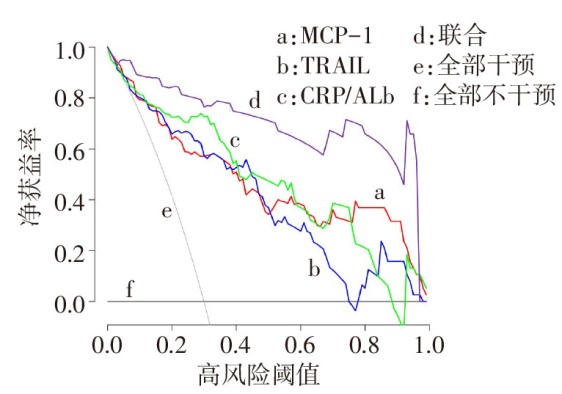
图2 血清MCP-1、TRAIL、CRP/ALb单独及联合检测预测NEC患儿预后不良的DCA曲线
Fig.2 DCA curves of the predictive values of serum MCP-1,TRAIL and CRP/ALb detection alone and in combination for adverse prognosis in NEC
| 指标 | AUC | 95%CI | 截断值 | 敏感度/ % | 特异度/ % | 约登 指数 |
|---|---|---|---|---|---|---|
| MCP-1 | 0.798 | 0.688~0.883 | 146.74 ng/L | 83.33 | 69.09 | 0.524 |
| TRAIL | 0.841 | 0.737~0.916 | 134.31 ng/L | 88.89 | 67.27 | 0.562 |
| CRP/ALb | 0.878 | 0.781~0.943 | 0.213 mg/g | 94.44 | 78.18 | 0.726 |
| 联合 | 0.957 | 0.881~0.990 | - | 88.89 | 94.55 | 0.834 |
表7 血清MCP-1、TRAIL、CRP/ALb单独及联合检测对外部验证队列NEC患儿预后不良的预测价值
Tab.7 Predictive value of serum MCP-1,TRAIL and CRP/ALb levels,individually and in combination,for adverse prognosis in external validation neonates with NEC
| 指标 | AUC | 95%CI | 截断值 | 敏感度/ % | 特异度/ % | 约登 指数 |
|---|---|---|---|---|---|---|
| MCP-1 | 0.798 | 0.688~0.883 | 146.74 ng/L | 83.33 | 69.09 | 0.524 |
| TRAIL | 0.841 | 0.737~0.916 | 134.31 ng/L | 88.89 | 67.27 | 0.562 |
| CRP/ALb | 0.878 | 0.781~0.943 | 0.213 mg/g | 94.44 | 78.18 | 0.726 |
| 联合 | 0.957 | 0.881~0.990 | - | 88.89 | 94.55 | 0.834 |
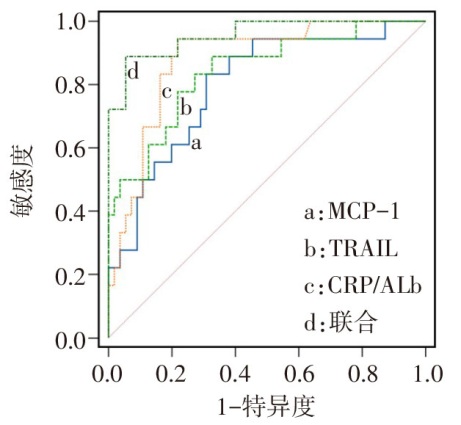
图3 血清MCP-1、TRAIL、CRP/ALb单独及联合检测预测外部验证队列NEC患儿预后不良的ROC曲线
Fig.3 ROC curve for the predictive value of serum MCP-1,TRAIL and CRP/ALb levels,individually and in combination, for adverse prognosis in external validation neonates with NEC
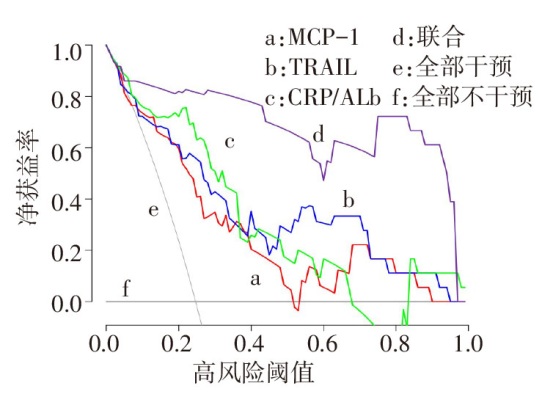
图4 血清MCP-1、TRAIL、CRP/ALb单独及联合检测预测外部验证队列NEC患儿预后不良的DCA曲线
Fig.4 DCA curve of the prognostic values of serum MCP-1,TRAIL and CRP/ALb detection alone and in combination for predicting adverse outcomes in external validation neonates with NEC
| [1] | Hu X, Liang H, Li F, et al. Necrotizing enterocolitis:current understanding of the prevention and management[J]. Pediatr Surg Int, 2024, 40(1):32. doi:10.1007/s00383-023-05619-3. |
| [2] | Monzon N, Kasahara E M, Gunasekaran A, et al. Impact of neonatal nutrition on necrotizing enterocolitis[J]. Semin Pediatr Surg, 2023, 32(3):151305. doi:10.1016/j.sempedsurg.2023.151305. |
| [3] | Egozi A, Olaloye O, Werner L, et al. Single-cell atlas of the human neonatal small intestine affected by necrotizing enterocolitis[J]. PLoS Biol, 2023, 21(5):e3002124. doi:10.1371/journal.pbio.3002124. |
| [4] | Garg P M, Sawaya D, Riddick R, et al. Targeted RNA sequencing identified gene expression profiles linked to severe necrosis and mortality in preterm infants with surgical necrotizing enterocolitis[J]. World J Pediatr Surg, 2026, 9(2):e001172. doi:10.1136/wjps-2026-001172. |
| [5] | Dong H, Zhang L, Li B, et al. Screening inflammatory protein biomarkers on premature infants with necrotizing enterocolitis[J]. Inflamm Res, 2023, 72(4):757-768. doi:10.1007/s00011-023-01702-6. |
| [6] | Mohd Amin A T, Zaki R A, Friedmacher F, et al. C-reactive protein/albumin ratio is a prognostic indicator for predicting surgical intervention and mortality in neonates with necrotizing enterocolitis[J]. Pediatr Surg Int, 2021, 37(7):881-886. doi:10.1007/s00383-021-04879-1. |
| [7] | 邵肖梅, 叶鸿瑁, 丘小汕. 实用新生儿学[M]. 5版. 北京: 人民卫生出版社, 2019:633-634. |
| Shao X M, Ye H M, Qiu X S. Practice of Neonatology[M]. 5th ed. Beijing: People's Medical Publishing House, 2019:633-634. | |
| [8] | Lu J T, Wang Q H, Liu Y Y, et al. The role of APOL1 in necrotizing enterocolitis and its promise as a diagnostic biomarker[J]. Mediat Inflamm, 2026, 2026:8637617. doi:10.1155/mi/8637617. |
| [9] | Shen L, Zhong X, Ji H, et al. Macrophage α7nAChR alleviates the inflammation of neonatal necrotizing enterocolitis through mTOR/NLRP3/IL-1β pathway[J]. Int Immunopharmacol, 2024, 139:112590. doi:10.1016/j.intimp.2024.112590. |
| [10] | Jones I H, Hall N J. Contemporary outcomes for infants with necrotizing enterocolitis-a systematic review[J]. J Pediatr, 2020, 220:86-92.e3. doi:10.1016/j.jpeds.2019.11.011. |
| [11] | Zhao G, Guo C, Li X, et al. MCP-1/CCR2 axis regulates M2 macrophage polarization and immunosuppression in mycobacterium tuberculosis[J]. Front Immunol, 2025, 16:1698369. doi:10.3389/fimmu.2025.1698369. |
| [12] | 徐铃琪, 马淑蓉, 陈璐璐, 等. 坏死性小肠结肠炎动物模型建立方法的改进与评价[J]. 临床小儿外科杂志, 2023, 22(6):569-575. |
| Xu L Q, Ma S R, Chen L L, et al. Improvement and evaluation of establishment methods of animal models of necrotizing enterocolitis[J]. J Clin Pediatr Surg, 2023, 22(6):569-575. doi:10.3760/cma.j.cn101785-202202036-014. | |
| [13] | Singh S, Anshita D, Ravichandiran V. MCP-1:Function,regulation,and involvement in disease[J]. Int Immunopharmacol, 2021, 101(Pt B):107598. doi:10.1016/j.intimp.2021.107598. |
| [14] | Lin W, Shen P, Huang Y, et al. Wutou decoction attenuates the synovial inflammation of collagen-induced arthritis rats via regulating macrophage M1/M2 type polarization[J]. J Ethnopharmacol, 2023, 301:115802. doi:10.1016/j.jep.2022.115802. |
| [15] | Pappas A, Shankaran S, McDonald S A, et al. Blood biomarkers and 6-to 7-year childhood outcomes following neonatal encephalopathy[J]. Am J Perinatol, 2022, 39(7):732-749. doi:10.1055/s-0040-1717072. |
| [16] | Laudisi F, Pacifico T, Maresca C, et al. Rafoxanide sensitizes colorectal cancer cells to TRAIL-mediated apoptosis[J]. Biomed Pharmacother, 2022, 155:113794. doi:10.1016/j.biopha.2022.113794. |
| [17] | Lin D P, Jin Y L, Hu D Y, et al. Influence of TRAIL deficiency on Th17 cells and colonic microbiota in experimental colitis mouse model[J]. Am J Med Sci, 2021, 362(2):188-197. doi:10.1016/j.amjms.2021.04.011. |
| [18] | 应时杰. 探讨TRAIL基因敲除对实验性结肠炎小鼠中Treg细胞的影响[D]. 温州: 温州医科大学, 2020. |
| Ying S J. Investigating the effect of TRAIL gene knockout on Treg cells in experimental colitis mice[D]. Wenzhou: Wenzhou Medical University, 2020. | |
| [19] | Boccellato C, Rehm M. TRAIL-induced apoptosis and proteasomal activity-Mechanisms,signalling and interplay[J]. Biochim Biophys Acta Mol Cell Res, 2024, 1871(4): 119688. doi:10.1016/j.bbamcr.2024.119688. |
| [20] | Garg P P, Shenberger J, South A M, et al. Necrotizing enterocolitis-associated acute kidney injury-transforming the paradigm[J]. Am J Perinatol, 2025, 42(1):108-112. doi:10.1055/a-2330-1244. |
| [21] | Luo G B, Yan D L, Luo C L, et al. Correlation between serum d-dimer,NLR,and CRP/ALB in patients with acute ischemic stroke[J]. Int J Gen Med, 2025, 18:2749-2756. doi:10.2147/IJGM.S516037. |
| [22] | 路钰夏, 翟瑞琴, 杨辉, 等. CRP、I-FABP、SIRT1在新生儿坏死性小肠结肠炎中的表达及意义[J]. 医学理论与实践, 2023, 36(4):664-666. |
| Lu Y X, Zhai R Q, Yang H, et al. Expression and significance of CRP,I-FABP and SIRT1 in NEC[J]. J Med Theory Pract, 2023, 36(4):664-666. doi:10.19381/j.issn.1001-7585.2023.04.049. | |
| [23] | Li B, Chen Y, Yang Z, et al. Lactate/albumin ratio as a prognostic biomarker for in-hospital mortality in pediatric patients with necrotizing enterocolitis[J]. BMC Pediatr, 2025, 25(1):93. doi:10.1186/s12887-025-05439-5. |
| [24] | Kang P, Kang W, Li Y, et al. C-reactive protein-to-albumin ratio as an early biomarker to identify sepsis in neonates with pneumonia[J]. Mediat Inflamm, 2022, 2022:4711018. doi:10.1155/2022/4711018. |
| [25] | 马媛媛, 冯茹清, 王媛媛. 新生儿坏死性小肠结肠炎患者血清CCL11和IRF5水平检测对临床诊断及预后价值研究[J]. 现代检验医学杂志, 2024, 39(5):146-151. |
| Ma Y Y, Feng R Q, Wang Y Y. Study on the clinical diagnostic and prognostic value of serum CCL11 and IRF5 levels in patients with NEC[J]. J Mod Lab Med, 2024, 39(5):146-151. doi:10.3969/j.issn.1671-7414.2024.05.027. |
| [1] | 张伟业, 朱萍, 高航, 包逢源, 席悦, 杨静. 血清CRP与SAA水平对早产儿坏死性小肠结肠炎病情的评估及预后预测[J]. 天津医药, 2026, 54(9): 957-961. |
| [2] | 牛晓霞, 牛旭东. 围产期甲状腺疾病特征及新生儿甲状腺功能异常的危险因素分析[J]. 天津医药, 2026, 54(7): 721-726. |
| [3] | 段程丽, 申彦杰, 郭丽霞, 王碧航, 俎晓霞, 刘玉强. 硬膜外镇痛产妇产时发热时刻和发热峰值对新生儿不良结局的交互作用分析[J]. 天津医药, 2026, 54(4): 364-368. |
| [4] | 黄建会, 李兰兰, 刘承丽. ARDS患者早期肠内营养不耐受的列线图预测模型构建[J]. 天津医药, 2026, 54(11): 1183-1188. |
| [5] | 谢银冬, 周颖, 李艳平, 牛亚静, 苏启超. 右美托咪定调控CCL2-CCR2通路对胆囊癌细胞生物学行为的影响[J]. 天津医药, 2025, 53(12): 1233-1240. |
| [6] | 张世杰, 孟宪春, 孙萍萍, 杨静静, 吴静. 新凝血标志物在新生儿弥漫性血管内凝血诊断及预后评估中的价值[J]. 天津医药, 2024, 52(2): 206-209. |
| [7] | 张婕, 苗耐英, 李欢, 刘新建. 奥曲肽对新生儿坏死性小肠结肠炎患儿粪便性状及体液免疫的影响[J]. 天津医药, 2024, 52(12): 1331-1334. |
| [8] | 马汇擎, 刘洋. 外周动静脉换血技术在新生儿疾病中的应用[J]. 天津医药, 2023, 51(5): 556-560. |
| [9] | 林永文, 陈巧媚, 敖当, 黄炳龙, 骆成珠, 李承燕. 线粒体自噬-NLRP3炎症小体通路在新生大鼠缺血性脑损伤中的作用研究[J]. 天津医药, 2023, 51(11): 1181-1186. |
| [10] | 李国旭, 王萍, 周伟玮, 崔晓玉, 张芳, 舒剑波, 刘洋. 足月新生儿黄疸与维生素D及NADSYN1基因多态性的相关性研究[J]. 天津医药, 2022, 50(9): 959-964. |
| [11] | 邹大军, 胡福德, 周启立, 徐晓青. miR-301a对小鼠坏死性小肠结肠炎的影响及作用机制[J]. 天津医药, 2022, 50(9): 938-942. |
| [12] | 陈晓玲, 陈晓君, 杨丽霞, 邢舒旺, 邱成英. 缺氧缺血性脑病新生儿血清sLOX-1、VILIP-1的变化及临床意义[J]. 天津医药, 2022, 50(3): 310-314. |
| [13] | 杨天骄, 柯创宏, 曾词正, 林丽曼, 胡海玲, 莫笑欢 . 腹部超声对新生儿食物蛋白诱导的小肠结肠炎综合征与早期新生儿坏死小肠结肠炎的鉴别价值[J]. 天津医药, 2022, 50(2): 210-213. |
| [14] | 魏晓永, 刘茜, 徐玲兰, 董正华, 赵军博, 刘博, 姜丽华. 右美托咪定镇静复合罗哌卡因骶管阻滞用于新生儿会阴肛门成形术的效果[J]. 天津医药, 2021, 49(9): 973-976. |
| [15] | 赵颖, 田秀英, 边希云△, 张婉娴. 早产儿动脉导管未闭的治疗进展[J]. 天津医药, 2021, 49(1): 103-106. |
| 阅读次数 | ||||||
|
全文 |
|
|||||
|
摘要 |
|
|||||
