
天津医药 ›› 2026, Vol. 54 ›› Issue (4): 423-428.doi: 10.11958/20253177
项亚娟( ), 陈长春, 张璐△()
收稿日期:2025-10-16
修回日期:2025-11-24
出版日期:2026-04-15
发布日期:2026-04-14
通讯作者:
△E-mail:作者简介:项亚娟(1981),女,副主任医师,主要从事神经病学方面研究。E-mail:基金资助:
XIANG Yajuan(), CHEN Changchun, ZHANG Lu△()
Received:2025-10-16
Revised:2025-11-24
Published:2026-04-15
Online:2026-04-14
Contact:
△E-mail:项亚娟, 陈长春, 张璐. 预后营养指数联合血清指标对急性脑梗死患者预后的预测价值[J]. 天津医药, 2026, 54(4): 423-428.
XIANG Yajuan, CHEN Changchun, ZHANG Lu. The predictive value of prognostic nutritional index combined with urea nitrogen/creatinine and DFR levels for poor prognosis in patients with acute cerebral infarction[J]. Tianjin Medical Journal, 2026, 54(4): 423-428.
摘要:
目的 探究预后营养指数(PNI)联合尿素氮/肌酐、D-二聚体/纤维蛋白原(DFR)、红细胞分布宽度(RDW)对急性脑梗死患者预后不良的预测价值。方法 采用便利抽样法抽取280例急性脑梗死患者作为研究对象,依据改良Rankin量表,将其分为预后良好组(177例)和预后不良组(103例)。收集患者年龄、性别、体质量指数(BMI)、基础疾病史;血清同型半胱氨酸(Hcy)、淋巴细胞总数(TLC)、血清白蛋白(ALB)、血红蛋白(Hb)、总胆固醇(TC)、血清总蛋白(TP)、C反应蛋白(CRP)、高密度脂蛋白胆固醇(HDL-C)、低密度脂蛋白胆固醇(LDL-C)、尿酸(UA)、尿素氮、肌酐、D-二聚体、纤维蛋白原、RDW等指标。计算PNI、DFR。采用Spearman法分析PNI、尿素氮/肌酐、DFR、RDW与预后不良的相关性,单、多因素Logistic回归分析急性脑梗死患者预后不良的影响因素,绘制受试者工作特征(ROC)曲线,比较其曲线下面积(AUC)。结果 预后不良组RDW、尿素氮/肌酐、DFR高于预后良好组,PNI低于预后良好组(均P<0.05)。单因素Logistic回归分析结果显示,PNI升高是急性脑梗死患者预后不良的保护因素,尿素氮/肌酐升高、DFR升高、RDW增大是危险因素(均P<0.05)。急性脑梗死患者的PNI与预后不良呈负相关,尿素氮/肌酐、DFR及RDW与预后不良均呈正相关(均P<0.01)。多因素Logistic回归分析结果显示,PNI升高是急性脑梗死患者预后不良的保护因素,尿素氮/肌酐升高、DFR升高、RDW增大是危险因素。ROC曲线分析结果显示,四者联合的AUC为0.986(95%CI:0.974~0.999),敏感度和特异度分别为84.50%、99.40%,均优于单独检测。结论 急性脑梗死预后不良患者相比预后良好患者,前者的PNI低,而尿素氮/肌酐、DFR和RDW比后者高,四指标联合检测对急性脑梗死患者的预后具有较高的预测价值。
中图分类号:
| 组别 | n | 年龄/岁 | 男性 | BMI/(kg/m2) | 糖尿病史 | |||||||||||
|---|---|---|---|---|---|---|---|---|---|---|---|---|---|---|---|---|
| 预后良好组 | 177 | 67.29±13.21 | 122(68.93) | 23.49±1.28 | 28(15.82) | |||||||||||
| 预后不良组 | 103 | 67.90±14.11 | 63(61.17) | 23.66±1.37 | 25(24.27) | |||||||||||
| χ2或t | 0.363 | 1.750 | 1.045 | 3.031 | ||||||||||||
| 组别 | 冠心病史 | 高血压病史 | Hb/(g/L) | TP/(g/L) | ||||||||||||
| 预后良好组 | 29(16.38) | 88(46.33) | 129.63±18.89 | 64.32±7.21 | ||||||||||||
| 预后不良组 | 15(14.56) | 61(59.22) | 131.25±17.46 | 65.46±8.01 | ||||||||||||
| χ2或t | 0.275 | 2.363 | 0.709 | 1.212 | ||||||||||||
| 组别 | CRP/ (mg/L) | TC/(mmol/L) | HDL-C/(mmol/L) | LDL-C/(mmol/L) | ||||||||||||
| 预后良好组 | 2.78±1.29 | 4.85±1.32 | 1.11±0.33 | 2.96±0.82 | ||||||||||||
| 预后不良组 | 3.02±1.32 | 4.91±1.26 | 1.04±0.29 | 3.10±0.87 | ||||||||||||
| t | 1.494 | 0.312 | 1.792 | 1.444 | ||||||||||||
| 组别 | Hcy/(μmol/L) | UA/(μmol/L) | RDW/% | |||||||||||||
| 预后良好组 | 17.28±9.45 | 320.01±93.89 | 14.59±1.92 | |||||||||||||
| 预后不良组 | 19.12±11.61 | 323.24±105.81 | 15.32±2.01 | |||||||||||||
| t | 1.445 | 0.265 | 3.049** | |||||||||||||
表1 2组患者一般资料比较
Tab.1 Comparison of general data between the good prognosis group and the poor prognosis group
| 组别 | n | 年龄/岁 | 男性 | BMI/(kg/m2) | 糖尿病史 | |||||||||||
|---|---|---|---|---|---|---|---|---|---|---|---|---|---|---|---|---|
| 预后良好组 | 177 | 67.29±13.21 | 122(68.93) | 23.49±1.28 | 28(15.82) | |||||||||||
| 预后不良组 | 103 | 67.90±14.11 | 63(61.17) | 23.66±1.37 | 25(24.27) | |||||||||||
| χ2或t | 0.363 | 1.750 | 1.045 | 3.031 | ||||||||||||
| 组别 | 冠心病史 | 高血压病史 | Hb/(g/L) | TP/(g/L) | ||||||||||||
| 预后良好组 | 29(16.38) | 88(46.33) | 129.63±18.89 | 64.32±7.21 | ||||||||||||
| 预后不良组 | 15(14.56) | 61(59.22) | 131.25±17.46 | 65.46±8.01 | ||||||||||||
| χ2或t | 0.275 | 2.363 | 0.709 | 1.212 | ||||||||||||
| 组别 | CRP/ (mg/L) | TC/(mmol/L) | HDL-C/(mmol/L) | LDL-C/(mmol/L) | ||||||||||||
| 预后良好组 | 2.78±1.29 | 4.85±1.32 | 1.11±0.33 | 2.96±0.82 | ||||||||||||
| 预后不良组 | 3.02±1.32 | 4.91±1.26 | 1.04±0.29 | 3.10±0.87 | ||||||||||||
| t | 1.494 | 0.312 | 1.792 | 1.444 | ||||||||||||
| 组别 | Hcy/(μmol/L) | UA/(μmol/L) | RDW/% | |||||||||||||
| 预后良好组 | 17.28±9.45 | 320.01±93.89 | 14.59±1.92 | |||||||||||||
| 预后不良组 | 19.12±11.61 | 323.24±105.81 | 15.32±2.01 | |||||||||||||
| t | 1.445 | 0.265 | 3.049** | |||||||||||||
| 组别 | n | PNI | 尿素氮/肌酐 | DFR(×10-3) |
|---|---|---|---|---|
| 预后良好组 | 177 | 52.06±4.65 | 13.98±3.46 | 19.68±3.03 |
| 预后不良组 | 103 | 44.55±6.12 | 21.60±4.97 | 39.06±7.01 |
| t | 11.587** | 15.090** | 32.032** |
表2 2组血清PNI、尿素氮/肌酐、DFR水平比较 ($\bar{x}±s$)
Tab.2 Comparison of serum PNI, urea nitrogen/creatinine and DFR index levels between the good prognosis group and the poor prognosis group
| 组别 | n | PNI | 尿素氮/肌酐 | DFR(×10-3) |
|---|---|---|---|---|
| 预后良好组 | 177 | 52.06±4.65 | 13.98±3.46 | 19.68±3.03 |
| 预后不良组 | 103 | 44.55±6.12 | 21.60±4.97 | 39.06±7.01 |
| t | 11.587** | 15.090** | 32.032** |
| 变量 | β | SE | Wald χ2 | P | OR(95%CI) |
|---|---|---|---|---|---|
| PNI | -0.276 | 0.036 | 59.346 | <0.001 | 0.759(0.708~0.814) |
| 尿素氮/肌酐 | 0.431 | 0.050 | 72.989 | <0.001 | 1.539(1.394~1.698) |
| DFR | 0.350 | 0.050 | 49.436 | <0.001 | 1.419(1.287~1.565) |
| RDW | 0.193 | 0.065 | 8.795 | 0.003 | 1.213(1.068~1.377) |
表3 急性脑梗死患者预后不良的单因素分析
Tab.3 Univariate analysis of poor prognosis in patients with acute cerebral infarction
| 变量 | β | SE | Wald χ2 | P | OR(95%CI) |
|---|---|---|---|---|---|
| PNI | -0.276 | 0.036 | 59.346 | <0.001 | 0.759(0.708~0.814) |
| 尿素氮/肌酐 | 0.431 | 0.050 | 72.989 | <0.001 | 1.539(1.394~1.698) |
| DFR | 0.350 | 0.050 | 49.436 | <0.001 | 1.419(1.287~1.565) |
| RDW | 0.193 | 0.065 | 8.795 | 0.003 | 1.213(1.068~1.377) |
| 变量 | 容差 | VIF |
|---|---|---|
| PNI | 0.774 | 1.293 |
| 尿素氮/肌酐 | 0.696 | 1.437 |
| DFR | 0.675 | 1.481 |
| RDW | 0.973 | 1.028 |
表4 多重共线性检验
Tab.4 Multicollinearity test
| 变量 | 容差 | VIF |
|---|---|---|
| PNI | 0.774 | 1.293 |
| 尿素氮/肌酐 | 0.696 | 1.437 |
| DFR | 0.675 | 1.481 |
| RDW | 0.973 | 1.028 |
| 变量 | β | SE | Wald χ2 | P | OR(95%CI) |
|---|---|---|---|---|---|
| PNI | -0.263 | 0.062 | 18.194 | <0.001 | 0.769(0.681~0.868) |
| 尿素氮/肌酐 | 0.400 | 0.087 | 21.348 | <0.001 | 1.492(1.259~1.767) |
| DFR | 0.385 | 0.081 | 22.690 | <0.001 | 1.469(1.469~1.721) |
| RDW | 0.133 | 0.158 | 0.716 | 0.049 | 1.142(1.142~1.555) |
| 常数项 | -5.977 | 4.314 | 1.919 | 0.166 | 0.003 |
表5 急性脑梗死患者预后不良的多因素分析
Tab.5 Multivariate analysis of poor prognosis in patients with acute cerebral infarction
| 变量 | β | SE | Wald χ2 | P | OR(95%CI) |
|---|---|---|---|---|---|
| PNI | -0.263 | 0.062 | 18.194 | <0.001 | 0.769(0.681~0.868) |
| 尿素氮/肌酐 | 0.400 | 0.087 | 21.348 | <0.001 | 1.492(1.259~1.767) |
| DFR | 0.385 | 0.081 | 22.690 | <0.001 | 1.469(1.469~1.721) |
| RDW | 0.133 | 0.158 | 0.716 | 0.049 | 1.142(1.142~1.555) |
| 常数项 | -5.977 | 4.314 | 1.919 | 0.166 | 0.003 |
| 指标 | AUC(95%CI) | P | 敏感度/ % | 特异度/ % | 约登 指数 |
|---|---|---|---|---|---|
| PNI | 0.835(0.784~0.885) | <0.001 | 70.90 | 84.20 | 0.551 |
| 尿素氮/肌酐 | 0.895(0.855~0.935) | <0.001 | 80.60 | 84.20 | 0.648 |
| DFR | 0.903(0.863~0.944) | <0.001 | 73.80 | 93.80 | 0.710 |
| RDW | 0.613(0.543~0.681) | 0.002 | 58.30 | 67.20 | 0.255 |
| 四者联合 | 0.986(0.974~0.999) | <0.001 | 84.50 | 99.40 | 0.839 |
表6 急性脑梗死患者预后不良的预测价值分析
Tab.6 Analysis of the predictive value of poor prognosis in patients with acute cerebral infarction
| 指标 | AUC(95%CI) | P | 敏感度/ % | 特异度/ % | 约登 指数 |
|---|---|---|---|---|---|
| PNI | 0.835(0.784~0.885) | <0.001 | 70.90 | 84.20 | 0.551 |
| 尿素氮/肌酐 | 0.895(0.855~0.935) | <0.001 | 80.60 | 84.20 | 0.648 |
| DFR | 0.903(0.863~0.944) | <0.001 | 73.80 | 93.80 | 0.710 |
| RDW | 0.613(0.543~0.681) | 0.002 | 58.30 | 67.20 | 0.255 |
| 四者联合 | 0.986(0.974~0.999) | <0.001 | 84.50 | 99.40 | 0.839 |
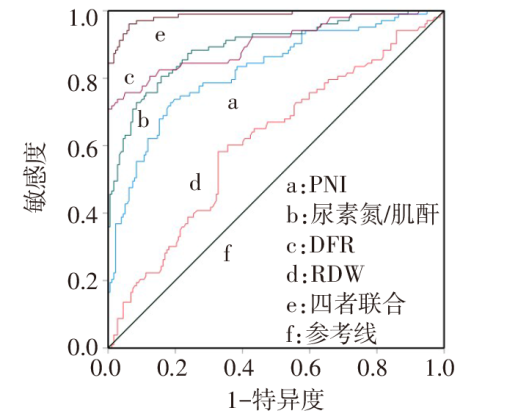
图1 急性脑梗死患者预后不良的预测ROC曲线
Fig.1 The predictive ROC curve for poor prognosis in patients with acute cerebral infarction
| [1] | LI C, XU B F, ZHANG M, et al. Severe thrombocytopenia with acute cerebral infarction:a case report and literature review[J]. Niger J Clin Pract, 2023, 26(7):1040-1044. doi:10.4103/njcp.njcp_844_22. |
| [2] | ZHENG D, LI X, FU Y. Risk factors of acute cerebral infarction in patients with primary hypertension[J]. Ir J Med Sci, 2023, 192(5):2441-2445. doi:10.1007/s11845-022-03206-4. |
| [3] | DEGUCHI I, TAKAHASHI S. Pathophysiology and optimal treatment of intracranial branch atheromatous disease[J]. J Atheroscler Thromb, 2023, 30(7):701-709. doi:10.5551/jat.RV22003. |
| [4] | CHEN Z, ZHANG L, LI R, et al. Development and validation of a nomogram for predicting the risk of poor prognosis in patients with cerebral infarction[J]. Heliyon, 2023, 10(1):e23754. doi:10.1016/j.heliyon.2023.e23754. |
| [5] | 崔玉环, 张婧文, 徐雅丽, 等. 预后营养指数与微型营养评估表评价老年急性脑梗死患者营养不良效果的对比分析[J]. 重庆医学, 2022, 51(9):1530-1535. |
| CUI Y H, ZHANG J W, XU Y L, et al. Comparative analysis of prognostic nutritional index and mini-nutrition assessment form in evaluating effects of malnutrition in elderly patients with acute cerebral infarction[J]. Chongqing Medicine, 2022, 51(9):1530-1535. doi:10.3969/j.issn.1671-8348.2022.09.019. | |
| [6] | 张茜, 陈偶英, 张占伟, 等. NLR、UA联合PNI对急性缺血性脑卒中患者溶栓近期预后的预测价值分析[J]. 分子诊断与治疗杂志, 2024, 16(4):692-695,699. |
| ZHANG X, CHEN O Y, ZHANG Z W, et al. Analysis of the predictive value of NLR and UA combined PNI on short-term prognosis of thrombolysis in patients with acute ischemic stroke[J]. Journal of Molecular Diagnosis and Therapy, 2024, 16(4):692-695,699. doi:10.3969/j.issn.1674-6929.2024.04.024. | |
| [7] | 葛冰磊, 杨凤, 王新辉, 等. 急性脑梗死患者早期神经功能恶化与肾功能的关系[J]. 中国实用神经疾病杂志, 2024, 27(12):1543-1547. |
| GE B L, YANG F, WANG X H, et al. Relationship between early neurological deterioration and renal function in patients with acute cerebral infarction[J]. Chinese Journal of Practical Nervous Diseases, 2024, 27(12):1543-1547. doi:10.12083/SYSJ.231775. | |
| [8] | 安新, 赵玫. D-二聚体/纤维蛋白原比值对老年ST段抬高型心肌梗死患者经皮冠状动脉介入治疗术中慢血流/无复流的预测价值[J]. 中国动脉硬化杂志, 2022, 30(9):799-804. |
| AN X, ZHAO M. Predictive value of D-dimer/fibrinogen ratio for slow flow/no-reflow during percutaneous coronary intervention in elderly patients with ST-segment elevation myocardial infarction[J]. Chinese Journal of Arteriosclerosis, 2022, 30(9):799-804. doi:10.3969/j.issn.1007-3949.2022.09.010. | |
| [9] | PENG Y, SASMITA B R, LUO S. Prognostic value of red cell distribution width in non-ST elevation myocardial infarction:a cohort study[J]. Medicine (Baltimore), 2024, 103(12):e37461. doi:10.1097/MD.0000000000037461. |
| [10] | 彭斌, 刘鸣, 崔丽英. 中国急性缺血性脑卒中诊治指南2018[J]. 中华神经科杂志, 2018, 51(9):666-682. |
| PENG B, LIU M, CUI L Y. Chinese guidelines for diagnosis and treatment of acute ischemic stroke 2018[J]. Chinese Journal of Neurology, 2018, 51(9):666-682. doi:10.3760/cma.j.issn.1006-7876.2018.09.004. | |
| [11] | 任娜, 邱昌凤. mRS评分、常规凝血试验联合高b值对急性脑梗死患者溶栓治疗预后的临床价值[J]. 血栓与止血学, 2022, 28(2):184-186. |
| REN N, QIU C F. Predictive value of mRS score,conventional coagulation test combined with high b value for prognosis of patients with acute cerebral infarction after thrombolytic therapy[J]. Chinese Journal of Thrombosis and Hemostasis, 2022, 28(2):184-186. doi:10.3969/j.issn.1009-6213.2022.02.004. | |
| [12] | GBD 2019 Stroke Collaborators. Global,regional,and national burden of stroke and its risk factors,1990-2019:a systematic analysis for the Global Burden of Disease Study 2019[J]. Lancet Neurol, 2021, 20(10):795-820. doi:10.1016/S1474-4422(21)00252-0. |
| [13] | CHANG C, PROVENCIO J J, SHAH S. Neurological critical care:the evolution of cerebrovascular critical care[J]. Crit Care Med, 2021, 49(6):881-900. doi:10.1097/CCM.0000000000004933. |
| [14] | 刘杰, 彭旭, 谭红, 等. 振幅整合脑电图联合脑电监测α波变异百分率评估重症急性脑梗死患者短期预后的价值[J]. 中华老年心脑血管病杂志, 2023, 25(10):1070-1073. |
| LIU J, PENG X, TAN H, et al. Predictive value of amplitude integrated electroencephalogram combined with EEG monitoring PAV for short-term prognosis of patients with SACI[J]. Chinese Journal of Geriatric Heart Brain and Vessel Diseases, 2023, 25(10):1070-1073. doi:10.3969/j.issn.1009-0126.2023.10.015. | |
| [15] | 徐伟, 李辉萍, 王振, 等. 老年急性脑梗死患者营养不良与静脉溶栓后出血转化的相关性[J]. 中国老年学杂志, 2023, 43(20):4877-4881. |
| XU W, LI H P, WANG Z, et al. Correlation between malnutrition and bleeding transformation after intravenous thrombolysis in elderly patients with acute cerebral infarction[J]. Chinese Journal of Gerontology, 2023, 43(20):4877-4881. doi:10.3969/j.issn.1005-9202.2023.20.005. | |
| [16] | ZHANG J, DU Y, HU C, et al. Elevated glycated albumin in serum is associated with adverse cardiac outcomes in patients with acute coronary syndrome who underwent revascularization therapy[J]. J Atheroscler Thromb, 2022, 29(4):482-491. doi:10.5551/jat.61358. |
| [17] | LIU C, ZHAO Q, MA X, et al. Prognostic implication of serum glycated albumin for patients with non-ST-segment elevation acute coronary syndrome undergoing percutaneous coronary intervention[J]. Cardiovasc Diabetol, 2022, 21(1):11. doi:10.1186/s12933-022-01446-3. |
| [18] | ZHONG C, CHEN T, SHEN Y, et al. The effects of serum ischemia modified albumin on diagnosis of cerebral infarction and vertebral basilar artery stenosis[J]. Brain Inj, 2021, 35(11):1457-1461. doi:10.1080/02699052.2021.1972145. |
| [19] | HE M, FAN Q, ZHU Y, et al. The need for nutritional assessment and interventions based on the prognostic nutritional index for patients with femoral fractures:a retrospective study[J]. Perioper Med(Lond), 2021, 10(1):61. doi:10.1186/s13741-021-00232-1. |
| [20] | 石秋艳, 郭亚新, 于颖, 等. 甘油三酯葡萄糖指数及预后营养指数对重症急性脑梗死患者预后的预测价值[J]. 中国煤炭工业医学杂志, 2024, 27(1):83-88. |
| SHI Q Y, GUO Y X, YU Y, et al. Prognostic value of TyG and PNI in patients with severe acute cerebral infarction[J]. Chinese Journal of Coal Industry Medicine, 2024, 27(1):83-88. doi:10.11723/mtgyyx1007-9564202401017. | |
| [21] | 高燕飞, 蔡莹, 陈卓友, 等. 预后营养指数联合炎症因子水平对老年脑卒中后肌力下降患者预后的应用价值[J]. 中国老年学杂志, 2023, 43(17):4110-4113. |
| GAO Y F, CAI Y, CHEN Z Y, et al. The application value of prognostic nutritional index combined with inflammatory factor levels in the prognosis of elderly patients with decreased muscle strength after stroke[J]. Chinese Journal of Gerontology, 2023, 43(17):4110-4113. doi:10.3969/j.issn.1005-9202.2023.17.005. | |
| [22] | 罗武, 马琼卉, 刘兴, 等. 新型冠状病毒肺炎并发急性肾损伤患者血清胱抑素C,尿素氮和肌酐水平变化及临床价值研究[J]. 现代检验医学杂志, 2023, 38(2):194-199. |
| LUO W, MA Q H, LIU X, et al. Variation of level,risk factors and clinical value research of serum cystatin C,blood urea nitrogen and creatinine in patients with COVID-19 complicated with acute kidney injury[J]. Journal of Modern Laboratory Medicine, 2023, 38(2):194-199. doi:10.3969/j.issn.1671-7414.2023.02.037. | |
| [23] | 朱康锋, 赵斌, 冯涛. 血尿素氮联合二氧化碳结合力预测急性缺血性卒中静脉溶栓患者短期预后的临床价值[J]. 重庆医学, 2024, 53(23):3570-3574,3580. |
| ZHU K F, ZHAO B, FENG T, et al. Clinical value of blood urea nitrogen combined with carbon dioxide binding power in predicting short-term outcome of patients acute ischemic stroke undergoing intravenous thrombolysis[J]. Chongqing Medicine, 2024, 53(23):3570-3574,3580. doi:10.3969/j.issn.1671-8348.2024.23.009. | |
| [24] | 张苏雅, 李梦丽, 王琴, 等. 血清尿素氮与肌酐比值预测重症肺炎患者病情与预后的价值[J]. 中国呼吸与危重监护杂志, 2021, 20(6):408-415. |
| ZHANG S Y, LI M L, WANG Q, et al. Predictive value of blood urea nitrogen to creatinine ratio in the condition and prognosis of severe pneumonia patients[J]. Chinese Journal of Respiratory and Critical Care Medicine, 2021, 20(6):408-415. doi:10.7507/1671-6205.202103071. | |
| [25] | 白雅红, 仵高强. D二聚体纤维蛋白原比值联合超敏C反应蛋白在急性冠脉综合征患者中的检测价值[J]. 血栓与止血学, 2022, 28(1):44-45. |
| BAI Y H, WU G Q. Detection value of D-dimer fibrinogen ratio combined with hypersensitivity C reaction protein in patients with acute coronary syndrome[J]. Chinese Journal of Thrombosis and Hemostasis, 2022, 28(1):44-45. doi:10.3969/j.issn.1009-6213.2022.01.020. | |
| [26] | 陈高泽, 颜豪. 血清BNP、sd-LDL-C、DFR水平与急性脑梗死患者阿替普酶溶栓治疗预后的关系[J]. 心脑血管病防治, 2024, 24(10):50-53. |
| CHEN G Z, YAN H. Relationship between serum BNP,sd-LDL-C and DFR levels and prognosis of patients with acute cerebral infarction treated with alteplase thrombolytic therapy[J]. Prevention and Treatment of Cardio-Cerebral-Vascular Disease, 2024, 24(10):50-53. doi:10.3969/j.issn.1009-816x.2024.10.013. | |
| [27] | 付越姣, 张赟, 肖彩霞, 等. 血清sd-LDL-C、NLR、DFR水平对急性脑梗死患者rt-PA治疗预后的预测价值分析[J]. 四川生理科学杂志, 2023, 45(2):223-226. |
| FU Y J, ZHANG Y, XIAO C X, et al. Correlation between serum sd-LDL-C,NLR,DFR levels and the prognosis of patients with ACl treated with intravenous thrombolysis with rt-PA[J]. Sichuan Journal of Physiological Sciences, 2023, 45(2):223-226. | |
| [28] | XIONG Y, XIE S, YAO Y, et al. Hemoglobin-to-red blood cell distribution width ratio is negatively associated with stroke:a cross-sectional study from NHANES[J]. Sci Rep, 2024, 14(1):28098. doi:10.1038/s41598-024-79520-x. |
| [29] | EYIOL A, ERTEKIN B. Association of red blood cell distribution width to albumin ratio with prognosis in stroke patients[J]. Biomark Med, 2024, 18(7):311-320. doi:10.2217/bmm-2023-0460. |
| [30] | XUE J, ZHANG D, ZHANG X G, et al. Red cell distribution width is associated with stroke severity and unfavorable functional outcomes in ischemic stroke[J]. Front Neurol, 2022, 13:938515. doi:10.3389/fneur.2022.938515. |
| [31] | LI Y, ZHANG M, DONG C, et al. Elevated red blood cell distribution width levels at admission predicts depression after acute ischemic stroke: a 3-month follow-up study[J]. Neuropsychiatr Dis Treat, 2022, 18:695-704. doi:10.2147/NDT.S351136. |
| [1] | 李容, 陈艳. 舌下微循环联合ROX-HR指数对脓毒症休克患者预后的预测价值[J]. 天津医药, 2026, 54(8): 815-820. |
| [2] | 张晶, 桂晓玲, 李金鹏, 陈新. 右束支传导阻滞联合血清HMGB1在COPD患者并发肺心病监测中的临床价值[J]. 天津医药, 2026, 54(8): 842-847. |
| [3] | 韦昌芹, 王琳, 蔡文君, 于勇, 徐丽丽. TyG指数联合那不勒斯预后评分对急性胰腺炎严重程度及预后的预测价值[J]. 天津医药, 2026, 54(8): 854-857. |
| [4] | 张轶轶, 刘帝亮, 陈飞, 龚媛媛, 王贵生. MTA1、ARL2和VEGF-C在非小细胞肺癌组织中的表达[J]. 天津医药, 2026, 54(7): 705-710. |
| [5] | 王斌, 苏国华, 马福坤, 刘勇, 刘亭亭. 血浆氧化低密度脂蛋白与磁共振血管壁成像高信号对急性脑梗死斑块稳定性的预测价值[J]. 天津医药, 2026, 54(7): 736-741. |
| [6] | 胡金宝, 柳文武, 胡志超. 视网膜静脉阻塞患者血清微小RNA表达水平与黄斑水肿程度的相关性[J]. 天津医药, 2026, 54(7): 741-746. |
| [7] | 钱进, 魏夕阳, 徐冲. 血磷、血镁水平与老年COPD急性加重患者病情及预后的关系[J]. 天津医药, 2026, 54(7): 765-770. |
| [8] | 董倩, 陈淑华, 张飞. ACE2在结直肠癌耐药中的作用及其预测价值的研究[J]. 天津医药, 2026, 54(6): 561-569. |
| [9] | 焦宇兵, 雷晓娟, 郭武华. 自发性门体分流对乙型肝炎肝硬化失代偿期患者预后的影响及预测模型构建[J]. 天津医药, 2026, 54(6): 612-617. |
| [10] | 曹阳, 段朋仓, 李梦雨, 史方堃, 胡晨, 邢方圆, 李花莲. 脑小血管病总负荷联合血清8-OHDG、Ficolin-3对老年穿支动脉粥样硬化病预后的预测价值[J]. 天津医药, 2026, 54(6): 618-622. |
| [11] | 张富允, 蒋龙超, 杨学燕. 食管癌患者血清TM4SF1、KLF5、SOX3水平与预后的关系[J]. 天津医药, 2026, 54(6): 623-626. |
| [12] | 范欣, 周晓影, 徐书晓. 补脾益心汤加减联合丁苯酞软胶囊治疗脑梗死后血管性痴呆的疗效观察[J]. 天津医药, 2026, 54(5): 533-538. |
| [13] | 陈一铭, 戈超, 徐姝琪, 孙威, 戴颖, 徐选福. CYP1B1和PSMD14在结直肠癌中的表达及其对预后的影响[J]. 天津医药, 2026, 54(4): 412-416. |
| [14] | 张润春, 李树华, 王玉珍, 王巧文. 肺炎支原体肺炎患儿血清LXA4和KLF5表达的临床意义[J]. 天津医药, 2026, 54(3): 269-274. |
| [15] | 刘晓华, 韩婷婷, 高玉杰. 增强CT淋巴结边缘特征联合IPI对难治性弥漫大B细胞巴瘤的预测价值[J]. 天津医药, 2026, 54(3): 303-308. |
| 阅读次数 | ||||||
|
全文 |
|
|||||
|
摘要 |
|
|||||
