
Tianjin Medical Journal ›› 2026, Vol. 54 ›› Issue (7): 760-764.doi: 10.11958/20260115
• Clinical Research • Previous Articles Next Articles
WU Jie( ), JI Bingrui, GUO Ruixia()
Received:2026-01-08
Revised:2026-03-11
Published:2026-07-15
Online:2026-07-13
Contact:
△E-mail:guoruixiawujie@163.com
WU Jie, JI Bingrui, GUO Ruixia. Predictive value of platelet-derived growth factor and lower uterine segment thickness for delivery outcome in pregnancy with a scarred uterus[J]. Tianjin Medical Journal, 2026, 54(7): 760-764.
CLC Number:
| 组别 | n | 年龄/岁 | 孕期体质量增加量/kg | 妊娠次数 | 人工流产史 | 早产史 | 分娩次数 | ||||||||||||||||
|---|---|---|---|---|---|---|---|---|---|---|---|---|---|---|---|---|---|---|---|---|---|---|---|
| ≥2次 | <2次 | ≥2次 | <2次 | ||||||||||||||||||||
| 结局良好组 | 132 | 33.24±1.96 | 14.24±2.01 | 47(35.61) | 85(64.39) | 60(45.45) | 25(18.94) | 41(31.06) | 91(68.94) | ||||||||||||||
| 结局不良组 | 64 | 34.01±2.14 | 15.36±2.18 | 29(45.31) | 35(54.69) | 36(56.25) | 18(28.13) | 24(37.50) | 40(62.50) | ||||||||||||||
| t或χ2 | 2.502* | 3.558** | 1.711 | 2.010 | 2.124 | 0.806 | |||||||||||||||||
| 组别 | 距上次剖宫产时间/年 | 孕期产检次数/次 | 临产入院 | 产前应用宫缩剂 | 分娩方式 | ||||||||||||||||||
| 阴道顺产 | 剖宫产 | ||||||||||||||||||||||
| 结局良好组 | 3.95±0.34 | 8.29±0.63 | 21(15.91) | 21(15.91) | 59(44.70) | 73(55.30) | |||||||||||||||||
| 结局不良组 | 2.86±0.38 | 8.14±0.59 | 13(20.31) | 14(21.88) | 26(40.63) | 38(59.38) | |||||||||||||||||
| t或χ2 | 20.244** | 1.595 | 0.583 | 1.046 | 0.291 | ||||||||||||||||||
| 组别 | 分娩孕周/周 | 新生儿体质量/kg | 收缩压/mmHg | 舒张压/mmHg | 血糖/(mmol/L) | APTT/s | PT/s | D-D/(mg/L) | |||||||||||||||
| 结局良好组 | 39.04±0.52 | 3.09±0.18 | 127.62±9.03 | 78.64±8.96 | 5.21±0.54 | 28.32±1.16 | 11.42±1.49 | 1.03±0.12 | |||||||||||||||
| 结局不良组 | 38.01±0.45 | 3.05±0.16 | 129.85±10.26 | 77.49±9.15 | 5.32±0.57 | 28.03±1.23 | 11.14±1.54 | 1.01±0.14 | |||||||||||||||
| t | 13.569** | 1.511 | 1.550 | 0.837 | 1.313 | 1.609 | 1.220 | 1.035 | |||||||||||||||
Tab.1 Comparison of clinical data between the group with good delivery outcomes and the group with poor delivery outcomes
| 组别 | n | 年龄/岁 | 孕期体质量增加量/kg | 妊娠次数 | 人工流产史 | 早产史 | 分娩次数 | ||||||||||||||||
|---|---|---|---|---|---|---|---|---|---|---|---|---|---|---|---|---|---|---|---|---|---|---|---|
| ≥2次 | <2次 | ≥2次 | <2次 | ||||||||||||||||||||
| 结局良好组 | 132 | 33.24±1.96 | 14.24±2.01 | 47(35.61) | 85(64.39) | 60(45.45) | 25(18.94) | 41(31.06) | 91(68.94) | ||||||||||||||
| 结局不良组 | 64 | 34.01±2.14 | 15.36±2.18 | 29(45.31) | 35(54.69) | 36(56.25) | 18(28.13) | 24(37.50) | 40(62.50) | ||||||||||||||
| t或χ2 | 2.502* | 3.558** | 1.711 | 2.010 | 2.124 | 0.806 | |||||||||||||||||
| 组别 | 距上次剖宫产时间/年 | 孕期产检次数/次 | 临产入院 | 产前应用宫缩剂 | 分娩方式 | ||||||||||||||||||
| 阴道顺产 | 剖宫产 | ||||||||||||||||||||||
| 结局良好组 | 3.95±0.34 | 8.29±0.63 | 21(15.91) | 21(15.91) | 59(44.70) | 73(55.30) | |||||||||||||||||
| 结局不良组 | 2.86±0.38 | 8.14±0.59 | 13(20.31) | 14(21.88) | 26(40.63) | 38(59.38) | |||||||||||||||||
| t或χ2 | 20.244** | 1.595 | 0.583 | 1.046 | 0.291 | ||||||||||||||||||
| 组别 | 分娩孕周/周 | 新生儿体质量/kg | 收缩压/mmHg | 舒张压/mmHg | 血糖/(mmol/L) | APTT/s | PT/s | D-D/(mg/L) | |||||||||||||||
| 结局良好组 | 39.04±0.52 | 3.09±0.18 | 127.62±9.03 | 78.64±8.96 | 5.21±0.54 | 28.32±1.16 | 11.42±1.49 | 1.03±0.12 | |||||||||||||||
| 结局不良组 | 38.01±0.45 | 3.05±0.16 | 129.85±10.26 | 77.49±9.15 | 5.32±0.57 | 28.03±1.23 | 11.14±1.54 | 1.01±0.14 | |||||||||||||||
| t | 13.569** | 1.511 | 1.550 | 0.837 | 1.313 | 1.609 | 1.220 | 1.035 | |||||||||||||||
| 组别 | n | PDGF/(ng/L) | 子宫下段肌壁厚度/mm |
|---|---|---|---|
| 结局良好组 | 132 | 39.14±4.86 | 3.29±0.34 |
| 结局不良组 | 64 | 45.08±5.01 | 2.86±0.32 |
| t | 7.944** | 8.461** |
Tab.2 Comparison of PDGF and thickness of the lower uterine segment muscle wall between the good delivery outcome group and the poor outcome group ($\stackrel{-}{x}\pm s$)
| 组别 | n | PDGF/(ng/L) | 子宫下段肌壁厚度/mm |
|---|---|---|---|
| 结局良好组 | 132 | 39.14±4.86 | 3.29±0.34 |
| 结局不良组 | 64 | 45.08±5.01 | 2.86±0.32 |
| t | 7.944** | 8.461** |
| 变量 | β | SE | Wald χ2 | P | OR | OR95%CI |
|---|---|---|---|---|---|---|
| 年龄 | 1.128 | 0.332 | 11.540 | <0.001 | 3.089 | 2.067~4.617 |
| 孕期体质量增加量 | 0.961 | 0.369 | 6.781 | 0.009 | 2.614 | 1.268~5.388 |
| PDGF | 1.014 | 0.216 | 22.044 | <0.001 | 2.757 | 1.805~4.210 |
| 子宫下段肌壁厚度 | -1.248 | 0.314 | 15.804 | <0.001 | 0.287 | 0.155~0.531 |
| 距上次剖宫产时间 | -2.235 | 1.621 | 1.901 | 0.168 | 0.107 | 0.004~2.566 |
| 分娩孕周 | -2.154 | 1.181 | 3.327 | 0.068 | 0.116 | 0.011~1.174 |
| 常数项 | -3.943 | 0.371 | 112.746 | <0.001 | 0.019 |
Tab.3 Logistic analysis on the delivery outcomes of pregnant women with a scarred uterus
| 变量 | β | SE | Wald χ2 | P | OR | OR95%CI |
|---|---|---|---|---|---|---|
| 年龄 | 1.128 | 0.332 | 11.540 | <0.001 | 3.089 | 2.067~4.617 |
| 孕期体质量增加量 | 0.961 | 0.369 | 6.781 | 0.009 | 2.614 | 1.268~5.388 |
| PDGF | 1.014 | 0.216 | 22.044 | <0.001 | 2.757 | 1.805~4.210 |
| 子宫下段肌壁厚度 | -1.248 | 0.314 | 15.804 | <0.001 | 0.287 | 0.155~0.531 |
| 距上次剖宫产时间 | -2.235 | 1.621 | 1.901 | 0.168 | 0.107 | 0.004~2.566 |
| 分娩孕周 | -2.154 | 1.181 | 3.327 | 0.068 | 0.116 | 0.011~1.174 |
| 常数项 | -3.943 | 0.371 | 112.746 | <0.001 | 0.019 |
| 变量 | AUC | 95%CI | 最佳截断值 | 敏感度/% | 特异度/% | 约登指数 |
|---|---|---|---|---|---|---|
| PDGF | 0.694 | 0.586~0.802 | 42.09 ng/L | 62.50 | 61.36 | 0.239 |
| 子宫下段肌壁厚度 | 0.705 | 0.604~0.807 | 3.08 mm | 60.94 | 75.76 | 0.367 |
| 联合 | 0.893 | 0.827~0.959 | — | 89.06 | 89.39 | 0.785 |
Tab.4 ROC curve analysis of PDGF and the thickness of the lower uterine muscle wall in predicting the delivery outcome of pregnant women with scarred uterus who become pregnant again
| 变量 | AUC | 95%CI | 最佳截断值 | 敏感度/% | 特异度/% | 约登指数 |
|---|---|---|---|---|---|---|
| PDGF | 0.694 | 0.586~0.802 | 42.09 ng/L | 62.50 | 61.36 | 0.239 |
| 子宫下段肌壁厚度 | 0.705 | 0.604~0.807 | 3.08 mm | 60.94 | 75.76 | 0.367 |
| 联合 | 0.893 | 0.827~0.959 | — | 89.06 | 89.39 | 0.785 |
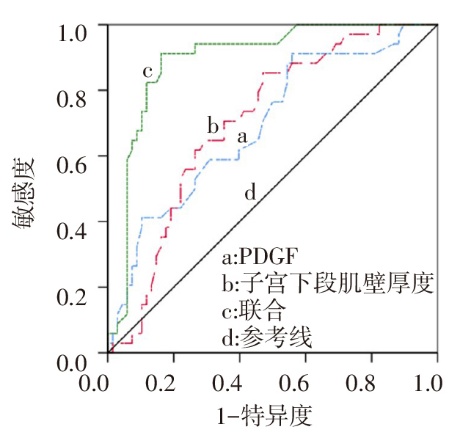
Fig.1 ROC curves of PDGF and the thickness of the lower uterine muscle wall for predicting the delivery outcome of pregnant women with scarred uterus who become pregnant again
| [1] | 施凤, 余韦. 3613例瘢痕子宫再次妊娠分娩结局分析[J]. 宁夏医科大学学报, 2023, 45(12):1272-1275. |
| Shi F, Yu W. Outcome analysis of 3613 cases of second pregnancy with scarred uterus[J]. J Ningxia Med Univ, 2023, 45(12):1272-1275. doi:10.16050/j.cnki.issn1674-6309.2023.12.014. | |
| [2] | Zhang Y, Zhang T, Liu X, et al. Research trends of pregnancy with scarred uterus after cesarean:a bibliometric analysis from 1999 to 2018[J]. J Matern Fetal Neonatal Med, 2022, 35(18):3555-3564. doi:10.1080/14767058.2020.1830368. |
| [3] | Meuleman S J M K, Murji A, Van Den Bosch T, et al. Definition and criteria for diagnosing cesarean scar disorder[J]. JAMA Netw Open, 2023, 6(3):e235321. doi:10.1001/jamanetworkopen.2023.5321. |
| [4] | Wang S, Zhu C, Su J, et al. Construction and application of a prediction model for the delivery outcome of women with scarred uterus based on ultrasonic parameters[J]. Am J Transl Res, 2023, 15(1):264-272. |
| [5] | Wang S, Hu Q, Liao H, et al. Perinatal outcomes of pregnancy in women with scarred uteri[J]. Int J Womens Health, 2023, 15:1453-1465. doi:10.2147/IJWH.S422187. |
| [6] | Kumar P, Mundkur A, Bhavna D S, et al. Intrauterine administration of autologous platelet-derived growth factor concentrate (aka autologous blood cell derivative) improves the endometrial thickness in 'thin' endometrium in the frozen embryo transfer cycle[J]. J Obstet Gynaecol India, 2023, 73(Suppl 1):108-114. doi:10.1007/s13224-022-01735-7. |
| [7] | Gao J, Song Y, Huang X, et al. The expression of platelet-derived growth factor,epidermal growth factor,and insulin-like growth factor-II in patients with polycystic ovary syndrome and its correlation with pregnancy outcomes[J]. Ann Palliat Med, 2021, 10(5):5671-5678. doi:10.21037/apm-21-1003. |
| [8] | 郭婧, 郭颖, 罗晓华. 瘢痕子宫再次妊娠产妇成功阴道试产的影响因素分析[J]. 医药论坛杂志, 2021, 42(6):82-85. |
| Guo J, Guo Y, Luo X H. Analysis of influencing factors on successful vaginal trial of labor in parturients with scarred uterus who are pregnant again[J]. Journal of Medical Forum, 2021, 42(6):82-85. | |
| [9] | 中华医学会妇产科学分会产科学组. 剖宫产术后再次妊娠阴道分娩管理的专家共识(2016)[J]. 中华妇产科杂志, 2016, 51(8):561-564. |
| Obstetrics Group,Obstetrics and Gynecology Branch,Chinese Medical Association. Consensus of management of vaginal birth after cesarean (2016)[J]. Chin J Obstet Gynecol, 2016, 51(8):561-564. doi:10.3760/cma.j.issn.0529-567X.2016.08.001. | |
| [10] | “高龄产妇妊娠期并发症防治策略研究”项目专家组. 高龄妇女瘢痕子宫再妊娠管理专家共识(2021年版)[J]. 中国实用妇科与产科杂志, 2021, 37(5):558-563. |
| Expert Group of the Project "Research on Prevention and Treatment Strategies for Complications during Pregnancy in Elderly Parturients". Expert Consensus on the Management of Re-pregnancy in Elderly Women with Scarred Uterus (2021 Edition)[J]. Chinese Journal of Practical Gynecology and Obstetrics, 2021, 37(5):558-563. doi:10.19538/j.fk2021050114. | |
| [11] | 杨水莲. 妇产科学[M]. 武汉: 华中科技大学出版社, 2021:104-109. |
| Yang S L. Obstetrics and gynecology[M]. Wuhan: Huazhong University of Science and Technology Publishing House, 2021:104-109. | |
| [12] | Mcevoy A, Corbett G A, Nolan C, et al. Outcomes of uterine rupture in the setting of the unscarred compared with the scarred uterus[J]. Obstet Gynecol, 2023, 141(4):854-856. doi:10.1097/AOG.0000000000005108. |
| [13] | Taye L R, Basumatari B, Das M C, et al. Ultrasonographical evaluation of placenta previa in scarred and unscarred uterus in a tertiary care centre[J]. Cureus, 2023, 15(7):e42586. doi:10.7759/cureus.42586. |
| [14] | 李凯, 王振东, 赵雪琴, 等. 血清VEGF-C、PDGF水平对瘢痕子宫产妇再次妊娠分娩结局的预测价值[J]. 分子诊断与治疗杂志, 2025, 17(7):1275-1277,1281. |
| Li K, Wang Z D, Zhao X Q, et al. The predictive value of serum VEGF-C and PDGF levels for the delivery outcome of women with scarred uterus[J]. J Mol Diagn Ther, 2025, 17(7):1275-1277,1281. doi:10.3969/j.issn.1674-6929.2025.07.029. | |
| [15] | Rashid F N, Clayton Z E, Ogawa M, et al. Platelet derived growth factor-A (PDGF-A) gene transfer modulates scar composition and improves left ventricular function after myocardial infarction[J]. Int J Cardiol, 2021, 341:24-30. doi:10.1016/j.ijcard.2021.07.021. |
| [16] | Park H, Seok J, You J H, et al. Increased phosphatase regenerating liver-1 trigger vascular remodeling in injured ovary via platelet-derived growth factor signaling pathway[J]. Stem Cell Res Ther, 2022, 13(1):95. doi:10.1186/s13287-022-02772-9. |
| [17] | Ross J L, Chen Z, Herting C J, et al. Platelet-derived growth factor beta is a potent inflammatory driver in paediatric high-grade glioma[J]. Brain, 2021, 144(1):53-69. doi:10.1093/brain/awaa382. |
| [18] | Debras E, Capmas P, Maudot C, et al. Uterine wound healing after caesarean section:a systematic review[J]. Eur J Obstet Gynecol Reprod Biol, 2024, 296:83-90. doi:10.1016/j.ejogrb.2024.02.045. |
| [19] | Hume R D, Deshmukh T, Doan T, et al. PDGF-AB reduces myofibroblast differentiation without increasing proliferation after myocardial infarction[J]. JACC Basic Transl Sci, 2023, 8(6):658-674. doi:10.1016/j.jacbts.2022.11.006. |
| [20] | 高洁凡, 王东晖, 宋阳阳, 等. 血清IGFBP-3、PDGF及bFGF联合检测对多囊卵巢综合征患者妊娠结局的预测价值[J]. 中国现代医学杂志, 2023, 33(21):94-98. |
| Gao J F, Wang D H, Song Y Y, et al. The predictive value of combined detection of serum IGFBP-3,PDGF and bFGF on pregnancy outcome in patients with polycystic ovary syndrome[J]. China Journal of Modern Medicine, 2023, 33(21):94-98. doi:10.3969/j.issn.1005-8982.2023.21.014. | |
| [21] | Zhang L, Li T, Zhang P, et al. Analyzing influencing factors of uterine rupture in pregnant women with scarred uterus undergoing repeat delivery and evaluating the predictive value of lower uterine anterior wall thickness[J]. Int J Womens Health, 2025, 17:2421-2431. doi:10.2147/IJWH.S530520. |
| [22] | 胡慧颖, 丁永霞. 瘢痕子宫再妊娠孕妇子宫肌层厚度与不良妊娠结局关系[J]. 中国计划生育学杂志, 2024, 32(2):417-420,426. |
| Hu H Y, Ding Y X. Correlation between the muscular layer thickness of pregnant women with scarred uterus and their adverse pregnancy outcomes[J]. Chin J Fam Plann, 2024, 32(2):417-420,426. doi:10.3969/j.issn.1004-8189.2024.02.034. | |
| [23] | 朱燕霞, 刘群英, 王苓入. 腹部超声检测子宫前壁下段肌层厚度在瘢痕子宫再次妊娠分娩前的应用价值[J]. 医学影像学杂志, 2025, 35(4):102-105. |
| Zhu Y X, Liu Q Y, Wang L R, et al. Application value of abdominal ultrasound in detecting the thickness of myometrium in the lower segment of the anterior uterine wall before delivery in repeated pregnancy of cesarean scar uterus[J]. J Med Imaging, 2025, 35(4):102-105. doi:10.20258/j.cnki.1006-9011.2025.04.025. |
| Viewed | ||||||
|
Full text |
|
|||||
|
Abstract |
|
|||||
