
Tianjin Medical Journal ›› 2026, Vol. 54 ›› Issue (7): 755-759.doi: 10.11958/20260148
• Clinical Research • Previous Articles Next Articles
WANG Chao( ), XIAO Jinchang, SHEN Bin, HUANG Qianxin, LIU Hongtao, ZHANG Qingqiao()
Received:2026-01-10
Revised:2026-03-25
Published:2026-07-15
Online:2026-07-13
Contact:
△E-mail:1427286069@qq.com
WANG Chao, XIAO Jinchang, SHEN Bin, HUANG Qianxin, LIU Hongtao, ZHANG Qingqiao. Interventional treatment of primary long-segment infrahepatic inferior vena cava occlusion[J]. Tianjin Medical Journal, 2026, 54(7): 755-759.
CLC Number:
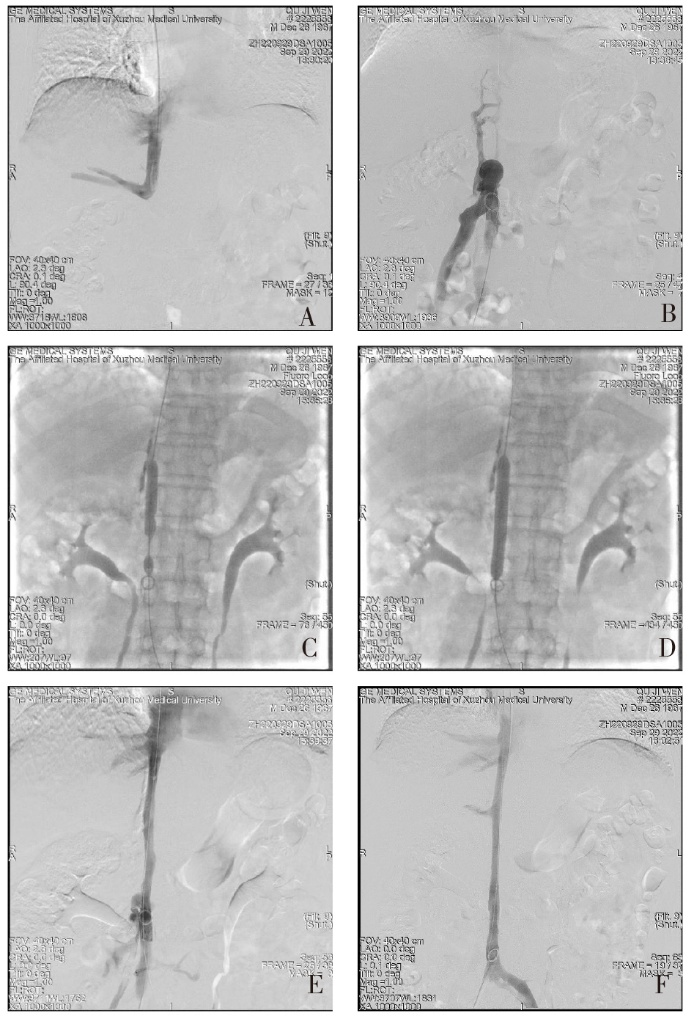
Fig.1 Interventional images of a patient with primary long-segment IIVC occlusion
| 时期 | CEAP分级 | ||||||
|---|---|---|---|---|---|---|---|
| C0 | C1 | C2 | C3 | C4 | C5 | C6 | |
| 术前 | 0(0.0) | 3(10.7) | 7(25.0) | 4(14.3) | 5(17.9) | 2(7.1) | 7(25.0) |
| 术后1个月 | 7(25.0) | 7(25.0) | 3(10.7) | 0(0.0) | 2(7.1) | 4(14.3) | 5(17.9) |
| Z | 3.724** | ||||||
Tab.1 Comparison of CEAP classification in enrolled patients before treatment and 1 month after treatment [n=28,例(%)]
| 时期 | CEAP分级 | ||||||
|---|---|---|---|---|---|---|---|
| C0 | C1 | C2 | C3 | C4 | C5 | C6 | |
| 术前 | 0(0.0) | 3(10.7) | 7(25.0) | 4(14.3) | 5(17.9) | 2(7.1) | 7(25.0) |
| 术后1个月 | 7(25.0) | 7(25.0) | 3(10.7) | 0(0.0) | 2(7.1) | 4(14.3) | 5(17.9) |
| Z | 3.724** | ||||||
| [1] | 张庆桥, 祖茂衡, 徐浩, 等. 特发性肝下下腔静脉长段闭塞合并血栓的介入治疗[J]. 中华医学杂志, 2010, 90(7):474-477. |
| Zhang Q Q, Zu M H, Xu H, et al. Interventional treatment of idiopathic long-segment occlusion of infrahepatic inferior vena cava complicated with thrombosis[J]. National Medical Journal of China, 2010, 90(7):474-477. doi:10.3760/cma.j.issn.0376-2491.2010.07.012. | |
| [2] | 方河清, 刘颖斌, 王建伟, 等. 疑难病例析评第44例:腹壁静脉及双下肢静脉曲张-肝下下腔静脉全程闭塞[J]. 中华医学杂志, 2003, 83(23):79-80. |
| Fang H Q, Liu Y B, Wang J W, et al. Analysis of difficult cases case 44:varicose veins of abdominal wall and lower extremities-total occlusion of infrahepatic inferior vena cava[J]. National Medical Journal of China, 2003, 83(23):79-80. | |
| [3] | Nitin G, Peter G, Karimi Kamran M, et al. Factors affecting outcome of open and hybrid reconstructions for nonmalignant obstruction of iliofemoral veins and inferior vena cava[J]. J Vasc Surg, 2011, 53(2):383-393. doi:10.1016/j.jvs.2010.08.086. |
| [4] | Baxi K, Shah S K, Clair D G. Complete infrahepatic inferior vena cava occlusion presenting as congenital absence[J]. J Vasc Surg, 2011, 53(6):1716-1719. doi:10.1016/j.jvs.2011.01.072. |
| [5] | Stern J R, Meltzer A J. Chronic obstruction of the inferior vena cava[M]//Cassius Iyad Ochoa Chaar. Current Management of Venous Diseases. Cham:Springer International Publishing,2017:519-527. doi:10.1007/978-3-319-65226-9_40. |
| [6] | Saleem T, Raju S. Management of iatrogenic inferior vena cava perforation with composite Wallstent-Z-stent technique[J]. J Vasc Surg Cases Innov Tech, 2021, 7(4):630-633. doi:10.1016/j.jvscit.2021.08.005. |
| [7] | Raju S, Hollis K, Neglen P. Obstructive lesions of the inferior vena cava:clinical features and endovenous treatment[J]. J Vasc Surg, 2006, 44(4):820-827. doi:10.1016/j.jvs.2006.05.054. |
| [8] | Robbins M R, Assi Z, Comerota A J. Endovascular stenting to treat chronic long-segment inferior vena cava occlusion[J]. J Vasc Surg, 2005, 41(1):136-140. doi:10.1016/j.jvs.2004.10.024. |
| [9] | Li S J, Lee J, Hall J, et al. The inferior vena cava:anatomical variants and acquired pathologies[J]. Insights Imaging, 2021, 12(1):123. doi:10.1186/s13244-021-01066-7. |
| [10] | Marie A A, Johanna L L, Annette T, et al. Malignant obstruction of the inferior vena cava:clinical experience with the self-expanding Sinus-XL stent system[J]. Abdom Radiol(NY), 2022, 47(10):3604-3614. doi:10.1007/s00261-022-03587-1. |
| [11] | Donaldson J, Obuchowski N A, Le R T, et al. Stenting for inferior vena cava stenosis after liver transplant[J]. AJR Am J Roentgenol, 2019, 213(6):1381-1387. doi:10.2214/AJR.18.20915. |
| [12] | 施万印, 陈亮, 刘长建, 等. 血管内介入治疗滤器源性下腔-髂髂静脉长段阻塞8例[J]. 介入放射学杂志, 2017, 26(11):978-982. |
| Shi W Y, Chen L, Liu C J, et al. Endovascular treatment for filter-related long segment obstruction of IVC and iliac vein:preliminary results in 8 patients[J]. Journal of Interventional Radiology, 2017, 26(11):978-982. doi:10.3969/j.issn.1008-794X.2017.11.004. | |
| [13] | 李文东, 李晓强. 下腔静脉综合征的诊断和治疗进展[J]. 中国血管外科杂志(电子版), 2022, 14(3):195-199. |
| Li W D, Li X Q. Advances in the diagnosis and treatment of inferior vena cava syndrome[J]. Chinese Journal of Vascular Surgery(Electronic Version), 2022, 14(3):195-199. doi:10.3969/j.issn.1674-7429.2022.03.002. | |
| [14] | 余深平, 初国良, 杨建勇, 等. 经下腔静脉肝后段肝内穿刺介入的相关解剖学研究[J]. 中国临床解剖学杂志, 2008, 26(1):35-37,40. |
| Yu S P, Chu G L, Yang J Y, et al. Transhepatic puncture via retrohepatic inferior vena cava:applied anatomical study[J]. Chinese Journal of Clinical Anatomy, 2008, 26(1):35-37,40. doi:10.3969/j.issn.1001-165X.2008.01.009. | |
| [15] | Zhang Q, Huang Q, Shen B, et al. Efficacy and safety of endovascular intervention for the management of primary entire-inferior vena cava occlusion[J]. Cardiovasc Intervent Radiol, 2015, 38(3):665-671. doi:10.1007/s00270-014-0980-4. |
| [16] | Smeets R R, Demir D, Van Laanen J, et al. Use of covered stent grafts as treatment of traumatic venous injury to the inferior vena cava and iliac veins:a systematic review[J]. J Vasc Surg Venous Lymphat Disord, 2021, 9(6):1577-1587.e1. doi:10.1016/j.jvsv.2021.03.008. |
| [17] | Akash S, Ananta S, Amar M, et al. Budd-Chiari syndrome:consensus guidance of the Asian Pacific Association for the study of the liver (APASL)[J]. Hepatol Int, 2021, 15(3):531-567. doi:10.1007/s12072-021-10189-4. |
| [18] | 王玉河, 檀增宪, 胡永立, 等. 下腔静脉阻塞型布加氏综合征的介入治疗[J]. 河北医药, 2009, 31(19):2635. |
| Wang Y H, Tan Z X, Hu Y L, et al. Interventional therapy for inferior vena cava obstruction type Budd-Chiari syndrome[J]. Hebei Medical Journal, 2009, 31(19):2635. doi:10.3969/j.issn.1002-7386.2009.19.064. | |
| [19] | Erben Y, Bjarnason H, Oladottir G L, et al. Endovascular recanalization for nonmalignant obstruction of the inferior vena cava[J]. J Vasc Surg Venous Lymphat Disord, 2018, 6(2):173-182. doi:10.1016/j.jvsv.2017.10.017. |
| [20] | 冯中秋, 张庆桥, 徐浩, 等. 布-加综合征肾静脉开口以上下腔静脉闭塞介入治疗效果[J]. 介入放射学杂志, 2020, 29(5):454-457. |
| Feng Z Q, Zhang Q Q, Xu H, et al. The curative effect of interventional therapy for IVC occlusion above the renal vein origin in patients with BCS[J]. Journal of Interventional Radiology, 2020, 29(5):454-457. doi:10.3969/j.issn.1008-794X.2020.05.006. | |
| [21] | Bi Y, Wu Z, Yi M, et al. Establishing a jugular-femoral venous route for recanalization of complicated inferior vena cava in Budd-Chiari Syndrome after transfemoral access failure[J]. Sci Rep, 2022, 12(1):3903. doi:10.1038/s41598-022-07935-5. |
| [22] | Srinivas B C, Dattatreya P V, Srinivasa K H, et al. Inferior vena cava obstruction:long-term results of endovascular management[J]. Indian Heart J, 2012, 64(2):162-169. doi:10.1016/S0019-4832(12)60054-6. |
| [23] | Grøtta O, Enden T, Sandbæk G, et al. Patency and clinical outcome after stent placement for chronic obstruction of the inferior vena cava[J]. Eur J Vasc Endovasc Surg, 2017, 54(5):620-628. doi:10.1016/j.ejvs.2017.07.003. |
| [24] | Jiang J, Li M, Li G, et al. Endovascular management of primary long-segment inferior vena cava occlusion:treatment strategies and clinical outcomes[J]. Front Pharmacol, 2025, 16:1512157. doi:10.3389/fphar.2025.1512157. |
| [25] | Murphy E H, Johns B, Varney E, et al. Endovascular management of chronic total occlusions of the inferior vena cava and iliac veins[J]. J Vasc Surg Venous Lymphat Disord, 2017, 5(1):47-59. doi:10.1016/j.jvsv.2016.07.005. |
| [26] | Razavi M K, Hansch E C, Kee S T, et al. Chronically occluded inferior venae cavae:endovascular treatment[J]. Radiology, 2000, 214(1):133-138. doi:10.1148/radiology.214.1.r00ja33133. |
| Viewed | ||||||
|
Full text |
|
|||||
|
Abstract |
|
|||||
