
Tianjin Medical Journal ›› 2026, Vol. 54 ›› Issue (9): 948-951.doi: 10.11958/20260370
• Clinical Research • Previous Articles Next Articles
LU Nannan( ), LIU Xin, SHU Hongyan, SHEN Cui△()
Received:2026-02-02
Revised:2026-03-20
Published:2026-09-15
Online:2026-09-14
Contact:
△E-mail:49130751@qq.com
LU Nannan, LIU Xin, SHU Hongyan, SHEN Cui. Diagnostic value of gastrointestinal filling contrast-enhanced ultrasound for gastroduodenal diseases in pregnant women[J]. Tianjin Medical Journal, 2026, 54(9): 948-951.
CLC Number:
| 胃肠超声造影 | 胃镜检查 | 合计 | |
|---|---|---|---|
| 阳性 | 阴性 | ||
| 阳性 | 119 | 4 | 123 |
| 阴性 | 13 | 8 | 21 |
| 合计 | 132 | 12 | 144 |
Tab.1 Comparison of GIC-US and gastroscopy results for all patients
| 胃肠超声造影 | 胃镜检查 | 合计 | |
|---|---|---|---|
| 阳性 | 阴性 | ||
| 阳性 | 119 | 4 | 123 |
| 阴性 | 13 | 8 | 21 |
| 合计 | 132 | 12 | 144 |
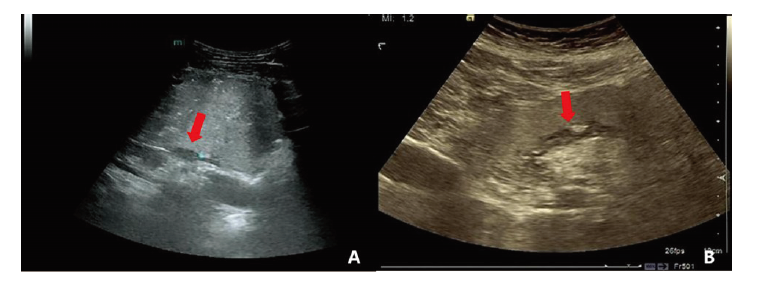
Fig.1 Representative images of gastroduodenal lesions observed by gastrointestinal filling contrast-enhanced ultrasound
| 检查方式 | 胃炎/例 | 胃溃疡/例 | 十二指肠溃疡/例 | 胃食管反流/例 | 其他/ 例 | 检出率/% |
|---|---|---|---|---|---|---|
| 胃肠超声造影 | 45 | 31 | 23 | 15 | 9 | 85.42 |
| 胃镜 | 46 | 33 | 29 | 15 | 9 | 91.67 |
Tab.2 Specific diagnostic results of the two examination methods for different gastrointestinal lesions
| 检查方式 | 胃炎/例 | 胃溃疡/例 | 十二指肠溃疡/例 | 胃食管反流/例 | 其他/ 例 | 检出率/% |
|---|---|---|---|---|---|---|
| 胃肠超声造影 | 45 | 31 | 23 | 15 | 9 | 85.42 |
| 胃镜 | 46 | 33 | 29 | 15 | 9 | 91.67 |
| 胃肠超声造影 | 胃镜检查 | 合计 | |
|---|---|---|---|
| 阳性 | 阴性 | ||
| 阳性 | 80 | 2 | 82 |
| 阴性 | 6 | 5 | 11 |
| 合计 | 86 | 7 | 93 |
Tab.3 Comparison of GIC-US and gastroscopy results between the early-mid pregnancy groups
| 胃肠超声造影 | 胃镜检查 | 合计 | |
|---|---|---|---|
| 阳性 | 阴性 | ||
| 阳性 | 80 | 2 | 82 |
| 阴性 | 6 | 5 | 11 |
| 合计 | 86 | 7 | 93 |
| 胃肠超声造影 | 胃镜检查 | 合计 | |
|---|---|---|---|
| 阳性 | 阴性 | ||
| 阳性 | 39 | 2 | 41 |
| 阴性 | 7 | 3 | 10 |
| 合计 | 46 | 5 | 51 |
Tab.4 Comparison of GIC-US and gastroscopy results between patients of the late pregnancy group
| 胃肠超声造影 | 胃镜检查 | 合计 | |
|---|---|---|---|
| 阳性 | 阴性 | ||
| 阳性 | 39 | 2 | 41 |
| 阴性 | 7 | 3 | 10 |
| 合计 | 46 | 5 | 51 |
| [1] | 许文静, 王素霞, 陈进康, 等. 妊娠剧吐相关因素研究进展[J]. 浙江中西医结合杂志, 2018, 28(12):1066-1068. |
| Xu W J, Wang S X, Chen J K, et al. Research progress on related factors of hyperemesis gravidarum[J]. Zhejiang J Integr Tradit Chin West Med, 2018, 28(12):1066-1068. doi:10.3969/j.issn.1005-4561.2018.12.031. | |
| [2] | Kamani L, Achakzai M S, Ismail F W, et al. Safety of endoscopy and its outcome in pregnancy[J]. Cureus, 2019, 11(12):e6301. doi:10.7759/cureus.6301. |
| [3] | 赵巧云, 章春泉, 郭良云. 胃超声造影的临床应用进展[J]. 中国医学科学院学报, 2025, 47(5):702-709. |
| Zhao Q Y, Zhang C Q, Guo L Y. Research progress in clinical applications of gastric contrast-enhanced ultrasound[J]. Acta Academiae Medicinae Sinicae, 2025, 47(5):702-709. doi:10.3881/j.issn.1000-503X.16655. | |
| [4] | Calderone C E, Lockhart M E, Fetzer D T. The use of contrast-enhanced ultrasound in genituourinary imaging:technical and clinical considerations[J]. Radiol Clin North Am, 2025, 63(6):1019-1036. doi:10.1016/j.rcl.2025.04.009. |
| [5] | 张茜. 孕产妇胃肠超声造影的优势与适用情况[J]. 人人健康, 2025(5):104-105. |
| Zhang Q. Advantages and applicable situations of gastrointestinal contrast-enhanced ultrasound for pregnant and postpartum women[J]. Renren Jiankang, 2025(5):104-105. doi:10.20252/j.cnki.rrjk.2025.05.053. | |
| [6] | 中华医学会消化病学分会,中华医学会消化病学分会消化系统肿瘤协作组. 中国慢性胃炎诊治指南(2022年,上海)[J]. 中华消化杂志, 2023, 43(3):145-175. |
| Chinese Society of Gastroenterology,Chinese Society of Gastroenterology Cooperative Group on Digestive System Tumors. Guidelines for diagnosis and treatment of chronic gastritis in China (2022,Shanghai)[J]. Chin J Dig, 2023, 43(3):145-175. doi:10.3760/cma.j.cn311367-20230117-00023. | |
| [7] | 中华消化杂志编辑委员会. 消化性溃疡诊断与治疗共识意见(2022年,上海)[J]. 中华消化杂志, 2023, 43(3):176-192. |
| Editorial Board of Chinese Journal of Digestion. Consensus on the diagnosis and therapy of peptic ulcer (2022,Shanghai)[J]. Chin J Dig,2023, 43(3):176-192. doi:10.3760/cma.j.cn311367-20230115-00022. | |
| [8] | Åström M, Lwin Z M T, Teni F S, et al. Use of the visual analogue scale for health state valuation:a scoping review[J]. Qual Life Res, 2023, 32(10):2719-2729. doi:10.1007/s11136-023-03411-3. |
| [9] | Mu K, Sun Q, Li X, et al. The value of oral contrast-enhanced gastric ultrasonography in the diagnosis and staging of benign peptic ulcer[J]. Sci Rep, 2024, 14(1):17390. doi:10.1038/s41598-024-68430-7. |
| [10] | 仉立辉. 胃肠超声造影在胃十二指肠疾病诊断中的应用[J]. 影像研究与医学应用, 2025, 9(9):150-152. |
| Zhang L H. Application of gastrointestinal contrast-enhanced ultrasound in the diagnosis of gastroduodenal diseases[J]. J Imaging Res Med Appl, 2025, 9(9):150-152. doi:10.20267/j.issn.2096-3807.2025.09.048. | |
| [11] | Sethi A, Banerjee S, Chahal P. Advanced endoscopic procedures in pregnancy[J]. Am J Gastroenterol, 2022, 117(10S):39-43. doi:10.14309/ajg.0000000000001959. |
| [12] | 占路娟. 妊娠期胃肠功能障碍相关疾病患病率调查和影响因素分析[J]. 中国妇幼保健, 2021, 36(15):3577-3580. |
| Zhan L J. Investigation on the prevalence and influencing factors of gastrointestinal dysfunction related diseases during pregnancy[J]. Matern Child Health Care China, 2021, 36(15):3577-3580. doi:10.19829/j.zgfybj.issn.1001-4411.2021.15.051. | |
| [13] | 赵雪婷, 漆洪波. 美国妇产科医师学会“产科超声指南2016”要点解读[J]. 中国实用妇科与产科杂志, 2017, 33(8):819-823. |
| Zhao X T, Qi H B. Interpretation of key points of “Guidelines for Obstetric Ultrasound (2016)” by American College of Obstetricians and Gynecologists[J]. Chin J Pract Gynecol Obstet, 2017, 33(8):819-823. doi:10.19538/j.fk2017080113. | |
| [14] | Uma M, Seow Cynthia H, Barnes Edward L, et al. Global consensus statement on the management of pregnancy in inflammatory bowel disease[J]. Gut, 2026, 75(2):208-251. doi:10.1136/gutjnl-2025-336402. |
| [15] | Akarsu M, Onem S, Htway Z, et al. Double balloon enteroscopy in a pregnant woman with Peutz-Jeghers syndrome[J]. J Coll Physicians Surg Pak, 2022, 32(1):99-101. doi:10.29271/jcpsp.2022.01.99. |
| [16] | Dal Buono A, Faita F, Peyrin-Biroulet L, et al. Ultrasound elastography in inflammatory bowel diseases:a systematic review of accuracy compared with histopathological assessment[J]. J Crohns Colitis, 2022, 16(10):1637-1646. doi:10.1093/ecco-jcc/jjac082. |
| [17] | Xue J, Lyu G, Li S. The diagnostic value of two-dimensional ultrasound Su-RADS combined with shear wave elastography for benign and malignant lesions of the gastric wall[J]. BMC Med Imaging, 2024, 24(1):352. doi:10.1186/s12880-024-01530-y. |
| [18] | Quek S X Z, Ho K Y. Artificial intelligence in upper gastrointestinal diagnosis[J]. Korean J Helicobacter Up Gastrointest Res, 2025, 25(3):251-260. doi:10.7704/kjhugr.2025.0024. |
| [19] | Xu L, Wang X, Wu W, et al. Diagnostic accuracy of double contrast-enhanced ultrasonography in clarifying tumor depth (T Stage) of gastric cancer:meta-analysis[J]. Ultrasound Med Biol, 2021, 47(9):2483-2493. doi:10.1016/j.ultrasmedbio.2021.05.017. |
| [20] | Xu Y, Ma H, Huang G, et al. Double contrast-enhanced ultrasonography improves diagnostic accuracy of T staging compared with multi-detector computed tomography in gastric cancer patients[J]. World J Gastroenterol, 2024, 30(23):3005-3015. doi:10.3748/wjg.v30.i23.3005. |
| [21] | Jain A, Dhande R P, Parihar P H, et al. Contrast-enhanced ultrasound for fetal and placental assessment:evidence,safety,and a roadmap for clinical translation[J]. Ultrasound J, 2025, 17(1):43. doi:10.1186/s13089-025-00449-x. |
| Viewed | ||||||
|
Full text |
|
|||||
|
Abstract |
|
|||||
