
Tianjin Medical Journal ›› 2025, Vol. 53 ›› Issue (11): 1197-1203.doi: 10.11958/20251550
• Clinical Research • Previous Articles Next Articles
REN Yu1( ), LI Huiyu2, MA Yajie3, ZHANG Yuling4, JI Qian4△()
Received:2025-04-22
Revised:2025-08-24
Published:2025-11-15
Online:2025-11-19
Contact:
△E-mail:REN Yu, LI Huiyu, MA Yajie, ZHANG Yuling, JI Qian. The effect of BOLD combined with mDixon Quant in quantitatively evaluating the early renal oxygen metabolism and iron deposition in patients with type 2 diabetes[J]. Tianjin Medical Journal, 2025, 53(11): 1197-1203.
CLC Number:

Fig.1 Schematic diagram of kidney ROI placement
| 组别 | n | 年龄/岁 | 男性 | 身高/m | |
|---|---|---|---|---|---|
| 对照组 | 33 | 46.24±11.53 | 20(60.6) | 1.69±0.08 | |
| NAU组 | 35 | 45.33±11.55 | 24(68.6) | 1.92±0.10 | |
| MAU组 | 23 | 48.52±12.04 | 16(69.6) | 1.70±0.72 | |
| F或 | 0.533 | 0.660 | 0.858 | ||
| 组别 | 体质量/kg | eGFR/ [mL/(min·1.73m2)] | ACR/(mg/g) | ||
| 对照组 | 68.22±11.71 | 108.55±13.29 | 15.86±2.17 | ||
| NAU组 | 85.14±14.42a | 121.93±24.73a | 13.42±7.13 | ||
| MAU组 | 81.55±16.76a | 95.61±27.86ab | 139.77±89.81ab | ||
| 13.029** | 9.902** | 66.091** | |||
Tab.1 Comparison of demographic and clinical biochemical parameters between the three groups
| 组别 | n | 年龄/岁 | 男性 | 身高/m | |
|---|---|---|---|---|---|
| 对照组 | 33 | 46.24±11.53 | 20(60.6) | 1.69±0.08 | |
| NAU组 | 35 | 45.33±11.55 | 24(68.6) | 1.92±0.10 | |
| MAU组 | 23 | 48.52±12.04 | 16(69.6) | 1.70±0.72 | |
| F或 | 0.533 | 0.660 | 0.858 | ||
| 组别 | 体质量/kg | eGFR/ [mL/(min·1.73m2)] | ACR/(mg/g) | ||
| 对照组 | 68.22±11.71 | 108.55±13.29 | 15.86±2.17 | ||
| NAU组 | 85.14±14.42a | 121.93±24.73a | 13.42±7.13 | ||
| MAU组 | 81.55±16.76a | 95.61±27.86ab | 139.77±89.81ab | ||
| 13.029** | 9.902** | 66.091** | |||
| 组别 | n | BOLD | ||
|---|---|---|---|---|
| 肾皮质R2* | 肾髓质R2* | t | ||
| 对照组 | 33 | 18.54±1.39 | 28.37±1.44 | 25.399** |
| NAU组 | 35 | 17.42±1.95 | 32.28±3.30a | 22.169** |
| MAU组 | 23 | 17.92±2.46 | 29.33±2.05b | 23.853** |
| F | 2.935 | 23.172** | ||
| 组别 | mDixon Quant | |||
| 肾皮质R2* | 肾髓质R2* | t | ||
| 对照组 | 18.23±1.09 | 28.04±2.29 | 20.945** | |
| NAU组 | 17.15±1.90a | 32.12±3.45a | 22.657** | |
| MAU组 | 17.55±1.52 | 29.35±1.41b | 26.143** | |
| F | 4.117* | 20.979** | ||
Tab.2 Comparison of BOLD and mDixon Quant parameters between the three groups and between cortical and medullary regions within groups
| 组别 | n | BOLD | ||
|---|---|---|---|---|
| 肾皮质R2* | 肾髓质R2* | t | ||
| 对照组 | 33 | 18.54±1.39 | 28.37±1.44 | 25.399** |
| NAU组 | 35 | 17.42±1.95 | 32.28±3.30a | 22.169** |
| MAU组 | 23 | 17.92±2.46 | 29.33±2.05b | 23.853** |
| F | 2.935 | 23.172** | ||
| 组别 | mDixon Quant | |||
| 肾皮质R2* | 肾髓质R2* | t | ||
| 对照组 | 18.23±1.09 | 28.04±2.29 | 20.945** | |
| NAU组 | 17.15±1.90a | 32.12±3.45a | 22.657** | |
| MAU组 | 17.55±1.52 | 29.35±1.41b | 26.143** | |
| F | 4.117* | 20.979** | ||

Fig.2 R2* of kidney BOLD sequence and typical pseudo-color diagram of water diagram of mDixon Quant sequence
| 参数 | AUC(95%CI) | 截断值/Hz | 敏感度/% | 特异度/% | 阳性预测值/% | 阴性预测值/% | 准确度/% |
|---|---|---|---|---|---|---|---|
| 髓质BOLD R2* | 0.869(0.782~0.957) | 32.6 | 97.0 | 65.7 | 86.9 | 84.2 | 82.4 |
| 皮质mDixon Quant R2* | 0.719(0.592~0.847) | 17.0 | 87.9 | 57.1 | 85.2 | 80.3 | 77.9 |
| 髓质mDixon Quant R2* | 0.867(0.774~0.959) | 33.3 | 93.9 | 74.3 | 85.5 | 84.6 | 85.3 |
| 皮质和髓质mDixon Quant R2* | 0.887(0.801~0.972) | 26.3 | 94.3 | 99.9 | 87.8 | 82.9 | 97.1 |
| BOLD联合mDixon Quant R2* | 0.892(0.809~0.975) | 19.9 | 97.0 | 88.9 | 90.4 | 88.1 | 92.6 |
Tab.3 Diagnostic efficacy of BOLD and mDixon Quant for differentiating the control group and the NAU group
| 参数 | AUC(95%CI) | 截断值/Hz | 敏感度/% | 特异度/% | 阳性预测值/% | 阴性预测值/% | 准确度/% |
|---|---|---|---|---|---|---|---|
| 髓质BOLD R2* | 0.869(0.782~0.957) | 32.6 | 97.0 | 65.7 | 86.9 | 84.2 | 82.4 |
| 皮质mDixon Quant R2* | 0.719(0.592~0.847) | 17.0 | 87.9 | 57.1 | 85.2 | 80.3 | 77.9 |
| 髓质mDixon Quant R2* | 0.867(0.774~0.959) | 33.3 | 93.9 | 74.3 | 85.5 | 84.6 | 85.3 |
| 皮质和髓质mDixon Quant R2* | 0.887(0.801~0.972) | 26.3 | 94.3 | 99.9 | 87.8 | 82.9 | 97.1 |
| BOLD联合mDixon Quant R2* | 0.892(0.809~0.975) | 19.9 | 97.0 | 88.9 | 90.4 | 88.1 | 92.6 |
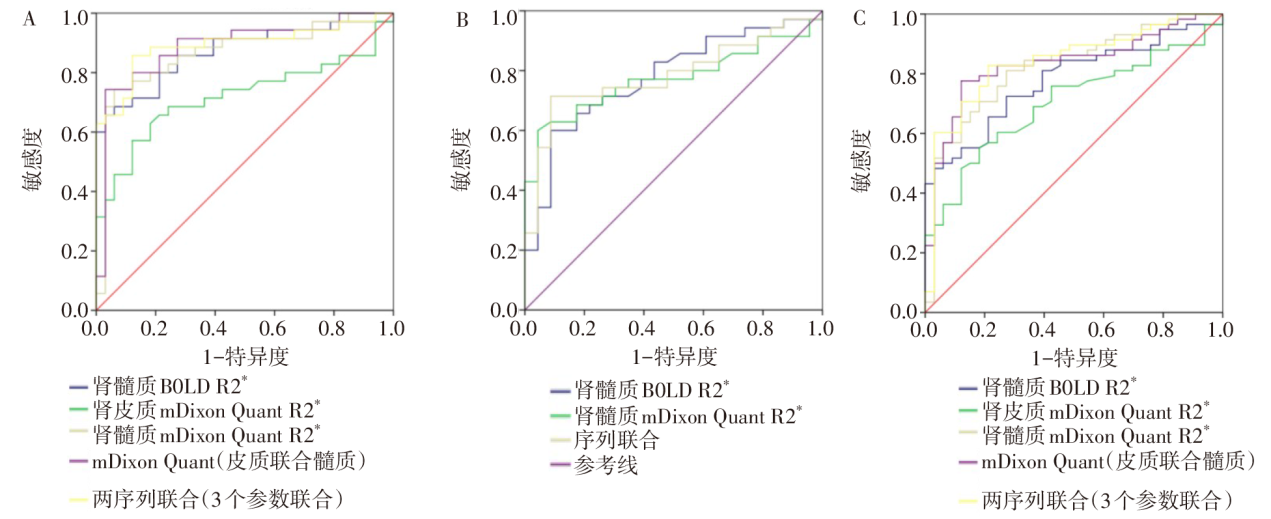
Fig.3 Analysis results of ROC curves distinguishing different renal function groups using BOLD and mDixon Quant
| 参数 | AUC(95%CI) | 截断值/Hz | 敏感度/% | 特异度/% | 阳性预测值/% | 阴性预测值/% | 准确度/% |
|---|---|---|---|---|---|---|---|
| 髓质BOLD R2* | 0.778(0.657~0.898) | 31.5 | 60.0 | 91.3 | 70.9 | 81.3 | 79.3 |
| 髓质mDixon Quant R2* | 0.773(0.652~0.894) | 30.9 | 60.0 | 95.7 | 76.7 | 80.4 | 79.3 |
| BOLD联合mDixon Quant R2* | 0.785(0.666~0.904) | 30.2 | 65.7 | 91.3 | 84.4 | 83.8 | 81.0 |
Tab.4 Diagnostic efficacy of BOLD and mDixon Quant for differentiating the NAU group and the MAU group
| 参数 | AUC(95%CI) | 截断值/Hz | 敏感度/% | 特异度/% | 阳性预测值/% | 阴性预测值/% | 准确度/% |
|---|---|---|---|---|---|---|---|
| 髓质BOLD R2* | 0.778(0.657~0.898) | 31.5 | 60.0 | 91.3 | 70.9 | 81.3 | 79.3 |
| 髓质mDixon Quant R2* | 0.773(0.652~0.894) | 30.9 | 60.0 | 95.7 | 76.7 | 80.4 | 79.3 |
| BOLD联合mDixon Quant R2* | 0.785(0.666~0.904) | 30.2 | 65.7 | 91.3 | 84.4 | 83.8 | 81.0 |
| 参数 | AUC(95%CI) | 截断值/Hz | 敏感度/% | 特异度/% | 阳性预测值/% | 阴性预测值/% | 准确度/% |
|---|---|---|---|---|---|---|---|
| 髓质BOLD R2* | 0.778(0.685~0.872) | 32.7 | 97.0 | 48.3 | 91.8 | 90.0 | 79.1 |
| 皮质mDixon Quant R2* | 0.702(0.596~0.808) | 17.23 | 81.8 | 55.2 | 79.9 | 84.2 | 52.8 |
| 髓质mDixon Quant R2* | 0.822(0.733~0.911) | 35.1 | 72.7 | 81 | 91.1 | 83.7 | 74.7 |
| 皮质和髓质mDixon Quant R2* | 0.834(0.749~0.919) | 28.0 | 77.6 | 87.9 | 84.2 | 85.7 | 81.3 |
| BOLD联合mDixon Quant R2* | 0.841(0.756~0.926) | 23.2 | 82.8 | 78.8 | 90.1 | 87.7 | 81.4 |
Tab.5 Diagnostic efficacy of BOLD and mDixon Quant for differentiating the control group and the early-stage T2DM group
| 参数 | AUC(95%CI) | 截断值/Hz | 敏感度/% | 特异度/% | 阳性预测值/% | 阴性预测值/% | 准确度/% |
|---|---|---|---|---|---|---|---|
| 髓质BOLD R2* | 0.778(0.685~0.872) | 32.7 | 97.0 | 48.3 | 91.8 | 90.0 | 79.1 |
| 皮质mDixon Quant R2* | 0.702(0.596~0.808) | 17.23 | 81.8 | 55.2 | 79.9 | 84.2 | 52.8 |
| 髓质mDixon Quant R2* | 0.822(0.733~0.911) | 35.1 | 72.7 | 81 | 91.1 | 83.7 | 74.7 |
| 皮质和髓质mDixon Quant R2* | 0.834(0.749~0.919) | 28.0 | 77.6 | 87.9 | 84.2 | 85.7 | 81.3 |
| BOLD联合mDixon Quant R2* | 0.841(0.756~0.926) | 23.2 | 82.8 | 78.8 | 90.1 | 87.7 | 81.4 |
| [1] | 徐震. 2型糖尿病患者血清白蛋白水平与肾功能的相关性研究[D]. 广州: 广州医科大学, 2021. |
| XU Z. Study on the Correlation between serum albuminLevel and renal function in patients with type 2 diabetes mellitus[D]. Guangzhou: Guangzhou Medical University, 2021. doi:10.27043/d.cnki.ggzyc.2021.000413. | |
| [2] | MAUS M, LÓPEZ-POLO V, MATEO L, et al. Iron accumulation drives fibrosis,senescence and the senescence-associated secretory phenotype[J]. Nat Metab, 2023, 5(12):2111-2130. doi:10.1038/s42255-023-00928-2. |
| [3] | 徐基磐, 陈丽华, 任燕, 等. 多参数功能MRI评价冷缺血再灌注肾损伤大鼠肾脏血流及氧合水平的价值[J]. 国际医学放射学杂志, 2024, 47(3):342-348. |
| XU J P, CHEN L H, REN Y, et al. The value of multi-parameter fMRI in evaluating renal blood flow and oxygenation levels in rats with cold ischemia-reperfusion injury[J]. Int J Med Radiol, 2024, 47(3):342-348. doi:10.19300/j.2024.L20862. | |
| [4] | PLAIKNER M, LANSER L, KREMSER C, 等. 1.5 T MR商用3D-Dixon与传统2D多梯度回波序列定量测量脾胰铁含量的回顾性对比分析[J]. 国际医学放射学杂志, 2023, 46(5):622. |
| PLAIKNER M, LANSER L, KREMSER C, et al. 1.5-T MR relaxometry in quantifying splenic andpancreatic iron:retrospective comparison of a commercia3D-Dixon sequence and an established 2D multi gradient echo sequence[J]. Int J Med Radiol, 2023, 46(5):622. doi:10.19300/j.2023.e0714. | |
| [5] | GENG W, PAN L, SHEN L, et al. Evaluating renal iron overload in diabetes mellitus by blood oxygen level-dependent magnetic resonance imaging:a longitudinal experimental study[J]. BMC Med Imaging, 2022, 22(1):200. doi:10.1186/s12880-022-00939-7. |
| [6] | OMOUMI P. The Dixon method in musculoskeletal MRI: from fat-sensitive to fat-specific imaging[J]. Skeletal Radiol. 2022, 51(7):1365-1369. doi:10.1007/s00256-021-03950-1. |
| [7] | 中华医学会糖尿病学分会. 中国2型糖尿病防治指南(2020年版)(下)[J]. 中国实用内科杂志, 2021, 41(9):757-784. |
| Diabetes Society of the Chinese Medical Association. Guidelines for the prevention and treatment of type 2 diabetes in China (2020 Edition)-Part II[J]. Chin J Pract Intern Med, 2021, 41(9):757-784. doi:10.19538/j.nk2021090106. | |
| [8] | 付帅, 李晓宁. 肾小球滤过率计算公式研究进展:从Cockcroft-Gault公式到FAS公式[J]. 临床肾脏病杂志, 2020, 20(1):73-77. |
| FU S, LI X N. The research development of formulas for calculatingglomerular filtration rate: from Cockcroft-Gault formulato full age spectrum(FAS) formula[J]. J Clin Nephrol, 2020, 20(1):73-77. doi:10.3969/j.issn.1671-2390.2020.01.014. | |
| [9] | YANG C, WANG Z, ZHANG J, et al. MRI assessment of renal lipid deposition and abnormal oxygen metabolism of type 2 diabetes mellitus based on mDixon-Quant[J]. J Magn Reson Imaging, 2023, 58(5):1408-1417. doi:10.1002/jmri.28701. |
| [10] | 王娴, 刘霞明, 陈曼玉, 等. 基于机器学习对2型糖尿病肾病预测模型的构建及验证[J]. 天津医药, 2024, 52(7):775-780. |
| WANG X, LIU X M, CHEN M Y, et al. Construction and verification of prediction model of type 2 diabetic nephropathy based on machine learning[J]. Tianjin Med J, 2024, 52(7):775-780. doi:10.11958/20231584. | |
| [11] | ZHENG S S, HE Y M, LU J. Noninvasive evaluation of diabetic patients with high fasting blood glucose using DWI and BOLD MRI[J]. Abdom Radiol(NY), 2021, 46(4):1659-1669. doi:10.1007/s00261-020-02780-4. |
| [12] | WANG J, YUE X, MENG C, et al. Acute hyperglycemia may induce renal tubular injury through mitophagy inhibition[J]. Front Endocrinol(Lausanne), 2020, 11:536213. doi:10.3389/fendo.2020.536213. |
| [13] | LU J C, LEE P, IERINO F, et al. Challenges of glycemic control in people with diabetes and advanced kidney disease and the potential of automated insulin delivery[J]. J Diabetes Sci Technol, 2024, 18(6):1500-1508. doi:10.1177/19322968231174040. |
| [14] | 中华医学会肾脏病学分会专家组. 糖尿病肾脏疾病临床诊疗中国指南[J]. 中华肾脏病杂志, 2021, 37(3):255-304. |
| Expert Group of Chinese Society of Nephrology. Chinese guidelines for diagnosis and treatment of diabetic kidney disease[J]. Chin J Nephrol, 2021, 37(3):255-304. doi:10.3760/cma.j.cn441217-20201125-00041. | |
| [15] | 高鹏, 王倩, 张维升. MR Dixon脂肪定量技术用于骨骼肌肉系统疾病进展[J]. 中国医学影像技术, 2023, 39(8):1257-1260. |
| GAO P, WANG Q, ZHANG W S. Progresses of MR Dixon fat quantification technique in musculoskeletal system diseases[J]. Chin J Med Imaging Technol, 2023, 39(8):1257-1260. doi:10.13929/j.issn.1003-3289.2023.08.031. | |
| [16] | 李啸扬. 基于磁共振Dixon技术以非侵入法无创评估胰腺脂肪含量[D]. 大连: 大连医科大学, 2022. |
| LI X Y. Noninvasive measurement of pancreatic fat content based on magnetic resonance mDixon technique[D]. Dalian: Dalian Medical University, 2022. doi:10.26994/d.cnki.gdlyu.2022.001028. | |
| [17] | MCGILL J B, HALLER H, ROY-CHAUDHURY P, et al. Making an impact on kidney disease in people with type 2 diabetes: the importance of screening for albuminuria[J]. BMJ Open Diabetes Res Care, 2022, 10(4):e002806. doi:10.1136/bmjdrc-2022-002806. |
| [18] | 任志芳, 任洁, 刘睿, 等. 铁代谢与2型糖尿病相关性及胰高血糖素样肽-1调控作用的研究进展[J]. 实用临床医药杂志, 2024, 28(7):138-142,148. |
| REN Z F, REN J, LIU R, et al. Research progress in the correlation between ironmetabolism and type 2 diabetes mellitus as well as theregulatory role of glucagon-like peptide-1[J]. J Clin Med Pract, 2024, 28(7):138-142,148. doi:10.7619/jcmp.20233644. | |
| [19] | PINTI M V, FINK G K, HATHAWAY Q A, et al. Mitochondrial dysfunction in type 2 diabetes mellitus:an organ-based analysis[J]. Am J Physiol Endocrinol Metab, 2019, 316(2):E268-E285. doi:10.1152/ajpendo.00314.2018. |
| [20] | ALTAMURA S, MÜDDER K, SCHLOTTERER A, et al. Iron aggravates hepatic insulin resistance in the absence of inflammation in a novel db/db mouse model with iron overload[J]. Mol Metab, 2021, 51:101235. doi:10.1016/j.molmet.2021.101235. |
| [21] | TANG R, TANG G, HUA T, et al. mDIXON-Quant technique diagnostic accuracy for assessing bone mineral density in male adult population[J]. BMC Musculoskelet Disord, 2023, 24(1):125. doi:10.1186/s12891-023-06225-z. |
| Viewed | ||||||
|
Full text |
|
|||||
|
Abstract |
|
|||||
