
Tianjin Medical Journal ›› 2026, Vol. 54 ›› Issue (5): 517-521.doi: 10.11958/20253266
• Clinical Research • Previous Articles Next Articles
LIU Yuxin1( ), YU Liang1, LU Tan2, LI Qi1, SHEN Zhizhong1, ZHAO Yilei1△()
Received:2025-10-30
Revised:2025-12-26
Published:2026-05-15
Online:2026-05-13
Contact:
△E-mail:LIU Yuxin, YU Liang, LU Tan, LI Qi, SHEN Zhizhong, ZHAO Yilei. Predictive value of combined serum DKK1, SETDB1 and SMURF1 tests for postoperative delayed healing in patients with tibial shaft fractures[J]. Tianjin Medical Journal, 2026, 54(5): 517-521.
CLC Number:
| 组别 | n | 性别(男/女) | 年龄(<50岁/≥50岁) | 吸烟史 | 饮酒史 | ||||||||||||
|---|---|---|---|---|---|---|---|---|---|---|---|---|---|---|---|---|---|
| 正常组 | 142 | 98/44 | 59/83 | 25(17.61) | 8(5.63) | ||||||||||||
| 延迟组 | 68 | 46/22 | 21/47 | 9(13.24) | 5(7.35) | ||||||||||||
| χ2 | 0.040 | 2.219 | 0.647 | 0.234 | |||||||||||||
| 组别 | 心血管疾病 | 糖尿病 | 高血压 | 骨质疏松 | |||||||||||||
| 正常组 | 31(21.83) | 30(21.13) | 24(16.90) | 28(19.72) | |||||||||||||
| 延迟组 | 36(52.94) | 22(32.35) | 35(51.47) | 33(48.53) | |||||||||||||
| χ2 | 20.484** | 3.110 | 27.200** | 18.519** | |||||||||||||
| 组别 | 骨折原因 | 骨折类型 | |||||||||||||||
| 交通 事故致伤 | 高处 坠落伤 | 重物 砸伤 | 运动 损伤 | 开放性 骨折 | 闭合性 骨折 | ||||||||||||
| 正常组 | 62(43.66) | 33(23.24) | 26(18.31) | 21(14.79) | 69(48.59) | 73(51.41) | |||||||||||
| 延迟组 | 39(57.35) | 16(23.53) | 8(11.76) | 5(7.35) | 37(54.41) | 31(45.59) | |||||||||||
| χ2 | 5.064 | 0.623 | |||||||||||||||
Tab.1 Comparison of clinical data between the two groups of patients
| 组别 | n | 性别(男/女) | 年龄(<50岁/≥50岁) | 吸烟史 | 饮酒史 | ||||||||||||
|---|---|---|---|---|---|---|---|---|---|---|---|---|---|---|---|---|---|
| 正常组 | 142 | 98/44 | 59/83 | 25(17.61) | 8(5.63) | ||||||||||||
| 延迟组 | 68 | 46/22 | 21/47 | 9(13.24) | 5(7.35) | ||||||||||||
| χ2 | 0.040 | 2.219 | 0.647 | 0.234 | |||||||||||||
| 组别 | 心血管疾病 | 糖尿病 | 高血压 | 骨质疏松 | |||||||||||||
| 正常组 | 31(21.83) | 30(21.13) | 24(16.90) | 28(19.72) | |||||||||||||
| 延迟组 | 36(52.94) | 22(32.35) | 35(51.47) | 33(48.53) | |||||||||||||
| χ2 | 20.484** | 3.110 | 27.200** | 18.519** | |||||||||||||
| 组别 | 骨折原因 | 骨折类型 | |||||||||||||||
| 交通 事故致伤 | 高处 坠落伤 | 重物 砸伤 | 运动 损伤 | 开放性 骨折 | 闭合性 骨折 | ||||||||||||
| 正常组 | 62(43.66) | 33(23.24) | 26(18.31) | 21(14.79) | 69(48.59) | 73(51.41) | |||||||||||
| 延迟组 | 39(57.35) | 16(23.53) | 8(11.76) | 5(7.35) | 37(54.41) | 31(45.59) | |||||||||||
| χ2 | 5.064 | 0.623 | |||||||||||||||
| 组别 | n | 术后1 d | 术后1周 | 术后4周 | 术后8周 |
|---|---|---|---|---|---|
| 正常组 | 142 | 3.74±0.59 | 2.93±1.13a | 2.68±0.94ab | 2.25±0.68abc |
| 延迟组 | 68 | 2.93±0.61 | 2.62±0.67a | 2.27±0.89ab | 2.01±0.54abc |
| t | 9.213** | 2.089* | 3.006** | 2.549* | |
| F时间/F组内/F交互 | 69.191**/65.851**/4.312** | ||||
Tab.2 Comparison of postoperative serum DKK1 level between the two groups of patients
| 组别 | n | 术后1 d | 术后1周 | 术后4周 | 术后8周 |
|---|---|---|---|---|---|
| 正常组 | 142 | 3.74±0.59 | 2.93±1.13a | 2.68±0.94ab | 2.25±0.68abc |
| 延迟组 | 68 | 2.93±0.61 | 2.62±0.67a | 2.27±0.89ab | 2.01±0.54abc |
| t | 9.213** | 2.089* | 3.006** | 2.549* | |
| F时间/F组内/F交互 | 69.191**/65.851**/4.312** | ||||
| 组别 | n | 术后1 d | 术后1周 | 术后4周 | 术后8周 |
|---|---|---|---|---|---|
| 正常组 | 142 | 57.24±2.71 | 52.69±1.36a | 50.37±1.09ab | 51.89±1.34abc |
| 延迟组 | 68 | 50.26±3.12 | 45.34±1.04a | 49.33±2.01ab | 50.76±1.25abc |
| t | 16.616** | 39.216** | 4.860** | 5.842** | |
| F时间/F组内/F交互 | 232.793**/924.091**/166.617** | ||||
Tab.3 Comparison of postoperative serum SETDB1 level between the two groups of patients
| 组别 | n | 术后1 d | 术后1周 | 术后4周 | 术后8周 |
|---|---|---|---|---|---|
| 正常组 | 142 | 57.24±2.71 | 52.69±1.36a | 50.37±1.09ab | 51.89±1.34abc |
| 延迟组 | 68 | 50.26±3.12 | 45.34±1.04a | 49.33±2.01ab | 50.76±1.25abc |
| t | 16.616** | 39.216** | 4.860** | 5.842** | |
| F时间/F组内/F交互 | 232.793**/924.091**/166.617** | ||||
| 组别 | n | 术后1 d | 术后1周 | 术后4周 | 术后8周 |
|---|---|---|---|---|---|
| 正常组 | 142 | 1.07±0.08 | 0.68±0.02a | 0.78±0.01ab | 0.79±0.03abc |
| 延迟组 | 68 | 1.14±0.04 | 0.87±0.05a | 0.98±0.03ab | 1.11±0.07abc |
| t | 6.806** | 38.716** | 71.458** | 46.188** | |
| F时间/F组内/F交互 | 1 684.982**/3 074.683**/230.161** | ||||
Tab.4 Comparison of postoperative serum SMURF1 level between the two groups of patients
| 组别 | n | 术后1 d | 术后1周 | 术后4周 | 术后8周 |
|---|---|---|---|---|---|
| 正常组 | 142 | 1.07±0.08 | 0.68±0.02a | 0.78±0.01ab | 0.79±0.03abc |
| 延迟组 | 68 | 1.14±0.04 | 0.87±0.05a | 0.98±0.03ab | 1.11±0.07abc |
| t | 6.806** | 38.716** | 71.458** | 46.188** | |
| F时间/F组内/F交互 | 1 684.982**/3 074.683**/230.161** | ||||
| 变量 | β | SE | Wald χ2 | P | OR(95%CI) |
|---|---|---|---|---|---|
| DKK1 | -4.178 | 1.470 | 8.078 | 0.004 | 0.015(0.001~0.273) |
| SETDB1 | -9.160 | 3.118 | 8.630 | 0.003 | 0.000(0.000~0.047) |
| SMURF1 | 2.823 | 1.069 | 6.966 | 0.008 | 16.823(2.068~136.855) |
| 心血管疾病 | 3.661 | 1.787 | 4.197 | 0.041 | 38.906(1.172~1 292.003) |
| 高血压 | 3.232 | 1.554 | 4.326 | 0.038 | 25.337(1.205~532.690) |
| 骨质疏松 | 2.925 | 1.399 | 4.373 | 0.037 | 18.626(1.201~288.805) |
| 常数项 | -8.309 | 2.500 | 11.042 | <0.001 | 0.000 |
Tab.5 Multivariate Logistic regression analysis of factors influencing postoperative delayed union in patients with tibial shaft fracture
| 变量 | β | SE | Wald χ2 | P | OR(95%CI) |
|---|---|---|---|---|---|
| DKK1 | -4.178 | 1.470 | 8.078 | 0.004 | 0.015(0.001~0.273) |
| SETDB1 | -9.160 | 3.118 | 8.630 | 0.003 | 0.000(0.000~0.047) |
| SMURF1 | 2.823 | 1.069 | 6.966 | 0.008 | 16.823(2.068~136.855) |
| 心血管疾病 | 3.661 | 1.787 | 4.197 | 0.041 | 38.906(1.172~1 292.003) |
| 高血压 | 3.232 | 1.554 | 4.326 | 0.038 | 25.337(1.205~532.690) |
| 骨质疏松 | 2.925 | 1.399 | 4.373 | 0.037 | 18.626(1.201~288.805) |
| 常数项 | -8.309 | 2.500 | 11.042 | <0.001 | 0.000 |
| 指标 | AUC(95%CI) | 敏感度/ % | 特异度/ % | 约登 指数 | 截断值 |
|---|---|---|---|---|---|
| DKK1 | 0.689(0.617~0.766) | 45.1 | 88.2 | 0.333 | 2.45 μg/L |
| SETDB1 | 0.713(0.637~0.788) | 81.0 | 54.4 | 0.354 | 40.45 ng/L |
| SMURF1 | 0.885(0.837~0.933) | 73.9 | 92.6 | 0.666 | 1.44 μg/L |
| 联合检测 | 0.931(0.897~0.966) | 78.9 | 97.0 |
Tab.6 Predictive value of serum DKK1, SETDB1 and SMURF1 levels on the first day after surgery for predicting delayed healing in patients with tibial shaft fracture
| 指标 | AUC(95%CI) | 敏感度/ % | 特异度/ % | 约登 指数 | 截断值 |
|---|---|---|---|---|---|
| DKK1 | 0.689(0.617~0.766) | 45.1 | 88.2 | 0.333 | 2.45 μg/L |
| SETDB1 | 0.713(0.637~0.788) | 81.0 | 54.4 | 0.354 | 40.45 ng/L |
| SMURF1 | 0.885(0.837~0.933) | 73.9 | 92.6 | 0.666 | 1.44 μg/L |
| 联合检测 | 0.931(0.897~0.966) | 78.9 | 97.0 |
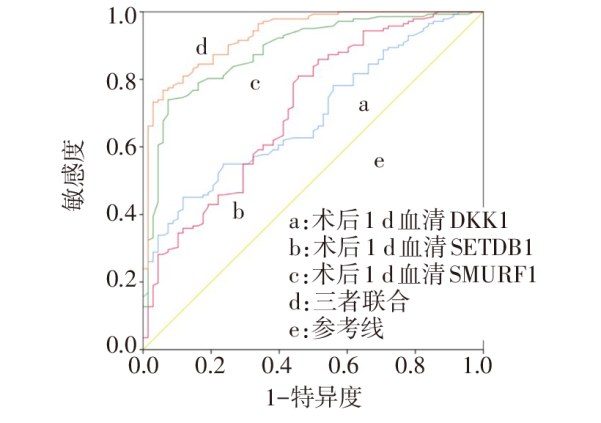
Fig.1 ROC curves of serum DKK1, SETDB1 and SMURF1 levels in predicting delayed healing after surgery in patients with tibial shaft fracture
| [1] | 陈垂继, 王安辉, 王海鹏, 等. 胫骨干骨折患者流行病学特征及新冠疫情对其影响的研究[J]. 实用骨科杂志, 2023, 29(3):198-201,223. |
| CHEN C J, WANG A H, WANG H P, et al. Epidemiological characteristics of patients with tibial shaft fractures and the effect of COVID-19[J]. Journal of Practical Orthopaedics, 2023, 29(3):198-201,223. doi:10.3760/cma.j.issn.1008-5572.2023.03.102. | |
| [2] | 何炜, 许兆光, 林蔚莘, 等. 锁定接骨板治疗胫骨中下段关节外骨折术后延迟愈合的危险因素分析[J]. 中国骨伤, 2024, 37(2):148-152. |
| HE W, XU Z G, LIN W S, et al. Analysis of the risk factors for delayed union of extra-articular fractures of the middle and lower third of the tibia treated by locking plate[J]. China J Orthop Traumatol, 2024, 37(2):148-152. doi:10.12200/j.issn.1003-0034.20220481. | |
| [3] | 秦华, 李中锋, 李霭, 等. 创伤性骨折患者骨折愈合延迟及影响因素研究[J]. 华南预防医学, 2023, 49(1):86-89. |
| QIN H, LI Z F, LI A, et al. Delayed fracture healing and its influencing factors in patients with traumatic fracture[J]. South China J Prev Med, 2023, 49(1):86-89. doi:10.12183/j.scjpm.2023.0086. | |
| [4] | JI X, ZHAO D, XIN Z, et al. The predictive value of stress-induced hyperglycemia parameters for delayed healing after tibial fracture post-surgery[J]. J Orthop Surg Res, 2024, 19(1):666. doi:10.1186/s13018-024-05138-4. |
| [5] | 李畅, 范荣, 李东波, 等. 当归补血汤促进大鼠骨质疏松性骨折愈合及调节Wnt/β-catenin通路作用研究[J]. 吉林中医药, 2022, 42(9):1069-1075. |
| LI C, FAN R, LI D B, et al. Danggui Buxue Decoction promoting the fracture healing in osteoporotic rats by regulating the Wnt/β-catenin pathway[J]. Jilin Journal of Chinese Medicine, 2022, 42(9):1069-1075. doi:10.13463/j.cnki.jlzyy.2022.09.020. | |
| [6] | 吴楠, 郑苗苗, 王信哲, 等. 蛋白质精氨酸甲基转移酶调控骨形成与骨愈合的研究进展[J]. 实用临床医药杂志, 2024, 28(5):126-129. |
| WU N, ZHENG M M, WANG X Z, et al. Research progress of protein arginine methyltransferase regulating bone formation and bone healing[J]. Journal of Clinical Medicine in Practice, 2024, 28(5):126-129. doi:10.7619/jcmp.20233520. | |
| [7] | HUANG Y, XU Y, FENG S, et al. miR-19b enhances osteogenic differentiation of mesenchymal stem cells and promotes fracture healing through the WWP1/Smurf2-mediated KLF5/β-catenin signaling pathway[J]. Exp Mol Med, 2021, 53(5):973-985. doi:10.1038/s12276-021-00631-w. |
| [8] | DINCEL A S, JØRGENSEN N R, et al. IOF-IFCC JOINT COMMITTEE ON BONE METABOLISM(C-BM), New emerging biomarkers for bone disease:Sclerostin and Dickkopf-1(DKK1)[J]. Calcif Tissue Int, 2023, 112(2):243-257. doi:10.1007/s00223-022-01020-9. |
| [9] | LUO H, WU X, ZHU X H, et al. The functions of SET domain bifurcated histone lysine methyltransferase 1(SETDB1)in biological process and disease[J]. Epigenetics Chromatin, 2023, 16(1):47. doi:10.1186/s13072-023-00519-1. |
| [10] | 刘延, 刘青山, 何大为. NEDD4泛素连接酶家族在骨质疏松症中的研究[J]. 中国骨质疏松杂志, 2023, 29(10):1550-1554. |
| LIU Y, LIU Q S, HE D W. The research of NEDD4 ubiquitin ligase family in osteoporosis[J]. Chin J Osteoporos, 2023, 29(10):1550-1554. doi:10.3969/j.issn.1006-7108.2023.10.027. | |
| [11] | 陈孝平, 张英泽, 兰平. 外科学[M]. 10版. 北京: 人民卫生出版社, 2024,628. |
| CHEN X P, LAN P. Surgery[M]. 10th ed. Beijing: People's Medical Publishing House, 2024,628. | |
| [12] | 丁涛, 夏克, 陈前永. 胫骨骨折患者术后血清小凹蛋白-1蛋白含量与延迟愈合关系的探究[J]. 中国骨伤, 2022, 35(6):527-531. |
| DING T, XIA K, CHEN Q Y. Exploration of relationship between postoperative serum caveolin-1 contents and delayed healing of tibial fracture patients[J]. China J Orthop Traumatol, 2022, 35(6):527-531. doi:10.12200/j.issn.1003-0034.2022.06.005. | |
| [13] | 李亚洁, 赵海英, 荆蕾蕾, 等. miR-29b、PTEN表达与胫骨干骨折延迟愈合的相关性分析[J]. 中国骨与关节损伤杂志, 2021, 36(6):626-628. |
| LI Y J, ZHAO H Y, JING L L, et al. Correlation analysis of miR-29b and PTEN expression with delayed union of tibial shaft fractures[J]. Chin J Bone Joint Injury, 2021, 36(6):626-628. doi:10.7531/j.issn.1672-9935.2021.06.023. | |
| [14] | 封彦齐, 邬学群, 许理忠, 等. 血清Chemerin、Ghrelin水平与胫骨干骨折延迟愈合的相关性分析[J]. 中国骨与关节损伤杂志, 2021, 36(8):864-866. |
| FENG Y Q, WU X Q, XU L Z, et al. Correlation analysis of serum Chemerin and Ghrelin levels with delayed union of tibial shaft fractures[J]. Chin J Bone Joint Injury, 2021, 36(8):864-866. doi:10.7531/j.issn.1672-9935.2021.08.026. | |
| [15] | ZENG H B, DONG L Q, XU C, et al. Artesunate promotes osteoblast differentiation through miR-34a/DKK1 axis[J]. Acta Histochem, 2020, 122(7):151601. doi:10.1016/j.acthis.2020.151601. |
| [16] | 韩锁, 齐岩松, 贾鹏, 等. LncRNA TERC调控H3K27me3、DKK1在地塞米松干预间充质干细胞成骨细胞分化中的相关研究[J]. 生物骨科材料与临床研究, 2024, 21(4):7267-7277. |
| HAN S, QI Y S, JIA P, et al. Research on the regulation of H3K27me3 and DKK1 by LncRNA TERC in dexamethasone-induced osteogenic differentiation of mesenchymal stem cells[J]. Orthopaedic Biomechanics Materials and Clinical Study, 2024, 21(4):7267-7277. doi:10.3969/j.issn.1672-5972.2024.04.015. | |
| [17] | 卜国云, 李曈曈, 王增亮. 骨折不愈合的治疗进展[J]. 实用医学杂志, 2023, 39(18):2416-2420. |
| BU G Y, LI T T, WANG Z L. Progress in the treatment of nonunion of fractures[J]. Journal of Practical Medicine, 2023, 39(18):2416-2420. doi:10.3969/j.issn.1006-5725.2023.18.023. | |
| [18] | HU L, CHENG Z, WU L, et al. Histone methyltransferase SETDB1 promotes osteogenic differentiation in osteoporosis by activating OTX2-mediated BMP-Smad and Wnt/β-catenin pathways[J]. Hum Cell, 2023, 36(4):1373-1388. doi:10.1007/s13577-023-00902-w. |
| [19] | MARKOULI M, STREPKOS D, PIPERI C. Structure,activity and function of the SETDB1 protein methyltransferase[J]. Life(Basel), 2021, 11(8):817. doi:10.3390/life11080817. |
| [20] | LIU Y, YUE M, LI Z. FOSL1 promotes tumorigenesis in colorectal carcinoma by mediating the FBXL2/Wnt/β-catenin axis via Smurf1[J]. Pharmacol Res, 2021, 165:105405. doi:10.1016/j.phrs.2020.105405. |
| [21] | 张新, 李洪昌, 汪思应, 等. 去泛素化酶USP10通过稳定Smurf1抑制TGF-β/BMP信号通路[J]. 生物化学与生物物理进展, 2023, 50(4):760-769. |
| ZHANG X, LI H C, WANG S Y, et al. Deubiquitinase USP10 inhibits the TGF-β/BMP signaling pathway by stabilizing Smurf1[J]. Progress in Biochemistry and Biophysics, 2023, 50(4):760-769. doi:10.16476/j.pibb.2022.0566. | |
| [22] | 郭路, 王玉丹, 侯晓丽, 等. 心脑血管疾病与骨质疏松性骨折的相关性[J]. 中华骨质疏松和骨矿盐疾病杂志, 2022, 15(6):683-690. |
| GUO L, WANG Y D, HOU X L, et al. Relationship between cardiovascular and cerebrovascular disease and osteoporotic fracture[J]. Chin J Osteoporos Bone Miner Res, 2022, 15(6):683-690. doi:10.3969/j.issn.1674-2591.2022.06.011. | |
| [23] | 王威, 陈益果, 黄洪波, 等. 高血压对骨折患者微循环及骨折愈合的影响[J]. 吉林医学, 2023, 44(3):685-688. |
| WANG W, CHEN Y G, HUANG H B, et al. The impact of hypertension on microcirculation and fracture healing in fracture patients[J]. Jilin Medical Journal, 2023, 44(3):685-688. doi:10.3969/j.issn.1004-0412.2023.03.033. | |
| [24] | 王敏, 王龙胜, 陈磊. 骨质疏松症患者腰椎骨折预测模型的构建[J]. 天津医药, 2024, 52(7):766-769. |
| WANG M, WANG L S, CHEN L. Construction of a prediction model for lumbar fracture in patients with osteoporosis[J]. Tianjin Med J, 2024, 52(7):766-769. doi:10.11958/20231883. |
| [1] | HOU Xiuxiu, XING Baorui, FENG Yuanchao, ZHANG Yadi. Magu Xujin capsule promotes hip fracture healing in aged rats through SDF-1/CXCR4 signaling pathway [J]. Tianjin Medical Journal, 2025, 53(1): 19-23. |
| [2] | LI Can, LU Shuang, WU Jun. Effects of danfang capsule on expressions of wnt1, β-catenin and DKK1 in rats with immunological hepat ic fibrosis [J]. Tianjin Medical Journal, 2019, 47(8): 804-809. |
| [3] | YANG Wei-qiang, DING Tong, FENG Li-ping, ZHANG Fu-mei, JIANG Zhen-gang, WANG Pei-shan. Study on therapeutic effects of combined variable stress plate fixation on femoral fracture healing in experimental sheep model [J]. Tianjin Medical Journal, 2019, 47(8): 815-819. |
| [4] | SUN Jie, BU Guo-yun, ZHANG Jin-li. The progress in treatment of osteoporotic tibial plateau fracture [J]. Tianjin Med J, 2018, 46(8): 894-899. |
| [5] | . The enhanced osteogenesis on bone fracture healing of intracerebroventricular leptin Injected through Foramen magnum [J]. , 2014, 42(6): 558-560 . |
| Viewed | ||||||
|
Full text |
|
|||||
|
Abstract |
|
|||||
