
天津医药 ›› 2026, Vol. 54 ›› Issue (8): 821-826.doi: 10.11958/20253241
张维昊1( ), 冯江涛1, 张凯辉2, 张泽佩2,△()
收稿日期:2025-10-28
修回日期:2026-04-03
出版日期:2026-08-15
发布日期:2026-08-07
通讯作者:
△E-mail:作者简介:张维昊(1992),男,主治医师,主要从事脊柱创伤、椎间盘退变与治疗方面研究。E-mail:基金资助:
ZHANG Weihao1(), FENG Jiangtao1, ZHANG Kaihui2, ZHANG Zepei2,△()
Received:2025-10-28
Revised:2026-04-03
Published:2026-08-15
Online:2026-08-07
Contact:
△E-mail: 张维昊, 冯江涛, 张凯辉, 张泽佩. 基于MRI测量的椎旁肌参数对单节段经皮椎间孔镜下椎间盘切除患者术后复发的预测价值[J]. 天津医药, 2026, 54(8): 821-826.
ZHANG Weihao, FENG Jiangtao, ZHANG Kaihui, ZHANG Zepei. Predictive value of MRI-based paraspinal muscle parameters for postoperative recurrence in patients undergoing single-level percutaneous endoscopic lumbar discectomy[J]. Tianjin Medical Journal, 2026, 54(8): 821-826.
摘要:
目的 探讨基于MRI测量的椎旁肌参数对腰椎间盘突出症(LDH)行经皮椎间孔镜下椎间盘切除术(PTED)患者术后复发的预测价值。方法 选取186例行PTED手术的单节段LDH患者,根据6个月以上的随访结果将患者分为复发组(24例)与未复发组(162例)。收集2组患者基线资料,测量并计算2组多裂肌与竖脊肌的标准化功能性横截面积(SCSA)和脂肪浸润率(FIR),评估脂肪浸润分级。采用多因素Logistic回归分析椎旁肌参数对术后复发的影响,并通过受试者工作特征(ROC)曲线评估其预测效能。结果 复发组的体质量指数(BMI)、糖尿病比例、疼痛视觉模拟量表(VAS)评分、Oswestry功能障碍指数(ODI)、Pfirrmann分级为Ⅳ—Ⅴ级的比例、多裂肌、竖脊肌FIR、严重浸润(2级)人数比例高于未复发组,多裂肌、竖脊肌SCSA小于未复发组(P<0.05)。Firth偏倚校正Logistic回归分析显示,多裂肌与竖脊肌SCSA降低、FIR升高为LDH患者PTED术后复发的危险因素。ROC曲线分析表明,椎旁肌参数联合预测术后复发的ROC曲线下面积(AUC)为0.898(95%CI:0.845~0.937),敏感度为83.3%,特异度为88.3%。结论 基于MRI测量的椎旁肌参数对单节段LDH患者PTED术后复发具有良好的预测价值,可作为术前评估复发风险、识别高危患者并提供个体化干预的指标。
中图分类号:
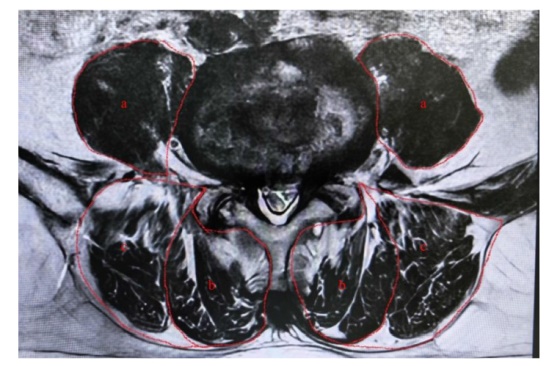
图1 腰大肌、多裂肌、竖脊肌以及同水平椎体横断面表面积测量图 LDH患者进行PTED治疗术前横断面MRI影像。a:椎体前方、两侧偏外的椭圆形/类圆形肌群,即红线区域为腰大肌;b:椎板后方、紧贴椎管与棘突两侧的短柱状肌群,即红线区域为多裂肌;c:多裂肌外侧、背侧深层的长条状肌群,即红线区域为竖脊肌;图像中央、椎管前方的大块骨性结构,即未被红色圈出的中央黑色区域为同水平椎体。
Fig.1 Measurement diagram of the psoas major muscle, multifidus muscle, erector spinae muscle, and the cross-sectional area of the vertebrae at the same level
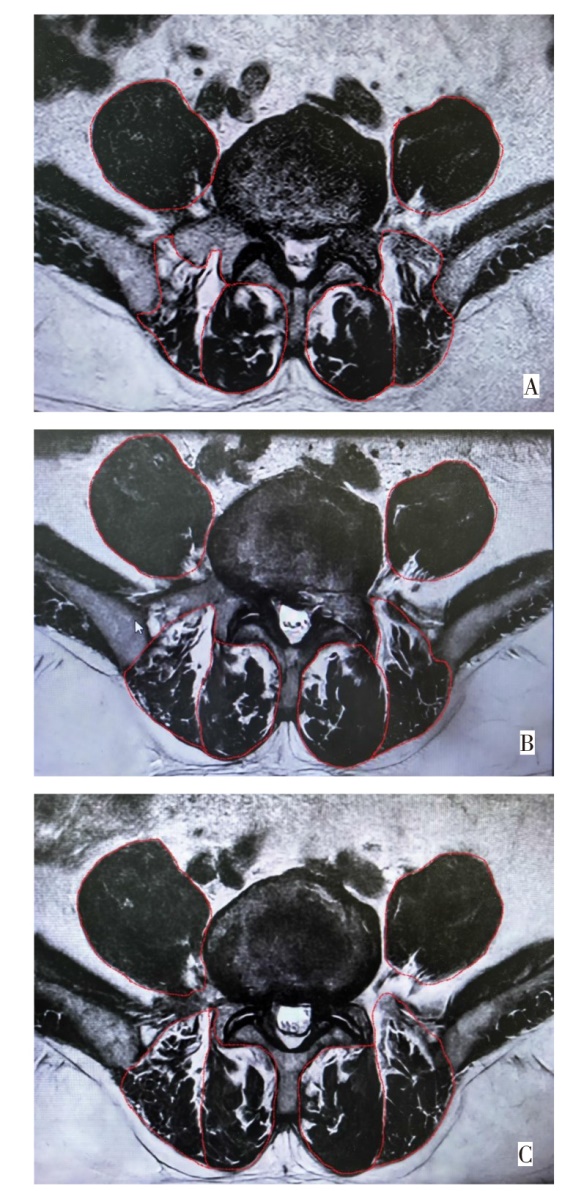
图2 LDH患者PTED术前及术后PRLDH典型MRI影像 A:LDH患者术前L4—5椎间盘水平MRI上可见椎间盘向右侧突出,压迫神经根及硬膜囊,侧隐窝狭窄;B:同一患者术后3个月同椎间盘水平MRI显示,突出髓核切除,压迫解除,无复发;C:同一患者术后6个月同椎间盘水平MRI上可见同节段椎间盘再次突出,神经根及硬膜囊再度受压,符合PRLDH。
Fig.2 Typical imaging images of PRLDH in LDH patients after PTED surgery
| 组别 | n | 性别(男/女) | 年龄/岁 | BMI/(kg/m2) | ||||||
|---|---|---|---|---|---|---|---|---|---|---|
| 未复发组 | 162 | 98/64 | 60.21±7.92 | 24.15±2.27 | ||||||
| 复发组 | 24 | 15/9 | 62.63±8.75 | 25.31±2.42 | ||||||
| t或χ2 | 0.035 | 1.280 | 2.209* | |||||||
| 组别 | 职业类型 | 吸烟史 | ||||||||
| 久坐办公 | 轻体力劳动 | 重体力劳动 | ||||||||
| 未复发组 | 42(25.93) | 68(41.98) | 52(32.09) | 51(31.48) | ||||||
| 复发组 | 8(33.33) | 7(29.17) | 9(37.50) | 10(41.67) | ||||||
| t或χ2 | 1.463 | 0.984 | ||||||||
| 组别 | 饮酒史 | 合并症 | ||||||||
| 糖尿病 | 高血压 | 骨质疏松症 | ||||||||
| 未复发组 | 45(27.78) | 13(8.02) | 25(15.43) | 25(15.43) | ||||||
| 复发组 | 8(33.33) | 5(20.83) | 5(20.83) | 3(15.20) | ||||||
| χ2 | 0.317 | 3.923* | 0.451 | 0.731 | ||||||
表1 2组患者的一般特征比较
Tab.1 Comparison of general characteristics after PTED surgery between the recurrence group and the non-recurrence group
| 组别 | n | 性别(男/女) | 年龄/岁 | BMI/(kg/m2) | ||||||
|---|---|---|---|---|---|---|---|---|---|---|
| 未复发组 | 162 | 98/64 | 60.21±7.92 | 24.15±2.27 | ||||||
| 复发组 | 24 | 15/9 | 62.63±8.75 | 25.31±2.42 | ||||||
| t或χ2 | 0.035 | 1.280 | 2.209* | |||||||
| 组别 | 职业类型 | 吸烟史 | ||||||||
| 久坐办公 | 轻体力劳动 | 重体力劳动 | ||||||||
| 未复发组 | 42(25.93) | 68(41.98) | 52(32.09) | 51(31.48) | ||||||
| 复发组 | 8(33.33) | 7(29.17) | 9(37.50) | 10(41.67) | ||||||
| t或χ2 | 1.463 | 0.984 | ||||||||
| 组别 | 饮酒史 | 合并症 | ||||||||
| 糖尿病 | 高血压 | 骨质疏松症 | ||||||||
| 未复发组 | 45(27.78) | 13(8.02) | 25(15.43) | 25(15.43) | ||||||
| 复发组 | 8(33.33) | 5(20.83) | 5(20.83) | 3(15.20) | ||||||
| χ2 | 0.317 | 3.923* | 0.451 | 0.731 | ||||||
| 组别 | n | 病程/月 | 突出类型 | |||||||
|---|---|---|---|---|---|---|---|---|---|---|
| 突出型 | 脱出型 | 游离型 | ||||||||
| 未复发组 | 162 | 11.67±4.92 | 123(75.93) | 37(22.84) | 2(1.23) | |||||
| 复发组 | 24 | 14.15±5.83 | 16(66.67) | 6(25.00) | 2(8.33) | |||||
| t或χ2 | 1.982 | 5.180 | ||||||||
| 组别 | 突出节段 | 疼痛VAS评分/分 | ||||||||
| L3—4 | L4—5 | L5—S1 | ||||||||
| 未复发组 | 15(9.26) | 83(51.23) | 64(39.51) | 6.15±1.37 | ||||||
| 复发组 | 3(12.50) | 12(50.00) | 9(37.50) | 6.83±1.52 | ||||||
| t或χ2 | 0.255 | 2.071* | ||||||||
| 组别 | ODI/% | Pfirrmann分级 | ||||||||
| Ⅰ—Ⅲ级 | Ⅳ—Ⅴ级 | |||||||||
| 未复发组 | 41.35±7.98 | 106(65.43) | 56(34.57) | |||||||
| 复发组 | 45.62±8.73 | 10(41.67) | 14(58.33) | |||||||
| t或χ2 | 3.209** | 5.030* | ||||||||
表2 PTED术后复发组与未复发组患者的临床特征比较
Tab.2 Comparison of clinical characteristics after PTED surgery between the recurrence group and the non-recurrence group
| 组别 | n | 病程/月 | 突出类型 | |||||||
|---|---|---|---|---|---|---|---|---|---|---|
| 突出型 | 脱出型 | 游离型 | ||||||||
| 未复发组 | 162 | 11.67±4.92 | 123(75.93) | 37(22.84) | 2(1.23) | |||||
| 复发组 | 24 | 14.15±5.83 | 16(66.67) | 6(25.00) | 2(8.33) | |||||
| t或χ2 | 1.982 | 5.180 | ||||||||
| 组别 | 突出节段 | 疼痛VAS评分/分 | ||||||||
| L3—4 | L4—5 | L5—S1 | ||||||||
| 未复发组 | 15(9.26) | 83(51.23) | 64(39.51) | 6.15±1.37 | ||||||
| 复发组 | 3(12.50) | 12(50.00) | 9(37.50) | 6.83±1.52 | ||||||
| t或χ2 | 0.255 | 2.071* | ||||||||
| 组别 | ODI/% | Pfirrmann分级 | ||||||||
| Ⅰ—Ⅲ级 | Ⅳ—Ⅴ级 | |||||||||
| 未复发组 | 41.35±7.98 | 106(65.43) | 56(34.57) | |||||||
| 复发组 | 45.62±8.73 | 10(41.67) | 14(58.33) | |||||||
| t或χ2 | 3.209** | 5.030* | ||||||||
| 组别 | n | 腰大肌 | 多裂肌 | 竖脊肌 | ||||||
|---|---|---|---|---|---|---|---|---|---|---|
| SCSA/% | SCSA/% | FIR/% | 脂肪浸润分级 | SCSA/% | FIR/% | 脂肪浸润分级 | ||||
| 0—1级 | 2级 | 0—1级 | 2级 | |||||||
| 未复发组 | 162 | 74.83±7.25 | 73.96±7.82 | 26.04±6.98 | 140(86.42) | 22(13.38) | 75.62±8.13 | 24.38±7.05 | 137(84.57) | 25(15.43) |
| 复发组 | 24 | 72.56±6.98 | 65.28±8.15 | 34.72±7.33 | 9(37.50) | 15(62.50) | 68.35±7.21 | 31.65±6.87 | 12(50.00) | 12(50.00) |
| t或χ2 | 1.647 | 4.894** | 5.447** | 31.392** | 4.531** | 4.822** | 15.675** | |||
表3 2组患者的椎旁肌影像学参数比较
Tab.3 Comparison of paraspinal muscle parameters after PTED surgery between the recurrence group and the non-recurrence group
| 组别 | n | 腰大肌 | 多裂肌 | 竖脊肌 | ||||||
|---|---|---|---|---|---|---|---|---|---|---|
| SCSA/% | SCSA/% | FIR/% | 脂肪浸润分级 | SCSA/% | FIR/% | 脂肪浸润分级 | ||||
| 0—1级 | 2级 | 0—1级 | 2级 | |||||||
| 未复发组 | 162 | 74.83±7.25 | 73.96±7.82 | 26.04±6.98 | 140(86.42) | 22(13.38) | 75.62±8.13 | 24.38±7.05 | 137(84.57) | 25(15.43) |
| 复发组 | 24 | 72.56±6.98 | 65.28±8.15 | 34.72±7.33 | 9(37.50) | 15(62.50) | 68.35±7.21 | 31.65±6.87 | 12(50.00) | 12(50.00) |
| t或χ2 | 1.647 | 4.894** | 5.447** | 31.392** | 4.531** | 4.822** | 15.675** | |||
| 模型及变量 | β | SE | Wald χ2 | P | OR(95%CI) |
|---|---|---|---|---|---|
| 模型1 | |||||
| 多裂肌SCSA | -0.088 | 0.027 | 10.623 | 0.001 | 0.916(0.869~0.966) |
| 多裂肌FIR | 0.105 | 0.030 | 12.250 | <0.001 | 1.111(1.047~1.178) |
| 竖脊肌SCSA | -0.062 | 0.022 | 9.232 | 0.005 | 0.940(0.900~0.981) |
| 竖脊肌FIR | 0.079 | 0.026 | 0.085 | 0.002 | 1.082(1.028~1.139) |
| 常数项 | -5.485 | 5.101 | 1.156 | 0.004 | 0.227(0.000~91.191) |
| 模型2 | |||||
| 多裂肌SCSA | -0.083 | 0.028 | 8.787 | 0.003 | 0.920(0.871~0.972) |
| 多裂肌FIR | 0.099 | 0.031 | 10.199 | 0.001 | 1.104(1.039~1.173) |
| 竖脊肌SCSA | -0.059 | 0.023 | 7.716 | 0.010 | 0.943(0.901~0.986) |
| 竖脊肌FIR | 0.075 | 0.027 | 3.510 | 0.005 | 1.078(1.022~1.136) |
| 突出类型 | 0.824 | 0.413 | 3.981 | 0.046 | 2.280(1.015~5.122) |
| 椎间盘退变程度 | 1.298 | 0.509 | 8.787 | 0.011 | 3.662(1.350~9.931) |
| 常数项 | -6.088 | 5.212 | 10.199 | 0.243 | 0.002(0.000~62.024) |
| 模型3 | |||||
| 多裂肌SCSA | -0.080 | 0.030 | 7.111 | 0.008 | 0.923(0.870~0.979) |
| 多裂肌FIR | 0.095 | 0.032 | 8.813 | 0.003 | 1.100(1.033~1.171) |
| 竖脊肌SCSA | -0.056 | 0.024 | 6.430 | 0.020 | 0.946(0.902~0.991) |
| 竖脊肌FIR | 0.071 | 0.028 | 3.267 | 0.011 | 1.074(1.016~1.134) |
| 突出类型 | 0.802 | 0.415 | 3.735 | 0.053 | 2.230(0.989~5.030) |
| 椎间盘退变程度 | 1.115 | 0.528 | 2.250 | 0.035 | 3.050(1.083~8.584) |
| BMI | 0.208 | 0.106 | 7.366 | 0.050 | 1.231(1.000~1.516) |
| 糖尿病史 | 0.030 | 0.020 | 7.111 | 0.134 | 1.030(0.991~1.072) |
| 常数项 | -6.845 | 4.522 | 2.291 | 0.130 | 0.001(0.000~7.524) |
表4 不同模型中椎旁肌参数对PRLDH风险的Logistic逐步回归分析
Tab.4 Logistic stepwise regression analysis of parametric changes in paraspinal muscle parameters on PRLDH risk in different models
| 模型及变量 | β | SE | Wald χ2 | P | OR(95%CI) |
|---|---|---|---|---|---|
| 模型1 | |||||
| 多裂肌SCSA | -0.088 | 0.027 | 10.623 | 0.001 | 0.916(0.869~0.966) |
| 多裂肌FIR | 0.105 | 0.030 | 12.250 | <0.001 | 1.111(1.047~1.178) |
| 竖脊肌SCSA | -0.062 | 0.022 | 9.232 | 0.005 | 0.940(0.900~0.981) |
| 竖脊肌FIR | 0.079 | 0.026 | 0.085 | 0.002 | 1.082(1.028~1.139) |
| 常数项 | -5.485 | 5.101 | 1.156 | 0.004 | 0.227(0.000~91.191) |
| 模型2 | |||||
| 多裂肌SCSA | -0.083 | 0.028 | 8.787 | 0.003 | 0.920(0.871~0.972) |
| 多裂肌FIR | 0.099 | 0.031 | 10.199 | 0.001 | 1.104(1.039~1.173) |
| 竖脊肌SCSA | -0.059 | 0.023 | 7.716 | 0.010 | 0.943(0.901~0.986) |
| 竖脊肌FIR | 0.075 | 0.027 | 3.510 | 0.005 | 1.078(1.022~1.136) |
| 突出类型 | 0.824 | 0.413 | 3.981 | 0.046 | 2.280(1.015~5.122) |
| 椎间盘退变程度 | 1.298 | 0.509 | 8.787 | 0.011 | 3.662(1.350~9.931) |
| 常数项 | -6.088 | 5.212 | 10.199 | 0.243 | 0.002(0.000~62.024) |
| 模型3 | |||||
| 多裂肌SCSA | -0.080 | 0.030 | 7.111 | 0.008 | 0.923(0.870~0.979) |
| 多裂肌FIR | 0.095 | 0.032 | 8.813 | 0.003 | 1.100(1.033~1.171) |
| 竖脊肌SCSA | -0.056 | 0.024 | 6.430 | 0.020 | 0.946(0.902~0.991) |
| 竖脊肌FIR | 0.071 | 0.028 | 3.267 | 0.011 | 1.074(1.016~1.134) |
| 突出类型 | 0.802 | 0.415 | 3.735 | 0.053 | 2.230(0.989~5.030) |
| 椎间盘退变程度 | 1.115 | 0.528 | 2.250 | 0.035 | 3.050(1.083~8.584) |
| BMI | 0.208 | 0.106 | 7.366 | 0.050 | 1.231(1.000~1.516) |
| 糖尿病史 | 0.030 | 0.020 | 7.111 | 0.134 | 1.030(0.991~1.072) |
| 常数项 | -6.845 | 4.522 | 2.291 | 0.130 | 0.001(0.000~7.524) |
| 指标 | 敏感度 | 特异度 | AUC | 95%CI | 截断值 | 约登指数 |
|---|---|---|---|---|---|---|
| 多裂肌SCSA | 0.542 | 0.821 | 0.752 | 0.683~0.812 | 65.08% | 0.443 |
| 多裂肌FIR | 0.833 | 0.624 | 0.760 | 0.692~0.819 | 26.35% | 0.457 |
| 竖脊肌SCSA | 0.625 | 0.778 | 0.727 | 0.657~0.790 | 69.79% | 0.403 |
| 竖脊肌FIR | 0.782 | 0.585 | 0.768 | 0.706~0.831 | 28.24% | 0.367 |
| 椎旁肌参数 联合预测 | 0.833 | 0.883 | 0.898 | 0.845~0.937 | / | 0.716 |
表5 椎旁肌参数对PRLDH风险的预测价值分析
Tab.5 Analysis of the predictive value of paraspinal muscle parameters for PRLDH risk
| 指标 | 敏感度 | 特异度 | AUC | 95%CI | 截断值 | 约登指数 |
|---|---|---|---|---|---|---|
| 多裂肌SCSA | 0.542 | 0.821 | 0.752 | 0.683~0.812 | 65.08% | 0.443 |
| 多裂肌FIR | 0.833 | 0.624 | 0.760 | 0.692~0.819 | 26.35% | 0.457 |
| 竖脊肌SCSA | 0.625 | 0.778 | 0.727 | 0.657~0.790 | 69.79% | 0.403 |
| 竖脊肌FIR | 0.782 | 0.585 | 0.768 | 0.706~0.831 | 28.24% | 0.367 |
| 椎旁肌参数 联合预测 | 0.833 | 0.883 | 0.898 | 0.845~0.937 | / | 0.716 |
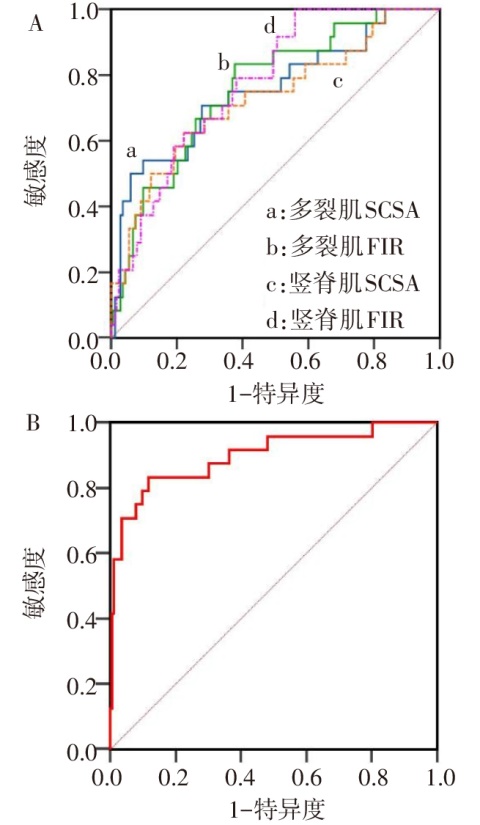
图3 椎旁肌参数预测PRLDH风险的ROC曲线 A:4个单独椎旁肌参数预测PRLDH风险的ROC曲线;B:椎旁肌参数联合预测PRLDH风险的ROC曲线。
Fig.3 The ROC curve for predicting the risk of PRLDH based on paraspinal muscle parameters
| [1] | Zhang A S, Xu A, Ansari K, et al. Lumbar disc herniation:diagnosis and management[J]. Am J Med, 2023, 136(7):645-651. doi:10.1016/j.amjmed.2023.03.024. |
| [2] | 徐波, 黄泽灵, 张龙, 等. 中国人群腰椎间盘突出症患病率的Meta分析[J]. 中医正骨, 2023, 35(9):17-23. |
| Xu B, Huang Z L, Zhang L, et al. Prevalence rate of lumbar disc herniation in the Chinese population:a meta-analysis[J]. J Trad Chin Orthop Trauma, 2023, 35(9):17-23. doi:10.3969/j.issn.1001-6015.2023.09.004. | |
| [3] | 许建文, 桂裕昌. 腰椎间盘突出症运动康复的专家共识[J]. 中国矫形外科杂志, 2025, 33(20):1825-1833. |
| Xu J W, Gui Y C. Expert consensus on exercise rehabilitation for lumbar disc herniation[J]. Orthopedic Journal of China, 2025, 33(20):1825-1833. doi:10.20184/j.cnki.Issn1005-8478.120225. | |
| [4] | Liu W, Li Q, Li Z, et al. Clinical efficacy of percutaneous transforaminal endoscopic discectomy in treating adolescent lumbar disc herniation[J]. Medicine(Baltimore), 2019, 98(9):e14682. doi:10.1097/MD.0000000000014682. |
| [5] | Gadjradj P S, Harhangi B S, Amelink J, et al. Percutaneous transforaminal endoscopic discectomy versus open microdiscectomy for lumbar disc herniation:A systematic review and meta-analysis[J]. Spine(Phila Pa 1976), 2021, 46(8):538-549. doi:10.1097/BRS.0000000000003843. |
| [6] | Zhao X M, Chen A F, Lou X X, et al. Comparison of three common intervertebral disc discectomies in the treatment of lumbar disc herniation:A systematic review and meta-analysis based on multiple data[J]. J Clin Med, 2022, 11(22):6604. doi:10.3390/jcm11226604. |
| [7] | Zhu F, Jia D, Zhang Y, et al. Moderate to severe multifidus fatty atrophy is the risk factor for recurrence after microdiscectomy of lumbar disc herniation[J]. Neurospine, 2023, 20(2):637-650. doi:10.14245/ns.2346054.027. |
| [8] | 陈小英. 腰椎间盘突出症术后复发的影响因素研究[J]. 中国全科医学, 2020, 23(S1):140-142. |
| Chen X Y. Study on the influencing factors of recurrence after lumbar disc herniation surgery[J]. Chinese General Practice, 2020, 23(S1):140-142. | |
| [9] | 朱磊, 吴瑞, 刘杰, 等. 腰椎间盘突出症经皮椎间孔镜下腰椎间盘切除术后复发影响因素分析[J]. 中国骨与关节杂志, 2025, 14(3):222-227. |
| Zhu L, Wu R, Liu J, et al. Analysis of risk factors for recurrence after percutaneous lumbar discectomy for lumbar disc herniation[J]. Chinese Journal of Bone and Joint, 2025, 14(3):222-227. doi:10.3969/j.issn.2095-252X.2025.03.005. | |
| [10] | 李昃鹏. 经皮经椎间孔内镜下腰椎间盘切除术后早期复发原因分析[D]. 衡阳: 南华大学, 2022. |
| Li Z P. Analysis of early recurrence afterpercutaneous transforaminal endoscopicdiscectomy[D]. Hengyang: University of South China, 2022. | |
| [11] | Tang M, Wang S, Wang Y, et al. Nomogram development and validation for predicting postoperative recurrent lumbar disc herniation based on paraspinal muscle parameters[J]. J Pain Res, 2024, 17:2121-2131. doi:10.2147/JPR.S459846. |
| [12] | 林砺, 罗爱芳, 陈奕杰, 等. 基于MRI的不同区域定位的L4-L5椎间盘突出症患者椎旁肌肉形态分析[J]. 中国CT和MRI杂志, 2025, 23(6):172-174. |
| Lin L, Luo A F, Chen Y J, et al. Morphological analysis of paraspinal muscles in patients with L4-L5 disc herniation based on different regional localization of MRI[J]. Chinese Journal of CT and MRI, 2025, 23(6):172-174. doi:10.3969/j.issn.1672-5131.2025.06.050. | |
| [13] | Wei W, Wang T, Liu J, et al. Biomechanical effect of proximal multifidus injury on adjacent segments during posterior lumbar interbody fusion:a finite element study[J]. BMC Musculoskelet Disord, 2023, 24(1):521. doi:10.1186/s12891-023-06649-7. |
| [14] | Huang Y, Wang L, Luo B, et al. Associations of lumber disc degeneration with paraspinal muscles myosteatosis in discogenic low back pain[J]. Front Endocrinol(Lausanne), 2022, 13:891088. doi:10.3389/fendo.2022.891088. |
| [15] | 中华医学会骨科学分会脊柱外科学组, 中华医学会骨科学分会骨科康复学组. 腰椎间盘突出症诊疗指南[J]. 中华骨科杂志, 2020, 40(8):477-487. |
| Chinese Orthopaedic Association of Spinal Surgery Group, Chinese Orthopaedic Association of Orthopaedic Rehabilitation Group. Clinical practice guideline for diagnosis and treatment of lumbar disc herniation[J]. Chin J Orthop, 2020, 40(8):477-487. doi:10.3760/cma.j.cn121113-20200402-00213. | |
| [16] | 余杨可. 经皮内镜腰椎间盘切除术术后复发的危险因素分析及概率预测[D]. 郑州: 郑州大学, 2021. |
| Yu Y K. Risk factors analysis and probability prediction for recurrence after percutaneous endoscopic lumbar discectomy[D]. Zhengzhou: Zhengzhou University, 2021. | |
| [17] | De Silva T, Vedula S S, Perdomo-Pantoja A, et al. SpineCloud:image analytics for predictive modeling of spine surgery outcomes[J]. J Med Imaging(Bellingham), 2020, 7(3):031502. doi:10.1117/1.JMI.7.3.031502. |
| [18] | 王思远. 经皮椎间孔镜治疗腰椎间盘突出症术后复发的相关影响因素分析[D]. 合肥: 安徽医科大学, 2024. |
| Wang S Y. Analysis of influencing factors associated with postoperative recurrence of lumbar disc herniation after percutaneous intervertebral foraminoscopy[D]. Hefei: Anhui Medical University, 2024. | |
| [19] | 何航, 徐峰, 马俊, 等. 经皮椎间孔镜治疗腰椎间盘突出症术后复发的影响因素分析[J]. 联勤军事医学, 2023, 37(1):38-42,47. |
| He H, Xu F, Ma J, et al. Clinical study on influencing factors of recurrence of lumbar disc herniation after percutaneous transforaminal endoscopy[J]. Mil Med Jnt Log, 2023, 37(1):38-42, 47. doi:10.13730/j.issn.2097-2148.2023.01.008. | |
| [20] | 关月红, 吴健, 范胜利, 等. 经皮椎间孔镜治疗单节段腰椎间盘突出症术后复发的相关因素分析[J]. 中国中医骨伤科杂志, 2022, 30(2):40-44. |
| Guan Y H, Wu J, Fan S L, et al. Clinical study on the influencing factors of recurrence of single-segment lumbar intervertebral disc herniation after percutaneous transforaminal endoscopy[J]. Chinese J Trad Med Traum and Orthop, 2022, 30(2):40-44. | |
| [21] | 陈波涛. 经皮内镜下腰椎椎间融合的生物力学和临床研究[D]. 成都: 成都中医药大学, 2021. |
| Chen B T. Biomechanical and clinical study of percutaneous endoscopic lumbar interbody fusion[D]. Chengdu: Chengdu University of Traditional Chinese Medicine, 2021. | |
| [22] | 徐森明, 覃兴乐. 多裂肌退变与脊柱疾病的关系研究进展[J]. 中国康复医学杂志, 2022, 37(5):709-713. |
| Xu S M, Qin X L. Research progress on the relationship between polymyositis degeneration and spinal diseases[J]. Chin J Rehabil Med, 2022, 37(5):709-713. doi:10.3969/j.issn.l001-1242.2022.05.026. | |
| [23] | 郑可丰, 王松, 王占道. 髓核摘除腰椎后稳定结构重建治疗中央型腰椎间盘突出症(附82例分析)[J]. 福建医药杂志, 2014, 36(5):136-138. |
| Zheng K F, Wang S, Wang Z D. Lumbar posterior stabilization with nucleus pulposus removal for central lumbar disc herniation(analysis of 82 cases)[J]. Fujian Med J, 2014, 36(5):136-138. doi:10.20148/j.fmj.2014.05.059. | |
| [24] | Jiang J, Huang Y, HE B. Advances in the interaction between lumbar intervertebral disc degeneration and fat infiltration of paraspinal muscles:critical summarization,classification,and perspectives[J]. Front Endocrinol(Lausanne), 2024, 15:1353087. doi:10.3389/fendo.2024.1353087. |
| [1] | 鲁青, 朱如森, 张伯裕, 于浩, 卫悦. 腰椎管狭窄症术后患者疼痛与运动恐惧对生活质量的潜在剖面分析[J]. 天津医药, 2026, 54(8): 827-833. |
| [2] | 刘阳, 丁梓华, 刘继琛, 王真. 脊柱内镜治疗脊柱疾病隐性失血的研究进展[J]. 天津医药, 2026, 54(8): 891-896. |
| [3] | 冯晨芳, 李雷, 陶瑞明. 血清CHI3L1、Sestrin2对症状性颈动脉狭窄患者再发缺血性脑卒中的预测价值[J]. 天津医药, 2026, 54(7): 731-735. |
| [4] | 杨英焘, 丁亚萌, 郭会军. 血清HDAC3、LOXL2对持续性房颤患者射频消融术后复发的预测价值[J]. 天津医药, 2026, 54(5): 493-497. |
| [5] | 李斌, 谭振刚, 张华清. 基于息肉特征和血清学指标构建结直肠息肉复发风险预测模型及效能分析[J]. 天津医药, 2026, 54(3): 249-253. |
| [6] | 张文延, 李祖贵, 贾永春, 江伟, 甄雨生, 许亮. 成人Still病活动度及复发风险与18F-FDG PET/CT代谢参数的相关性研究[J]. 天津医药, 2026, 54(3): 283-288. |
| [7] | 朱梦雅, 霍莹, 郭志鹏, 刘洋, 刘刚. 单纯经超声引导的房间隔缺损封堵术安全性及有效性研究[J]. 天津医药, 2026, 54(3): 309-313. |
| [8] | 高正杰, 孟涛, 张俏, 陈炳合, 侯栋, 朱绍辉. 术前CALLY指数对根治性胃切除术患者短期预后的预测价值[J]. 天津医药, 2025, 53(9): 967-971. |
| [9] | 闫陶然, 田雨, 郭雪松. 血管瘤患儿血清Apelin、IGF-2、GLUT1水平与瘤体增生及复发的关系[J]. 天津医药, 2025, 53(4): 378-382. |
| [10] | 胡烙, 章程, 胡志军. 血清TRPV1、TIMP4、TGF-β1水平对良性阵发性位置性眩晕复发的预测价值[J]. 天津医药, 2025, 53(3): 267-271. |
| [11] | 李小硕, 韩子旭, 李洋, 李梦宁. 椎体CT参数对TLIF术后早期融合器沉降的预测价值[J]. 天津医药, 2025, 53(3): 301-306. |
| [12] | 刘颖, 葛东建, 朱炫姿, 向雯, 耿明悦, 程伟. 经皮耳迷走神经刺激对妇科腹腔镜手术患者术后胃肠功能恢复的影响[J]. 天津医药, 2025, 53(2): 189-193. |
| [13] | 崔琳, 李海晴, 陈雨彤, 朱佳璇, 王璐怡. 经皮神经电刺激联合动态关节松动术对膝骨关节炎疗效观察[J]. 天津医药, 2025, 53(12): 1285-1289. |
| [14] | 古博, 谷松涛, 李月川, 高淑连, 李崟, 杨立, 姜庆利. 1例肺动脉取栓患者的多学科诊疗分析[J]. 天津医药, 2025, 53(12): 1320-1325. |
| [15] | 江泽华, 崔皓竣, 张伯裕, 任志帅, 马钧峰, 张洪杰, 朱如森. 脊柱-骨盆矢状位参数与腰椎融合术预后相关性的研究进展[J]. 天津医药, 2025, 53(1): 103-107. |
| 阅读次数 | ||||||
|
全文 |
|
|||||
|
摘要 |
|
|||||
