
天津医药 ›› 2022, Vol. 50 ›› Issue (11): 1177-1181.doi: 10.11958/20220912
陈池义( ), 张炜琪, 谢炎, 蒋文涛△()
收稿日期:2022-08-19
出版日期:2022-11-15
发布日期:2022-11-11
通讯作者:
蒋文涛
E-mail:ccy_616@126.com;jiangwentao@nankai.edu.cn
作者简介:陈池义(1987),男,住院医师,主要从事肝脏移植的临床与基础研究。E-mail:基金资助:
CHEN Chiyi(), ZHANG Weiqi, XIE Yan, JIANG Wentao△()
Received:2022-08-19
Published:2022-11-15
Online:2022-11-11
Contact:
JIANG Wentao
E-mail:ccy_616@126.com;jiangwentao@nankai.edu.cn
陈池义, 张炜琪, 谢炎, 蒋文涛. 肿瘤组织Ki67的表达与肝细胞癌肝移植患者预后的关系[J]. 天津医药, 2022, 50(11): 1177-1181.
CHEN Chiyi, ZHANG Weiqi, XIE Yan, JIANG Wentao. Association of the expression of Ki67 with the prognosis of liver transplantation in patients with hepatocellular carcinoma[J]. Tianjin Medical Journal, 2022, 50(11): 1177-1181.
摘要:
目的 探讨肝细胞癌(HCC)组织中Ki67的表达与肝移植(LT)患者预后的关系。方法 收集178例接受原位肝移植治疗的HCC患者的临床资料和免疫组化结果,按照患者肿瘤组织Ki67表达水平的中位数将患者分为Ki67高表达组和低表达组。比较2组患者的临床指标。采用Kaplan-Meier法绘制生存曲线,比较2组患者的预后情况。采用单因素和多因素Cox回归分析影响患者LT术后预后的危险因素。结果 178例研究对象中,Ki67高表达组85例,低表达组93例。Ki67高表达组患者术后1、3、5年总体生存率(78.7%、52.6%、39.5%)与无复发生存率(47.9%、34.7%、32.0%)明显低于Ki67低表达组(86.5%、76.3%、76.3%;84.4%、77.5%、72.4%,Log-rank χ2分别为9.016和28.467,P<0.01)。Cox多因素分析显示Ki67高表达是影响患者术后无复发生存的独立危险因素(HR=3.653,95%CI:1.997~6.683,均P<0.01)。Ki67高表达患者术前血清甲胎蛋白水平、微血管侵犯以及肿瘤低分化的发生率高于低表达组(P<0.05)。结论 HCC组织中Ki67的表达与患者LT术后的预后有关,Ki67可作为预测肝细胞癌肝移植患者预后的一个潜在指标。
中图分类号:
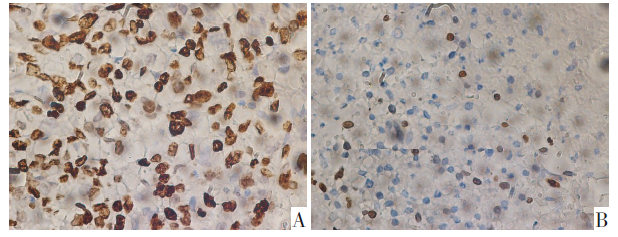
图1 免疫组化检测Ki67在肝癌组织中的表达(×400) A:肝癌组织Ki67高表达;B:肝癌组织Ki67低表达。
Fig.1 The expression of Ki67 in liver cancer tissues detected by immunohistochemistry (×400)
| 组别 | n | 年龄(岁) | AST(U/L) | ALT(U/L) | TB(μmol/L) | ALB(g/L) | WBC(×109/L) | HGB(g/L) | ||||||||||||||||
|---|---|---|---|---|---|---|---|---|---|---|---|---|---|---|---|---|---|---|---|---|---|---|---|---|
| 低表达组 | 93 | 54.60±8.92 | 42.50(29.75,67.35) | 34.30(22.00,52.65) | 26.54(14.35,43.09) | 35.62±6.19 | 4.13(2.94,5.49) | 129.00(104.00,146.50) | ||||||||||||||||
| 高表达组 | 85 | 53.86±9.87 | 51.00(28.70,100.40) | 39.60(23.15,57.30) | 22.59(14.45,63.12) | 35.72±6.03 | 4.62(3.19,6.87) | 130.00(111.00,142.00) | ||||||||||||||||
| t、Z或χ2 | 0.528 | 1.587 | 1.241 | 0.406 | 0.107 | 1.889 | 0.220 | |||||||||||||||||
| 组别 | PLT(×109/L) | INR | PT(s) | MELD评分(分) | AFP(μg/L) | 肿瘤最大直径(cm) | ||||||||||||||||||
| 低表达组 | 85.00(55.00,138.50) | 1.22(1.06,1.34) | 13.70(11.90,15.05) | 8.26(7.06,9.90) | 44.54(6.63,481.10) | 3.00(2.30,5.00) | ||||||||||||||||||
| 高表达组 | 116.00(70.50,155.50) | 1.19(1.09,1.36) | 13.30(12.20,15.30) | 7.85(6.91,9.92) | 133.50(12.60,3 071.00) | 3.50(2.00,7.00) | ||||||||||||||||||
| t、Z或χ2 | 1.871 | 0.039 | 0.016 | 0.221 | 2.337* | 0.390 | ||||||||||||||||||
| 组别 | 性别 | 肿瘤个数 | 卫星灶 | 微血管侵犯 | 肿瘤低分化 | |||||||||||||||||||
| 男 | 女 | 单个 | 多个 | 有 | 无 | 有 | 无 | 是 | 否 | |||||||||||||||
| 低表达组 | 81(87.10) | 12(12.90) | 42(45.16) | 51(54.84) | 14(15.05) | 79(84.95) | 33(35.48) | 60(64.52) | 4(4.30) | 89(95.70) | ||||||||||||||
| 高表达组 | 75(88.24) | 10(11.76) | 33(38.82) | 52(61.18) | 12(14.12) | 73(85.88) | 44(51.76) | 41(48.24) | 22(25.88) | 63(74.12) | ||||||||||||||
| t、Z或χ2 | 0.053 | 0.732 | 0.031 | 4.796* | 16.583** | |||||||||||||||||||
表1 2组患者临床病理资料比较
Tab.1 Comparison of clinicopathological data between the two groups
| 组别 | n | 年龄(岁) | AST(U/L) | ALT(U/L) | TB(μmol/L) | ALB(g/L) | WBC(×109/L) | HGB(g/L) | ||||||||||||||||
|---|---|---|---|---|---|---|---|---|---|---|---|---|---|---|---|---|---|---|---|---|---|---|---|---|
| 低表达组 | 93 | 54.60±8.92 | 42.50(29.75,67.35) | 34.30(22.00,52.65) | 26.54(14.35,43.09) | 35.62±6.19 | 4.13(2.94,5.49) | 129.00(104.00,146.50) | ||||||||||||||||
| 高表达组 | 85 | 53.86±9.87 | 51.00(28.70,100.40) | 39.60(23.15,57.30) | 22.59(14.45,63.12) | 35.72±6.03 | 4.62(3.19,6.87) | 130.00(111.00,142.00) | ||||||||||||||||
| t、Z或χ2 | 0.528 | 1.587 | 1.241 | 0.406 | 0.107 | 1.889 | 0.220 | |||||||||||||||||
| 组别 | PLT(×109/L) | INR | PT(s) | MELD评分(分) | AFP(μg/L) | 肿瘤最大直径(cm) | ||||||||||||||||||
| 低表达组 | 85.00(55.00,138.50) | 1.22(1.06,1.34) | 13.70(11.90,15.05) | 8.26(7.06,9.90) | 44.54(6.63,481.10) | 3.00(2.30,5.00) | ||||||||||||||||||
| 高表达组 | 116.00(70.50,155.50) | 1.19(1.09,1.36) | 13.30(12.20,15.30) | 7.85(6.91,9.92) | 133.50(12.60,3 071.00) | 3.50(2.00,7.00) | ||||||||||||||||||
| t、Z或χ2 | 1.871 | 0.039 | 0.016 | 0.221 | 2.337* | 0.390 | ||||||||||||||||||
| 组别 | 性别 | 肿瘤个数 | 卫星灶 | 微血管侵犯 | 肿瘤低分化 | |||||||||||||||||||
| 男 | 女 | 单个 | 多个 | 有 | 无 | 有 | 无 | 是 | 否 | |||||||||||||||
| 低表达组 | 81(87.10) | 12(12.90) | 42(45.16) | 51(54.84) | 14(15.05) | 79(84.95) | 33(35.48) | 60(64.52) | 4(4.30) | 89(95.70) | ||||||||||||||
| 高表达组 | 75(88.24) | 10(11.76) | 33(38.82) | 52(61.18) | 12(14.12) | 73(85.88) | 44(51.76) | 41(48.24) | 22(25.88) | 63(74.12) | ||||||||||||||
| t、Z或χ2 | 0.053 | 0.732 | 0.031 | 4.796* | 16.583** | |||||||||||||||||||
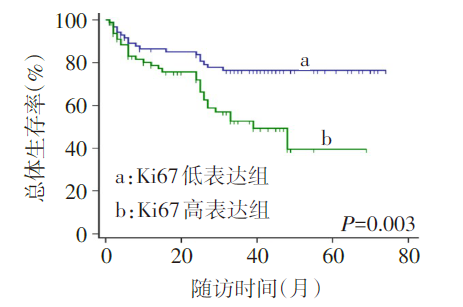
图2 2组患者肝移植术后OS比较
Fig.2 Comparison of overall survival between two groups of patients after liver transplantation
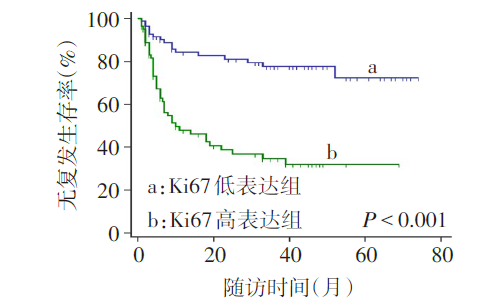
图3 2组患者肝移植术后RFS比较
Fig.3 Comparison of recurrence-free survival between two groups of patients after liver transplantation
| 编号 | 变量名称 | 赋值 |
|---|---|---|
| Y | 患者死亡/肿瘤复发 | 发生=1,未发生=0 |
| X1 | 年龄 | >55岁=1,≤55岁=0 |
| X2 | 性别 | 男=1,女=0 |
| X3 | 肿瘤个数 | 多个=1,单个=0 |
| X4 | 卫星灶 | 有=1,无=0 |
| X5 | 微血管侵犯 | 有=1,无=0 |
| X6 | 肿瘤分化程度 | 低分化=1,非低分化=0 |
| X7 | KLI | >20%=1,≤20%=0 |
| X8 | 术前血清AFP | >400 μg/L=1,≤400 μg/L=0 |
| X9 | 肿瘤最大直径 | >5 cm=1,≤5 cm=0 |
表2 变量赋值情况
Tab.2 Variable assignment
| 编号 | 变量名称 | 赋值 |
|---|---|---|
| Y | 患者死亡/肿瘤复发 | 发生=1,未发生=0 |
| X1 | 年龄 | >55岁=1,≤55岁=0 |
| X2 | 性别 | 男=1,女=0 |
| X3 | 肿瘤个数 | 多个=1,单个=0 |
| X4 | 卫星灶 | 有=1,无=0 |
| X5 | 微血管侵犯 | 有=1,无=0 |
| X6 | 肿瘤分化程度 | 低分化=1,非低分化=0 |
| X7 | KLI | >20%=1,≤20%=0 |
| X8 | 术前血清AFP | >400 μg/L=1,≤400 μg/L=0 |
| X9 | 肿瘤最大直径 | >5 cm=1,≤5 cm=0 |
| 变量 | B | SE | Wald χ2 | P | HR | HR 95%CI |
|---|---|---|---|---|---|---|
| 年龄 | 0.510 | 0.281 | 3.305 | 0.069 | 1.666 | 0.961~2.889 |
| 性别 | -0.222 | 0.361 | 0.379 | 0.538 | 0.801 | 0.394~1.625 |
| 肿瘤个数 | 0.827 | 0.282 | 8.622 | 0.003 | 2.286 | 1.316~3.970 |
| 肿瘤最大直径 | 1.620 | 0.271 | 35.747 | <0.001 | 5.054 | 2.972~8.597 |
| 卫星灶 | 0.911 | 0.298 | 9.323 | 0.002 | 2.486 | 1.386~4.460 |
| 微血管侵犯 | 1.573 | 0.285 | 30.392 | <0.001 | 4.819 | 2.755~8.429 |
| 肿瘤分化程度 | 0.781 | 0.315 | 6.129 | 0.013 | 2.183 | 1.177~4.050 |
| Ki67表达 | 1.412 | 0.289 | 23.811 | <0.001 | 4.103 | 2.327~7.235 |
| 术前血清AFP | 1.435 | 0.262 | 29.904 | <0.001 | 4.199 | 2.511~7.022 |
表3 影响患者术后无复发生存的单因素Cox回归分析
Tab.3 Univariate Cox regression analysis on recurrence-free survival of patients
| 变量 | B | SE | Wald χ2 | P | HR | HR 95%CI |
|---|---|---|---|---|---|---|
| 年龄 | 0.510 | 0.281 | 3.305 | 0.069 | 1.666 | 0.961~2.889 |
| 性别 | -0.222 | 0.361 | 0.379 | 0.538 | 0.801 | 0.394~1.625 |
| 肿瘤个数 | 0.827 | 0.282 | 8.622 | 0.003 | 2.286 | 1.316~3.970 |
| 肿瘤最大直径 | 1.620 | 0.271 | 35.747 | <0.001 | 5.054 | 2.972~8.597 |
| 卫星灶 | 0.911 | 0.298 | 9.323 | 0.002 | 2.486 | 1.386~4.460 |
| 微血管侵犯 | 1.573 | 0.285 | 30.392 | <0.001 | 4.819 | 2.755~8.429 |
| 肿瘤分化程度 | 0.781 | 0.315 | 6.129 | 0.013 | 2.183 | 1.177~4.050 |
| Ki67表达 | 1.412 | 0.289 | 23.811 | <0.001 | 4.103 | 2.327~7.235 |
| 术前血清AFP | 1.435 | 0.262 | 29.904 | <0.001 | 4.199 | 2.511~7.022 |
| 变量 | B | SE | Wald χ2 | P | HR | HR 95%CI |
|---|---|---|---|---|---|---|
| 年龄 | -0.289 | 0.283 | 1.041 | 0.307 | 0.749 | 0.430~1.305 |
| 性别 | -0.080 | 0.408 | 0.038 | 0.845 | 0.923 | 0.415~2.055 |
| 肿瘤个数 | 0.894 | 0.323 | 7.666 | 0.006 | 2.444 | 1.298~4.600 |
| 肿瘤最大直径 | 1.206 | 0.288 | 17.511 | <0.001 | 3.341 | 1.899~5.878 |
| 微血管侵犯 | 1.419 | 0.317 | 20.068 | <0.001 | 4.132 | 2.221~7.687 |
| 肿瘤分化程度 | 0.930 | 0.324 | 8.221 | 0.004 | 2.535 | 1.342~4.789 |
| Ki67表达 | 0.857 | 0.297 | 8.333 | 0.004 | 2.355 | 1.317~4.213 |
| 术前血清AFP | 1.265 | 0.290 | 19.003 | <0.001 | 3.543 | 2.006~6.257 |
表4 影响患者术后生存的单因素Cox回归分析
Tab.4 Univariate Cox regression analysis on overall survival of patients
| 变量 | B | SE | Wald χ2 | P | HR | HR 95%CI |
|---|---|---|---|---|---|---|
| 年龄 | -0.289 | 0.283 | 1.041 | 0.307 | 0.749 | 0.430~1.305 |
| 性别 | -0.080 | 0.408 | 0.038 | 0.845 | 0.923 | 0.415~2.055 |
| 肿瘤个数 | 0.894 | 0.323 | 7.666 | 0.006 | 2.444 | 1.298~4.600 |
| 肿瘤最大直径 | 1.206 | 0.288 | 17.511 | <0.001 | 3.341 | 1.899~5.878 |
| 微血管侵犯 | 1.419 | 0.317 | 20.068 | <0.001 | 4.132 | 2.221~7.687 |
| 肿瘤分化程度 | 0.930 | 0.324 | 8.221 | 0.004 | 2.535 | 1.342~4.789 |
| Ki67表达 | 0.857 | 0.297 | 8.333 | 0.004 | 2.355 | 1.317~4.213 |
| 术前血清AFP | 1.265 | 0.290 | 19.003 | <0.001 | 3.543 | 2.006~6.257 |
| 变量 | B | SE | Wald χ2 | P | HR | HR 95%CI |
|---|---|---|---|---|---|---|
| 肿瘤最大直径 | 0.945 | 0.309 | 9.344 | 0.002 | 2.572 | 1.404~4.714 |
| 微血管侵犯 | 0.905 | 0.319 | 8.055 | 0.005 | 2.472 | 1.323~4.618 |
| Ki67表达 | 1.295 | 0.308 | 17.669 | <0.001 | 3.653 | 1.997~6.683 |
| 术前血清AFP | 0.781 | 0.294 | 7.864 | 0.008 | 2.184 | 1.226~3.888 |
表5 影响患者术后无复发生存的多因素Cox回归分析
Tab.5 Multivariate Cox regression analysis on recurrence-free survival of patients
| 变量 | B | SE | Wald χ2 | P | HR | HR 95%CI |
|---|---|---|---|---|---|---|
| 肿瘤最大直径 | 0.945 | 0.309 | 9.344 | 0.002 | 2.572 | 1.404~4.714 |
| 微血管侵犯 | 0.905 | 0.319 | 8.055 | 0.005 | 2.472 | 1.323~4.618 |
| Ki67表达 | 1.295 | 0.308 | 17.669 | <0.001 | 3.653 | 1.997~6.683 |
| 术前血清AFP | 0.781 | 0.294 | 7.864 | 0.008 | 2.184 | 1.226~3.888 |
| 变量 | B | SE | Wald χ2 | P | HR | HR 95%CI |
|---|---|---|---|---|---|---|
| 微血管侵犯 | 0.827 | 0.352 | 5.525 | 0.019 | 2.287 | 1.147~4.558 |
| 术前血清AFP | 0.667 | 0.328 | 4.127 | 0.042 | 1.948 | 1.024~3.705 |
表6 影响患者术后生存的多因素Cox回归分析
Tab.6 Multivariate Cox regression analysis on overall survival of patients
| 变量 | B | SE | Wald χ2 | P | HR | HR 95%CI |
|---|---|---|---|---|---|---|
| 微血管侵犯 | 0.827 | 0.352 | 5.525 | 0.019 | 2.287 | 1.147~4.558 |
| 术前血清AFP | 0.667 | 0.328 | 4.127 | 0.042 | 1.948 | 1.024~3.705 |
| [1] | BRAY F, FERLAY J, SOERJOMATARAM I, et al. Global cancer statistics 2018: GLOBOCAN estimates of incidence and mortality worldwide for 36 cancers in 185 countries[J]. CA Cancer J Clin, 2018, 68(6):394-424. doi:10.3322/caac.21492. |
| [2] | XU X, LU D, LING Q, et al. Liver transplantation for hepatocellular carcinoma beyond the Milan criteria[J]. Gut, 2016, 65(6):1035-1041. doi:10.1136/gutjnl-2014-308513. |
| [3] | MAZZAFERRO V, CITTERIO D, BHOORI S, et al. Liver transplantation in hepatocellular carcinoma after tumour downstaging(XXL):a randomised, controlled,phase 2b/3 trial[J]. Lancet Oncol, 2020,21(7):947-956. doi:10.1016/S1470-2045(20)30224-2. |
| [4] | MA E, LI J, XING H, et al. Development of a predictive nomogram for early recurrence of hepatocellular carcinoma in patients undergoing liver transplantation[J]. Ann Transl Med, 2021, 9(6):468. doi:10.21037/atm-21-334. |
| [5] | YAO F Y, XIAO L, BASS N M, et al. Liver transplantation for hepatocellular carcinoma: validation of the UCSF-expanded criteria based on preoperative imaging[J]. Am J Transplant, 2007, 7(11):2587-2596. doi:10.1111/j.1600-6143.2007.01965.x. |
| [6] | JIANG P, JIA M, HU J, et al. Prognostic value of Ki67 in patients with stage 1-2 endometrial cancer:Validation of the cut-off value of Ki67 as a predictive factor[J]. Onco Targets Ther, 2020, 13:10841-10850. doi:10.2147/OTT.S274420. |
| [7] | CSERNI G, VÖRÖS A, LIEPNIECE-KARELE I, et al. Distribution pattern of the Ki67 labelling index in breast cancer and its implications for choosing cut-off values[J]. Breast, 2014, 23(3):259-263. doi:10.1016/j.breast.2014.02.003. |
| [8] | CAO Y, KE R, WANG S, et al. DNA topoisomerase IIα and Ki67 are prognostic factors in patients with hepatocellular carcinoma[J]. Oncol Lett, 2017, 13(6):4109-4116. doi:10.3892/ol.2017.5999. |
| [9] | GÜLSEREN V, KOCAER M, ÖZDEMIR İA, et al. Do estrogen, progesterone, P53 and Ki67 receptor ratios determined from curettage materials in endometrioid-type endometrial carcinoma predict lymph node metastasis?[J]. Curr Probl Cancer, 2020, 44(1):100498. doi:10.1016/j.currproblcancer.2019.07.003. |
| [10] | SCHOLZEN T, GERDES J. The Ki-67 protein:from the known and the unknown[J]. J Cell Physiol, 2000, 182(3):311-322. doi:10.1002/(SICI)1097-4652(200003)182:3<311::AID-JCP1>3.0.CO;2-9. |
| [11] | WILKINS A C, GUSTERSON B, SZIJGYARTO Z, et al. Ki67 is an independent predictor of recurrence in the largest randomized trial of 3 radiation fractionation schedules in localized prostate cancer[J]. Int J Radiat Oncol Biol Phys, 2018, 101(2):309-315. doi:10.1016/j.ijrobp.2018.01.072. |
| [12] | GRANT L, BANERJI S, MURPHY L, et al. Androgen receptor and Ki67 expression and survival outcomes in non-small cell lung cancer[J]. Horm Cancer, 2018, 9(4):288-294. doi:10.1007/s12672-018-0336-7. |
| [13] | JACOBSEN F, KOHSAR J, GEBAUER F, et al. Loss of p16 and high Ki67 labeling index is associated with poor outcome in esophageal carcinoma[J]. Oncotarget, 2020, 11(12):1007-1016. doi:10.18632/oncotarget.27507. |
| [14] | TEMRAZ S, SHAMSEDDINE A, MUKHERJI D, et al. Ki67 and P53 in relation to disease progression in metastatic pancreatic cancer:A single institution analysis[J]. Pathol Oncol Res, 2019, 25(3):1059-1066. doi:10.1007/s12253-018-0464-y. |
| [15] | THOTAKURA M, TIRUMALASETTI N, KRISHNA R. Role of Ki-67 labeling index as an adjunct to the histopathological diagnosis and grading of astrocytomas[J]. J Cancer Res Ther, 2014, 10(3):641-645. doi:10.4103/0973-1482.139154. |
| [16] | GENÇ C G, FALCONI M, PARTELLI S, et al. Recurrence of pancreatic neuroendocrine tumors and survival predicted by Ki67[J]. Ann Surg Oncol, 2018, 25(8):2467-2474. doi:10.1245/s10434-018-6518-2. |
| [17] | PETRY C, POLI J, DE AZEVEDO DOSSIN I, et al. Evaluation of the potential of the Ki67 index to predict tumor evolution in patients with pituitary adenoma[J]. Int J Clin Exp Pathol, 2019, 12(1):320-326. |
| [18] | ZHANG X, WU Z, PENG Y, et al. Correlationship between Ki67,VEGF,and p53 and hepatocellular carcinoma recurrence in liver transplant patients[J]. Biomed Res Int, 2021, 2021:6651397. doi:10.1155/2021/6651397. |
| [19] | 贾磊, 李豪, 白鸿太, 等. CD34和Ki67的表达预测肝癌术后复发的风险[J]. 肝脏, 2020, 25(2):197-199. |
| JIA L, LI H, BAI H T, et al. The expression of CD34 and Ki67 predicts the risk of postoperative recurrence of hepatocellular carcinoma[J]. Chinese Hepatology, 2020, 25(2):197-199. doi:10.3969/j.issn.1008-1704.2020.02.034. | |
| [20] | 郭飞宇, 杨军, 熊书名, 等. 耐药基因蛋白和Ki67在原发性肝癌中的表达及其在预后中的价值[J]. 中华肝脏外科手术学电子杂志, 2018, 7(1):77-81. |
| GUO F Y, YANG J, XIONG S M, et al. Expressions of drug resistance gene proteins and Ki67 in primary liver cancer and their value in prognosis[J]. Chin J Hepat Surg(Electronic Edition), 2018, 7(1):77-81. doi:10.3877/cma.j.issn.2095-3232.2018.01.019. | |
| [21] | 张彦, 陆伟. Ki67在HBV相关肝细胞癌病理组织中的表达及其临床意义[J]. 天津医药, 2015, 43(8):929-931. |
| ZHANG Y, LU W. Expression of Ki67 and its clinic significance in HBV related hepatocellular carcinoma[J]. Tianjin Med J, 2015, 43(8):929-931. doi:10.11958/j.issn.0253-9896.2015.08.027. | |
| [22] | 韩帅, 孟帆, 张宏凯, 等. Ki67、Ck19与肝细胞癌临床病理特征和磁共振成像表观扩散系数的相关性分析[J]. 中华医学杂志, 2021, 101(11):798-802. |
| HAN S, MENG F, ZHANG H K, et al. Correlation analysis of Ki67,Ck19 with clinicopathological features and apparent diffusion coefficient value of hepatocellular carcinoma[J]. Natl Med J China, 2021, 101(11):798-802. doi:10.3760/cma.j.cn112137-20210108-00058. | |
| [23] | LUO Y, REN F, LIU Y, et al. Clinicopathological and prognostic significance of high Ki-67 labeling index in hepatocellular carcinoma patients:a meta-analysis[J]. Int J Clin Exp Med, 2015, 8(7):10235-10247. |
| [24] | GOLDHIRSCH A, WINER E P, COATES A S, et al. Personalizing the treatment of women with early breast cancer:highlights of the St Gallen International Expert Consensus on the Primary Therapy of Early Breast Cancer 2013[J]. Ann Oncol, 2013, 24(9):2206-2223. doi:10.1093/annonc/mdt303. |
| [1] | 马月湘, 冯展旺, 王千雨, 彭锦雯, 王文颖, 朱镇华, 宾骥. 瑞香素调控Src/FAK通路对鼻咽癌细胞增殖、迁移和上皮间质转化的影响[J]. 天津医药, 2026, 54(8): 790-795. |
| [2] | 李容, 陈艳. 舌下微循环联合ROX-HR指数对脓毒症休克患者预后的预测价值[J]. 天津医药, 2026, 54(8): 815-820. |
| [3] | 张晶, 桂晓玲, 李金鹏, 陈新. 右束支传导阻滞联合血清HMGB1在COPD患者并发肺心病监测中的临床价值[J]. 天津医药, 2026, 54(8): 842-847. |
| [4] | 韦昌芹, 王琳, 蔡文君, 于勇, 徐丽丽. TyG指数联合那不勒斯预后评分对急性胰腺炎严重程度及预后的预测价值[J]. 天津医药, 2026, 54(8): 854-857. |
| [5] | 付楠楠, 刘涛, 李娟, 赵煜. 雷公藤红素对肝癌细胞氧化应激和衰老的调控作用[J]. 天津医药, 2026, 54(7): 681-686. |
| [6] | 张渤, 徐伟, 张静, 马肖. GFPT1通过调节PD-L1通路对非小细胞肺癌细胞的影响[J]. 天津医药, 2026, 54(7): 687-692. |
| [7] | 张轶轶, 刘帝亮, 陈飞, 龚媛媛, 王贵生. MTA1、ARL2和VEGF-C在非小细胞肺癌组织中的表达[J]. 天津医药, 2026, 54(7): 705-710. |
| [8] | 胡金宝, 柳文武, 胡志超. 视网膜静脉阻塞患者血清微小RNA表达水平与黄斑水肿程度的相关性[J]. 天津医药, 2026, 54(7): 741-746. |
| [9] | 钱进, 魏夕阳, 徐冲. 血磷、血镁水平与老年COPD急性加重患者病情及预后的关系[J]. 天津医药, 2026, 54(7): 765-770. |
| [10] | 董倩, 陈淑华, 张飞. ACE2在结直肠癌耐药中的作用及其预测价值的研究[J]. 天津医药, 2026, 54(6): 561-569. |
| [11] | 邓新宜, 杨晨, 曹建林, 杨磊, 谭建, 贾强, 孟召伟. 金诺芬抑制葡萄糖摄取并诱导未分化甲状腺癌铁死亡[J]. 天津医药, 2026, 54(6): 570-576. |
| [12] | 焦宇兵, 雷晓娟, 郭武华. 自发性门体分流对乙型肝炎肝硬化失代偿期患者预后的影响及预测模型构建[J]. 天津医药, 2026, 54(6): 612-617. |
| [13] | 曹阳, 段朋仓, 李梦雨, 史方堃, 胡晨, 邢方圆, 李花莲. 脑小血管病总负荷联合血清8-OHDG、Ficolin-3对老年穿支动脉粥样硬化病预后的预测价值[J]. 天津医药, 2026, 54(6): 618-622. |
| [14] | 张富允, 蒋龙超, 杨学燕. 食管癌患者血清TM4SF1、KLF5、SOX3水平与预后的关系[J]. 天津医药, 2026, 54(6): 623-626. |
| [15] | 黄秀强, 刘倩, 刘鲁荣, 李慕然, 刘艳迪. 人工智能辅助结肠镜在结直肠癌早期及癌前病变诊断中的应用进展[J]. 天津医药, 2026, 54(6): 668-672. |
| 阅读次数 | ||||||
|
全文 |
|
|||||
|
摘要 |
|
|||||
