
Tianjin Medical Journal ›› 2026, Vol. 54 ›› Issue (7): 765-770.doi: 10.11958/20253577
• Clinical Research • Previous Articles Next Articles
QIAN Jin1( ), WEI Xiyang1,△(), XU Chong2
Received:2025-12-11
Revised:2026-01-21
Published:2026-07-15
Online:2026-07-13
Contact:
△E-mail:593116108@qq.com
QIAN Jin, WEI Xiyang, XU Chong. Association between serum phosphorus and magnesium levels and disease severity/prognosis in elderly patients with acute exacerbation of COPD[J]. Tianjin Medical Journal, 2026, 54(7): 765-770.
CLC Number:
| 组别 | n | 血磷/(mmol/L) | 血镁/(mmol/L) | CURB-65评分/分 | FEV1%预计值/% | FEV1/FVC/% |
|---|---|---|---|---|---|---|
| 轻度组 | 52 | 1.17±0.30 | 0.91±0.20 | 1.04±0.21 | 62.04±8.48 | 58.64±4.81 |
| 中度组 | 46 | 1.02±0.27a | 0.88±0.17a | 2.07±0.31a | 50.23±6.20a | 52.43±4.29a |
| 重度组 | 60 | 0.88±0.20ab | 0.78±0.15ab | 2.88±0.43ab | 42.43±7.14ab | 49.68±7.01ab |
| F | 18.081** | 7.954** | 419.805** | 99.219** | 36.410** |
Tab.1 Comparison of serum phosphorus, serum magnesium and disease-related indicators between the three groups ($\stackrel{-}{x}\pm s$)
| 组别 | n | 血磷/(mmol/L) | 血镁/(mmol/L) | CURB-65评分/分 | FEV1%预计值/% | FEV1/FVC/% |
|---|---|---|---|---|---|---|
| 轻度组 | 52 | 1.17±0.30 | 0.91±0.20 | 1.04±0.21 | 62.04±8.48 | 58.64±4.81 |
| 中度组 | 46 | 1.02±0.27a | 0.88±0.17a | 2.07±0.31a | 50.23±6.20a | 52.43±4.29a |
| 重度组 | 60 | 0.88±0.20ab | 0.78±0.15ab | 2.88±0.43ab | 42.43±7.14ab | 49.68±7.01ab |
| F | 18.081** | 7.954** | 419.805** | 99.219** | 36.410** |
| 组别 | n | 年龄/岁 | 性别(男/女) | 体质量指数/(kg/m2) | 受教育程度(高中及以下/大专及以上) | 居住地(城镇/农村) | 吸烟 | 饮酒 | 高血压 | 糖尿病 | 冠心病 | |||||||||||||||
|---|---|---|---|---|---|---|---|---|---|---|---|---|---|---|---|---|---|---|---|---|---|---|---|---|---|---|
| 预后良好组 | 116 | 71.70±5.35 | 82/34 | 22.30±2.64 | 75/41 | 68/48 | 80(68.97) | 45(38.79) | 52(44.83) | 30(25.86) | 28(24.14) | |||||||||||||||
| 预后不良组 | 42 | 76.66±5.75 | 32/10 | 21.76±2.28 | 30/12 | 22/20 | 32(76.19) | 14(33.33) | 22(52.38) | 14(33.33) | 13(30.95) | |||||||||||||||
| t或χ2 | 5.046** | 0.464 | 1.179 | 0.635 | 0.490 | 0.780 | 0.393 | 0.707 | 0.857 | 0.745 | ||||||||||||||||
| 组别 | COPD病程/年 | WBC/(×109/L) | LY/(×109/L) | NE/(×109/L) | HGB/(g/L) | PLT/(×109/L) | ALT/(U/L) | |||||||||||||||||||
| 预后良好组 | 8.85±2.30 | 10.91±2.75 | 1.11±0.33 | 8.10±2.50 | 134.05±16.92 | 209.86±45.29 | 27.13(20.36,32.48) | |||||||||||||||||||
| 预后不良组 | 8.80±2.71 | 11.63±2.89 | 1.04±0.34 | 8.55±2.26 | 131.92±13.26 | 226.00±50.09 | 29.83(22.43,36.39) | |||||||||||||||||||
| t或Z | 0.109 | 1.443 | 1.106 | 1.019 | 0.736 | 1.923 | 1.019 | |||||||||||||||||||
| 组别 | AST/(U/L) | ALB/(g/L) | TG/(mmol/L) | TC/(mmol/L) | FEV1%预计值/% | FEV1/FVC/% | 血磷/(mmol/L) | 血镁/(mmol/L) | ||||||||||||||||||
| 预后良好组 | 25.21(20.04,31.22) | 35.81±3.40 | 1.36±0.31 | 4.20±0.83 | 45.69±8.36 | 57.39±9.06 | 0.90±0.31 | 0.85±0.20 | ||||||||||||||||||
| 预后不良组 | 27.02(25.83,37.32) | 35.53±3.85 | 1.33±0.29 | 4.10±0.91 | 36.88±7.15 | 54.97±9.25 | 0.68±0.21 | 0.67±0.20 | ||||||||||||||||||
| Z或t | 1.622 | 0.442 | 0.595 | 0.615 | 6.075** | 1.475 | 4.279** | 4.686** | ||||||||||||||||||
Tab.2 Comparison of baseline characteristics between the good prognosis group and the poor prognosis group
| 组别 | n | 年龄/岁 | 性别(男/女) | 体质量指数/(kg/m2) | 受教育程度(高中及以下/大专及以上) | 居住地(城镇/农村) | 吸烟 | 饮酒 | 高血压 | 糖尿病 | 冠心病 | |||||||||||||||
|---|---|---|---|---|---|---|---|---|---|---|---|---|---|---|---|---|---|---|---|---|---|---|---|---|---|---|
| 预后良好组 | 116 | 71.70±5.35 | 82/34 | 22.30±2.64 | 75/41 | 68/48 | 80(68.97) | 45(38.79) | 52(44.83) | 30(25.86) | 28(24.14) | |||||||||||||||
| 预后不良组 | 42 | 76.66±5.75 | 32/10 | 21.76±2.28 | 30/12 | 22/20 | 32(76.19) | 14(33.33) | 22(52.38) | 14(33.33) | 13(30.95) | |||||||||||||||
| t或χ2 | 5.046** | 0.464 | 1.179 | 0.635 | 0.490 | 0.780 | 0.393 | 0.707 | 0.857 | 0.745 | ||||||||||||||||
| 组别 | COPD病程/年 | WBC/(×109/L) | LY/(×109/L) | NE/(×109/L) | HGB/(g/L) | PLT/(×109/L) | ALT/(U/L) | |||||||||||||||||||
| 预后良好组 | 8.85±2.30 | 10.91±2.75 | 1.11±0.33 | 8.10±2.50 | 134.05±16.92 | 209.86±45.29 | 27.13(20.36,32.48) | |||||||||||||||||||
| 预后不良组 | 8.80±2.71 | 11.63±2.89 | 1.04±0.34 | 8.55±2.26 | 131.92±13.26 | 226.00±50.09 | 29.83(22.43,36.39) | |||||||||||||||||||
| t或Z | 0.109 | 1.443 | 1.106 | 1.019 | 0.736 | 1.923 | 1.019 | |||||||||||||||||||
| 组别 | AST/(U/L) | ALB/(g/L) | TG/(mmol/L) | TC/(mmol/L) | FEV1%预计值/% | FEV1/FVC/% | 血磷/(mmol/L) | 血镁/(mmol/L) | ||||||||||||||||||
| 预后良好组 | 25.21(20.04,31.22) | 35.81±3.40 | 1.36±0.31 | 4.20±0.83 | 45.69±8.36 | 57.39±9.06 | 0.90±0.31 | 0.85±0.20 | ||||||||||||||||||
| 预后不良组 | 27.02(25.83,37.32) | 35.53±3.85 | 1.33±0.29 | 4.10±0.91 | 36.88±7.15 | 54.97±9.25 | 0.68±0.21 | 0.67±0.20 | ||||||||||||||||||
| Z或t | 1.622 | 0.442 | 0.595 | 0.615 | 6.075** | 1.475 | 4.279** | 4.686** | ||||||||||||||||||
| 变量 | β | SE | Wald χ2 | P | OR | 95%CI |
|---|---|---|---|---|---|---|
| 年龄 | 0.121 | 0.031 | 14.989 | <0.001 | 1.128 | 1.061~1.199 |
| FEV1%预计值 | -0.147 | 0.030 | 24.018 | <0.001 | 0.863 | 0.814~0.915 |
| 血磷 | -0.282 | 0.073 | 15.032 | <0.001 | 0.754 | 0.654~0.870 |
| 血镁 | -0.409 | 0.100 | 16.627 | <0.001 | 0.665 | 0.546~0.809 |
Tab.3 Univariate Logistic regression analysis of factors influencing poor prognosis in elderly AECOPD patients
| 变量 | β | SE | Wald χ2 | P | OR | 95%CI |
|---|---|---|---|---|---|---|
| 年龄 | 0.121 | 0.031 | 14.989 | <0.001 | 1.128 | 1.061~1.199 |
| FEV1%预计值 | -0.147 | 0.030 | 24.018 | <0.001 | 0.863 | 0.814~0.915 |
| 血磷 | -0.282 | 0.073 | 15.032 | <0.001 | 0.754 | 0.654~0.870 |
| 血镁 | -0.409 | 0.100 | 16.627 | <0.001 | 0.665 | 0.546~0.809 |
| 变量 | β | SE | Wald χ2 | P | OR | 95%CI |
|---|---|---|---|---|---|---|
| 年龄 | 0.135 | 0.041 | 10.684 | 0.001 | 1.145 | 1.056~1.242 |
| FEV1%预计值 | -0.138 | 0.034 | 16.050 | <0.001 | 0.871 | 0.815~0.932 |
| 血磷 | -0.319 | 0.102 | 9.770 | 0.002 | 0.727 | 0.595~0.888 |
| 血镁 | -0.464 | 0.127 | 13.350 | <0.001 | 0.629 | 0.490~0.806 |
| 常数项 | 0.643 | 3.281 | 0.038 | 0.845 | 1.903 |
Tab.4 Multivariate Logistic regression analysis of factors associated with poor prognosis in elderly AECOPD patients
| 变量 | β | SE | Wald χ2 | P | OR | 95%CI |
|---|---|---|---|---|---|---|
| 年龄 | 0.135 | 0.041 | 10.684 | 0.001 | 1.145 | 1.056~1.242 |
| FEV1%预计值 | -0.138 | 0.034 | 16.050 | <0.001 | 0.871 | 0.815~0.932 |
| 血磷 | -0.319 | 0.102 | 9.770 | 0.002 | 0.727 | 0.595~0.888 |
| 血镁 | -0.464 | 0.127 | 13.350 | <0.001 | 0.629 | 0.490~0.806 |
| 常数项 | 0.643 | 3.281 | 0.038 | 0.845 | 1.903 |
| 项目 | AUC | 95%CI | P | 约登指数 | |||
|---|---|---|---|---|---|---|---|
| 年龄 | 0.689 | 0.611~0.760 | 0.001 | 0.306 | |||
| FEV1%预计值 | 0.793 | 0.721~0.853 | <0.001 | 0.512 | |||
| 血磷 | 0.713 | 0.636~0.782 | <0.001 | 0.339 | |||
| 血镁 | 0.721 | 0.644~0.789 | <0.001 | 0.356 | |||
| 联合 | 0.908 | 0.852~0.948 | <0.001 | 0.719 | |||
| 项目 | 截断值 | 敏感度/% | 特异度/% | ||||
| 年龄 | 78.088岁 | 45.24 | 85.34 | ||||
| FEV1%预计值 | 39.902% | 76.19 | 75.00 | ||||
| 血磷 | 0.776 mmol/L | 66.67 | 67.24 | ||||
| 血镁 | 0.698 mmol/L | 57.14 | 78.45 | ||||
| 联合 | - | 85.71 | 86.21 | ||||
Tab.5 Predictive value of combined detection of age, FEV1% predicted value, serum phosphorus and serum magnesium for poor prognosis in elderly AECOPD patients
| 项目 | AUC | 95%CI | P | 约登指数 | |||
|---|---|---|---|---|---|---|---|
| 年龄 | 0.689 | 0.611~0.760 | 0.001 | 0.306 | |||
| FEV1%预计值 | 0.793 | 0.721~0.853 | <0.001 | 0.512 | |||
| 血磷 | 0.713 | 0.636~0.782 | <0.001 | 0.339 | |||
| 血镁 | 0.721 | 0.644~0.789 | <0.001 | 0.356 | |||
| 联合 | 0.908 | 0.852~0.948 | <0.001 | 0.719 | |||
| 项目 | 截断值 | 敏感度/% | 特异度/% | ||||
| 年龄 | 78.088岁 | 45.24 | 85.34 | ||||
| FEV1%预计值 | 39.902% | 76.19 | 75.00 | ||||
| 血磷 | 0.776 mmol/L | 66.67 | 67.24 | ||||
| 血镁 | 0.698 mmol/L | 57.14 | 78.45 | ||||
| 联合 | - | 85.71 | 86.21 | ||||
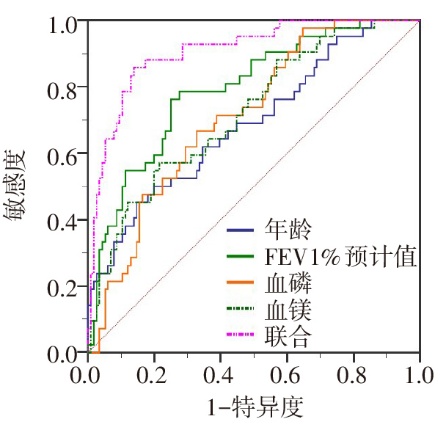
Fig.1 ROC curves of age, FEV1% predicted value, serum phosphorus and serum magnesium alone and in combination for predicting poor prognosis in elderly patients with AECOPD
| [1] | 张海龙, 阮欢荣, 司一妹, 等. 辨证治疗对慢性阻塞性肺疾病急性加重患者临床症状体征评分及生活质量影响的多中心随机对照研究[J]. 中华中医药杂志, 2024, 39(1):485-490. |
| Zhang H L, Ruan H R, Si Y M, et al. Multi-center randomized controlled study on the effect of syndrome differentiation therapy on clinical symptoms and signs score and quality of life in patients with AECOPD[J]. Chinese Journal of Traditional Chinese Medicine, 2024, 39(1):485-490. | |
| [2] | 徐贤彪, 杨明芳, 李瑞丹, 等. 慢性阻塞性肺疾病急性加重期患者并发呼吸道合胞病毒感染的影响因素及与血清HSP70、KLF5、MIP-2水平的相关性[J]. 昆明医科大学学报, 2025, 46(11):107-115. |
| Xu X B, Yang M F, Li R D, et al. Factors influencing respiratory syncytial virus infection in patients with acute exacerbation of chronic obstructive pulmonary disease and correlation with serum levels of HSP70,KLF5,MIP-2[J]. Journal of Kunming Medical University, 2025, 46(11):107-115. doi:10.12259/j.issn.2095-610X.S20251114. | |
| [3] | 刘兴. 超声雾化吸入联合氨茶碱治疗慢性阻塞性肺疾病急性加重期(AECOPD)患者对肺功能与TNF-α、IL-8水平的改善[J]. 现代消化及介入诊疗, 2021, 26(S2):1238-1239. |
| Liu X. Improvement of pulmonary function and TNF-α,IL-8 levels by ultrasonic nebulization combined with aminophylline in patients with acute exacerbation of chronic obstructive pulmonary disease (AECOPD)[J]. Modern Digestion & Intervention, 2021, 26(S2):1238-1239. | |
| [4] | 李世刚, 陈喆, 颜卫峰. 重症肺炎患者血磷与淋巴细胞亚群及预后的相关性分析[J]. 标记免疫分析与临床, 2021, 28(2):197-202. |
| Li S G, Chen Z, Yan W F. A correlation analysis of serum phosphorus,lymphocyte subsets and prognosis in patients with severe pneumonia[J]. Labeled Immunoassays and Clinical Medicine, 2021, 28(2):197-202. doi:10.11748/bjmy.issn.1006-1703.2021.02.005. | |
| [5] | 徐晓琴, 常帅, 胡小娟, 等. 慢性肾病患者低镁血症与动脉粥样硬化发生的相关性分析[J]. 心脑血管病防治, 2023, 23(3):20-23. |
| Xu X Q, Chang S, Hu X J, et al. Correlation analysis of hypomagnesemia and atherosclerosis in patients with chronic kidney disease[J]. Cardio-Cerebrovasc Dis Prev Treat, 2023, 23(3):20-23. doi:10.3969/j.issn.1009-816x.2023.03.006. | |
| [6] | 慢性阻塞性肺疾病急性加重(AECOPD)诊治专家组. 慢性阻塞性肺疾病急性加重(AECOPD)诊治中国专家共识(2017年更新版)[J]. 国际呼吸杂志, 2017, 37(14):1041-1057. |
| AECOPD Diagnosis and Treatment Expert Group. Chinese Expert Consensus on Diagnosis and Treatment of Acute Exacerbation of Chronic Obstructive Pulmonary Disease (AECOPD) (2017 Updated Edition)[J]. International Journal of Respiration, 2017, 37(14):1041-1057. doi:10.3760/cma.j.issn.1673-436X.2017.14.001. | |
| [7] | 胡营斌, 李泉, 冯琦, 等. 慢性阻塞性肺疾病患者血清组蛋白去乙酰化酶2、孤独G蛋白耦联受体配体、B型脑钠肽水平变化及其对预后的预测价值[J]. 中国医师进修杂志, 2025, 48(12):1069-1073. |
| Hu Y B, Li Q, Feng Q, et al. The changes of serum histone deacetylase 2,lonely G protein-coupled receptor ligand and B-type brain natriuretic peptide in patients with chronic obstructive pulmonary disease and the predictive value for prognosis[J]. Chinese Journal of Postgraduates of Medicine, 2025, 48(12):1069-1073. doi:10.3760/cma.j.cn115455-20241218-01140. | |
| [8] | 周瑞玲, 张新宇, 张文江, 等. 基于"虚-毒-瘀"病机探讨慢性阻塞性肺疾病急性加重与炎症免疫相关miRNA的关系[J]. 辽宁中医药大学学报, 2023, 25(12):208-212. |
| Zhou R L, Zhang X Y, Zhang W J, et al. Exploration of the relationship between acute exacerbations of chronic obstructive pulmonary disease and inflammatory immune-related miRNA based on the“Deficiency-Toxicity-Stasis”pathology[J]. Journal of Liaoning University of Traditional Chinese Medicine, 2023, 25(12):208-212. doi:10.13194/j.issn.1673-842x.2023.12.044. | |
| [9] | Qian Y, Cai C, Sun M, et al. Analyses of factors associated with acute exacerbations of chronic obstructive pulmonary disease:a review[J]. Int J Chron Obstruct Pulmon Dis, 2023, 18:2707-2723. doi:10.2147/COPD.S433183. |
| [10] | Sinatra N, Cuttone G, Geraci G, et al. Correlation between hypophosphatemia and hyperventilation in critically ill patients:causes,clinical manifestations,and management strategies[J]. Biomedicines, 2025, 13(10):2382. doi:10.3390/biomedicines13102382. |
| [11] | Diop S, Legriel S, Ferré A. Assessment of phosphatemia at admission to the intensive care unit to predict mechanical ventilation among patients with acute exacerbation of chronic obstructive pulmonary disease:a retrospective cohort study[J]. Ann Transl Med, 2024, 12(3):50. doi:10.21037/atm-23-1650. |
| [12] | Xiao M, Wang X, Wang H, et al. Risk factors for hyponatremia in acute exacerbation chronic obstructive pulmonary disease(AECOPD):a multicenter cross-sectional study[J]. BMC Pulm Med, 2023, 23(1):39. doi:10.1186/s12890-023-02328-4. |
| [13] | Kumar P N, Amirullah A, Kumar D R. Association between serum magnesium levels and acute exacerbations in chronic obstructive pulmonary disease patients[J]. Int J Med Health Dev, 2025, 30(2):146-151. |
| [14] | Cacciante L, Turolla A, Pregnolato G, et al. The use of respiratory muscle training in patients with pulmonary dysfunction, internal diseases or central nervous system disorders:a systematic review with meta-analysis[J]. Qual Life Res, 2023, 32(1):1-26. doi:10.1007/s11136-022-03133-y. |
| [15] | šIleikienė V, Jurgauskienė L. Role of regulatory T cells in pulmonary ageing and COPD development[J]. Int J Mol Sci, 2025, 26(8):3721. doi:10.3390/ijms26083721. |
| [16] | 魏杰, 刘皎然, 彭龙, 等. 膈肌功能参数与慢性阻塞性肺疾病患者肺功能指标的相关性及其评估病情严重程度的价值[J]. 临床误诊误治, 2024, 37(8):40-45. |
| Wei J, Liu J R, Peng L, et al. Correlation of diaphragm function parameters with pulmonary function indicators in COPD patients and their value in evaluation of disease severity[J]. Clinical Misdiagnosis & Mistherapy, 2024, 37(8):40-45. doi:10.3969/j.issn.1002-3429.2024.08.009. | |
| [17] | Zhou R, Wang H, Zhang Y, et al. Small airway disease as a key factor in COPD:new perspectives and insights[J]. Front Med (Lausanne), 2025, 12:1648612. doi:10.3389/fmed.2025.1648612. |
| [18] | 李萍, 林桦, 张爱丽, 等. 血清磷水平与老年慢性阻塞性肺疾病合并Ⅱ型呼吸衰竭患者机械通气撤机结局的相关性分析[J]. 中华老年医学杂志, 2020, 39(6):613-617. |
| Li P, Lin H, Zhang A L, et al. Correlation between serum phosphorus levels and outcomes of weaning from mechanical ventilation in elderly chronic obstructive pulmonary disease patients with typeⅡrespiratory failure[J]. Chinese Journal of Geriatrics, 2020, 39(6):613-617. doi:10.3760/cma.j.issn.0254-9026.2020.06.002. | |
| [19] | 邵栗严, 胡松, 文新平, 等. 老年病人低镁血症与慢性心力衰竭的相关性[J]. 青岛大学学报(医学版), 2020, 56(3):281-284. |
| Shao L Y, Hu S, Wen X P, et al. Association between hypomagnesemia and chronic heart failure in elderly patients[J]. Journal of Qingdao University(Medical Sciences), 2020, 56(3):281-284. doi:10.11712/jms.2096-5532.2020.56.033. | |
| [20] | Hayat I M, GüNak F. Chronic obstructive pulmonary disease(COPD) and magnesium levels:relationship analysis[J]. Med J Suleyman Demirel Univ, 2025, 32(1):81-87. |
| [21] | 房华, 高锋, 钱文霞, 等. AECOPD患者发生低钠血症风险列线图预测模型的构建[J]. 中国急救复苏与灾害医学杂志, 2024, 19(7):922-925,930. |
| Fang H, Gao F, Qian W X, et al. Construction of a nomogram predictive model for hyponatremia in AECOPD patients[J]. China Journal of Emergency Resuscitation and Disaster Medicine, 2024, 19(7):922-925. doi: 10.3969/j.issn.1673-6966.2024.07.019. |
| Viewed | ||||||
|
Full text |
|
|||||
|
Abstract |
|
|||||
