
Tianjin Medical Journal ›› 2026, Vol. 54 ›› Issue (10): 1039-1044.doi: 10.11958/20253752
• Clinical Research • Previous Articles Next Articles
XIE Yilin1( ), XU Dandan1, PAN Luxiang1, LIU Qin2,△()
Received:2026-01-04
Revised:2026-05-07
Published:2026-10-15
Online:2026-10-10
Contact:
△E-mail:holly0303@163.com
XIE Yilin, XU Dandan, PAN Luxiang, LIU Qin. The predictive value of volumetric blood flow parameters for outcome of hysteroscopic adhesiolysis and frozen embryo transfer after hysteroscopic adhesion resection[J]. Tianjin Medical Journal, 2026, 54(10): 1039-1044.
CLC Number:
| 组别 | n | 年龄/岁 | BMI/(kg/m2) | FSH/(U/L) | LH/(U/L) | E2/(pmol/L) | P/(nmol/L) | T/(nmol/L) | |||||||||||||||||
|---|---|---|---|---|---|---|---|---|---|---|---|---|---|---|---|---|---|---|---|---|---|---|---|---|---|
| 妊娠组 | 76 | 28.14±6.22 | 23.16±1.07 | 6.17±1.29 | 4.14±0.81 | 197.50±37.14 | 2.41±0.63 | 1.21±0.33 | |||||||||||||||||
| 非妊娠组 | 62 | 28.53±4.13 | 23.15±1.05 | 6.20±1.39 | 4.17±0.83 | 196.95±36.18 | 2.45±0.63 | 1.20±0.30 | |||||||||||||||||
| t | 0.420 | 0.059 | 0.129 | 0.222 | 0.087 | 0.395 | 0.271 | ||||||||||||||||||
| 组别 | 既往流产史 | 转化日子宫 内膜厚度/mm | 胚胎移植方案 | 胚胎冷冻 保存时间/月 | |||||||||||||||||||||
| (改良)自然周期 | 激素替代周期 | 降调后激素替代周期 | |||||||||||||||||||||||
| 0次 | 1次 | ≥2次 | |||||||||||||||||||||||
| 妊娠组 | 22(28.95) | 38(50.00) | 16(21.05) | 10.43±1.44 | 30(39.47) | 10(13.16) | 36(47.37) | 9.14±2.05 | |||||||||||||||||
| 非妊娠组 | 18(29.03) | 33(53.23) | 11(17.74) | 8.83±1.59 | 26(41.94) | 8(12.90) | 28(45.16) | 9.17±1.32 | |||||||||||||||||
| χ2或t | 0.260 | 6.184** | 0.089 | 0.113 | |||||||||||||||||||||
| 组别 | 移植胚胎阶段 | 移植优质胚胎数 | 术前宫腔粘连程度 | ||||||||||||||||||||||
| D3 | D5 | 0~1枚 | 2枚 | 轻度 | 中度 | 重度 | |||||||||||||||||||
| 妊娠组 | 24(31.58) | 52(68.42) | 27(35.53) | 49(64.47) | 15(19.74) | 50(65.79) | 11(14.47) | ||||||||||||||||||
| 非妊娠组 | 19(30.65) | 43(69.35) | 37(59.68) | 25(40.32) | 12(19.35) | 41(66.13) | 9(14.52) | ||||||||||||||||||
| χ2 | 0.014 | 8.008** | 0.003 | ||||||||||||||||||||||
Tab.1 Comparison of baseline clinical data between two groups of patients
| 组别 | n | 年龄/岁 | BMI/(kg/m2) | FSH/(U/L) | LH/(U/L) | E2/(pmol/L) | P/(nmol/L) | T/(nmol/L) | |||||||||||||||||
|---|---|---|---|---|---|---|---|---|---|---|---|---|---|---|---|---|---|---|---|---|---|---|---|---|---|
| 妊娠组 | 76 | 28.14±6.22 | 23.16±1.07 | 6.17±1.29 | 4.14±0.81 | 197.50±37.14 | 2.41±0.63 | 1.21±0.33 | |||||||||||||||||
| 非妊娠组 | 62 | 28.53±4.13 | 23.15±1.05 | 6.20±1.39 | 4.17±0.83 | 196.95±36.18 | 2.45±0.63 | 1.20±0.30 | |||||||||||||||||
| t | 0.420 | 0.059 | 0.129 | 0.222 | 0.087 | 0.395 | 0.271 | ||||||||||||||||||
| 组别 | 既往流产史 | 转化日子宫 内膜厚度/mm | 胚胎移植方案 | 胚胎冷冻 保存时间/月 | |||||||||||||||||||||
| (改良)自然周期 | 激素替代周期 | 降调后激素替代周期 | |||||||||||||||||||||||
| 0次 | 1次 | ≥2次 | |||||||||||||||||||||||
| 妊娠组 | 22(28.95) | 38(50.00) | 16(21.05) | 10.43±1.44 | 30(39.47) | 10(13.16) | 36(47.37) | 9.14±2.05 | |||||||||||||||||
| 非妊娠组 | 18(29.03) | 33(53.23) | 11(17.74) | 8.83±1.59 | 26(41.94) | 8(12.90) | 28(45.16) | 9.17±1.32 | |||||||||||||||||
| χ2或t | 0.260 | 6.184** | 0.089 | 0.113 | |||||||||||||||||||||
| 组别 | 移植胚胎阶段 | 移植优质胚胎数 | 术前宫腔粘连程度 | ||||||||||||||||||||||
| D3 | D5 | 0~1枚 | 2枚 | 轻度 | 中度 | 重度 | |||||||||||||||||||
| 妊娠组 | 24(31.58) | 52(68.42) | 27(35.53) | 49(64.47) | 15(19.74) | 50(65.79) | 11(14.47) | ||||||||||||||||||
| 非妊娠组 | 19(30.65) | 43(69.35) | 37(59.68) | 25(40.32) | 12(19.35) | 41(66.13) | 9(14.52) | ||||||||||||||||||
| χ2 | 0.014 | 8.008** | 0.003 | ||||||||||||||||||||||
| 组别 | n | VI/% | FI | VFI |
|---|---|---|---|---|
| 妊娠组 | 76 | 2.01±0.29 | 22.16±3.25 | 0.71±0.12 |
| 非妊娠组 | 62 | 1.76±0.24 | 19.29±3.26 | 0.52±0.12 |
| t | 5.540** | 5.198** | 9.164** |
Tab.2 Comparison of volumetric blood flow parameters between two groups of patients
| 组别 | n | VI/% | FI | VFI |
|---|---|---|---|---|
| 妊娠组 | 76 | 2.01±0.29 | 22.16±3.25 | 0.71±0.12 |
| 非妊娠组 | 62 | 1.76±0.24 | 19.29±3.26 | 0.52±0.12 |
| t | 5.540** | 5.198** | 9.164** |
| 变量 | β | SE | Wald χ2 | P | OR | OR(95%CI) |
|---|---|---|---|---|---|---|
| VI | -2.872 | 1.036 | 7.680 | 0.006 | 0.057 | 0.007~0.431 |
| FI | -0.245 | 0.090 | 7.440 | 0.006 | 0.782 | 0.656~0.933 |
| VFI | -0.116 | 0.026 | 19.299 | <0.001 | 0.891 | 0.846~0.938 |
| 转化日子宫内膜 厚度 | -0.610 | 0.189 | 10.464 | 0.001 | 0.543 | 0.375~0.786 |
| 移植优质胚胎数 | 1.187 | 0.588 | 4.082 | 0.043 | 3.278 | 1.038~10.367 |
| 常数项 | 22.662 | 4.135 | 30.031 | <0.001 | 6.96×10⁹ | - |
Tab.3 Multivariate Logistic regression analysis of factors affecting pregnancy failure in FET patients after TCRA surgery
| 变量 | β | SE | Wald χ2 | P | OR | OR(95%CI) |
|---|---|---|---|---|---|---|
| VI | -2.872 | 1.036 | 7.680 | 0.006 | 0.057 | 0.007~0.431 |
| FI | -0.245 | 0.090 | 7.440 | 0.006 | 0.782 | 0.656~0.933 |
| VFI | -0.116 | 0.026 | 19.299 | <0.001 | 0.891 | 0.846~0.938 |
| 转化日子宫内膜 厚度 | -0.610 | 0.189 | 10.464 | 0.001 | 0.543 | 0.375~0.786 |
| 移植优质胚胎数 | 1.187 | 0.588 | 4.082 | 0.043 | 3.278 | 1.038~10.367 |
| 常数项 | 22.662 | 4.135 | 30.031 | <0.001 | 6.96×10⁹ | - |
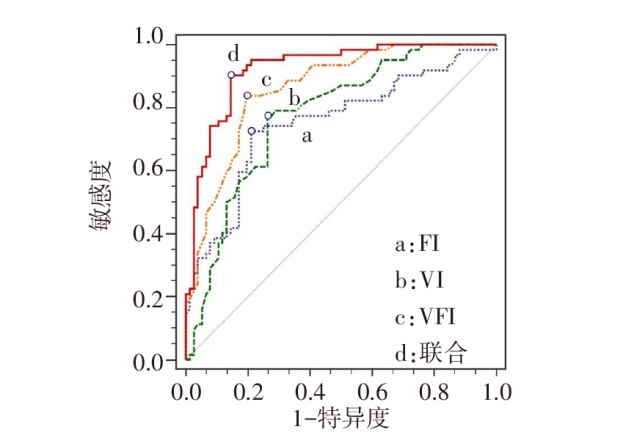
Fig.1 ROC curves of VI, FI, VFI and their combined indicators for predicting pregnancy failure
| 变量 | 截断值 | AUC (95%CI) | 敏感度/ % | 特异度/ % | 约登 指数 |
|---|---|---|---|---|---|
| VI | 1.88% | 0.776(0.697~0.842) | 77.42 | 73.68 | 0.511 |
| FI | 19.24 | 0.752(0.672~0.822) | 72.58 | 78.95 | 0.515 |
| VFI | 0.62 | 0.861(0.792~0.914) | 83.87 | 80.26 | 0.641 |
| 联合检测 | 0.923(0.865~0.961) | 90.32 | 85.53 | 0.759 |
Tab.4 Analysis of the predictive efficacy of VI, FI and VFI for pregnancy failure
| 变量 | 截断值 | AUC (95%CI) | 敏感度/ % | 特异度/ % | 约登 指数 |
|---|---|---|---|---|---|
| VI | 1.88% | 0.776(0.697~0.842) | 77.42 | 73.68 | 0.511 |
| FI | 19.24 | 0.752(0.672~0.822) | 72.58 | 78.95 | 0.515 |
| VFI | 0.62 | 0.861(0.792~0.914) | 83.87 | 80.26 | 0.641 |
| 联合检测 | 0.923(0.865~0.961) | 90.32 | 85.53 | 0.759 |
| [1] | Lv H, Wu B, Song J, et al. Hydrogel,a novel therapeutic and delivery strategy,in the treatment of intrauterine adhesions[J]. J Mater Chem B, 2021, 9(33):6536-6552. doi:10.1039/d1tb01005k. |
| [2] | Vitale S G, Riemma G, Carugno J, et al. Postsurgical barrier strategies to avoid the recurrence of intrauterine adhesion formation after hysteroscopic adhesiolysis:a network meta-analysis of randomized controlled trials[J]. Am J Obstet Gynecol, 2022, 226(4):487-498.e8. doi:10.1016/j.ajog.2021.09.015. |
| [3] | Kadour-Peero E, Feferkorn I, Bellemare V, et al. A comparison of frozen-thawed embryo transfer protocols in 2920 single-blastocyst transfers[J]. Arch Gynecol Obstet, 2022, 306(3):887-892. doi:10.1007/s00404-022-06588-z. |
| [4] | Wenzhi X, Xin X, Ping Z, et al. A meta-analysis of obstetric and neonatal outcomes in patients after treatment of hysteroscopic adhesiolysis[J]. Front Endocrinol(Lausanne), 2023, 14:1126740. doi:10.3389/fendo.2023.1126740. |
| [5] | 宋梦洁, 徐虹, 汪龙霞, 等. 子宫内膜容受性的超声评价指标在辅助生殖技术中预测妊娠结局的研究进展[J]. 解放军医学院学报, 2021, 42(11):1211-1215. |
| Song M J, Xu H, Wang L X, et al. Research advances in ultrasound evaluation index of endometrial receptivity in prediction of pregnancy outcome with assisted reproductive technology[J]. Acad J Chin PLA Med Sch, 2021, 42(11):1211-1215. doi:10.3969/j.issn.2095-5227.2021.11.018. | |
| [6] | Bahrami F, Eftekhar M, Zanbagh L. Uterine artery Doppler and endometrial blood flow in frozen embryo transfer:a cohort study[J]. Int J Reprod Biomed, 2023, 21(3):205-212. doi:10.18502/ijrm.v21i3.13196. |
| [7] | 段任婉, 袁建军, 刘谓, 等. 关节滑膜血管指数评价类风湿关节炎活跃程度的研究[J]. 中华超声影像学杂志, 2023, 32(2):149-155. |
| Duan R W, Yuan J J, Liu W, et al. Value of vascularity index in joints synovial to evaluate rheumatoid arthritis activity[J]. Chinese Journal of Ultrasonography, 2023, 32(2):149-155. doi:10.3760/cma.j.cn131148-20220527-00385. | |
| [8] | 张丽, 孙萍, 韩国伟, 等. 经阴道彩色多普勒超声成像对卵巢早衰的诊断及血流动力学特征分析[J]. 中国超声医学杂志, 2023, 39(2):198-200. |
| Zhang L, Sun P, Han G W, et al. Analysis of the diagnostic value of transvaginal color Doppler ultrasound and hemodynamics in patients with premature ovarian failure[J]. Chinese J Ultrasound Med, 2023, 39(2):198-200. doi:10.3969/j.issn.1002-0101.2023.02.024. | |
| [9] | 范智媛, 王圣华, 陈秋冬, 等. 超声SWE技术联合血管形成-血流指数对乳腺浸润性导管癌腋窝淋巴结转移的预测价值[J]. 临床和实验医学杂志, 2025, 24(10):1106-1110. |
| Fan Z Y, Wang S H, Chen Q D, et al. Predictive value of ultrasound SWE combined with angiogenesis-blood flow index for axillary lymph node metastasis of breast invasive ductal carcinoma[J]. Journal of Clinical and Experimental Medicine, 2025, 24(10):1106-1110. doi:10.3969/j.issn.1671-4695.2025.10.026. | |
| [10] | 李文远. 子宫内膜血流参数的超声特征与胚胎移植成功率的关系[J]. 解放军预防医学杂志, 2019, 37(2):38-40. |
| Li W Y. The relationship between ultrasound characteristics of endometrial blood flow parameters and the success rate of embryo transfer[J]. J Prev Med Chin PLA, 2019, 37(2):38-40. doi:10.13704/j.cnki.jyyx.2019.02.014. | |
| [11] | 陈雷宁, 裘毓雯, 欧湘红, 等. 子宫内膜三维超声能量多普勒血流图预测冻融优良胚胎移植妊娠结局[J]. 实用妇产科杂志, 2013, 29(1):39-43. |
| Chen L N, Qiu Y W, Ou X H, et al. Prediction of the pregnancy outcome of frozen-thawed good-quality embryo transfer cycles by assessment of endometrial vascularity using three-dimensional power doppler ultrasound[J]. Journal of Practical Obstetrics and Gynecology, 2013, 29(1):39-43. | |
| [12] | Practice Committee of the American Society for Reproductive Medicine. Electronic address: ASRM@asrm.org;Practice Committee of the American Society for Reproductive Medicine. Performing the embryo transfer:a guideline[J]. Fertil Steril, 2017, 107(4):882-896. doi:10.1016/j.fertnstert.2017.01.025. |
| [13] | Lin Y, Li Y, Chen P, et al. Exosome-based regimen rescues endometrial fibrosis in intrauterine adhesions via targeting clinical fibrosis biomarkers[J]. Stem Cells Transl Med, 2023, 12(3):154-168. doi:10.1093/stcltm/szad007. |
| [14] | Mortimer R M, Lanes A, Srouji S S, et al. Treatment of intrauterine adhesions and subsequent pregnancy outcomes in an in vitro fertilization population[J]. Am J Obstet Gynecol, 2024, 231(5):536.e1-536.e10. doi:10.1016/j.ajog.2024.05.026. |
| [15] | 刘环, 努尔艾力·木台力甫, 努尔比耶·图尔迪, 等. 3D-PDI相关参数对体外受精-胚胎移植妊娠结局的预测价值[J]. 中国医学物理学杂志, 2023, 40(6):709-713. |
| Liu H, Mueraili M, Nuerbiye T, et al. Predictive value of 3D-PDI parameters for pregnancy outcomes after in vitro fertilization-embryo transfer[J]. Chinese Journal of Medical Physics, 2023, 40(6):709-713. doi:10.3969/j.issn.1005-202X.2023.06.007. | |
| [16] | 李芷舒, 鲁海鸥, 张宇明, 等. 不孕患者移植当日子宫内膜容受性评估对临床妊娠率影响研究[J]. 中国实用妇科与产科杂志, 2020, 36(3):264-266. |
| Li Z S, Lu H O, Zhang Y M, et al. Effect of endometrial receptivity evaluation on clinical pregnancy rate in infertile patients on the day of transplantation[J]. Chinese Journal of Practical Gynecology and Obstetrics, 2020, 36(3):264-266. doi:10.19538/j.fk2020030118. | |
| [17] | Bajpai K, Acharya N, Prasad R, et al. Endometrial receptivity during the preimplantation period:A narrative review[J]. Cureus, 2023, 15(4):e37753. doi:10.7769/cureus.37753. |
| [18] | Hazari V, Sarvi F, Alyasin A, et al. Enhancing endometrial receptivity in FET cycles: exploring the influence of endometrial and subendometrial blood flow along with endometrial volume[J]. Front Med(Lausanne), 2024, 11(4):1260960. doi:10.3389/fmed.2024.1260960. |
| [19] | Chen K, Liang J, Qin T, et al. The role of extracellular vesicles in embryo implantation[J]. Front Endocrinol(Lausanne), 2022, 13(1):809596. doi:10.3389/fendo.2022.809596. |
| [20] | Mishra A, Ashary N, Sharma R, et al. Extracellular vesicles in embryo implantation and disorders of the endometrium[J]. Am J Reprod Immunol, 2021, 85(2):e13360. doi:10.1111/aji.13360. |
| [21] | 张娇, 谭友慧, 高静, 等. 子宫动脉及内膜血流参数与人工周期冻融胚胎移植结局的关系[J]. 安徽医药, 2020, 24(2):323-326. |
| Zhang J, Tan Y H, Gao J, et al. Relationship between uterine artery and endometrial blood flow and the outcome of FET with artificial cycle[J]. Anhui Medical and Pharmaceutical Journal, 2020, 24(2):323-326. doi:10.3969/j.issn.1009-6469.2020.02.028. | |
| [22] | 王之枫, 杨丽娟, 彭强丽, 等. 糖酵解在胚胎着床中的作用及机制研究进展[J]. 生殖医学杂志, 2025, 34(6):852-856. |
| Wang Z F, Yang L J, Peng Q L, et al. Research progress in the role and mechanisms of glycolysis in embryo implantation[J]. Journal of Reproductive Medicine, 2025, 34(6):852-856. doi:10.3969/j.issn.1004-3845.2025.06.019. | |
| [23] | 胡丹, 郝克红, 任敏. 经阴道三维超声卵泡自动测量和超微血流成像评估卵巢储备功能的应用研究[J]. 同济大学学报(医学版), 2025, 46(2):222-227. |
| Hu D, Hao K H, Ren M. Application study of transvaginal three-dimensional ultrasound automatic follicle measurement and ultra-micro flow imaging to assess ovarian reserve function[J]. Journal of Tongji University(Medical Science), 2025, 46(2):222-227. doi:10.12289/j.issn.2097-4345.24195. | |
| [24] | Matsuyama S, Whiteside S, Li S Y. Implantation and decidualization in PCOS:Unraveling the complexities of pregnancy[J]. Int J Mol Sci, 2024, 25(2):1203. doi:10.3390/ijms25021203. |
| [25] | 汪晓祎, 王婷一, 郑霜, 等. 剪切波弹性成像技术联合三维能量多普勒超声在冻胚移植患者妊娠结局预测中的价值研究[J]. 中国超声医学杂志, 2025, 41(3):313-316. |
| Wang X Y, Wang T Y, Zheng S, et al. Clinical value of shear wave elastography combined with three-dimensional power doppler ultrasound in predicting pregnancy outcomes in patients with frozen embryo transfer[J]. Chinese J Ultrasound Med, 2025, 41(3):313-316. doi:10.3969/j.issn.1002-0101.2025.03.019. |
| Viewed | ||||||
|
Full text |
|
|||||
|
Abstract |
|
|||||
