
Tianjin Medical Journal ›› 2026, Vol. 54 ›› Issue (4): 364-368.doi: 10.11958/20253174
• Clinical Research • Previous Articles Next Articles
DUAN Chengli1( ), SHEN Yanjie2, GUO Lixia1, WANG Bihang1, ZU Xiaoxia1△(), LIU Yuqiang3
Received:2025-10-16
Revised:2025-11-28
Published:2026-04-15
Online:2026-04-14
Contact:
△E-mail:DUAN Chengli, SHEN Yanjie, GUO Lixia, WANG Bihang, ZU Xiaoxia, LIU Yuqiang. Analysis of the interaction between the moment of fever during labor and the peak of fever in parturients with epidural analgesia and adverse neonatal outcome[J]. Tianjin Medical Journal, 2026, 54(4): 364-368.
CLC Number:
| 组别 | n | 年龄/岁 | 孕前体质量指数/(kg/m2) | 产妇类型 | 孕周/周 | 妊娠期高 血压疾病 | 妊娠期 糖尿病 | 人工破膜 | 催引产 | ||||||||||
|---|---|---|---|---|---|---|---|---|---|---|---|---|---|---|---|---|---|---|---|
| 初产妇 | 经产妇 | ||||||||||||||||||
| 正常组 | 75 | 31.99±3.10 | 23.49±2.59 | 56(74.67) | 19(25.33) | 39.42±1.05 | 13(17.33) | 8(10.67) | 65(86.67) | 38(50.67) | |||||||||
| 不良组 | 43 | 33.26±3.05 | 23.62±2.75 | 30(69.77) | 13(30.23) | 39.37±1.02 | 7(16.28) | 13(30.23) | 38(88.37) | 24(55.81) | |||||||||
| t或χ2 | 2.154* | 0.257 | 0.332 | 0.252 | 0.022 | 7.152** | 0.072 | 0.290 | |||||||||||
| 组别 | 使用 抗生素 | 产程/h | 产时发热情况 | 新生儿性别(男/女) | 新生儿 体质量/kg | ||||||||||||||
| 第一产程 | 第二产程 | 第三产程 | 产时发热时刻/h | 发热峰值/℃ | 发热持续时间/h | ||||||||||||||
| 正常组 | 65 | 12.83±3.78 | 0.50±0.20 | 0.17±0.06 | 8.09±0.76 | 37.93±0.20 | 1.34±0.25 | 38/37 | 3.30±0.29 | ||||||||||
| 不良组 | 37 | 13.02±3.91 | 0.52±0.19 | 0.18±0.05 | 7.51±0.80 | 38.12±0.22 | 1.37±0.26 | 23/20 | 3.27±0.31 | ||||||||||
| t或χ2 | 0.009 | 0.260 | 0.532 | 0.924 | 3.914** | 4.788** | 0.618 | 0.087 | 0.527 | ||||||||||
Tab.1 Comparison of maternal and neonatal data between the two groups
| 组别 | n | 年龄/岁 | 孕前体质量指数/(kg/m2) | 产妇类型 | 孕周/周 | 妊娠期高 血压疾病 | 妊娠期 糖尿病 | 人工破膜 | 催引产 | ||||||||||
|---|---|---|---|---|---|---|---|---|---|---|---|---|---|---|---|---|---|---|---|
| 初产妇 | 经产妇 | ||||||||||||||||||
| 正常组 | 75 | 31.99±3.10 | 23.49±2.59 | 56(74.67) | 19(25.33) | 39.42±1.05 | 13(17.33) | 8(10.67) | 65(86.67) | 38(50.67) | |||||||||
| 不良组 | 43 | 33.26±3.05 | 23.62±2.75 | 30(69.77) | 13(30.23) | 39.37±1.02 | 7(16.28) | 13(30.23) | 38(88.37) | 24(55.81) | |||||||||
| t或χ2 | 2.154* | 0.257 | 0.332 | 0.252 | 0.022 | 7.152** | 0.072 | 0.290 | |||||||||||
| 组别 | 使用 抗生素 | 产程/h | 产时发热情况 | 新生儿性别(男/女) | 新生儿 体质量/kg | ||||||||||||||
| 第一产程 | 第二产程 | 第三产程 | 产时发热时刻/h | 发热峰值/℃ | 发热持续时间/h | ||||||||||||||
| 正常组 | 65 | 12.83±3.78 | 0.50±0.20 | 0.17±0.06 | 8.09±0.76 | 37.93±0.20 | 1.34±0.25 | 38/37 | 3.30±0.29 | ||||||||||
| 不良组 | 37 | 13.02±3.91 | 0.52±0.19 | 0.18±0.05 | 7.51±0.80 | 38.12±0.22 | 1.37±0.26 | 23/20 | 3.27±0.31 | ||||||||||
| t或χ2 | 0.009 | 0.260 | 0.532 | 0.924 | 3.914** | 4.788** | 0.618 | 0.087 | 0.527 | ||||||||||
| 变量 | β | SE | Wald χ2 | P | OR (95%CI) |
|---|---|---|---|---|---|
| 年龄 | 0.156 | 0.075 | 4.312 | 0.038 | 1.169(1.009~1.354) |
| 妊娠期糖尿病 | 1.322 | 0.571 | 5.365 | 0.021 | 3.749(1.225~11.471) |
| 产时发热时刻 | -0.547 | 0.211 | 6.705 | 0.010 | 0.578(0.382~0.875) |
| 发热峰值 | 0.680 | 0.238 | 8.153 | 0.004 | 1.975(1.238~3.151) |
| 常数项 | -7.247 | 6.920 | 8.666 | 0.003 | 0.002 |
Tab.2 Influencing factors for adverse neonatal outcome in parturients with intrapartum fever undergoing epidural analgesia
| 变量 | β | SE | Wald χ2 | P | OR (95%CI) |
|---|---|---|---|---|---|
| 年龄 | 0.156 | 0.075 | 4.312 | 0.038 | 1.169(1.009~1.354) |
| 妊娠期糖尿病 | 1.322 | 0.571 | 5.365 | 0.021 | 3.749(1.225~11.471) |
| 产时发热时刻 | -0.547 | 0.211 | 6.705 | 0.010 | 0.578(0.382~0.875) |
| 发热峰值 | 0.680 | 0.238 | 8.153 | 0.004 | 1.975(1.238~3.151) |
| 常数项 | -7.247 | 6.920 | 8.666 | 0.003 | 0.002 |
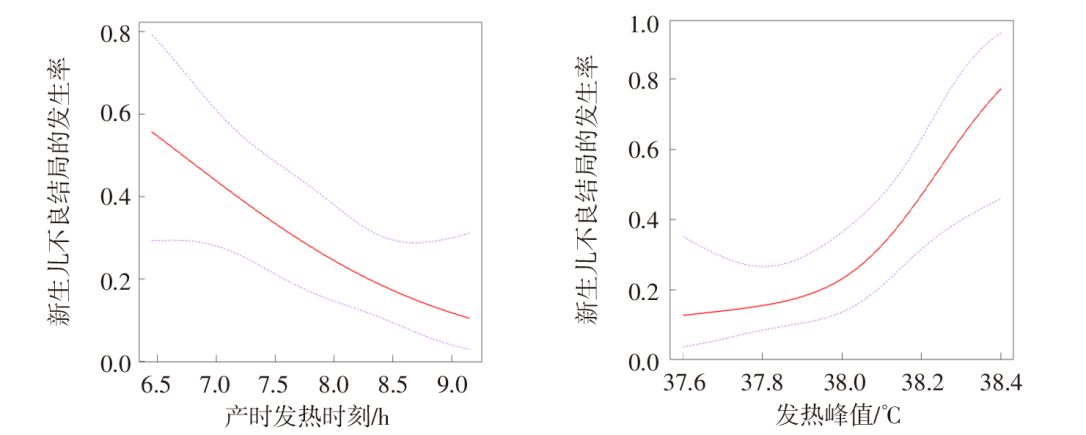
Fig.1 Smooth fitting curve of the relationship between the timing of intrapartum fever, peak fever temperature and adverse neonatal outcome
| 临床表现 | 总例数 | 不良结局例数 | 正常结局例数 | OR(95%CI) | P |
|---|---|---|---|---|---|
| 产时发热时刻(-)/发热峰值(-) | 30 | 11 | 19 | 1 | |
| 产时发热时刻(-)/发热峰值(+) | 25 | 13 | 12 | 1.870(1.005~3.480) | <0.001 |
| 产时发热时刻(+)/发热峰值(-) | 33 | 7 | 26 | 0.465(0.251~0.861) | <0.001 |
| 产时发热时刻(+)/发热峰值(+) | 30 | 12 | 18 | 1.152(0.497~2.672) | >0.05 |
Tab.3 Interaction effects of the timing of intrapartum fever and peak fever temperature on adverse neonatal outcome
| 临床表现 | 总例数 | 不良结局例数 | 正常结局例数 | OR(95%CI) | P |
|---|---|---|---|---|---|
| 产时发热时刻(-)/发热峰值(-) | 30 | 11 | 19 | 1 | |
| 产时发热时刻(-)/发热峰值(+) | 25 | 13 | 12 | 1.870(1.005~3.480) | <0.001 |
| 产时发热时刻(+)/发热峰值(-) | 33 | 7 | 26 | 0.465(0.251~0.861) | <0.001 |
| 产时发热时刻(+)/发热峰值(+) | 30 | 12 | 18 | 1.152(0.497~2.672) | >0.05 |
| [1] | 王颖, 石慧峰, 杨怡珂, 等. 产时发热的危险因素分析[J]. 中国实用妇科与产科杂志, 2024, 40(10):1036-1041. |
| WANG Y, SHI H F, YANG Y K, et al. Analysis of the risk factors for intrapartum fever[J]. Chinese Journal of Practical Gynecology and Obstetrics, 2024, 40(10):1036-1041. doi:10.19538/j.fk2024100115. | |
| [2] | 徐恒, 卢佳萍, 全莉梅, 等. 全身免疫炎症指数对硬膜外镇痛相关产时发热的预测价值[J]. 广东医学, 2025, 46(5):771-775. |
| XU H, LU J P, QUAN L M, et al. Predictive value of systemic immune-inflammation index for epidural analgesia-related maternal fever duringlabor[J]. Guangdong Medical Journal, 2025, 46(5):771-775. doi:10.13820/j.cnki.gdyx.20243223. | |
| [3] | 施蓉, 李维维, 张静. 硬膜外分娩镇痛产妇血清SAA1、TNF-α水平与产时发热及分娩结局关系[J]. 中国计划生育学杂志, 2023, 31(9):2186-2189,2194. |
| SHI R, LI W W, ZHANG J. Correlation between the serum amyloid A1 and tumor necrosis factor alpha levels of women with epidural labor analgesia and their fever during labor and delivery outcomes[J]. Chinese Journal of Family Planning, 2023, 31(9):2186-2189,2194. doi:10.3969/j.issn.1004-8189.2023.09.036. | |
| [4] | LORAIN P, BOWER A, GOTTARDI E, et al. Risk factors for hypoxic-ischemic encephalopathy in cases of severe acidosis:a case-control study[J]. Acta Obstet Gynecol Scand, 2022, 101(4):471-478. doi:10.1111/aogs.14326. |
| [5] | REN J, WANG T, YANG B, et al. Risk factors and safety analyses for intrapartum fever in pregnant women receiving epidural analgesia during labor[J]. Med Sci Monit, 2021, 27:e929283. doi:10.12659/MSM.929283. |
| [6] | ZHAO B S, LI B, WANG Q N, et al. Time- and dose-dependent correlations between patient-controlled epidural analgesia and intrapartum maternal fever[J]. BMC Anesthesiol, 2021, 21(1):31. doi:10.1186/s12871-021-01249-1. |
| [7] | 陈文婷, 陈国庆. 硬膜外分娩镇痛产时发热程度对母儿围生结局的影响[J]. 天津医药, 2025, 53(5):474-477. |
| CHEN W T, CHEN G Q. The impact of intrapartum fever severity associated with epidural labor analgesia on maternal and neonatal perinatal outcomes[J]. Tianjin Med J, 2025, 53(5):474-477.doi:10.11958/20250020. | |
| [8] | YIN H, HU R. Risk factors of maternal intrapartum fever and the effect of fever duration on neonatal morbidity in different temperature[J]. J Obstet Gynaecol Res, 2022, 48(10):2522-2527. doi:10.1111/jog.15362. |
| [9] | 刘丽恒, 邹丽颖, 米雪, 等. 产时发热程度对母婴结局的影响研究[J]. 中国全科医学, 2024, 27(6):699-703. |
| LIU L H, ZOU L Y, MI X, et al. Effect of intrapartum fever severity on maternal and fetal outcomes[J]. Chinese General Practice, 2024, 27(6):699-703. doi:10.12114/j.issn.1007-9572.2023.0318. | |
| [10] | National Institute for Health and Care Excellence. Intrapartum care[EB/OL].(2023-09-29)[2025-10-01]. http://www.nice.org.uk/guidance/ng235. |
| [11] | 中国优生科学协会, 郑明昱, 常青. 孕产妇围分娩期预防性使用抗菌药物的专家共识[J]. 中国药房, 2025, 36(2):129-139. |
| China Society of Birth Defect Prevention and Control, ZHENG M Y, CHANG Q. Expert consensus on prophylactic use of antibiotics for pregnant women during peripartum period[J]. China Pharmacy, 2025, 36(2):129-139. doi:10.6039/j.issn.1001-0408.2025.02.01. | |
| [12] | 中华医学会围产医学分会新生儿复苏学组. 新生儿窒息诊断的专家共识[J]. 中华围产医学杂志, 2016, 19(1):3-6. |
| Neonatal Resuscitation Subgroup,Perinatal Medicine Branch of the Chinese Medical Association. Expert consensus on the diagnosis of neonatal asphyxia[J]. Chinese Journal of Perinatal Medicine, 2016, 19(1):3-6. doi:10.3760/cma.j.issn.1007-9408.2016.01.002. | |
| [13] | 中国医师协会新生儿科医师分会. 新生儿缺氧缺血性脑病磁共振诊断与损伤类型的分类建议[J]. 中国当代儿科杂志, 2017, 19(12):1225-1233. |
| Neonatologist Branch of Chinese Medical Doctor Association. Patterns of brain injury in neonatal hypoxic-ischemic encephalopathy on magnetic resonance imaging:recommendations on classification[J]. Chinese Journal of Contemporary Pediatrics, 2017, 19(12):1225-1233. doi:10.7499/j.issn.1008-8830.2017.12.001. | |
| [14] | 胡亚美, 江载芳. 诸福棠实用儿科学[M]. 8版. 北京: 人民卫生出版社, 2015. |
| HU Y M, JIANG Z F. Zhu Futang's Practical Pediatrics[M]. 8th ed. Beijing: People's Medical Publishing House, 2015. | |
| [15] | 中华医学会神经病学分会, 中华医学会神经病学分会脑血管病学组. 中国脑出血诊治指南(2019)[J]. 中华神经科杂志, 2019, 52(12):994-1005. |
| Neurology Branch of the Chinese Medical Association, Cerebrovascular Disease Group of the Neurology Branch of the Chinese Medical Association. Chinese guidelines for diagnosis and treatment of acute intracerebral hemorrhage 2019[J]. Chinese Journal of Neurology, 2019, 52(12):994-1005. | |
| [16] | 中华医学会儿科学分会新生儿学组, 中华儿科杂志编辑委员会. 新生儿惊厥临床管理专家共识(2022版)[J]. 中华儿科杂志, 2022, 60(11):1127-1133. |
| Neonatology Group of the Pediatric Society,Chinese Medical Association,Editorial Board of Chinese Journal of Pediatrics. Expert consensus on clinical management of neonatal seizures[J]. Chinese Journal of Pediatrics, 2022, 60(11):1127-1133. doi:10.3760/cma.j.cn112140-20220531-00498. | |
| [17] | ZHAO B, LI B, WANG Q, et al. The relationship between epidural analgesia and intrapartum maternal fever and the consequences for maternal and neonatal outcomes:a prospective observational study[J]. J Matern Fetal Neonatal Med, 2022, 35(25):5354-5362. doi:10.1080/14767058.2021.1879042. |
| [18] | YUAN J, JIN A, SHEN J, et al. Maternal intrapartum fever during epidural labour analgesia:incidence and influencing factors[J]. Int J Nurs Pract, 2024, 30(1):e13188. doi:10.1111/ijn.13188. |
| [19] | KIM S Y, HONG S Y, KWON D Y, et al. Degree of intrapartum fever and associated factors:three group analysis of no fever,borderline and overt fever[J]. J Obstet Gynaecol Res, 2021, 47(3):1153-1163. doi:10.1111/jog.14651. |
| [20] | LI B, LIAO Y, WANG Q, et al. Association between epidural-related maternal fever and short-and long-term prognosis of parturients:a prospective observational study[J]. Front Surg, 2022, 9:1064272. doi:10.3389/fsurg.2022.1064272. |
| [21] | SHIFERA N, DEJENIE F, MESAFINT G, et al. Risk factors for neonatal sepsis among neonates in the neonatal intensive care unit at Hawassa University Comprehensive Specialized Hospital and Adare General Hospital in Hawassa City,Ethiopia[J]. Front Pediatr, 2023, 11:1092671. doi:10.3389/fped.2023.1092671. |
| [22] | 张佩丽, 胡鹏, 郭静宜, 等. 产时发热峰值及发热持续时间对母婴围产期不良结局的影响[J]. 中华疾病控制杂志, 2024, 28(8):903-908. |
| ZHANG P L, HU P, GUO J Y, et al. The impact of peak and duration of intrapartum fever on adverse perinatal maternal and neonatal outcomes[J]. Chinese Journal of Disease Control & Prevention, 2024, 28(8):903-908. doi:10.16462/j.cnki.zhjbkz.2024.08.006. | |
| [23] | AN H, ZHENG W, ZHU Q, et al. Retrospective study of intrapartum fever in term pregnancies and adverse obstetric and neonatal outcomes[J]. PeerJ, 2022, 10:e14242. doi:10.7717/peerj.14242. |
| [24] | HENSEL D, ZHANG F, CARTER E B, et al. Severity of intrapartum fever and neonatal outcomes[J]. Am J Obstet Gynecol, 2022, 227(3):513.e1-513.e8. doi:10.1016/j.ajog.2022.05.031. |
| [25] | GOETZL L. Maternal fever in labor:etiologies,consequences,and clinical management[J]. Am J Obstet Gynecol, 2023, 228(5S):S1274-S1282. doi:10.1016/j.ajog.2022.11.002. |
| [26] | SOUSSAN S, EGLOFF C, RAVEAU J, et al. Intra partum fever in term pregnancies:predictive factors of poor neonatal outcome[J]. J Gynecol Obstet Hum Reprod, 2025, 54(8):102993. doi:10.1016/j.jogoh.2025.102993. |
| [27] | 贾飞, 凌亮, 刘波, 等. 椎管内分娩镇痛相关产时发热出现时刻延迟的影响因素及对母婴结局的影响[J]. 实用妇产科杂志, 2025, 41(2):169-173. |
| JIA F, LING L, LIU B, et al. The influencing factors of delayed onset of intrapartum fever related to intrathecal labor analgesia and its impact on maternal and neonatal outcomes[J]. Journal of Practical Obstetrics and Gynecology, 2025, 41(2):169-173. | |
| [28] | CORNET M C, KUZNIEWICZ M W, SCHEFFLER A W, et al. Maternal fever during labor and the risk of neonatal encephalopathy:duration and magnitude of hyperthermia[J]. Am J Obstet Gynecol, 2025, 233(6):651.e1-651.e12. doi:10.1016/j.ajog.2025.07.046. |
| [1] | WU Jie, JI Bingrui, GUO Ruixia. Predictive value of platelet-derived growth factor and lower uterine segment thickness for delivery outcome in pregnancy with a scarred uterus [J]. Tianjin Medical Journal, 2026, 54(7): 760-764. |
| [2] | CHEN Wenting, CHEN Guoqing. The impact of intrapartum fever severity associated with epidural labor analgesia on maternal and neonatal perinatal outcomes [J]. Tianjin Medical Journal, 2025, 53(5): 474-477. |
| [3] | ZHANG Xue-yin, CHEN Li-jian. The influence of programmed intermittent epidural bolus and continuous epidural infusion on fever during delivery [J]. Tianjin Medical Journal, 2021, 49(7): 752-756. |
| [4] | ZHAO Ying, TIAN Xiu-ying, ZHANG Wan-xian. Analysis of related factors of intraventricular hemorrhage in very low birth weight premature infants [J]. Tianjin Medical Journal, 2021, 49(6): 608-612. |
| [5] | HE Zhi-quan, YUAN Chun, CUI Ning, HUANG Xue-yong, DU Yan-hua, LI Yi, SU Jia, XU Bian-li, GUO Wan-shen. The clinical characteristics of 74 cases of severe fever with thrombocytopenia syndrome [J]. Tianjin Medical Journal, 2019, 47(7): 738-741. |
| [6] | WANG Jing, NAN Yan-rong△, MA Xiao-juan. Clinical analysis of 263 cases of uncomplicated twin pregnancy in a single center for 5 years [J]. Tianjin Med J, 2018, 46(11): 1197-1200. |
| [7] | DU Yan-hua, LI Yi, MA Hong, WANG Hai-feng, XU Bian-li, HUANG Xue-yong△. Pathogenic analysis of rat infected hantavirus in Henan province, 2014-2016 [J]. Tianjin Med J, 2017, 45(6): 648-651. |
| [8] | CHENG Ning-ning1, DU Yan-hua2, HUANG Xue-yong2,3, LI Yi2, ZHAO Yi-ke1, MA Hong-xia2, XU Bian-li1△. Comparison and evaluation of different assays in the diagnosis of severe fever with thrombocytopenia syndrome [J]. Tianjin Med J, 2017, 45(2): 210-214. |
| [9] | PANG Yunduo, MA Yan,DONG Shengwen, SUN Zhong. Study of different modes of delivery and outcome of pregnant women [J]. Tianjin Med J, 2016, 44(10): 1280-1282. |
| [10] | . The new birth for delivery mode influenced by the way [J]. , 2012, 40(9): 948-949 . |
| Viewed | ||||||
|
Full text |
|
|||||
|
Abstract |
|
|||||
