
Tianjin Medical Journal ›› 2026, Vol. 54 ›› Issue (8): 815-820.doi: 10.11958/20253353
• Clinical Research • Previous Articles Next Articles
LI Rong( ), CHEN Yan△()
Received:2025-11-14
Revised:2026-01-21
Published:2026-08-15
Online:2026-08-07
Contact:
△E-mail: LI Rong, CHEN Yan. The predictive value of sublingual microcirculation combined with ROX-HR index for the prognosis of patients with septic shock[J]. Tianjin Medical Journal, 2026, 54(8): 815-820.
CLC Number:
| 组别 | n | 性别 | 年龄/岁 | 体温/℃ | 心率/ (次/min) | 呼吸频率/ (次/min) | APACHEⅡ 评分/分 | SOFA评分/ 分 | GCS评分/ 分 | 乳酸/ (mmol/L) | |||||||||||||||||
|---|---|---|---|---|---|---|---|---|---|---|---|---|---|---|---|---|---|---|---|---|---|---|---|---|---|---|---|
| 男 | 女 | ||||||||||||||||||||||||||
| 生存组 | 103 | 68(66.02) | 35(33.98) | 68.39±6.26 | 37.20±1.12 | 101.08±18.06 | 22.24±4.68 | 15.89±2.06 | 8.72±1.23 | 10(9,12) | 2.9(2.4,3.5) | ||||||||||||||||
| 死亡组 | 47 | 29(61.70) | 18(38.30) | 66.20±7.78 | 37.51±1.02 | 95.63±12.31 | 20.91±3.41 | 25.35±2.64 | 12.31±1.17 | 8(7,9) | 3.7(3.3,4.2) | ||||||||||||||||
| t、Z或χ2 | 0.263 | 1.838 | 1.616 | 1.878 | 1.747 | 23.819** | 16.832** | 5.912** | 4.873** | ||||||||||||||||||
| 组别 | 基础疾病 | 感染部位 | IL-6/ (ng/L) | ||||||||||||||||||||||||
| 高血压 | 糖尿病 | 冠心病 | 慢性肾疾病 | 其他 | 呼吸道 | 腹部 | 泌尿系统 | 皮肤/软组织 | 其他 | ||||||||||||||||||
| 生存组 | 43(41.75) | 28(27.18) | 56(54.37) | 26(25.24) | 28(27.18) | 53(51.46) | 24(23.30) | 23(22.33) | 15(14.56) | 2(1.94) | 1 285.5(1 150.0,1 520.0) | ||||||||||||||||
| 死亡组 | 23(48.94) | 9(19.15) | 29(61.7) | 15(31.91) | 10(21.28) | 26(55.32) | 9(19.15) | 14(29.79) | 3(6.38) | 4(8.51) | 1 580.0(1 422.5,1 850.0) | ||||||||||||||||
| χ2或Z | 0.677 | 1.664 | 0.707 | 0.723 | 0.596 | 0.193 | 0.324 | 0.966 | 2.045 | 3.627 | 4.256** | ||||||||||||||||
| 组别 | IL-10/(ng/L) | PCT/(pg/L) | SCr/(μmol/L) | ROX-HR指数 | 6 hΔPPV/% | 24 hΔPPV/% | 72 hΔPPV/% | ||||||||||||||||||||
| 生存组 | 155.0(135.0,195.0) | 2.8(1.5,5.2) | 112.0(95.0,135.0) | 8.5(7.1,11.3) | 9.8(8.5,11.6) | 6.8(5.0,9.0) | 11.5(9.3,14.1) | ||||||||||||||||||||
| 死亡组 | 192.0(180.0,210.0) | 2.5(1.8,3.8) | 98.0(85.0,125.0) | 5.5(4.9,6.3) | 7.5(6.8,8.4) | 4.0(3.3,4.8) | 6.5(5.5,8.2) | ||||||||||||||||||||
| Z | 3.905** | 0.732 | 1.812 | 6.445** | 6.921** | 7.102** | 7.854** | ||||||||||||||||||||
Tab.1 Comparison of baseline data and observation indicators between the survival group and the death group of patients
| 组别 | n | 性别 | 年龄/岁 | 体温/℃ | 心率/ (次/min) | 呼吸频率/ (次/min) | APACHEⅡ 评分/分 | SOFA评分/ 分 | GCS评分/ 分 | 乳酸/ (mmol/L) | |||||||||||||||||
|---|---|---|---|---|---|---|---|---|---|---|---|---|---|---|---|---|---|---|---|---|---|---|---|---|---|---|---|
| 男 | 女 | ||||||||||||||||||||||||||
| 生存组 | 103 | 68(66.02) | 35(33.98) | 68.39±6.26 | 37.20±1.12 | 101.08±18.06 | 22.24±4.68 | 15.89±2.06 | 8.72±1.23 | 10(9,12) | 2.9(2.4,3.5) | ||||||||||||||||
| 死亡组 | 47 | 29(61.70) | 18(38.30) | 66.20±7.78 | 37.51±1.02 | 95.63±12.31 | 20.91±3.41 | 25.35±2.64 | 12.31±1.17 | 8(7,9) | 3.7(3.3,4.2) | ||||||||||||||||
| t、Z或χ2 | 0.263 | 1.838 | 1.616 | 1.878 | 1.747 | 23.819** | 16.832** | 5.912** | 4.873** | ||||||||||||||||||
| 组别 | 基础疾病 | 感染部位 | IL-6/ (ng/L) | ||||||||||||||||||||||||
| 高血压 | 糖尿病 | 冠心病 | 慢性肾疾病 | 其他 | 呼吸道 | 腹部 | 泌尿系统 | 皮肤/软组织 | 其他 | ||||||||||||||||||
| 生存组 | 43(41.75) | 28(27.18) | 56(54.37) | 26(25.24) | 28(27.18) | 53(51.46) | 24(23.30) | 23(22.33) | 15(14.56) | 2(1.94) | 1 285.5(1 150.0,1 520.0) | ||||||||||||||||
| 死亡组 | 23(48.94) | 9(19.15) | 29(61.7) | 15(31.91) | 10(21.28) | 26(55.32) | 9(19.15) | 14(29.79) | 3(6.38) | 4(8.51) | 1 580.0(1 422.5,1 850.0) | ||||||||||||||||
| χ2或Z | 0.677 | 1.664 | 0.707 | 0.723 | 0.596 | 0.193 | 0.324 | 0.966 | 2.045 | 3.627 | 4.256** | ||||||||||||||||
| 组别 | IL-10/(ng/L) | PCT/(pg/L) | SCr/(μmol/L) | ROX-HR指数 | 6 hΔPPV/% | 24 hΔPPV/% | 72 hΔPPV/% | ||||||||||||||||||||
| 生存组 | 155.0(135.0,195.0) | 2.8(1.5,5.2) | 112.0(95.0,135.0) | 8.5(7.1,11.3) | 9.8(8.5,11.6) | 6.8(5.0,9.0) | 11.5(9.3,14.1) | ||||||||||||||||||||
| 死亡组 | 192.0(180.0,210.0) | 2.5(1.8,3.8) | 98.0(85.0,125.0) | 5.5(4.9,6.3) | 7.5(6.8,8.4) | 4.0(3.3,4.8) | 6.5(5.5,8.2) | ||||||||||||||||||||
| Z | 3.905** | 0.732 | 1.812 | 6.445** | 6.921** | 7.102** | 7.854** | ||||||||||||||||||||
| 组别 | n | 液体管理(前72 h)/mL | 去甲肾上腺素最大剂量/ (μg·kg-1·min-1) | 去甲肾上腺素 使用时长/h | 抗生素使用 时间/h | |||||||
|---|---|---|---|---|---|---|---|---|---|---|---|---|
| 晶体液输注量 | 胶体液输注量 | 总液体平衡量 | ||||||||||
| 生存组 | 103 | 4 658.45±1 340.26 | 788.93±221.66 | 1 623.88±905.42 | 0.18±0.03 | 40.1±10.3 | 3.2±1.1 | |||||
| 死亡组 | 47 | 4 856.82±1 254.71 | 852.34±255.29 | 1 856.73±842.15 | 0.25±0.07 | 55.2±15.7 | 3.5±1.1 | |||||
| t | 0.841 | 1.069 | 1.514 | 4.027** | 5.382** | 1.051 | ||||||
| 组别 | 病原体类型 | |||||||||||
| 革兰阴性菌 | 革兰阳性菌 | 真菌 | 混合感染 | 未明确/培养阴性 | ||||||||
| 生存组 | 48(46.60) | 31(30.10) | 3(2.91) | 11(10.68) | 10(9.71) | |||||||
| 死亡组 | 20(42.55) | 12(25.53) | 6(12.77) | 4(8.51) | 5(10.64) | |||||||
| χ2 | 0.213 | 0.329 | 5.556* | 0.169 | 0.031 | |||||||
Tab.2 Comparison of clinical intervention and pathogen type between the survival group and the death group of septic shock patients
| 组别 | n | 液体管理(前72 h)/mL | 去甲肾上腺素最大剂量/ (μg·kg-1·min-1) | 去甲肾上腺素 使用时长/h | 抗生素使用 时间/h | |||||||
|---|---|---|---|---|---|---|---|---|---|---|---|---|
| 晶体液输注量 | 胶体液输注量 | 总液体平衡量 | ||||||||||
| 生存组 | 103 | 4 658.45±1 340.26 | 788.93±221.66 | 1 623.88±905.42 | 0.18±0.03 | 40.1±10.3 | 3.2±1.1 | |||||
| 死亡组 | 47 | 4 856.82±1 254.71 | 852.34±255.29 | 1 856.73±842.15 | 0.25±0.07 | 55.2±15.7 | 3.5±1.1 | |||||
| t | 0.841 | 1.069 | 1.514 | 4.027** | 5.382** | 1.051 | ||||||
| 组别 | 病原体类型 | |||||||||||
| 革兰阴性菌 | 革兰阳性菌 | 真菌 | 混合感染 | 未明确/培养阴性 | ||||||||
| 生存组 | 48(46.60) | 31(30.10) | 3(2.91) | 11(10.68) | 10(9.71) | |||||||
| 死亡组 | 20(42.55) | 12(25.53) | 6(12.77) | 4(8.51) | 5(10.64) | |||||||
| χ2 | 0.213 | 0.329 | 5.556* | 0.169 | 0.031 | |||||||
| 变量 | β | SE | Wald χ2 | P | OR | 95%CI |
|---|---|---|---|---|---|---|
| SOFA评分 | 0.753 | 0.230 | 10.708 | 0.001 | 2.123 | 1.352~3.332 |
| 乳酸 | 1.761 | 0.771 | 5.212 | 0.022 | 5.816 | 1.283~26.366 |
| ROX-HR指数 | -1.080 | 0.294 | 13.476 | <0.001 | 0.340 | 0.191~0.605 |
| 72 hΔPPV | -1.143 | 0.297 | 14.864 | <0.001 | 0.319 | 0.178~0.570 |
| 常数项 | 2.121 | 4.136 | 0.263 | 0.608 | 8.336 | - |
Tab.3 Results of multivariate Logistic regression analysis affecting 28-day mortality prognosis in patients with septic shock
| 变量 | β | SE | Wald χ2 | P | OR | 95%CI |
|---|---|---|---|---|---|---|
| SOFA评分 | 0.753 | 0.230 | 10.708 | 0.001 | 2.123 | 1.352~3.332 |
| 乳酸 | 1.761 | 0.771 | 5.212 | 0.022 | 5.816 | 1.283~26.366 |
| ROX-HR指数 | -1.080 | 0.294 | 13.476 | <0.001 | 0.340 | 0.191~0.605 |
| 72 hΔPPV | -1.143 | 0.297 | 14.864 | <0.001 | 0.319 | 0.178~0.570 |
| 常数项 | 2.121 | 4.136 | 0.263 | 0.608 | 8.336 | - |
| 指标 | AUC | 95%CI | 截断值 | 敏感度/ % | 特异度/ % |
|---|---|---|---|---|---|
| SOFA评分 | 0.806 | 0.734~0.866 | 10.16分 | 97.87 | 59.22 |
| 乳酸 | 0.757 | 0.681~0.823 | 3.13 mmol/L | 87.23 | 55.34 |
| ROX-HR指数 | 0.885 | 0.823~0.932 | 7.51 | 95.74 | 76.70 |
| 72 hΔPPV | 0.890 | 0.828~0.935 | 8.68% | 85.11 | 80.58 |
| 联合预测 | 0.989 | 0.956~0.999 | - | 91.49 | 98.06 |
Tab.4 Predictive efficacy of SOFA score, lactate, ROX-HR index and 72 hΔPPV for the prognosis of patients with septic shock
| 指标 | AUC | 95%CI | 截断值 | 敏感度/ % | 特异度/ % |
|---|---|---|---|---|---|
| SOFA评分 | 0.806 | 0.734~0.866 | 10.16分 | 97.87 | 59.22 |
| 乳酸 | 0.757 | 0.681~0.823 | 3.13 mmol/L | 87.23 | 55.34 |
| ROX-HR指数 | 0.885 | 0.823~0.932 | 7.51 | 95.74 | 76.70 |
| 72 hΔPPV | 0.890 | 0.828~0.935 | 8.68% | 85.11 | 80.58 |
| 联合预测 | 0.989 | 0.956~0.999 | - | 91.49 | 98.06 |
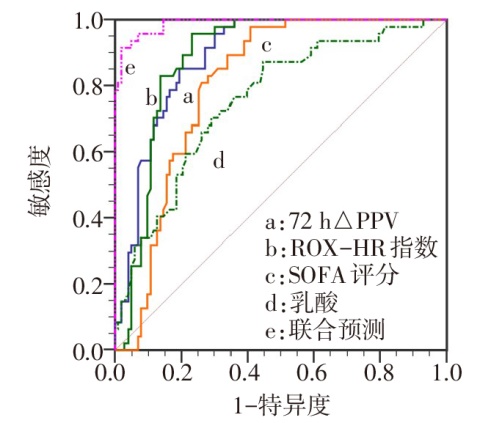
Fig.1 ROC curves of ROX-HR index, 72 h ΔPPV, SOFA score, lactate and the combined model for predicting the prognosis of patients with septic shock
| [1] | 金婷婷, 蔺雪, 尤伟艳, 等. 脓毒症急性肾损伤患者THBS1、TRAF-6、KIM-1、NLRP3水平及其与病情程度的关系[J]. 中华医院感染学杂志, 2025, 35(4):518-522. |
| Jin T T, Lin X, You W Y, et al. THBS1,TRAF-6,KIM-1,NLRP3 and their relationship with the severity of disease in sepsis patients with acute renal injury[J]. Chin J Nosocomiol, 2025, 35(4):518-522. doi:10.11816/cn.ni.2025-240823. | |
| [2] | 秦利静, 畅智慧. 中性粒细胞胞外诱捕网在脓毒症及其器官功能障碍中的研究进展[J]. 中华微生物学和免疫学杂志, 2025, 45(3):264-268. |
| Qin L J, Chang Z H. Progress in the role of neutrophil extracellular traps in sepsis and organ dysfunction[J]. Chin J Microbiol Immunol, 2025, 45(3):264-268. doi:10.3760/cma.j.cn112309-20231111-00130. | |
| [3] | 赖丽玲, 陈宝泉, 吴珠娥, 等. 多参数构建脓毒症休克预测模型[J]. 中华急诊医学杂志, 2025, 34(6):852-857. |
| Lai L L, Chen B Q, Wu Z E, et al. The prediction model of septic shock was constructed with multiple parameters[J]. Chin Crit Care Med, 2025, 34(6):852-857. doi:10.3760/cma.j.issn.1671-0282.2025.06.017. | |
| [4] | 董立鹏, 武新慧, 赵聪聪, 等. 不同种类液体复苏对早期脓毒症和脓毒症休克患者多糖包被的影响及临床意义:一项单中心、前瞻性、随机对照试验[J]. 中华危重病急救医学, 2025, 37(3):237-244. |
| Dong L P, Wu X H, Zhao C C, et al. Impact and clinical significance of different types of fluid resuscitation on the glycocalyx in patients with early sepsis and septic shock:a single center,prospective,randomized controlled trial[J]. Chin Crit Care Med, 2025, 37(3):237-244. doi:10.3760/cma.j.cn121430-20240711-00583. | |
| [5] | 吴静静, 张福森, 陈皓, 等. 血清Syndecan-1、endocan-1联合qSOFA评分在脓毒症诊断及预后评估中的应用价值[J]. 天津医药, 2025, 53(2):185-189. |
| Wu J J, Zhang F S, Chen H, et al. Application value of serum Syndecan-1,endocan-1 and qSOFA scores in diagnosis and prognosis of sepsis[J]. Tianjin Med J, 2025, 53(2):185-189. doi:10.11958/20241664. | |
| [6] | 吴飞, 时素琴, 王玉荣. ROX-HR指数联合血浆BNP水平对脓毒症休克液体复苏效果的预测价值[J]. 转化医学杂志, 2024, 13(5):705-709. |
| Wu F, Shi S Q, Wang Y R. Predictive value of ROX-HR index combined with plasma BNP level in fluid resuscitation of septic shock[J]. Translational Medicine Journal, 2024, 13(5):705-709. doi:10.3639/j.issn.2095-3097.2024.05.009. | |
| [7] | 中国医师协会急诊医师分会, 中国研究型医院学会休克与脓毒症专业委员会. 中国脓毒症/脓毒症休克急诊治疗指南(2018)[J]. 中国急救医学, 2018, 38(9):741-756. |
| Emergency Physicians Branch of Chinese Medical Doctor Association, Shock and Sepsis Professional Committee of Chinese Research Hospital Association. Chinese guidelines for the emergency treatment of sepsis/septic shock(2018)[J]. Chin J Crit Care Sep, 2018, 38(9):741-756. doi:10.3969/j.issn.1002-1949.2018.09.001. | |
| [8] | Evans L, Rhodes A, Alhazzani W, et al. Surviving sepsis campaign:international guidelines for management of sepsis and septic shock 2021[J]. Intensive Care Med, 2021, 47(11):1181-1247. doi:10.1007/s00134-021-06506-y. |
| [9] | Varon J, Baron R M. A current appraisal of evidence for the approach to sepsis and septic shock[J]. Ther Adv Infect Dis, 2019, 6:2049936119856517. doi:10.1177/2049936119856517. |
| [10] | Kumar S, Srivastava V K, Kaushik S, et al. Free radicals,mitochondrial dysfunction and sepsis-induced organ dysfunction:a mechanistic insight[J]. Curr Pharm Des, 2024, 30(3):161-168. doi:10.2174/0113816128279655231228055842. |
| [11] | 曹卫健, 王言理. ROX-HR指数对于脓毒症患者死亡率的预测价值[J]. 临床急诊杂志, 2024, 25(5):229-234. |
| Cao W J, Wang Y L. Predictive value of the ROX-HR index for mortality in patients with sepsis[J]. J Clin Emerg, 2024, 25(5):229-234. doi:10.13201/j.issn.1009-5918.2024.05.004. | |
| [12] | 丁斌, 郝明伟, 李从圣, 等. Pcv-aCO2/Ca-cvO2联合ROX指数对脓毒症患者病情及预后的价值[J]. 安徽医学, 2022, 43(8):881-886. |
| Ding B, Hao M W, Li C S, et al. Value of Pcv-aCO2/Ca-cvO2 combined with ROX index in evaluating severity and prognosis of patients with sepsis[J]. Anhui Medical Journal, 2022, 43(8):881-886. doi:10.3969/j.issn.1000-0399.2022.08.003. | |
| [13] | 赵霞飞, 丁明月, 邵换璋, 等. 血浆神经丝轻链对脓毒症ICU获得性衰弱的预测价值[J]. 中华实用诊断与治疗杂志, 2023, 37(3):304-307. |
| Zhao X F, Ding M Y, Shao H Z, et al. Value of plasma neurofilament light chain to the prediction of ICU-acquired weakness in patients with sepsis[J]. J Chin Pract Diagn Ther, 2023, 37(3):304-307. doi:10.13507/j.issn.1674-3474.2023.03.019. | |
| [14] | 毕春华, 朱曼晨, 倪辰, 等. 入重症监护病房时氧合指数对脓毒症患者30 d病死率的预测价值[J]. 中华危重病急救医学, 2025, 37(2):111-117. |
| Bi C H, Zhu M C, Ni C, et al. Predictive value of oxygenation index at intensive care unit admission for 30-day mortality in patients with sepsis[J]. Chin Crit Care Med, 2025, 37(2):111-117. doi:10.3760/cma.j.cn121430-20240327-00292. | |
| [15] | 梁煜, 董睿, 马丽, 等. 舌下微循环、高迁移率族蛋白B1与脓毒症性凝血病的相关性研究[J]. 中华急诊医学杂志, 2025, 34(6):837-843. |
| Liang Y, Dong R, Ma L, et al. Association between sublingual microcirculation,high mobility group box 1 protein,and sepsis induced coagulopathy:a clinical correlation study[J]. Chin J Emerg Med, 2025, 34(6):837-843. doi:10.3760/cma.j.issn.1671-0282.2025.06.015. | |
| [16] | Hung H C, Shen C H, Lee C F, et al. Sequential organ failure assessment(SOFA) score-based factors predict early mortality in high-risk patients with living donor liver transplant[J]. Ann Transplant, 2021, 26:e931045. doi:10.12659/AOT.931045. |
| [17] | Deulkar P, Singam A, Mudiganti V, et al. Lactate monitoring in intensive care:a comprehensive review of its utility and interpretation[J]. Cureus, 2024, 16(8):e66356. doi:10.7759/cureus.66356. |
| [18] | Lai K, Song C, Gao M, et al. Uridine alleviates sepsis-induced acute lung injury by inhibiting ferroptosis of macrophage[J]. Int J Mol Sci, 2023, 24(6):5093. doi:10.3390/ijms24065093. |
| [19] | 王历, 彭适, 蔡馨, 等. 血清PAD2、PCT及CRP对脓毒症的诊断价值[J]. 热带医学杂志, 2024, 24(9):1230-1234. |
| Wang L, Peng S, Cai X, et al. The diagnostic value of serum PAD2,PCT and CRP in sepsis[J]. J Trop Med, 2024, 24(9):1230-1234. doi:10.3969/j.issn.1672-3619.2024.09.004. | |
| [20] | Hao X, Duan H, Shi L, et al. Clinical value of combined detection of procalcitonin,D-dimer and fibrinogen in the evaluation of children with sepsis[J]. Pak J Med Sci, 2025, 41(7):1991-1995. doi:10.12669/pjms.41.7.11195. |
| [21] | 王志杨, 黄芳, 李世峰, 等. 基于乳酸脱氢酶/白蛋白比值的脓毒症28 d死亡预测模型构建与验证[J]. 中华危重病急救医学, 2024, 36(11):1140-1146. |
| Wang Z Y, Huang F, Li S F, et al. Establishment and validation of a sepsis 28-day mortality prediction model based on the lactate dehydrogenaseto-albumin ratio in patients with sepsis[J]. Chin Crit Care Med, 2024, 36(11):1140-1146. doi:10.3760/cma.j.cn121430-20231012-00865. | |
| [22] | Yan F, Chen X, Quan X, et al. Association between the stress hyperglycemia ratio and 28-day all-cause mortality in critically ill patients with sepsis:a retrospective cohort study and predictive model establishment based on machine learning[J]. Cardiovasc Diabetol, 2024, 23(1):163. doi:10.1186/s12933-024-02265-4. |
| Viewed | ||||||
|
Full text |
|
|||||
|
Abstract |
|
|||||
