
天津医药 ›› 2023, Vol. 51 ›› Issue (10): 1090-1097.doi: 10.11958/20221976
王柯1( ), 叶寒露2,△()
收稿日期:2022-12-02
修回日期:2023-02-17
出版日期:2023-10-15
发布日期:2023-10-18
通讯作者:
∆E-mail:jueax516@163.com
作者简介:王柯(1981),男,主治医师,主要从事膝关节骨性关节炎临床研究。E-mail:基金资助:
WANG Ke1(), YE Hanlu2,△()
Received:2022-12-02
Revised:2023-02-17
Published:2023-10-15
Online:2023-10-18
Contact:
∆E-mail:jueax516@163.com
王柯, 叶寒露. 大黄素对膝骨关节炎大鼠软骨细胞铁死亡的影响及机制研究[J]. 天津医药, 2023, 51(10): 1090-1097.
WANG Ke, YE Hanlu. Effect and its mechanism of emodin on the ferroptosis of chondrocytes in rats with knee osteoarthritis[J]. Tianjin Medical Journal, 2023, 51(10): 1090-1097.
摘要:
目的 探讨大黄素对膝骨关节炎(KOA)大鼠软骨细胞铁死亡的影响及其机制。方法 96只SD大鼠分为假手术(Sham)组、KOA组、大黄素(EMO)组、大黄素+Nrf2抑制剂(EMO+ML385)组,每组24只,除Sham组外,其余组均采用改良Hulth法构建KOA模型。酶联免疫吸附试验(ELISA)检测血清肿瘤坏死因子-α(TNF-α)、一氧化氮(NO)、前列腺素E2(PGE2)水平;肉眼观察膝关节大体形态;番红O-固绿染色观察膝关节软骨组织病理形态学;原位末端标记(TUNEL)染色检测膝关节软骨细胞凋亡率;生化试剂盒检测膝关节软骨组织中丙二醛(MDA)、活性氧(ROS)、谷胱甘肽(GSH)、亚铁离子(Fe2+)水平;实时荧光定量PCR(qRT-PCR)、蛋白免疫印迹或免疫组化检测膝关节软骨组织中基质金属蛋白酶(MMP)-3、MMP-13、Ⅱ型胶原α1(COL2A1)、前列腺素内过氧化物合酶2(PTGS2)、谷胱甘肽过氧化物酶4(GPX4)、长链脂酰辅酶A合成酶4(ACSL4)、核因子E2相关因子2(Nrf2)、血红素加氧酶-1(HO-1)mRNA或蛋白表达。结果 与Sham组比较,KOA组大鼠血清TNF-α、NO、PGE2水平,膝关节软骨组织国际骨关节炎研究协会(OARSI)评分,细胞凋亡率,MMP-3、MMP-13、PTGS2 mRNA和蛋白表达,MDA、ROS、Fe2+水平,ACSL4阳性细胞比例和ACSL4、胞核Nrf2、HO-1蛋白表达升高,GSH水平、COL2A1 mRNA和蛋白表达、GPX4阳性细胞比例和GPX4、胞质Nrf2蛋白表达降低(P<0.05),关节软骨明显破坏。EMO可改善KOA大鼠炎症反应、膝关节软骨组织损伤和软骨细胞铁死亡,同时进一步激活Nrf2/HO-1信号通路,而ML385不仅抑制Nrf2/HO-1信号通路激活,还可减弱EMO对KOA大鼠膝关节软骨组织损伤和软骨细胞铁死亡的改善作用。结论 大黄素可激活Nrf2/HO-1信号通路,抑制KOA大鼠软骨细胞铁死亡,保护膝关节软骨。
中图分类号:
| 基因名称 | 引物序列 |
|---|---|
| MMP-3 | 上游:5′-TTTGGCCGTCTCTTCCATCC-3′ |
| 下游:5′-GCATCGATCTTCTGGACGGT-3′ | |
| MMP-13 | 上游:5′-TTCTGGTCTTCTGGCACACG-3′ |
| 下游:5′-TGGAGCTGCTTGTCCAGGT-3′ | |
| COL2A1 | 上游:5′-GGTAAGTGGGGCAAGACTGTTA-3′ |
| 下游:5′-TGTTGTTTCTGGGTTCAGGTTT-3′ | |
| PTGS2 | 上游:5′-ATGTTCGCATTCTTTGCCCAG-3′ |
| 下游:5′-TACACCTCTCCACCGATGAC-3′ | |
| GAPDH | 上游:5′-ATGACAACTCCCTCAAGAT-3′ |
| 下游:5′-GATCCACAACGGATACATT-3′ |
表1 引物序列
Tab.1 Primer sequence
| 基因名称 | 引物序列 |
|---|---|
| MMP-3 | 上游:5′-TTTGGCCGTCTCTTCCATCC-3′ |
| 下游:5′-GCATCGATCTTCTGGACGGT-3′ | |
| MMP-13 | 上游:5′-TTCTGGTCTTCTGGCACACG-3′ |
| 下游:5′-TGGAGCTGCTTGTCCAGGT-3′ | |
| COL2A1 | 上游:5′-GGTAAGTGGGGCAAGACTGTTA-3′ |
| 下游:5′-TGTTGTTTCTGGGTTCAGGTTT-3′ | |
| PTGS2 | 上游:5′-ATGTTCGCATTCTTTGCCCAG-3′ |
| 下游:5′-TACACCTCTCCACCGATGAC-3′ | |
| GAPDH | 上游:5′-ATGACAACTCCCTCAAGAT-3′ |
| 下游:5′-GATCCACAACGGATACATT-3′ |
| 组别 | TNF-α/(ng/L) | NO/(μg/L) | PGE2/(μg/L) |
|---|---|---|---|
| Sham组 | 48.97±6.38 | 30.64±4.19 | 0.23±0.06 |
| KOA组 | 117.54±8.67a | 58.27±5.63a | 0.52±0.08a |
| EMO组 | 69.85±7.52b | 37.52±4.56b | 0.31±0.06b |
| EMO+ML385组 | 102.71±8.35c | 51.38±5.32c | 0.46±0.07c |
| F | 127.745** | 51.816** | 30.789** |
表2 各组大鼠血清TNF-α、NO、PGE2水平比较 (n=8,$\bar{x}±s$)
Tab.2 Comparison of serum TNF-α, NO and PGE2 levels between the four groups of rats
| 组别 | TNF-α/(ng/L) | NO/(μg/L) | PGE2/(μg/L) |
|---|---|---|---|
| Sham组 | 48.97±6.38 | 30.64±4.19 | 0.23±0.06 |
| KOA组 | 117.54±8.67a | 58.27±5.63a | 0.52±0.08a |
| EMO组 | 69.85±7.52b | 37.52±4.56b | 0.31±0.06b |
| EMO+ML385组 | 102.71±8.35c | 51.38±5.32c | 0.46±0.07c |
| F | 127.745** | 51.816** | 30.789** |
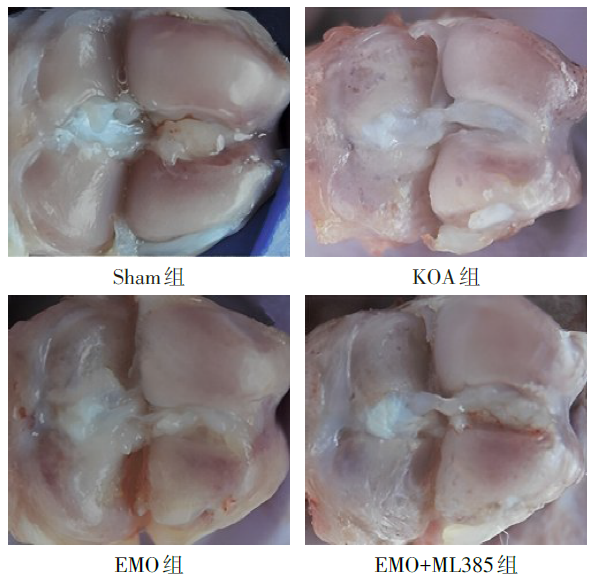
图1 各组大鼠膝关节大体形态
Fig.1 General morphology of knee joint of rats in each group
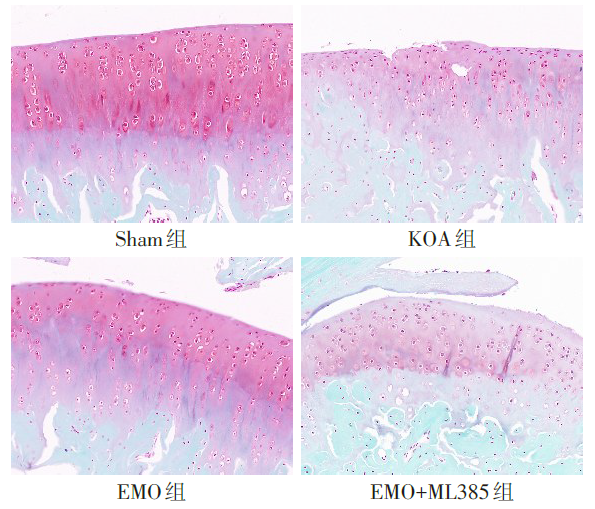
图2 各组大鼠膝关节软骨组织病理形态学变化(番红O- 固绿染色,×200)
Fig.2 Pathological changes of knee joint cartilage tissue of rats in each group (safranine O-solid green staining, ×200)
| 组别 | OARSI评分/分 | 凋亡率/% |
|---|---|---|
| Sham组 | 1.46±0.31 | 4.34±0.62 |
| KOA组 | 6.50±0.69a | 21.17±3.74a |
| EMO组 | 3.64±0.45b | 8.26±1.45b |
| EMO+ML385组 | 5.78±0.52c | 17.58±2.67c |
| F | 158.438** | 83.641** |
表3 各组大鼠膝关节软骨OARSI评分和软骨细胞凋亡率比较 (n=8,$\bar{x}±s$)
Tab.3 Comparison of OARSI score of knee joint cartilage and apoptosis rate of chondrocytes between the four groups of rats
| 组别 | OARSI评分/分 | 凋亡率/% |
|---|---|---|
| Sham组 | 1.46±0.31 | 4.34±0.62 |
| KOA组 | 6.50±0.69a | 21.17±3.74a |
| EMO组 | 3.64±0.45b | 8.26±1.45b |
| EMO+ML385组 | 5.78±0.52c | 17.58±2.67c |
| F | 158.438** | 83.641** |
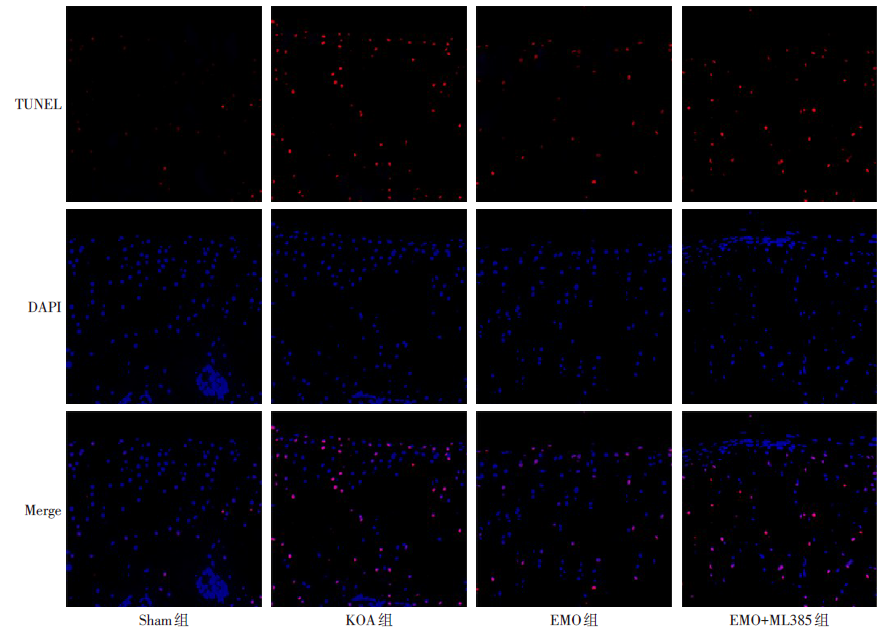
图3 各组大鼠膝关节软骨细胞凋亡情况(TUNEL染色,×200)
Fig.3 Apoptosis of chondrocytes of knee joint of rats in each group (TUNEL staining, ×200)
| 组别 | MMP-3 | MMP-13 | COL2A1 | PTGS2 |
|---|---|---|---|---|
| Sham组 | 0.98±0.09 | 1.01±0.10 | 1.00±0.08 | 1.02±0.09 |
| KOA组 | 3.52±0.13a | 2.73±0.11a | 0.39±0.06a | 3.68±0.12a |
| EMO组 | 2.16±0.10b | 1.85±0.12b | 0.75±0.08b | 1.54±0.08b |
| EMO+ML385组 | 3.04±0.12c | 2.30±0.13c | 0.48±0.07c | 3.07±0.11c |
| F | 806.586** | 324.090** | 114.629** | 1 225.437** |
表4 各组大鼠膝关节软骨组织中MMP-3、MMP-13、COL2A1、PTGS2 mRNA相对表达水平比较 (n=8,$\bar{x}±s$)
Tab.4 Comparison of MMP-3, MMP-13, COL2A1 and PTGS2 mRNA relative expression levels in knee joint cartilage between the four groups of rats
| 组别 | MMP-3 | MMP-13 | COL2A1 | PTGS2 |
|---|---|---|---|---|
| Sham组 | 0.98±0.09 | 1.01±0.10 | 1.00±0.08 | 1.02±0.09 |
| KOA组 | 3.52±0.13a | 2.73±0.11a | 0.39±0.06a | 3.68±0.12a |
| EMO组 | 2.16±0.10b | 1.85±0.12b | 0.75±0.08b | 1.54±0.08b |
| EMO+ML385组 | 3.04±0.12c | 2.30±0.13c | 0.48±0.07c | 3.07±0.11c |
| F | 806.586** | 324.090** | 114.629** | 1 225.437** |
| 组别 | MDA/(μmol/g) | ROS | GSH/(μmol/g) | Fe2+/(mg/g) |
|---|---|---|---|---|
| Sham组 | 3.41±0.48 | 1.00±0.00 | 7.98±0.75 | 0.26±0.06 |
| KOA组 | 8.96±0.65a | 3.68±0.37a | 3.61±0.49a | 0.64±0.08a |
| EMO组 | 5.37±0.54b | 1.95±0.26b | 6.37±0.64b | 0.41±0.07b |
| EMO+ ML385组 | 8.02±0.66c | 3.07±0.31c | 4.29±0.56c | 0.58±0.06c |
| F | 148.183** | 150.714** | 83.386** | 51.128** |
表5 各组大鼠膝关节软骨组织中MDA、ROS、GSH、Fe2+水平比较 (n=8,$\bar{x}±s$)
Tab.5 Comparison of MDA, ROS, GSH and Fe2+ levels in knee joint cartilage of rats between the four groups
| 组别 | MDA/(μmol/g) | ROS | GSH/(μmol/g) | Fe2+/(mg/g) |
|---|---|---|---|---|
| Sham组 | 3.41±0.48 | 1.00±0.00 | 7.98±0.75 | 0.26±0.06 |
| KOA组 | 8.96±0.65a | 3.68±0.37a | 3.61±0.49a | 0.64±0.08a |
| EMO组 | 5.37±0.54b | 1.95±0.26b | 6.37±0.64b | 0.41±0.07b |
| EMO+ ML385组 | 8.02±0.66c | 3.07±0.31c | 4.29±0.56c | 0.58±0.06c |
| F | 148.183** | 150.714** | 83.386** | 51.128** |
| 组别 | GPX4 | ACSL4 |
|---|---|---|
| Sham组 | 83.21±7.54 | 28.64±6.38 |
| KOA组 | 42.16±6.89a | 69.31±8.14a |
| EMO组 | 71.39±8.43b | 40.52±7.03b |
| EMO+ML385组 | 50.98±7.85c | 58.26±7.69c |
| F | 47.394** | 48.728** |
表6 各组大鼠膝关节软骨组织中GPX4、ACSL4阳性细胞比例比较 (n=8,%,$\bar{x}±s$)
Tab.6 Comparison of the proportion of GPX4 and ACSL4 positive cells in knee joint cartilage between the four groups of rats
| 组别 | GPX4 | ACSL4 |
|---|---|---|
| Sham组 | 83.21±7.54 | 28.64±6.38 |
| KOA组 | 42.16±6.89a | 69.31±8.14a |
| EMO组 | 71.39±8.43b | 40.52±7.03b |
| EMO+ML385组 | 50.98±7.85c | 58.26±7.69c |
| F | 47.394** | 48.728** |
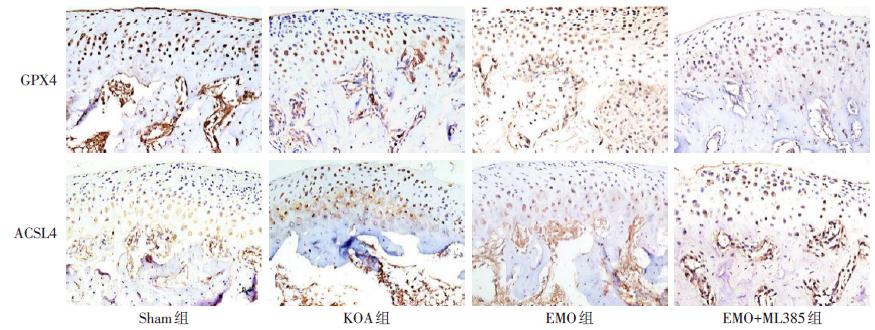
图4 各组大鼠膝关节软骨组织中GPX4、ACSL4阳性表达情况(免疫组化染色,×200)
Fig.4 Positive expression of GPX4 and ACSL4 in knee joint cartilage of rats in each group (immunohistochemistry staining, ×200)
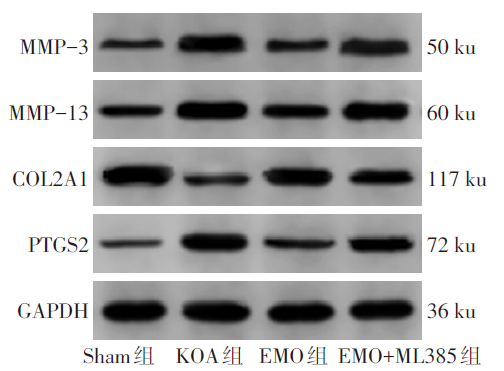
图5 各组大鼠膝关节软骨组织中MMP-3、MMP-13、COL2A1、PTGS2蛋白表达
Fig.5 Protein expression of MMP-3, MMP-13, COL2A1 and PTGS2 in knee joint cartilage of rats in each group
| 组别 | MMP-3 | MMP-13 | COL2A1 | PTGS2 |
|---|---|---|---|---|
| Sham组 | 0.23±0.04 | 0.29±0.05 | 0.79±0.05 | 0.19±0.04 |
| KOA组 | 0.85±0.06a | 0.93±0.06a | 0.38±0.04a | 0.72±0.05a |
| EMO组 | 0.34±0.05b | 0.42±0.05b | 0.71±0.05b | 0.28±0.04b |
| EMO+ML385组 | 0.72±0.06c | 0.84±0.06c | 0.46±0.04c | 0.53±0.06c |
| F | 249.676** | 256.525** | 149.984** | 199.799** |
表7 各组大鼠膝关节软骨组织中MMP-3、MMP-13、COL2A1、PTGS2蛋白相对表达水平比较 (n=8,$\bar{x}±s$)
Tab.7 Comparison of the protein relative expression levels of MMP-3, MMP-13, COL2A1 and PTGS2 in knee joint cartilage between the four groups of rats
| 组别 | MMP-3 | MMP-13 | COL2A1 | PTGS2 |
|---|---|---|---|---|
| Sham组 | 0.23±0.04 | 0.29±0.05 | 0.79±0.05 | 0.19±0.04 |
| KOA组 | 0.85±0.06a | 0.93±0.06a | 0.38±0.04a | 0.72±0.05a |
| EMO组 | 0.34±0.05b | 0.42±0.05b | 0.71±0.05b | 0.28±0.04b |
| EMO+ML385组 | 0.72±0.06c | 0.84±0.06c | 0.46±0.04c | 0.53±0.06c |
| F | 249.676** | 256.525** | 149.984** | 199.799** |
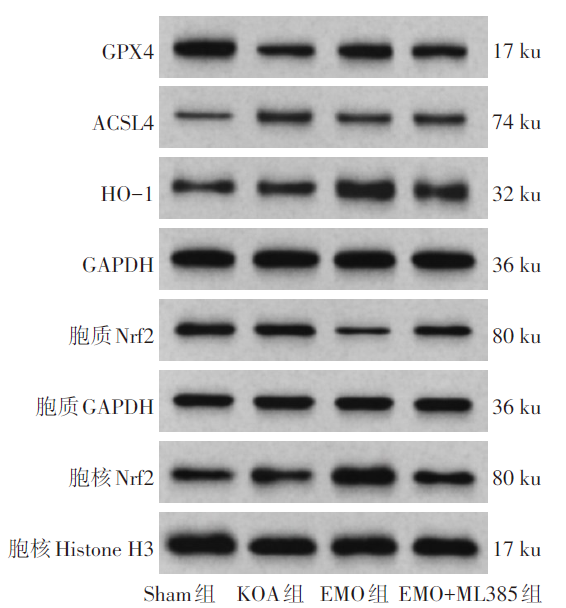
图6 各组大鼠膝关节软骨组织中GPX4、ACSL4、Nrf2、HO-1蛋白表达
Fig.6 Protein expression of GPX4, ACSL4, Nrf2 and HO-1 in knee joint cartilage of rats in each group
| 组别 | GPX4 | ACSL4 | HO-1 | 胞质Nrf2 | 胞核Nrf2 |
|---|---|---|---|---|---|
| Sham组 | 0.82±0.05 | 0.12±0.03 | 0.46±0.04 | 0.89±0.05 | 0.17±0.03 |
| KOA组 | 0.36±0.04a | 0.39±0.05a | 0.58±0.05a | 0.74±0.07a | 0.29±0.05a |
| EMO组 | 0.72±0.06b | 0.20±0.04b | 1.13±0.06b | 0.23±0.05b | 0.94±0.06b |
| EMO+ML385组 | 0.43±0.05c | 0.31±0.05c | 0.71±0.05c | 0.56±0.06c | 0.49±0.05c |
| F | 154.850** | 60.444** | 267.085** | 191.289** | 385.881** |
表8 各组大鼠膝关节软骨组织中GPX4、ACSL4、Nrf2、HO-1蛋白相对表达水平比较 (n=8,$\bar{x}±s$)
Tab.8 Comparison of the protein relative expression levels of GPX4, ACSL4, Nrf2 and HO-1 in knee joint cartilage of rats between the four groups
| 组别 | GPX4 | ACSL4 | HO-1 | 胞质Nrf2 | 胞核Nrf2 |
|---|---|---|---|---|---|
| Sham组 | 0.82±0.05 | 0.12±0.03 | 0.46±0.04 | 0.89±0.05 | 0.17±0.03 |
| KOA组 | 0.36±0.04a | 0.39±0.05a | 0.58±0.05a | 0.74±0.07a | 0.29±0.05a |
| EMO组 | 0.72±0.06b | 0.20±0.04b | 1.13±0.06b | 0.23±0.05b | 0.94±0.06b |
| EMO+ML385组 | 0.43±0.05c | 0.31±0.05c | 0.71±0.05c | 0.56±0.06c | 0.49±0.05c |
| F | 154.850** | 60.444** | 267.085** | 191.289** | 385.881** |
| [1] | KATZ J N, ARANT K R, LOESER R F. Diagnosis and treatment of hip and knee osteoarthritis:A review[J]. JAMA, 2021, 325(6):568-578. doi:10.1001/jama.2020.22171. |
| [2] | 李远栋, 杨琨, 王平, 等. 中药基于Wnt/β-catenin信号通路治疗膝骨性关节炎的研究进展[J]. 中草药, 2021, 52(21):6717-6723. |
| LI Y D, YANG K, WANG P, et al. Research progress on mechanism of traditional Chinese medicine against knee osteoarthritis based on Wnt/β-catenin signaling pathway[J]. Chin Tradit Herbal Drugs, 2021, 52(21):6717-6723. doi:10.7501/j.issn.0253-2670.2021.21.030. | |
| [3] | HU H, SONG X, LI Y, et al. Emodin protects knee joint cartilage in rats through anti-matrix degradation pathway:An in vitro and in vivo study[J]. Life Sci, 2021, 269:119001. doi:10.1016/j.lfs.2020.119001. |
| [4] | 海云翔, 巩彦龙, 宋敏, 等. 细胞程序性死亡在骨质疏松症中的研究进展[J]. 中国骨质疏松杂志, 2023, 29(1):89-94. |
| HAI Y X, GONG Y L, SONG M, et al. Effect of the programmed cell death of osteocyte on osteoporosis[J]. Chin J Osteoporos, 2023, 29(1):89-94. doi:10.3969/j.issn.1006-7108.2023.01.017. | |
| [5] | GUO Z, LIN J, SUN K, et al. Deferoxamine alleviates osteoarthritis by inhibiting chondrocyte ferroptosis and activating the Nrf2 pathway[J]. Front Pharmacol, 2022, 13:791376. doi:10.3389/fphar.2022.791376. |
| [6] | 张昊悦, 赵蓓, 王业皇, 等. 大黄素通过调节Nrf2/HO-和MAPKs抑制炎症和氧化应激机制研究[J]. 中国免疫学杂志, 2021, 37(9):1063-1068. |
| ZHANG H Y, ZHAO B, WANG Y H, et al. Emodin inhibits inflammation and oxidative stress by regulating Nrf2/HO-1 and MAPKs[J]. Chin J Immunol, 2021, 37(9):1063-1068. doi:10.3969/j.issn.1000-484X.2021.09.008. | |
| [7] | 吴强, 郑倩华, 蒋一璐, 等. 膝骨性关节炎动物模型选择与制备的比较[J]. 中国比较医学杂志, 2019, 29(5):125-130. |
| WU Q, ZHENG Q H, JIANG Y L, et al. Comparison of selection and preparation of animal models of knee osteoarthritis[J]. Chin J Comp Med, 2019, 29(5):125-130. doi:10.3969/j.issn.1671-7856.2019.05.020. | |
| [8] | GAO Z, SUI J, FAN R, et al. Emodin protects against acute pancreatitis-associated lung injury by inhibiting NLPR3 inflammasome activation via Nrf2/HO-1 signaling[J]. Drug Des Devel Ther, 2020, 14:1971-1982. doi:10.2147/DDDT.S247103. |
| [9] | BANNURU R R, OSANI M C, VAYSBROT E E, et al. OARSI guidelines for the non-surgical management of knee,hip,and polyarticular osteoarthritis[J]. Osteoarthritis Cartilage, 2019, 27(11):1578-1589. doi:10.1016/j.joca.2019.06.011. |
| [10] | JANG S, LEE K, JU J H. Recent updates of diagnosis,pathophysiology,and treatment on osteoarthritis of the knee[J]. Int J Mol Sci, 2021, 22(5):2619. doi:10.3390/ijms22052619. |
| [11] | DING Q H, YE C Y, CHEN E M, et al. Emodin ameliorates cartilage degradation in osteoarthritis by inhibiting NF-κB and Wnt/β-catenin signaling in-vitro and in-vivo[J]. Int Immunopharmacol, 2018, 61:222-230. doi:10.1016/j.intimp.2018.05.026. |
| [12] | LIU Z, LANG Y, LI L, et al. Effect of emodin on chondrocyte viability in an in vitro model of osteoarthritis[J]. Exp Ther Med, 2018, 16(6):5384-5389. doi:10.3892/etm.2018.6877. |
| [13] | LIAO H, ZHANG Z, LIU Z, et al. Inhibited microRNA-218-5p attenuates synovial inflammation and cartilage injury in rats with knee osteoarthritis by promoting sclerostin[J]. Life Sci, 2021, 267:118893. doi:10.1016/j.lfs.2020.118893. |
| [14] | GUAN T, DING L G, LU B Y, et al. Combined administration of curcumin and chondroitin sulfate alleviates cartilage injury and inflammation via NF-κB pathway in knee osteoarthritis rats[J]. Front Pharmacol, 2022, 13:882304. doi:10.3389/fphar.2022.882304. |
| [15] | YAO X, SUN K, YU S, et al. Chondrocyte ferroptosis contribute to the progression of osteoarthritis[J]. J Orthop Translat, 2020, 27:33-43. doi:10.1016/j.jot.2020.09.006. |
| [16] | HU Z, YIN Y, JIANG J, et al. Exosomal miR-142-3p secreted by hepatitis B virus (HBV)-hepatocellular carcinoma (HCC) cells promotes ferroptosis of M1-type macrophages through SLC3A2 and the mechanism of HCC progression[J]. J Gastrointest Oncol, 2022, 13(2):754-767. doi:10.21037/jgo-21-916. |
| [17] | 李哲, 袁长深, 官岩兵, 等. 骨关节炎中铁死亡的生物信息学分析与实验验证[J]. 中国组织工程研究, 2023, 27(17):2637-2643. |
| LI Z, YUAN C S, GUAN Y B, et al. Bioinformatic analysis and experimental validation of ferroptosis in osteoarthritis[J]. Chin J Tissue Engin Res, 2023, 27(17):2637-2643. doi:org/10.12307/2023.437. | |
| [18] | WANG Z, EFFERTH T, HUA X, et al. Medicinal plants and their secondary metabolites in alleviating knee osteoarthritis:A systematic review[J]. Phytomedicine, 2022, 105:154347. doi:10.1016/j.phymed.2022.154347. |
| [19] | ZHANG J, LIU L, LI F, et al. Treatment with catalpol protects against cisplatin-induced renal injury through Nrf2 and NF-κB signaling pathways[J]. Exp Ther Med, 2020, 20(4):3025-3032. doi:10.3892/etm.2020.9077. |
| [20] | BUSA P, LEE S O, HUANG N, et al. Carnosine alleviates knee osteoarthritis and promotes synoviocyte protection via activating the Nrf2/HO-1 signaling pathway: An in-vivo and in-vitro study[J]. Antioxidants (Basel), 2022, 11(6):1209. doi:10.3390/antiox11061209. |
| [21] | MA H, WANG X, ZHANG W, et al. Melatonin suppresses ferroptosis induced by high glucose via activation of the Nrf2/HO-1 signaling pathway in type 2 diabetic osteoporosis[J]. Oxid Med Cell Longev, 2020, 2020:9067610. doi:10.1155/2020/9067610. |
| [22] | SHANG L, LIU Y, LI J, et al. Emodin protects sepsis associated damage to the intestinal mucosal barrier through the VDR/Nrf2/HO-1 pathway[J]. Front Pharmacol, 2021, 12:724511. doi:10.3389/fphar.2021.724511. |
| [23] | WU H, LUAN Y, WANG H, et al. Selenium inhibits ferroptosis and ameliorates autistic-like behaviors of BTBR mice by regulating the Nrf2/GPx4 pathway[J]. Brain Res Bull, 2022, 183:38-48. doi:10.1016/j.brainresbull.2022.02.018. |
| [1] | 吕大鹏, 周红荣, 李丹, 周娜. 瑞芬太尼调节HIF-1α/BNIP3通路对骨关节炎大鼠软骨损伤的影响[J]. 天津医药, 2026, 54(7): 699-704. |
| [2] | 邓新宜, 杨晨, 曹建林, 杨磊, 谭建, 贾强, 孟召伟. 金诺芬抑制葡萄糖摄取并诱导未分化甲状腺癌铁死亡[J]. 天津医药, 2026, 54(6): 570-576. |
| [3] | 何玉, 孙宇, 张艺琼, 许永劼, 王双, 潘卫, 任智晶. 大黄素改善高糖诱导海马神经元线粒体自噬障碍的研究[J]. 天津医药, 2026, 54(5): 449-454. |
| [4] | 艾希睿, 赵亚男, 刘鹏, 闫景明, 朱藜, 苑成浩. 膝关节腔内注射PRP联合间歇性低氧训练治疗早期膝骨关节炎的疗效及安全性[J]. 天津医药, 2026, 54(4): 384-389. |
| [5] | 高峰, 陈达, 惠文文. 钩吻素子调节AMPK/NLRP3信号通路对膝骨关节炎大鼠软骨损伤的影响[J]. 天津医药, 2026, 54(2): 158-163. |
| [6] | 赵兰君, 李良惠, 马馨, 巩娇娇, 郑臣辉, 石琳. 穿心莲内酯调控STAT3/GPX4通路对骨髓瘤细胞增殖和凋亡的影响[J]. 天津医药, 2026, 54(1): 8-13. |
| [7] | 李荣琪, 李宇轩, 张燕, 李昕, 魏蔚. 血清干扰素调节因子1在类风湿关节炎中的临床意义[J]. 天津医药, 2026, 54(1): 84-87. |
| [8] | 何仁豪, 张聘, 尹识渊, 张杰. 关节镜探查联合单髁置换术对膝关节骨性关节炎患者膝关节功能的影响[J]. 天津医药, 2025, 53(7): 725-729. |
| [9] | 苏红见, 张春艳, 张卫东, 韩利, 乔亚红. 鸢尾素调控EBF3/ALOX15通路影响肺腺癌细胞增殖和迁移[J]. 天津医药, 2025, 53(4): 337-342. |
| [10] | 钟玉梅, 何流, 张敏, 周海燕. 艾灸调控巨噬细胞不同表型极化治疗RA滑膜炎症的疗效[J]. 天津医药, 2025, 53(3): 236-241. |
| [11] | 贾方, 李平, 李静, 尹路. 全膝关节置换术后神经认知功能障碍的影响因素及列线图模型的构建[J]. 天津医药, 2025, 53(3): 287-292. |
| [12] | 崔琳, 李海晴, 陈雨彤, 朱佳璇, 王璐怡. 经皮神经电刺激联合动态关节松动术对膝骨关节炎疗效观察[J]. 天津医药, 2025, 53(12): 1285-1289. |
| [13] | 高辰, 乔云阳, 季嘉玲, 王娥, 霍影, 张爱青. 蟾蜍灵对高糖诱导的肾小管上皮细胞细胞外基质合成的影响[J]. 天津医药, 2025, 53(10): 1009-1015. |
| [14] | 吕婧, 朱方颖, 朱凯, 李云, 杨娜, 温淑云, 仲米倩. 类风湿关节炎患者动脉粥样硬化风险预测模型的构建与验证[J]. 天津医药, 2025, 53(10): 1043-1047. |
| [15] | 李波, 林红, 黄兰英, 李玲钰. HMOX1和MAPK14与脓毒症急性肺损伤患儿发病和预后的关系[J]. 天津医药, 2025, 53(10): 1052-1056. |
| 阅读次数 | ||||||
|
全文 |
|
|||||
|
摘要 |
|
|||||
