
Tianjin Medical Journal ›› 2025, Vol. 53 ›› Issue (9): 967-971.doi: 10.11958/20250589
• Clinical Research • Previous Articles Next Articles
GAO Zhengjie( ), MENG Tao, ZHANG Qiao, CHEN Binghe, HOU Dong, ZHU Shaohui△()
Received:2025-02-06
Revised:2025-05-26
Published:2025-09-15
Online:2025-09-16
Contact:
△E-mail: GAO Zhengjie, MENG Tao, ZHANG Qiao, CHEN Binghe, HOU Dong, ZHU Shaohui. The predictive value of preoperative CALLY index for the short-term prognosis in patients undergoing radical gastrectomy[J]. Tianjin Medical Journal, 2025, 53(9): 967-971.
CLC Number:
| 组别 | PLT/(×109/L) | CRP/(mg/L) | ALB/(g/L) | PA/(mg/L) | |||||||
|---|---|---|---|---|---|---|---|---|---|---|---|
| 预后良好组 | 252.4±75.6 | 3.3±0.6 | 38.5±4.2 | 250.9±45.5 | |||||||
| 预后不良组 | 285.9±91.4 | 4.6±0.9 | 35.2±5.1 | 217.6±58.6 | |||||||
| t | 1.971 | 9.292** | 7.666** | 3.226** | |||||||
| 组别 | n | WBC/(×109/L) | NEU/(×109/L) | LYM/(×109/L) | |||||||
| 预后良好组 | 205 | 7.0±1.8 | 4.6±1.3 | 2.0±0.5 | |||||||
| 预后不良组 | 23 | 7.9±2.2 | 5.6±1.8 | 1.6±0.6 | |||||||
| t | 2.221* | 3.352** | 3.563** | ||||||||
| 组别 | Hb/(g/L) | TC/(mmol/L) | CALLY指数 | ||||||||
| 预后良好组 | 122.4±15.1 | 4.5±1.2 | 2.32±0.96 | ||||||||
| 预后不良组 | 116.9±18.3 | 3.9±1.1 | 1.29±0.41 | ||||||||
| t | 1.620 | 2.292* | 5.074** | ||||||||
Tab.1 Comparison of clinical characteristics between the good prognosis group and the poor prognosis group
| 组别 | PLT/(×109/L) | CRP/(mg/L) | ALB/(g/L) | PA/(mg/L) | |||||||
|---|---|---|---|---|---|---|---|---|---|---|---|
| 预后良好组 | 252.4±75.6 | 3.3±0.6 | 38.5±4.2 | 250.9±45.5 | |||||||
| 预后不良组 | 285.9±91.4 | 4.6±0.9 | 35.2±5.1 | 217.6±58.6 | |||||||
| t | 1.971 | 9.292** | 7.666** | 3.226** | |||||||
| 组别 | n | WBC/(×109/L) | NEU/(×109/L) | LYM/(×109/L) | |||||||
| 预后良好组 | 205 | 7.0±1.8 | 4.6±1.3 | 2.0±0.5 | |||||||
| 预后不良组 | 23 | 7.9±2.2 | 5.6±1.8 | 1.6±0.6 | |||||||
| t | 2.221* | 3.352** | 3.563** | ||||||||
| 组别 | Hb/(g/L) | TC/(mmol/L) | CALLY指数 | ||||||||
| 预后良好组 | 122.4±15.1 | 4.5±1.2 | 2.32±0.96 | ||||||||
| 预后不良组 | 116.9±18.3 | 3.9±1.1 | 1.29±0.41 | ||||||||
| t | 1.620 | 2.292* | 5.074** | ||||||||
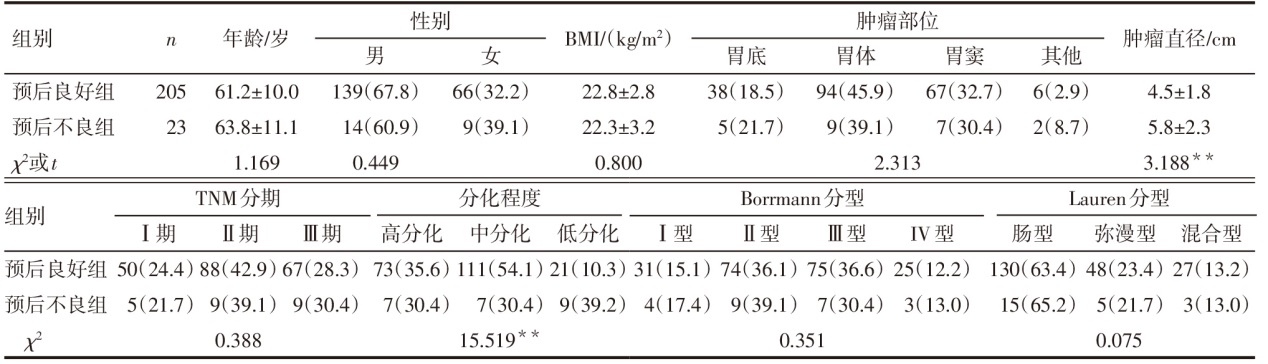 |
Tab.2 Comparison of clinical characteristics between the good prognosis group and the poor prognosis group
| |
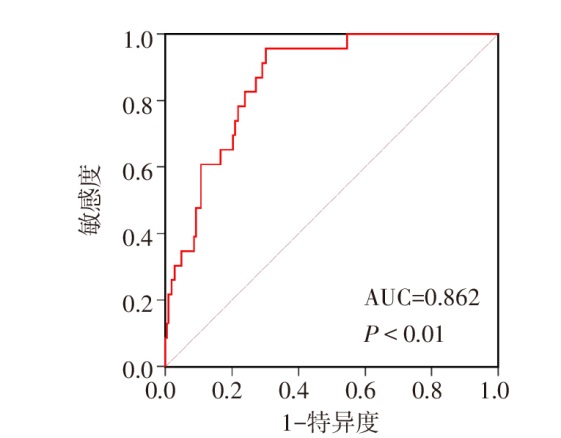
Fig.1 ROC curve of the CALLY index for predicting poor prognosis in patients with gastric cancer after radical gastrectomy
| 变量 | β | SE | Wald χ2 | P | HR(95%CI) |
|---|---|---|---|---|---|
| 单因素 | |||||
| CALLY指数 | -0.873 | 0.362 | 5.816 | 0.016 | 0.418(0.205~0.849) |
| 多因素 | |||||
| CALLY指数 | -1.484 | 0.562 | 4.438 | 0.035 | 0.306(0.102~0.921) |
| 肿瘤直径 | 0.638 | 0.225 | 8.040 | 0.005 | 1.893(1.218~2.942) |
| 分化程度 | 0.718 | 0.286 | 6.303 | 0.012 | 2.050(1.171~3.591) |
Tab.3 The effects of univariate and multivariate Cox regression analyses on poor prognosis of patients with gastric cancer
| 变量 | β | SE | Wald χ2 | P | HR(95%CI) |
|---|---|---|---|---|---|
| 单因素 | |||||
| CALLY指数 | -0.873 | 0.362 | 5.816 | 0.016 | 0.418(0.205~0.849) |
| 多因素 | |||||
| CALLY指数 | -1.484 | 0.562 | 4.438 | 0.035 | 0.306(0.102~0.921) |
| 肿瘤直径 | 0.638 | 0.225 | 8.040 | 0.005 | 1.893(1.218~2.942) |
| 分化程度 | 0.718 | 0.286 | 6.303 | 0.012 | 2.050(1.171~3.591) |
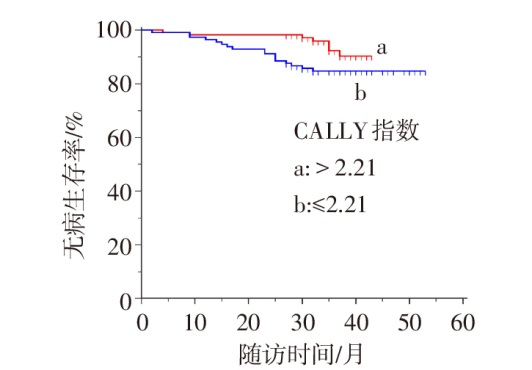
Fig.2 The disease-free survival curves of the high CALLY index group and the low CALLY index group
| [1] | LI Y, HAHN A I, LASZKOWSKA M, et al. Clinicopathological characteristics and risk factors of young-onset gastric carcinoma:a systematic review and meta-analysis[J]. Clin Transl Gastroenterol, 2024, 15(6):e1. doi:10.14309/ctg.0000000000000714. |
| [2] | ZHENG W, TIAN X, FAN J, et al. Application of dexmedetomidine in surgical anesthesia for gastric cancer and its effects on IL-1β,IL-6,TNF-α and CRP[J]. Cell Mol Biol(Noisy-le-grand), 2023, 69(3):177-181. doi:10.14715/cmb/2023.69.3.26. |
| [3] | MAO Y, LIU J, LI J, et al. Elevation of preoperative serum hs-CRP is an independent risk factor for malnutrition in patients with gastric cancer[J]. Front Oncol, 2023, 13:1173532. doi:10.3389/fonc.2023.1173532. |
| [4] | CHEN C, WANG Z, QIN Y. A novel hematological inflammation-nutrition score(HINS)and its related nomogram model to predict survival outcome in advanced gastric cancer patients receiving first-line palliative chemotherapy[J]. J Inflamm Res, 2023, 16:2929-2946. doi:10.2147/JIR.S417798. |
| [5] | CHEN L, SUN H, ZHAO R, et al. Controlling nutritional status(CONUT) predicts survival in gastric cancer patients with immune checkpoint inhibitor(PD-1/PD-L1)outcomes[J]. Front Pharmacol, 2022, 13:836958. doi:10.3389/fphar.2022.836958. |
| [6] | HÖGNER A, MOEHLER M. Immunotherapy in gastric cancer[J]. Curr Oncol, 2022, 29(3):1559-1574. doi:10.3390/curroncol29030131. |
| [7] | IIDA H, TANI M, KOMEDA K, et al. Superiority of CRP-albumin-lymphocyte index (CALLY index)as a non-invasive prognostic biomarker after hepatectomy for hepatocellular carcinoma[J]. HPB (Oxford), 2022, 24(1):101-115. doi:10.1016/j.hpb.2021.06.414. |
| [8] | MÜLLER L, HAHN F, MäHRINGER-KUNZ A, et al. Immunonutritive scoring for patients with hepatocellular carcinoma undergoing transarterial chemoembolization:evaluation of the CALLY index[J]. Cancers (Basel), 2021, 13(19):5018. doi:10.3390/cancers13195018. |
| [9] | YANG M, LIN S Q, LIU X Y, et al. Association between C-reactive protein-albumin-lymphocyte(CALLY)index and overall survival in patients with colorectal cancer:from the investigation on nutrition status and clinical outcome of common cancers study[J]. Front Immunol, 2023, 14:1131496. doi:10.3389/fimmu.2023.1131496. |
| [10] | 中国抗癌协会胃癌专业委员会影像协作组,中华放射学会腹部学组. 胃癌影像学检查与诊断规范化流程专家共识(2022版)[J]. 中华胃肠外科杂志, 2022, 25(10):859-868. |
| Imaging Cooperative Group of Gastric Cancer Professional Committee of China Anti-Cancer Association. Abdomen Group of Chinese Society of Radiology. Expert consensus on standardized process of imaging examination and diagnosis of gastric cancer (2022 edition)[J]. Chinese Journal of Gastrointestinal Surgery, 2022, 25(10):859-868.doi:10.3760/cma.j.cn441530-20220703-00295. | |
| [11] | 中国腹腔镜胃肠外科研究组(CLASS), 中国抗癌协会胃癌专业委员会,中华医学会外科分会腹腔镜与内镜外科学组. 腹腔镜局部进展期远端胃癌D2根治术标准操作流程:CLASS-01研究共识[J]. 中华胃肠外科杂志, 2019, 22(9):807-811. |
| Chinese Laparoscopic Gastrointestinal Surgery Study Group(CLASS), Gastric Cancer Professional Committee of Chinese Anti-Cancer Association,Laparoscopic and Endoscopic Surgery Group, Chinese Medical Association Surgical Branch. Standard operation procedure of laparoscopic D2 distal gastrectomy for locally advanced gastric cancer:consensus on CLASS-01 trial[J]. Chinese Journal of Gastrointestinal Surgery, 2019, 22(9):807-811. doi:10.3760/cma.j.issn.1671-0274.2019.09.002. | |
| [12] | FENG J, WANG L, YANG X, et al. Clinical significance of preoperative CALLY index for prognostication in patients with esophageal squamous cell carcinoma undergoing surgery[J]. Sci Rep, 2024, 14(1):713. doi:10.1038/s41598-023-51109-w. |
| [13] | 张晶晶, 赵文栋, 赵远, 等. CALLY指数对缺血性脑卒中后抑郁的预测价值[J]. 天津医药, 2024, 52(12):1300-1304. |
| ZHANG J J, ZHAO W D, ZHAO Y, et al. Predictive value of CALLY index for depression after ischemic stroke[J]. Tianjin Med J, 2024, 52(12):1300-1304. doi:10.11958/20241063. | |
| [14] | 王刚, 曹立瀛, 陈朔华, 等. 基线高敏C反应蛋白水平与女性消化系统恶性肿瘤发病风险的队列研究[J]. 中华肿瘤杂志, 2016, 38(11):876-880. |
| WANG G, CAO L Y, CHEN S H, et al. A prospective follow-up study on thea ssociation between serum level of C-reactive protein and risk of digestive system cancers in Chinese women[J]. Chinese Journal of Oncology, 2016, 38(11):876-880. doi:10.3760/cma.j.issn.0253-3766.2016.11.015. | |
| [15] | SHOKA M, KANDA M, ITO S, et al. Modified albumin-bilirubin grade optimized for risk stratification of patients with stage II-III gastric cancer[J]. Surg Today, 2023, 53(10):1149-1159. doi:10.1007/s00595-023-02669-x. |
| [16] | WANG W, GU J, LIU Y, et al. Pre-treatment CRP-albumin-lymphocyte index(CALLY index)as a prognostic biomarker of survival in patients with epithelial ovarian cancer[J]. Cancer Manag Res, 2022, 14:2803-2812. doi:10.2147/CMAR.S359968. |
| [17] | MUTLUCAN U O, BEDEL C, SELVI F, et al. The effect of indicators of CALLY index on survival in glioblastoma[J]. Ir J Med Sci, 2024, 193(4):2029-2033. doi:10.1007/s11845-024-03666-w. |
| [18] | MA R, OKUGAWA Y, SHIMURA T, et al. Clinical implications of C-reactive protein-albumin-lymphocyte (CALLY) index in patients with esophageal cancer[J]. Surg Oncol, 2024, 53:102044. doi:10.1016/j.suronc.2024.102044. |
| [19] | AOYAMA T, HASHIMOTO I, MAEZAWA Y, et al. CRP-albumin-lymphocyte(CALLY)index is an independent prognostic factor for the esophageal cancer patients who received curative treatment[J]. Anticancer Res, 2024, 44(2):815-822. doi:10.21873/anticanres.16873. |
| Viewed | ||||||
|
Full text |
|
|||||
|
Abstract |
|
|||||
