
Tianjin Medical Journal ›› 2026, Vol. 54 ›› Issue (2): 211-215.doi: 10.11958/20251554
• Epidemiological Survey • Previous Articles Next Articles
XI Rui1( ), GUO Dongxia2, FENG Kai2, ZHANG Dongfang1, ZHANG Qiang1, YANG Xueli1, LI Tongmin2,△()
Received:2025-04-07
Revised:2025-09-30
Published:2026-02-15
Online:2026-02-12
Contact:
△E-mail:XI Rui, GUO Dongxia, FENG Kai, ZHANG Dongfang, ZHANG Qiang, YANG Xueli, LI Tongmin. Study on the disease burden of polycystic ovary syndrome in women worldwide and in China from 1990 to 2021 and ten-year trend forecast[J]. Tianjin Medical Journal, 2026, 54(2): 211-215.
CLC Number:
| 年龄段 | 发病率(95%UI) | 患病率(95%UI) | DALYs率(95%UI) | |
|---|---|---|---|---|
| 10~<15岁 | 348.52(185.23,566.54) | 588.50(311.61,960.06) | 5.11(2.07,11.32) | |
| 15~<20岁 | 347.88(217.07,540.95) | 2 523.76(1 707.00,3 613.35) | 22.66(10.00,48.03) | |
| 20~<25岁 | 17.10(6.97,42.46) | 3 453.97(2 489.13,4 742.61) | 31.71(14.20,65.97) | |
| 25~<30岁 | 9.97(5.08,18.52) | 3 581.86(2 571.90,4 968.04) | 32.14(14.15,65.96) | |
| 30~<35岁 | 5.75(2.63,9.22) | 3 600.50(2 579.79,5 007.28) | 31.20(13.75,66.48) | |
| 35~<40岁 | 4.33(1.99,7.09) | 3 644.97(2 588.05,5 067.78) | 31.02(13.70,65.23) | |
| 40~<45岁 | 2.79(1.06,4.80) | 3 687.03(2 637.99,5 121.84) | 31.24(13.90,65.23) | |
| 45~<50岁 | 1.43(0.30,2.91) | 3 182.50(2 297.85,4 407.06) | 26.99(12.17,53.83) | |
| 50~<55岁 | 0.44(0.06,1.17) | 809.75(560.45,1 130.82) | 6.82(3.02,14.70) | |
| 合计 | 58.53(42.12,80.55) | 1 766.89(1 259.71,2 434.52) | 15.46(6.94,32.26) | |
Tab.1 Global disease burden of PCOS by age group in 2021
| 年龄段 | 发病率(95%UI) | 患病率(95%UI) | DALYs率(95%UI) | |
|---|---|---|---|---|
| 10~<15岁 | 348.52(185.23,566.54) | 588.50(311.61,960.06) | 5.11(2.07,11.32) | |
| 15~<20岁 | 347.88(217.07,540.95) | 2 523.76(1 707.00,3 613.35) | 22.66(10.00,48.03) | |
| 20~<25岁 | 17.10(6.97,42.46) | 3 453.97(2 489.13,4 742.61) | 31.71(14.20,65.97) | |
| 25~<30岁 | 9.97(5.08,18.52) | 3 581.86(2 571.90,4 968.04) | 32.14(14.15,65.96) | |
| 30~<35岁 | 5.75(2.63,9.22) | 3 600.50(2 579.79,5 007.28) | 31.20(13.75,66.48) | |
| 35~<40岁 | 4.33(1.99,7.09) | 3 644.97(2 588.05,5 067.78) | 31.02(13.70,65.23) | |
| 40~<45岁 | 2.79(1.06,4.80) | 3 687.03(2 637.99,5 121.84) | 31.24(13.90,65.23) | |
| 45~<50岁 | 1.43(0.30,2.91) | 3 182.50(2 297.85,4 407.06) | 26.99(12.17,53.83) | |
| 50~<55岁 | 0.44(0.06,1.17) | 809.75(560.45,1 130.82) | 6.82(3.02,14.70) | |
| 合计 | 58.53(42.12,80.55) | 1 766.89(1 259.71,2 434.52) | 15.46(6.94,32.26) | |
| 年龄段 | 发病率(95%UI) | 患病率(95%UI) | DALYs率(95%UI) | |
|---|---|---|---|---|
| 10~<15岁 | 318.95(163.62,525.15) | 538.30(273.70,888.11) | 4.69(1.85,10.39) | |
| 15~<20岁 | 317.17(194.96,506.81) | 2 355.47(1 561.64,3 424.03) | 21.12(9.23,45.85) | |
| 20~<25岁 | 20.29(8.18,51.95) | 3 152.21(2 172.27,4 475.82) | 28.32(12.52,58.89) | |
| 25~<30岁 | 11.78(5.95,22.32) | 3 185.40(2 216.66,4 486.80) | 27.75(11.90,58.19) | |
| 30~<35岁 | 6.71(3.08,10.67) | 3 176.70(2 226.05,4 512.19) | 26.94(11.59,57. 36) | |
| 35~<40岁 | 5.08(2.33,8.32) | 3 136.47(2 184.73,4 484.60) | 26.35(11.31,55.00) | |
| 40~<45岁 | 3.30(1.38,5.76) | 3 068.28(2 148.52,4 351.29) | 25.70(11.13,53.28) | |
| 45~<50岁 | 1.67(0.33,3.43) | 2 652.35(1 867.24,3 763.75) | 22.42(10.00,46.13) | |
| 50~<55岁 | 0.51(0.05,1.33) | 635.66(424.95,918.72) | 5.39(2.30,11.66) | |
| 合计 | 37.28(26.40,52.04) | 1 450.75(1 024.99,2 051.31) | 12.44(5.46,25.69) | |
Tab.2 Disease burden of PCOS in China by age group in 2021
| 年龄段 | 发病率(95%UI) | 患病率(95%UI) | DALYs率(95%UI) | |
|---|---|---|---|---|
| 10~<15岁 | 318.95(163.62,525.15) | 538.30(273.70,888.11) | 4.69(1.85,10.39) | |
| 15~<20岁 | 317.17(194.96,506.81) | 2 355.47(1 561.64,3 424.03) | 21.12(9.23,45.85) | |
| 20~<25岁 | 20.29(8.18,51.95) | 3 152.21(2 172.27,4 475.82) | 28.32(12.52,58.89) | |
| 25~<30岁 | 11.78(5.95,22.32) | 3 185.40(2 216.66,4 486.80) | 27.75(11.90,58.19) | |
| 30~<35岁 | 6.71(3.08,10.67) | 3 176.70(2 226.05,4 512.19) | 26.94(11.59,57. 36) | |
| 35~<40岁 | 5.08(2.33,8.32) | 3 136.47(2 184.73,4 484.60) | 26.35(11.31,55.00) | |
| 40~<45岁 | 3.30(1.38,5.76) | 3 068.28(2 148.52,4 351.29) | 25.70(11.13,53.28) | |
| 45~<50岁 | 1.67(0.33,3.43) | 2 652.35(1 867.24,3 763.75) | 22.42(10.00,46.13) | |
| 50~<55岁 | 0.51(0.05,1.33) | 635.66(424.95,918.72) | 5.39(2.30,11.66) | |
| 合计 | 37.28(26.40,52.04) | 1 450.75(1 024.99,2 051.31) | 12.44(5.46,25.69) | |
| 范围 | ASIR(95%UI)/10万 | AAPC (95%CI)/% | |||
|---|---|---|---|---|---|
| 1990年 | 2000年 | 2010年 | 2021年 | ||
| 全球 | 49.45(35.57,68.45) | 53.50(38.69,73.52) | 57.11(41.97,77.54) | 63.26(45.41,87.28) | 0.80(0.79,0.81) |
| 中国 | 31.62(22.52,44.15) | 42.39(30.15,59.20) | 49.09(34.93,68.36) | 58.61(41.19,82.36) | 2.01(1.99,2.04) |
| 范围 | ASPR(95%UI)/10万 | AAPC (95%CI)/% | |||
| 1990年 | 2000年 | 2010年 | 2021年 | ||
| 全球 | 1 372.77(984.64,1 891.60) | 1 505.11(1 088.94,2 043.26) | 1 574.42(1 151.90,2 131.29) | 1 757.83(1 253.36,2 421.26) | 0.81(0.80,0.82) |
| 中国 | 832.95(590.98,1 169.17) | 1 109.81(779.11,1 559.31) | 1 309.05(924.84,1 825.31) | 1 544.17(1 081.83,2 169.82) | 2.01(1.99,2.03) |
| 范围 | ASDR(95%UI)/10万 | AAPC (95%CI)/% | |||
| 1990年 | 2000年 | 2010年 | 2021年 | ||
| 全球 | 12.08(5.38,25.21) | 13.24(5.93,27.86) | 13.84(6.25,28.90) | 15.40(6.91,32.13) | 0.79(0.78,0.80) |
| 中国 | 7.13(3.08,14.86) | 9.58(4.18,19.89) | 11.32(4.92,23.82) | 13.34(5.88,27.55) | 2.04(2.02,2.06) |
Tab.3 The changes in the global and Chinese disease burden of PCOS in 1990, 2000, 2010 and 2021
| 范围 | ASIR(95%UI)/10万 | AAPC (95%CI)/% | |||
|---|---|---|---|---|---|
| 1990年 | 2000年 | 2010年 | 2021年 | ||
| 全球 | 49.45(35.57,68.45) | 53.50(38.69,73.52) | 57.11(41.97,77.54) | 63.26(45.41,87.28) | 0.80(0.79,0.81) |
| 中国 | 31.62(22.52,44.15) | 42.39(30.15,59.20) | 49.09(34.93,68.36) | 58.61(41.19,82.36) | 2.01(1.99,2.04) |
| 范围 | ASPR(95%UI)/10万 | AAPC (95%CI)/% | |||
| 1990年 | 2000年 | 2010年 | 2021年 | ||
| 全球 | 1 372.77(984.64,1 891.60) | 1 505.11(1 088.94,2 043.26) | 1 574.42(1 151.90,2 131.29) | 1 757.83(1 253.36,2 421.26) | 0.81(0.80,0.82) |
| 中国 | 832.95(590.98,1 169.17) | 1 109.81(779.11,1 559.31) | 1 309.05(924.84,1 825.31) | 1 544.17(1 081.83,2 169.82) | 2.01(1.99,2.03) |
| 范围 | ASDR(95%UI)/10万 | AAPC (95%CI)/% | |||
| 1990年 | 2000年 | 2010年 | 2021年 | ||
| 全球 | 12.08(5.38,25.21) | 13.24(5.93,27.86) | 13.84(6.25,28.90) | 15.40(6.91,32.13) | 0.79(0.78,0.80) |
| 中国 | 7.13(3.08,14.86) | 9.58(4.18,19.89) | 11.32(4.92,23.82) | 13.34(5.88,27.55) | 2.04(2.02,2.06) |
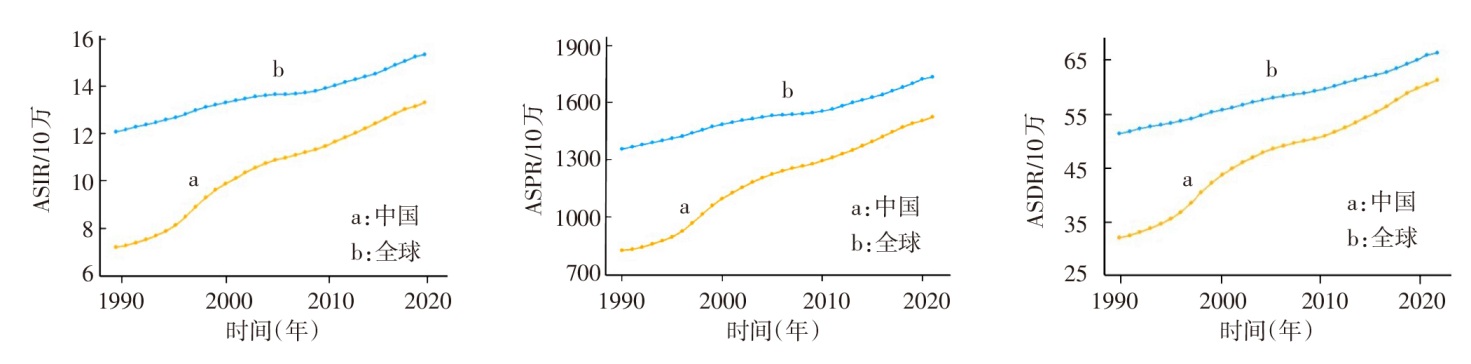
Fig.1 Temporal trends of ASIR, ASPR and ASDR of PCOS in global and Chinese populations
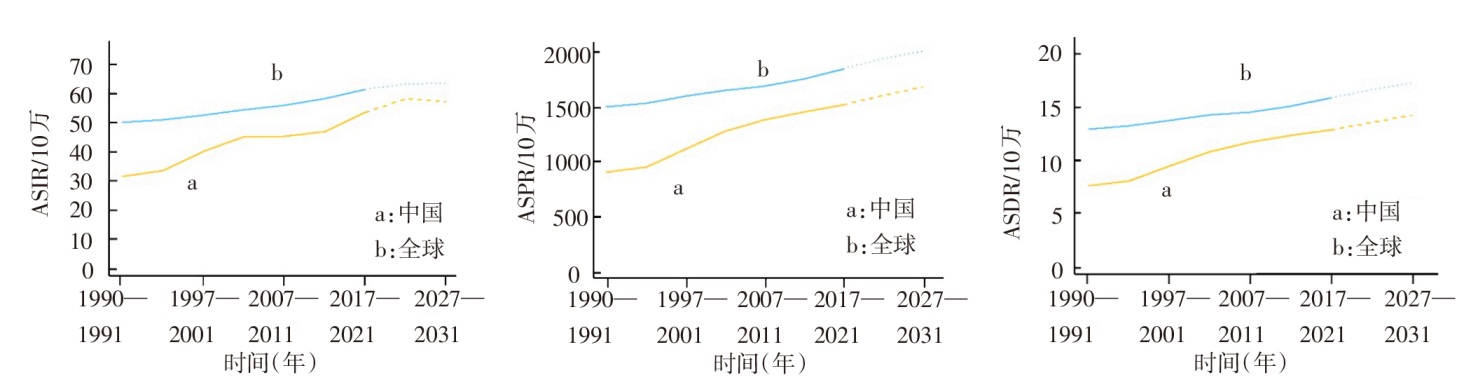
Fig.2 Trends in ASIR, ASPR, ASDR of PCOS globally and in China from 1990 to 2031
| [1] | KIM J, MERSEREAU J E, KHANKARI N, et al. Polycystic ovarian syndrome(PCOS),related symptoms/sequelae,and breast cancer risk in a population-based case-control study[J]. Cancer Causes Control, 2016, 27(3):403-414. doi:10.1007/s10552-016-0716-7. |
| [2] | BAHRI K M, SHORAKAE S, HASHEMI S, et al. Systematic review and meta-analysis of pregnancy outcomes in women with polycystic ovary syndrome[J]. Nature Communications, 2024, 15(1):5591. doi:10.1038/s41467-024-49749-1. |
| [3] | GAO Y, LIU H, QIAO L, et al. Study of burden in polycystic ovary syndrome at global,regional,and national levels from 1990 to 2019[J]. Healthcare (Basel), 2023, 11(4):562-569. doi:10.3390/healthcare11040562. |
| [4] | 柳丽佳, 邵铜, 方媛, 等. 1990—2019年中国多囊卵巢综合征发病趋势分析[J]. 中国预防医学杂志, 2023, 24(3):259-263. |
| LIU L J, SHAO T, FANG Y, et al. The incidence trend of polycystic ovary syndrome in China from 1990 to 2019[J]. China Preventive Medicine, 2023, 24(3):259-263. doi:10.16506/j.1009-6639.2023.03.016. | |
| [5] | KUANG Z, WANG J, LIU K, et al. and national burden of tracheal, bronchus,and lung cancer and its risk factors from 1990 to 2021: findings from the global burden of disease study 2021[J]. EClinical Medicine, 2024, 75:102804. doi:10.1016/j.eclinm.2024.102804. |
| [6] | 龙政, 殷鹏, 王黎君, 等. 1990-2021年中国及分省贫血疾病负担分析[J]. 中国慢性病预防与控制, 2024, 32(12):900-904,909. |
| LONG Z, YIN P, WANG L J, et al. Disease burden of anemia in China and its provinces from 1990 to 2021[J]. Chinese Journal of Prevention and Control of Chronic Diseases, 2024, 32(12):900-904,909. doi:10.16386/j.cjpccd.issn.1004-6194.2024.12.004. | |
| [7] | 宋姗姗, 姜敏, 王亮, 等. 1990—2021年全球气管、支气管和肺癌疾病负担及其到2040年的预测[J]. 天津医药, 2025, 53(8):875-884. |
| SONG S S, JIANG M, WANG L, et al. The global burden of tracheal, bronchial and lung cancer disease from 1990 to 2021 and theforecast to 2040[J]. Tianjin Med J, 2025, 53(8):875-884. doi:10.11958/20250372. | |
| [8] | 林艺, 李玲, 许瑞元. 不同年龄段女性的生理和疾病与性激素水平变化的关系[J]. 河南预防医学杂志, 2010, 21(3):179-181. |
| LIN Y, LI L, XU R Y. The relationship between changes in sex hormone level and physiology and disease of women in different age groups[J]. Henan Journal of Preventive Medicine, 2010, 21(3):179-181. doi:10.13515/j.cnki.hnjpm.2010.03.012. | |
| [9] | MORAN L J, BRINKWORTH G, NOAKES M, et al. Effects of lifestyle modification in polycystic ovarian syndrome[J]. Reproductive Biomedicine Online, 2006, 12(5):569-578. doi:10.1016/s1472-6483(10)61182-0. |
| [10] | MERKIN S S, PHY J L, SITES C K, et al. Environmental determinants of polycystic ovary syndrome[J]. Fertil Steril, 2016, 106(1):16-24. doi: 10.1016/j.fertnstert.2016.05.011. |
| [11] | RUTKOWSKA A Z, DIAMANYI-KANDARAKIS E. Polycystic ovary syndrome and environmental toxins[J]. Fertil Steril, 2016, 106(4):948-958. doi: 10.1016/j.fertnstert.2016.08.031. |
| [12] | NAUTIYAL H, IMAM S S, ALSHEHRI S, et al. Polycystic ovarian syndrome:a complex disease with a genetics approach[J]. Biomedicines, 2022, 10(3):540. doi: 10.3390/biomedicines10030540. |
| [13] | SIDDIQUI S, MATEEN S, AHMAD R, et al. A brief insight into the etiology,genetics,and immunology of polycystic ovarian syndrome(PCOS)[J]. J Assist Reprodu Genet, 2022, 39(11):2439-2473. doi:10.1007/s10815-022-02625-7. |
| [14] | JUHASZ A E, STUBNYA M P, TEUTSCH B, et al. Ranking the dietary interventions by their effectiveness in the management of polycystic ovary syndrome:a systematic review and network meta-analysis[J]. Reprod Health, 2024, 21(1):28. doi: 10.1186/s12978-024-01758-5. |
| [15] | NG M, FLEMING T, ROBINSON M, et al. Global,regional,and national prevalence of overweight and obesity in children and adults during 1980-2013:a systematic analysis for the Global Burden of Disease Study 2013[J]. Lancet, 2014, 384(9945):766-781. doi: 10.1016/S0140-6736(14)60460-8. |
| [16] | 张海琴. 肥胖与青春期多囊卵巢综合征的关系及生活方式干预[J]. 中国现代医药杂志, 2016, 18(9):87-90. |
| ZHANG H Q. The relationship between obesity and adolescent polycystic ovary syndrome and lifestyle interventions[J]. Modern Medicine Journal of China, 2016, 18(9):87-90. doi: 10.3969/j.issn.1672-9463.2016.09.031. | |
| [17] | LIU Q, ZHU Z, KRAFT P, et al. Genomic correlation,shared loci,and causal relationship between obesity and polycystic ovary syndrome:a large-scale genome-wide cross-trait analysis[J]. BMC Med, 2022, 20(1):66. doi:10.1186/s12916-022-02238-y. |
| [18] | 范哲华, 刘建荣. 葡萄糖依赖性促胰岛素多肽与多囊卵巢综合征相关性的研究进展[J]. 天津医药, 2024, 52(9):996-1000. |
| FAN Z H, LIU J R. Advances in the study of the correlation between incretin hormone GIP and polycystic ovary syndrome[J]. Tianjin Med J, 2024, 52(9):996-1000. doi:10.11958/20240051. | |
| [19] | DING T, HARDIMAN P J, PETERSEN I, et al. Incidence and prevalence of diabetes and cost of illness analysis of polycystic ovary syndrome:a Bayesian modelling study[J]. Hum Reprod, 2018, 33(7):1299-1306. doi:10.1093/humrep/dey093. |
| [20] | HASAN M, SULTAN S, SOHAN M, et al. Prevalence and associated risk factors for mental health problems among patients with polycystic ovary syndrome in Bangladesh: A nationwide cross—sectional study[J]. PLoS One, 2022, 17(6):e0270102. doi:10.1371/journal.pone.0270102. |
| [21] | GENG X, ZHAO J, HUANG J, et al. lnc-MAP3K13-7:1 inhibits ovarian GC proliferation in PCOS via DNMT1 downregulation-mediated CDKN1A promoter hypomethylation[J]. Mol Ther, 2021, 29(3):1279-1293. doi:10.1016/j.ymthe.2020.11.018. |
| [22] | VAGIOS S, JAMES K E, SACHA C R, et al. A patient-specific model combining antimüllerian hormone and body mass index as a predictor of polycystic ovary syndrome and other oligo-anovulation disorders[J]. Fertil Steril, 2021, 115(1):229-237. doi:10.1016/j.fertnstert.2020.07.023. |
| [23] | GUNGOR K, GUNGOR N D, CELIK O, et al. Polycystic ovary syndrome accompanied by hyperandrogenemia or metabolic syndrome triggers glomerular podocyte injury[J]. Diagnostic(Basel), 2024, 14(19):2197. doi:10.3390/diagnostics14192197. |
| [24] | 贾慧芬, 甄俊红, 郝晓莹. 多囊卵巢综合征患者发生代谢综合征的风险预测模型构建及验证[J]. 生殖医学杂志, 2024, 33(9):1183-1191. |
| JIA H F, ZHEN J H, HAO X Y. Construction and validation of a risk prediction model for metabolic syndrome in patients with polycystic ovary syndrome[J]. Journal of Reproductive Medicine, 2024, 33(9):1183-1191. doi:10.3969/j.issn.1004-3845.2024.09.009. | |
| [25] | XIE Z, YU C, CUI Q, et al. Global burden of the key components of cardiovascular-kidney-metabolic syndrome[J]. J Am Soc Nephrol, 2025, 10:1681. doi:10.1681/ASN.0000000658. |
| Viewed | ||||||
|
Full text |
|
|||||
|
Abstract |
|
|||||
