
Tianjin Medical Journal ›› 2026, Vol. 54 ›› Issue (5): 503-507.doi: 10.11958/20252830
• Clinical Research • Previous Articles Next Articles
LI Fei( ), WU Chengwen, WANG Fengyun, KANG Haihan△()
Received:2025-08-31
Revised:2026-01-11
Published:2026-05-15
Online:2026-05-13
Contact:
△E-mail:LI Fei, WU Chengwen, WANG Fengyun, KANG Haihan. The predictive value of the TyG index for restenosis after interventional treatment in patients with lower extremity arteriosclerotic occlusive disease[J]. Tianjin Medical Journal, 2026, 54(5): 503-507.
CLC Number:
| 组别 | n | 年龄/岁 | 性别(男/女) | BMI/(kg/m2) | 高血压 | ||||||||
|---|---|---|---|---|---|---|---|---|---|---|---|---|---|
| 低TyG组 | 75 | 61.89±6.97 | 46/29 | 24.92±2.85 | 53(70.7) | ||||||||
| 中TyG组 | 80 | 66.25±7.83 | 50/30 | 25.88±3.29 | 57(71.2) | ||||||||
| 高TyG组 | 55 | 69.93±8.71ab | 37/18 | 27.35±3.54ab | 40(72.7) | ||||||||
| F或χ2 | 10.152** | 0.783 | 5.217** | 0.089 | |||||||||
| 组别 | 糖尿病 | 高脂血症 | 冠心病 | 吸烟史 | |||||||||
| 低TyG组 | 34(45.3) | 48(64.0) | 24(32.0) | 36(48.0) | |||||||||
| 中TyG组 | 42(52.5) | 51(63.8) | 26(32.5) | 38(47.5) | |||||||||
| 高TyG组 | 40(72.7)ab | 39(70.9) | 20(36.4) | 29(52.7) | |||||||||
| F或χ2 | 12.874** | 0.936 | 0.358 | 0.472 | |||||||||
| 组别 | 病变部位(股浅动脉/ 腘动脉/胫腓干动脉) | 病变长度/ cm | 介入治疗方式(支架 置入/DCB/单纯球囊) | ||||||||||
| 低TyG组 | 38/22/15 | 10.56±4.78 | 33/25/17 | ||||||||||
| 中TyG组 | 41/24/15 | 12.18±5.32 | 36/28/16 | ||||||||||
| 高TyG组 | 27/16/12 | 16.12±6.89ab | 34/4/17 | ||||||||||
| F或χ2 | 1.532 | 18.753** | 14.296** | ||||||||||
Tab.1 Comparison of clinical characteristics of patients between different TyG index groups
| 组别 | n | 年龄/岁 | 性别(男/女) | BMI/(kg/m2) | 高血压 | ||||||||
|---|---|---|---|---|---|---|---|---|---|---|---|---|---|
| 低TyG组 | 75 | 61.89±6.97 | 46/29 | 24.92±2.85 | 53(70.7) | ||||||||
| 中TyG组 | 80 | 66.25±7.83 | 50/30 | 25.88±3.29 | 57(71.2) | ||||||||
| 高TyG组 | 55 | 69.93±8.71ab | 37/18 | 27.35±3.54ab | 40(72.7) | ||||||||
| F或χ2 | 10.152** | 0.783 | 5.217** | 0.089 | |||||||||
| 组别 | 糖尿病 | 高脂血症 | 冠心病 | 吸烟史 | |||||||||
| 低TyG组 | 34(45.3) | 48(64.0) | 24(32.0) | 36(48.0) | |||||||||
| 中TyG组 | 42(52.5) | 51(63.8) | 26(32.5) | 38(47.5) | |||||||||
| 高TyG组 | 40(72.7)ab | 39(70.9) | 20(36.4) | 29(52.7) | |||||||||
| F或χ2 | 12.874** | 0.936 | 0.358 | 0.472 | |||||||||
| 组别 | 病变部位(股浅动脉/ 腘动脉/胫腓干动脉) | 病变长度/ cm | 介入治疗方式(支架 置入/DCB/单纯球囊) | ||||||||||
| 低TyG组 | 38/22/15 | 10.56±4.78 | 33/25/17 | ||||||||||
| 中TyG组 | 41/24/15 | 12.18±5.32 | 36/28/16 | ||||||||||
| 高TyG组 | 27/16/12 | 16.12±6.89ab | 34/4/17 | ||||||||||
| F或χ2 | 1.532 | 18.753** | 14.296** | ||||||||||
| 组别 | n | 年龄/岁 | 性别(男/女) | BMI/(kg/m2) | 高血压 | ||||||||
|---|---|---|---|---|---|---|---|---|---|---|---|---|---|
| 非再狭窄组 | 137 | 63.58±7.12 | 84/53 | 25.36±3.11 | 95(69.3) | ||||||||
| 再狭窄组 | 73 | 69.87±8.45 | 49/24 | 26.98±3.42 | 55(75.3) | ||||||||
| t或χ2 | 5.924** | 0.692 | 3.107** | 0.876 | |||||||||
| 组别 | 糖尿病 | 高脂 血症 | 冠心病 | 吸烟史 | 病变长度/cm | ||||||||
| 非再狭窄组 | 58(42.3) | 85(62.0) | 42(30.7) | 66(48.2) | 11.56±5.23 | ||||||||
| 再狭窄组 | 58(79.5) | 53(72.6) | 28(38.4) | 37(50.7) | 15.97±6.71 | ||||||||
| t或χ2 | 26.534** | 2.357 | 0.075 | 0.125 | 6.215** | ||||||||
| 组别 | 病变部位(股浅动脉/ 腘动脉/胫腓干动脉) | 介入治疗方式(支架 置入/DCB/单纯球囊) | TyG 指数 | ||||||||||
| 非再狭窄组 | 69/38/30 | 66/40/31 | 7.85±0.82 | ||||||||||
| 再狭窄组 | 37/24/12 | 37/17/19 | 8.92±1.03 | ||||||||||
| t或χ2 | 1.325 | 21.367** | 7.032** | ||||||||||
Tab.2 Comparison of clinical characteristics between the restenosis group and the non-restenosis group
| 组别 | n | 年龄/岁 | 性别(男/女) | BMI/(kg/m2) | 高血压 | ||||||||
|---|---|---|---|---|---|---|---|---|---|---|---|---|---|
| 非再狭窄组 | 137 | 63.58±7.12 | 84/53 | 25.36±3.11 | 95(69.3) | ||||||||
| 再狭窄组 | 73 | 69.87±8.45 | 49/24 | 26.98±3.42 | 55(75.3) | ||||||||
| t或χ2 | 5.924** | 0.692 | 3.107** | 0.876 | |||||||||
| 组别 | 糖尿病 | 高脂 血症 | 冠心病 | 吸烟史 | 病变长度/cm | ||||||||
| 非再狭窄组 | 58(42.3) | 85(62.0) | 42(30.7) | 66(48.2) | 11.56±5.23 | ||||||||
| 再狭窄组 | 58(79.5) | 53(72.6) | 28(38.4) | 37(50.7) | 15.97±6.71 | ||||||||
| t或χ2 | 26.534** | 2.357 | 0.075 | 0.125 | 6.215** | ||||||||
| 组别 | 病变部位(股浅动脉/ 腘动脉/胫腓干动脉) | 介入治疗方式(支架 置入/DCB/单纯球囊) | TyG 指数 | ||||||||||
| 非再狭窄组 | 69/38/30 | 66/40/31 | 7.85±0.82 | ||||||||||
| 再狭窄组 | 37/24/12 | 37/17/19 | 8.92±1.03 | ||||||||||
| t或χ2 | 1.325 | 21.367** | 7.032** | ||||||||||
| 自变量 | B | SE | Wald χ2 | P | HR(95%CI) |
|---|---|---|---|---|---|
| 年龄 | 0.124 | 0.063 | 3.876 | 0.052 | 1.132(1.001~1.280) |
| 糖尿病 | 0.985 | 0.382 | 6.741 | 0.003 | 2.678(1.403~5.114) |
| BMI | 0.156 | 0.061 | 6.452 | 0.011 | 1.169(1.038~1.316) |
| 病变长度 | 0.372 | 0.109 | 11.582 | <0.001 | 1.450(1.189~1.772) |
| 介入治疗方式 | 14.328 | <0.001 | |||
| DCB | 0.125 | 0.218 | 0.328 | 0.567 | 1.133(0.725~1.768) |
| 支架置入 | 1.508 | 0.412 | 13.364 | <0.001 | 4.512(2.189~9.307) |
| TyG指数 | 1.176 | 0.295 | 15.897 | <0.001 | 3.245(1.987~5.316) |
Tab.3 Cox proportional hazards regression analysis of restenosis after interventional therapy for lower extremity arteriosclerotic occlusive disease
| 自变量 | B | SE | Wald χ2 | P | HR(95%CI) |
|---|---|---|---|---|---|
| 年龄 | 0.124 | 0.063 | 3.876 | 0.052 | 1.132(1.001~1.280) |
| 糖尿病 | 0.985 | 0.382 | 6.741 | 0.003 | 2.678(1.403~5.114) |
| BMI | 0.156 | 0.061 | 6.452 | 0.011 | 1.169(1.038~1.316) |
| 病变长度 | 0.372 | 0.109 | 11.582 | <0.001 | 1.450(1.189~1.772) |
| 介入治疗方式 | 14.328 | <0.001 | |||
| DCB | 0.125 | 0.218 | 0.328 | 0.567 | 1.133(0.725~1.768) |
| 支架置入 | 1.508 | 0.412 | 13.364 | <0.001 | 4.512(2.189~9.307) |
| TyG指数 | 1.176 | 0.295 | 15.897 | <0.001 | 3.245(1.987~5.316) |
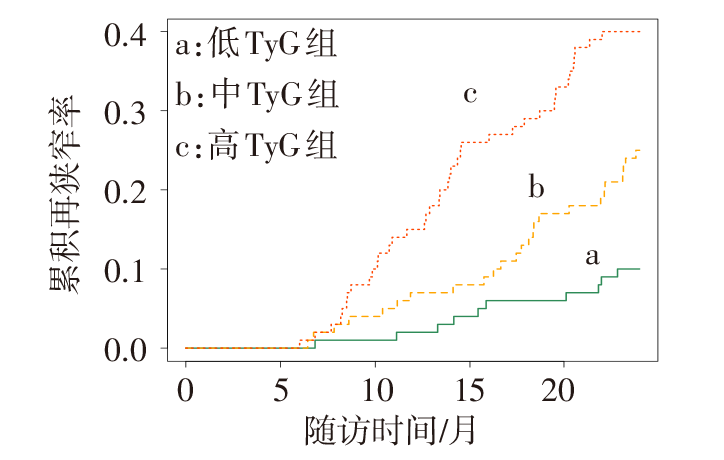
Fig.1 Restenosis curves of patients with lower extremity arteriosclerosis obliterans undergoing interventional therapy at different TyG index levels
| [1] | LIANG H, LIU P, YANG M, et al. Effect of alprostadil plus cilostazol on the treatment outcomes and inflammatory factors in patients with lower extremity arteriosclerosis obliterans receiving evidence-based care[J]. Clin Hemorheol Microcirc, 2024, 87(4):405-413. doi:10.3233/CH-232068. |
| [2] | YANG B, XIAPING Z. The clinical significance of serum HMGB1 in patients with lower extremity arteriosclerosis obliterans after interventional vascular restenosis[J]. Front Surg, 2022, 9:1031108. doi:10.3389/fsurg.2022.1031108. |
| [3] | 那顺孟和, 玉海, 陈恕, 等. 下肢动脉硬化闭塞症患者支架植入术后血清LncRNA-MALAT1、LncRNA-XIST与1年内支架内再狭窄相关性研究[J]. 疑难病杂志, 2024, 23(8):913-918. |
| NA S M H, YU H, CHEN S, et al. Correlation study between serum LncRNA-MALAT1,LncRNA-XIST and in-stent restenosis within 1 year after stent implantation in patients with arteriosclerosis obliterans of lower extremities[J]. Chin J Difficult Cases, 2024, 23(8):913-918. doi:10.3969/j.issn.1671-6450.2024.08.004. | |
| [4] | HE H M, XIE Y Y, CHEN Q, et al. The additive effect of the triglyceride-glucose index and estimated glucose disposal rate on long-term mortality among individuals with and without diabetes:a population-based study[J]. Cardiovasc Diabetol, 2024, 23(1):307. doi:10.1186/s12933-024-02396-8. |
| [5] | 李晶, 范卓然, 张俊农, 等. 早产型子痫前期及慢性高血压并发子痫前期患者的临床特征及TyG指数对比研究[J]. 天津医药, 2023, 51(2):190-193. |
| LI J, FAN Z R, ZHANG J N, et al. Comparative study on clinical characteristics and TyG index between patients with preterm preeclampsia and chronic hypertension complicated with preeclampsia[J]. Tianjin Med J, 2023, 51(2):190-193. doi:10.11958/20220717. | |
| [6] | 中华医学会外科学分会血管外科学组. 下肢动脉硬化闭塞症诊治指南[J]. 中华医学杂志, 2015, 95(24):1883-1896. |
| Vascular Surgery Group, Chinese Society of Surgery, Chinese Medical Association. Guidelines for the Diagnosis and Treatment of Lower Extremity Arteriosclerotic Occlusive Disease[J]. Natl Med J China, 2015, 95(24):1883-1896. doi:10.3760/cma.j.issn.0376-2491.2015.24.004. | |
| [7] | RAMDAS NAYAK V K, SATHEESH P, SHENOY M T, et al. Triglyceride glucose(TyG)index: a surrogate biomarker of insulin resistance[J]. J Pak Med Assoc, 2022, 72(5):986-988. doi:10.47391/JPMA.22-63. |
| [8] | 王庆贺, 唐晨, 王宜梅, 等. 髂动脉钙化评分与下肢动脉硬化闭塞症患者药物涂层球囊联合支架植入术后下肢动脉再狭窄的相关性及其预测价值分析[J]. 中华医学杂志, 2024, 104(37):3520-3527. |
| WANG Q H, TANG C, WANG Y M, et al. Correlation and predictive value analysis of iliac artery calcification score and restenosis of lower extremity arteries after drug-coated balloon combined with stent implantation in patients with lower extremity atherosclerotic occlusive disease[J]. Natl Med J China, 2024, 104(37):3520-3527. doi:10.3760/cma.j.cn112137-20240310-00539. | |
| [9] | ALIZARGAR J, BAI C H. Comparison of carotid ultrasound indices and the triglyceride glucose index in hypertensive and normotensive community-dwelling individuals:a case control study for evaluating atherosclerosis[J]. Medicina(Kaunas), 2018, 54(5):71. doi:10.3390/medicina54050071. |
| [10] | RALLIDIS L S, KATSIMARDOS A, KOSMAS N, et al. Differential prognostic value of resistin for cardiac death in patients with coronary artery disease according to the presence of metabolic syndrome[J]. Heart Vessels, 2022, 37(5):713-719. doi:10.1007/s00380-021-01964-2. |
| [11] | LIAN W, NIE H, YUAN Y, et al. Clinical significance of endothelin-1 and C-reaction protein in restenosis after the intervention of lower extremity arteriosclerosis obliterans[J]. J Invest Surg, 2021, 34(7):765-770. doi:10.1080/08941939.2019.1690600. |
| [12] | YAO W, WANG L, CHEN Q, et al. Effects of valsartan on restenosis in patients with arteriosclerosis obliterans of the lower extremities undergoing interventional therapy:a prospective,randomized,single-blind trial[J]. Med Sci Monit, 2020, 26:e919977. doi:10.12659/MSM.919977. |
| [13] | LIU C, ZHAO Q, ZHAO Z, et al. Correlation between estimated glucose disposal rate and in-stent restenosis following percutaneous coronary intervention in individuals with non-ST-segment elevation acute coronary syndrome[J]. Front Endocrinol(Lausanne), 2022, 13:1033354. doi:10.3389/fendo.2022.1033354. |
| [14] | KOMATSU T, YAGUCHI I, KOMATSU S, et al. Impact of insulin resistance on neointimal tissue proliferation after 2nd-generation drug-eluting stent implantation[J]. Tex Heart Inst J, 2015, 42(4):327-332. doi:10.14503/THIJ-14-4393. |
| [15] | NGUYEN P A, HEGGERMONT W A, VANHAVERBEKE M, et al. Leptin-adiponectin ratio in pre-diabetic patients undergoing percutaneous coronary intervention[J]. Acta Cardiol, 2015, 70(6):640-646. doi:10.2143/AC.70.6.3120175. |
| [16] | LI M, MA C, YIN K, et al. The mechanism of matrilin-2 inhibiting the progression of in-stent restenosis for lower extremity arteriosclerosis obliterans via TGF-β/Smad signaling pathway[J]. Ann Vasc Surg, 2025, 121:65-72. doi:10.1016/j.avsg.2025.05.030. |
| [17] | CHEN D, LI K, WEI L L, et al. Neointimal hyperplasia after endoluminal injury in mice is dependent on tissue factor- and angiopoietin-2 dependent interferon gamma production by fibrocytes and macrophages[J]. Front Immunol, 2024, 15:1345199. doi:10.3389/fimmu.2024.1345199. |
| [18] | TIAN S Y. Systemic immune-inflammation index predicts restenosis after interventions for lower extremity arteriosclerosis obliterans[J]. Heart Surg Forum, 2023, 26(3):E225-E233. doi:10.1532/hsf.5303. |
| [19] | WANG H J, MAO S Y. Exploring the novel potential of serum SIRT1 and TIMP3 as biomarkers for in-stent restenosis following percutaneous transluminal angioplasty and stenting in arteriosclerosis obliterans patients[J]. Tohoku J Exp Med, 2025, 265(2):83-90. doi:10.1620/tjem.2024.J083. |
| [20] | ZHANG Y, WANG K, ZHOU L, et al. Comparison of the effects of drug-coated balloon and bare metal stent in the treatment of lower extremity arteriosclerosis obliterans[J]. Pak J Med Sci, 2025, 41(5):1274-1279. doi:10.12669/pjms.41.5.11520. |
| [21] | CHENG S, XU J X, LONG W J. Advances in the management of arteriosclerosis of the lower extremity: Integrating Western and Chinese medicine approaches[J]. World J Clin Cases, 2024, 12(36):6871-6876. doi:10.12998/wjcc.v12.i36.6871. |
| Viewed | ||||||
|
Full text |
|
|||||
|
Abstract |
|
|||||
