
Tianjin Medical Journal ›› 2026, Vol. 54 ›› Issue (2): 179-183.doi: 10.11958/20253015
• Clinical Research • Previous Articles Next Articles
LI Wendi1( ), WANG Huanling2, YANG Xuewei1, XIE Shuhua1, ZHANG Jun2,△()
Received:2025-09-26
Revised:2025-12-10
Published:2026-02-15
Online:2026-02-12
Contact:
△E-mail:LI Wendi, WANG Huanling, YANG Xuewei, XIE Shuhua, ZHANG Jun. The application effect of ultrasound-guided superior laryngeal nerve block in endotracheal intubation with preserved spontaneous breathing[J]. Tianjin Medical Journal, 2026, 54(2): 179-183.
CLC Number:
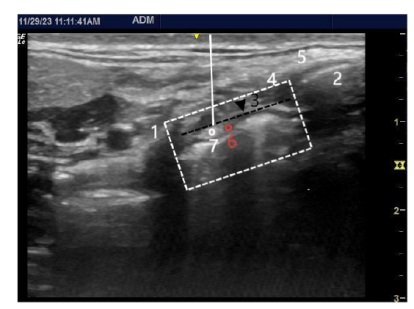
Fig.1 Anatomical structure and needle insertion path of SLNB under ultrasound guidance
| 组别 | n | 年龄/岁 | 性别(男/女) | BMI/(kg/m2) |
|---|---|---|---|---|
| C组 | 30 | 58.67±9.25 | 14/16 | 23.89±3.89 |
| L组 | 30 | 57.40±13.64 | 19/11 | 24.34±2.20 |
| t或χ2 | 0.421 | 1.684 | 0.658 |
Tab.1 Comparison of the general condition between the two groups of patients
| 组别 | n | 年龄/岁 | 性别(男/女) | BMI/(kg/m2) |
|---|---|---|---|---|
| C组 | 30 | 58.67±9.25 | 14/16 | 23.89±3.89 |
| L组 | 30 | 57.40±13.64 | 19/11 | 24.34±2.20 |
| t或χ2 | 0.421 | 1.684 | 0.658 |
| 组别 | n | T2 | T3 | T4 |
|---|---|---|---|---|
| C组 | 30 | 1(0,1) | 1(1,1) | 0(0,1) |
| L组 | 30 | 0(0,1) | 1(0,1) | 0(0,1) |
| Z | 2.110* | 1.970* | 0.356 |
Tab.2 Comparison of nausea and choking cough scores at T2, T3 and T4 between the two groups of patients
| 组别 | n | T2 | T3 | T4 |
|---|---|---|---|---|
| C组 | 30 | 1(0,1) | 1(1,1) | 0(0,1) |
| L组 | 30 | 0(0,1) | 1(0,1) | 0(0,1) |
| Z | 2.110* | 1.970* | 0.356 |
| 组别 | n | T0 | T1 | T5 | ΔMAP |
|---|---|---|---|---|---|
| C组 | 30 | 98.5±8.8 | 87.4±9.2 | 100.4±10.9 | 12.5(6.2,18.1) |
| L组 | 30 | 101.0±11.8 | 88.9±12.4 | 99.0±15.4 | 6.3(2.6,17.4) |
| t或Z | 0.925 | 0.526 | 0.420 | 1.538 |
Tab.3 Comparison of MAP changes of T0, T1 and T5 between groups
| 组别 | n | T0 | T1 | T5 | ΔMAP |
|---|---|---|---|---|---|
| C组 | 30 | 98.5±8.8 | 87.4±9.2 | 100.4±10.9 | 12.5(6.2,18.1) |
| L组 | 30 | 101.0±11.8 | 88.9±12.4 | 99.0±15.4 | 6.3(2.6,17.4) |
| t或Z | 0.925 | 0.526 | 0.420 | 1.538 |
| 组别 | n | T0 | T1 | T5 | ΔHR |
|---|---|---|---|---|---|
| C组 | 30 | 70.3±11.3 | 59.0(55.0,62.5) | 73.0±11.2 | 10.0(7.3,16.0) |
| L组 | 30 | 72.7±14.2 | 62.0(56.0,72.5) | 77.0±19.0 | 8.0(6.0,17.0) |
| t或Z | 0.724 | 1.926 | 1.003 | 0.955 |
Tab.4 Comparison of HR changes of T0, T1 and T5 between the two groups
| 组别 | n | T0 | T1 | T5 | ΔHR |
|---|---|---|---|---|---|
| C组 | 30 | 70.3±11.3 | 59.0(55.0,62.5) | 73.0±11.2 | 10.0(7.3,16.0) |
| L组 | 30 | 72.7±14.2 | 62.0(56.0,72.5) | 77.0±19.0 | 8.0(6.0,17.0) |
| t或Z | 0.724 | 1.926 | 1.003 | 0.955 |
| 组别 | n | 声门开放情况评分 | 术后咽喉痛评分 | 患者满意度评分 |
|---|---|---|---|---|
| C组 | 30 | 3.00(2.00,3.00) | 1.50(1.00,2.00) | 3.00(3.00,4.00) |
| L组 | 30 | 1.00(1.00,2.00) | 0.50(0.00,1.00) | 4.00(3.00,4.00) |
| Z | 4.690** | 3.730** | 2.131* |
Tab.5 Comparison of glottic opening, postoperative sore throat score and patient satisfaction score between the two groups of patients
| 组别 | n | 声门开放情况评分 | 术后咽喉痛评分 | 患者满意度评分 |
|---|---|---|---|---|
| C组 | 30 | 3.00(2.00,3.00) | 1.50(1.00,2.00) | 3.00(3.00,4.00) |
| L组 | 30 | 1.00(1.00,2.00) | 0.50(0.00,1.00) | 4.00(3.00,4.00) |
| Z | 4.690** | 3.730** | 2.131* |
| [1] | 高汇彬, 肖石林, 王倩钰, 等. 清醒气管插管气道局部麻醉技术的研究进展[J]. 临床麻醉学杂志, 2023, 39(1):81-84. |
| GAO H B, XIAO S L, WANG Q Y, et al. Research progress of airway local anesthesia for awake tracheal intubation[J]. J Clin Anesthesiol, 2023, 39(1):81-84. doi:10.12089/jca.2023.01.016. | |
| [2] | 陈哲平, 金延武, 冯昌, 等. 超声引导下喉上神经阻滞研究进展[J]. 临床麻醉学杂志, 2022, 38(6):648-653. |
| CHEN Z P, JIN Y W, FENG C, et al. Research progress of ultrasound-guided superior laryngeal nerve block[J]. J Clin Anesthesiol, 2022, 38(6):648-653. doi:10.12089/jca.2022.06.017. | |
| [3] | BAO Y, XIONG J, WANG H, et al. Ultrasound-guided block of the internal branch of the superior laryngeal nerve reduces postoperative sore throat caused by suspension laryngoscopic surgery:a prospective randomized trial[J]. Front Surg, 2022, 9:829811. doi:10.3389/fsurg.2022.829811. |
| [4] | DUFFY J R, LITTS J K, FINK D S. Superior laryngeal nerve block for treatment of neurogenic cough[J]. Laryngoscope, 2021, 131(10):E2676-E2680. doi:10.1002/lary.29585. |
| [5] | DHILLON V K. Longitudinal follow-up of superior laryngeal nerve block for chronic neurogenic cough[J]. OTO Open, 2021, 5(1):2473974X21994468. doi:10.1177/2473974X21994468. |
| [6] | GRAY A J, HOFFMAN M R, YANG Z M, et al. Indications and short-term outcomes for in-office therapeutic superior laryngeal nerve block[J]. Ann Otol Rhinol Laryngol, 2024, 133(2):174-180. doi:10.1177/00034894231194384. |
| [7] | 马媛媛, 曹雪, 张虹, 等. 喉上神经阻滞用于经口清醒气管插管的临床疗效分析[J]. 中国临床医学, 2020, 27(3):488-492. |
| MA Y Y, CAO X, ZHANG H, et al. Clinical efficacy analysis of superior laryngeal nerve block for awake orotracheal intubation[J]. Chin J Clin Med, 2020, 27(3):488-492. doi:10.12025/j.issn.1008-6358. | |
| [8] | ADDINGTON W R, STEPHENS R E, GOULDING R E. Anesthesia for the superior laryngeal nerves and tartaric acid-induced cough[J]. Arch Phys Med Rehabil, 1999, 80(12):1584-1586. doi:10.1016/s0003-9993(99)90334-9. |
| [9] | KIM D W, LEE H, JI J Y, et al. Superior laryngeal nerve block in transcutaneous vocal fold injection:a pilot study[J]. J Voice, 2025, 39(5):1417.e11-1417.e16. doi:10.1016/j.jvoice.2023.03.015. |
| [10] | HUA Y, HUANG Q, CHEN G, et al. Comparison of modified anterior and traditional posterior accesses for ultrasound-guided superior laryngeal nerve block in awake endotracheal intubation:study protocol for a randomised non-inferiority clinical trial[J]. BMJ Open, 2023, 13(2):e068779. doi:10.1136/bmjopen-2022-068779. |
| [11] | SUN J, ZHANG E, CHEN X, et al. Ultrasound-guided superior laryngeal nerve block facilitates anesthesia management in bariatric surgery[J]. J Emerg Med, 2022, 62(4):e85-e87. doi:10.1016/j.jemermed.2021.12.019. |
| [12] | KOJIMA Y, SUGIMURA M. Superior laryngeal nerve block for intubation in patients with covid-19[J]. Anesth Prog, 2021, 68(1):50-51. doi:10.2344/anpr-68-01-09. |
| [13] | JADHAV K, KARNALKAR A, PATIL S. Superior laryngeal nerve block with in-line lignocaine nebulization for awake extubation response[J]. J Anaesthesiol Clin Pharmacol, 2022, 38(2):228. doi:10.4103/joacp.JOACP_113_20. |
| [14] | WANG Y, FENG C, FU J, et al. Clinical application of ultrasound-guided internal branch of superior laryngeal nerve block in patients with severe copd undergoing awake fibreoptic nasotracheal intubation:a randomized controlled clinical trial[J]. Int J Chron Obstruct Pulmon Dis, 2023, 18:521-532. doi:10.2147/COPD.S399513. |
| [15] | SUDA Y, SUGAWARA A, KANAO-KANDA M, et al. Awake intubation for thoracic aortic aneurysm causing esophageal stenosis with food residues and compression of the pulmonary artery and left bronchi:a case report[J]. JA Clin Rep, 2022, 8(1):46. doi:10.1186/s40981-022-00534-3. |
| [16] | YILDIZ M, TAVLAN A, TUNCER S, et al. Effect of dexmedetomidine on haemodynamic responses to laryngoscopy and intubation :perioperative haemodynamics and anaesthetic requirements[J]. Drugs R D, 2006, 7(1):43-52. doi:10.2165/00126839-200607010-00004. |
| [17] | 崔松勤, 黄红芳, 黄雪莲, 等. 地佐辛联合不同剂量右美托咪定用于OSAHS患者经鼻清醒插管的效果比较[J]. 天津医药, 2022, 50(7):775-779. |
| CUI S Q, HUANG H F, HUANG X L, et al. Comparison of dezocine combined with different doses of dexmedetomidine for awake nasotracheal intubation in OSAHS patients[J]. Tianjin Med J, 2022, 50(7):775-779. doi:10.11958/20212855. | |
| [18] | SCHEININ B, LINDGREN L, RANDELL T, et al. Dexmedetomidine attenuates sympathoadrenal responses to tracheal intubation and reduces the need for thiopentone and peroperative fentanyl[J]. Br J Anaesth, 1992, 68(2):126-131. doi:10.1093/bja/68.2.126. |
| [19] | ACHARYA R, SRIRAMKA B, KOUSHIK P. Comparison of dexmedetomidine alone with dexmedetomidine and fentanyl during awake fiberoptic intubation in patients with difficult airway:a randomized clinical trial[J]. J Dent Anesth Pain Med, 2022, 22(5):349-356. doi:10.17245/jdapm.2022.22.5.349. |
| [20] | EL-BOGHDADLY K, BAILEY C R, WILES M D. Postoperative sore throat:a systematic review[J]. Anaesthesia, 2016, 71(6):706-717. doi:10.1111/anae.13438. |
| [21] | WANG J, CHAI B, ZHANG Y, et al. Effect of postoperative ultrasound-guided internal superior laryngeal nerve block on sore throat after intubation of double-lumen bronchial tube:a randomized controlled double-blind trial[J]. BMC Anesthesiol, 2022, 22:276. doi:10.1186/s12871-022-01819-x. |
| [22] | CHEN Z, JIN Y, LU G, et al. Preoperative ultrasound-guided internal branch block of superior laryngeal nerve reduces postoperative sore throat caused by double lumen endotracheal intubation:a randomized trial[J]. Anesth Analg, 2023, 137(6):1270-1278. doi:10.1213/ANE.0000000000006534. |
| [23] | AKHADDAR A, BAALLAL H, HAMMOUNE N, et al. Unilateral blindness following superior laryngeal nerve block for awake tracheal intubation in a case of posterior cervical spine surgery[J]. Surg Neurol Int, 2020, 11:277. doi:10.25259/SNI_505_2020. |
| [24] | CHEN C, WEN D, WANG Y, et al. A spray-as-you-go airway topical anesthesia attenuates cardiovascular responses for double-lumen tube tracheal intubation[J]. BMC Anesthesiol, 2022, 22(1):203. doi:10.1186/s12871-022-01749-8. |
| [1] | LIU Li, HU Xiaotian, QIAN Xuejiao, JIANG Ping. Epidemiological survey on the diagnosis and treatment status of cough patients in Tianjin [J]. Tianjin Medical Journal, 2026, 54(6): 653-657. |
| [2] | LI Jia, ZHAO Moju, YANG Huiru, GAO Lifeng, GAO Yue, LI Kan, GUO Suna, SHEN Jianjun. Comparison of anesthetic effect and safety of two nerve block methods under ultrasound guidance in laparoscopic total hysterectomy [J]. Tianjin Medical Journal, 2026, 54(3): 264-268. |
| [3] | ZHAO Jingjing, LIU Yamin, SUO Rui, WUMAIER Ruxianguli, LIU Shuangjun, LI Ying, ZHAO Xiaoyun. Construction and verification of pertussis infection characteristic analysis and symptom combination prediction model in patients with cough [J]. Tianjin Medical Journal, 2025, 53(4): 434-439. |
| [4] | HAN Zhengyi, LI Rui, CHEN Qi, WANG Jiayou, SHENG Kui, SONG Jie, ZHANG Ye. Effects of ultrasound-guided adductor canal block combined with general anesthesia on postoperative pain and cognitive function in elderly patients undergoing total knee arthroplasty [J]. Tianjin Medical Journal, 2024, 52(5): 523-527. |
| [5] | CHEN Wei, ZHAO Mengya, XIAO Fei, LIU Chuanhe. Changes of pulmonary function of pertussis in children aged 5-17 years [J]. Tianjin Medical Journal, 2024, 52(10): 1075-1079. |
| [6] | LIU Dan, WAN Nansheng, WANG Jie, LI Guangsheng, XIE Wei, TIAN Yu, FENG Jing. Standard operating procedure for endobronchial ultrasound guided laser multi-point ablation of mediastinal tumors [J]. Tianjin Medical Journal, 2024, 52(1): 80-82. |
| [7] | WU Keyi, HUANG Yong, XU Chenghao, MA Tianming, DAI Feibiao, LI Xue, TANG Chaoliang. Effects of general anesthesia combined with thoracic paravertebral nerve block on postoperative analgesia and pulmonary infection in patients with lung cancer surgery [J]. Tianjin Medical Journal, 2023, 51(6): 648-652. |
| [8] | WANG Dan, ZHAO Lixia, PENG Yaqi, YUAN Dajiang. Effects of different doses of dexamethasone on iliac fascia block of ropivacaine under ultrasound guidance [J]. Tianjin Medical Journal, 2022, 50(8): 878-882. |
| [9] | BAO Xiaoli, TAO Tao, TANG Nan△. The diagnostic values of closed, ultrasound-guided and medical thoracoscopic pleural biopsy in tuberculous pleurisy [J]. Tianjin Medical Journal, 2022, 50(6): 613-617. |
| [10] | FENG Jing, SHI Yu. EBUS-TDB, endobronchial ultrasound guided tunnel- drilling biopsy #br# [J]. Tianjin Medical Journal, 2021, 49(6): 633-635. |
| [11] | SUN Yi, WANG Hai-yun, HUA Wei△, ZHAO Ming-shu. EC50 and EC95 of ropivacaine for ultrasound-guided llioinguinal, lliohypogastric and genitocrural nerve block in aged patients with inguinal hernia [J]. Tianjin Medical Journal, 2020, 48(7): 654-656. |
| [12] | HU Guang-jun, LI Li, SONG Xiao-yang, LI Bi-xi, GAN Guo-sheng. Effects of 2.5 mg and 5 mg dexamethasone on ropivacaine brachial plexus nerve block [J]. Tianjin Medical Journal, 2020, 48(10): 997-1000. |
| [13] | YAO Ju, HUANG Hong-fang, HUANG Sai-sai, ZHANG Zhong. [J]. Tianjin Medical Journal, 2019, 47(8): 851-854. |
| [14] | XIE Shu-hua, DING Ling, WEI Ying, GENG Li-cheng, WANG Guo-lin. Application of ultrasound guided brachial plexus combined with deep cervical plexus nerve block in shoulder arthroscopic surgery [J]. Tianjin Medical Journal, 2018, 46(7): 751-754. |
| [15] | JI Lin-lin, LI Xin, ZHU Jian-ping, REN Shuai, SUN Da-qiang. Clinical observation of persistent cough after thoracoscopic lobectomy for preserved inferior pulmonary ligament in video-assisted thoracic surgery [J]. Tianjin Medical Journal, 2018, 46(12): 1308-1309. |
| Viewed | ||||||
|
Full text |
|
|||||
|
Abstract |
|
|||||
