
Tianjin Medical Journal ›› 2026, Vol. 54 ›› Issue (9): 957-961.doi: 10.11958/20253327
• Clinical Research • Previous Articles Next Articles
ZHANG Weiye( ), ZHU Ping, GAO Hang, BAO Fengyuan, XI Yue, YANG Jing
Received:2025-11-13
Revised:2026-02-04
Published:2026-09-15
Online:2026-09-14
ZHANG Weiye, ZHU Ping, GAO Hang, BAO Fengyuan, XI Yue, YANG Jing. Evaluation and prognosis prediction of serum levels of C-reactive protein and serum amyloid A in premature infants with necrotizing enterocolitis[J]. Tianjin Medical Journal, 2026, 54(9): 957-961.
CLC Number:
| 组别 | n | 性别(男/女) | 胎龄/周 | 出生体质量/kg | 羊水污染 | ||||||
|---|---|---|---|---|---|---|---|---|---|---|---|
| 对照组 | 90 | 49/41 | 28.19±2.48 | 1.62±0.41 | 19(21.11) | ||||||
| NEC组 | 90 | 46/44 | 27.94±2.31 | 1.57±0.33 | 24(26.67) | ||||||
| χ²或t | 0.201 | 0.708 | 0.840 | 0.764 | |||||||
| 组别 | 分娩方式 | 妊娠期合并症 | 开始喂食 时间/d | ||||||||
| 顺产 | 剖宫产 | 高血压 | 糖尿病 | ||||||||
| 对照组 | 25(27.78) | 65(72.22) | 19(21.11) | 21(23.33) | 3.15±1.23 | ||||||
| NEC组 | 19(21.11) | 71(78.89) | 22(24.44) | 24(26.67) | 3.36±1.05 | ||||||
| χ² | 1.083 | 0.284 | 0.267 | 1.233 | |||||||
Tab.1 Comparison of baseline data between the two groups of infants
| 组别 | n | 性别(男/女) | 胎龄/周 | 出生体质量/kg | 羊水污染 | ||||||
|---|---|---|---|---|---|---|---|---|---|---|---|
| 对照组 | 90 | 49/41 | 28.19±2.48 | 1.62±0.41 | 19(21.11) | ||||||
| NEC组 | 90 | 46/44 | 27.94±2.31 | 1.57±0.33 | 24(26.67) | ||||||
| χ²或t | 0.201 | 0.708 | 0.840 | 0.764 | |||||||
| 组别 | 分娩方式 | 妊娠期合并症 | 开始喂食 时间/d | ||||||||
| 顺产 | 剖宫产 | 高血压 | 糖尿病 | ||||||||
| 对照组 | 25(27.78) | 65(72.22) | 19(21.11) | 21(23.33) | 3.15±1.23 | ||||||
| NEC组 | 19(21.11) | 71(78.89) | 22(24.44) | 24(26.67) | 3.36±1.05 | ||||||
| χ² | 1.083 | 0.284 | 0.267 | 1.233 | |||||||
| 组别 | n | 围产期 缺氧史 | 感染 征象 | 喂养 不当 | 输血史 | ||||
|---|---|---|---|---|---|---|---|---|---|
| 对照组 | 90 | 5(5.56) | 3(3.33) | 4(4.44) | 3(3.33) | ||||
| NEC组 | 90 | 28(31.11) | 62(68.89) | 29(32.22) | 21(23.33) | ||||
| χ² | 19.629** | 29.829** | 23.191** | 15.577** | |||||
| 组别 | CRP/(mg/L) | PCT/ (μg/L) | IL-6/ (ng/L) | SAA/ (mg/L) | |||||
| 对照组 | 14.34±3.03 | 0.18±0.06 | 27.24±5.31 | 102.68±42.67 | |||||
| NEC组 | 23.01±8.59 | 1.39±0.58 | 111.36±24.14 | 312.28±70.21 | |||||
| t | 9.027** | 19.736** | 32.289** | 24.202** | |||||
Tab.2 Comparison of general data between the NEC group and the control group
| 组别 | n | 围产期 缺氧史 | 感染 征象 | 喂养 不当 | 输血史 | ||||
|---|---|---|---|---|---|---|---|---|---|
| 对照组 | 90 | 5(5.56) | 3(3.33) | 4(4.44) | 3(3.33) | ||||
| NEC组 | 90 | 28(31.11) | 62(68.89) | 29(32.22) | 21(23.33) | ||||
| χ² | 19.629** | 29.829** | 23.191** | 15.577** | |||||
| 组别 | CRP/(mg/L) | PCT/ (μg/L) | IL-6/ (ng/L) | SAA/ (mg/L) | |||||
| 对照组 | 14.34±3.03 | 0.18±0.06 | 27.24±5.31 | 102.68±42.67 | |||||
| NEC组 | 23.01±8.59 | 1.39±0.58 | 111.36±24.14 | 312.28±70.21 | |||||
| t | 9.027** | 19.736** | 32.289** | 24.202** | |||||
| Bell-NEC分期 | n | CRP | SAA |
|---|---|---|---|
| Ⅱ期 | 49 | 17.70±7.46 | 261.41±66.11 |
| Ⅲ期 | 41 | 29.35±9.27 | 373.08±85.57 |
| t | 6.481** | 6.824** |
Tab.3 Comparison of serum CRP and SAA levels between preterm infants with NEC at different clinical stages
| Bell-NEC分期 | n | CRP | SAA |
|---|---|---|---|
| Ⅱ期 | 49 | 17.70±7.46 | 261.41±66.11 |
| Ⅲ期 | 41 | 29.35±9.27 | 373.08±85.57 |
| t | 6.481** | 6.824** |
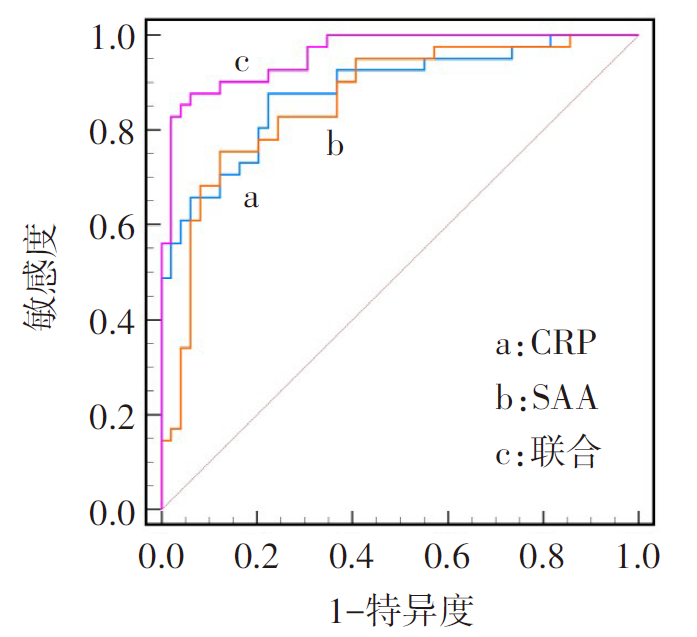
Fig.1 ROC curves of serum CRP, SAA and their combination for diagnosing NEC in preterm infants
| 指标 | AUC | AUC 95%CI | 特异度/ % | 敏感度/ % | 约登 指数 | 截断值 |
|---|---|---|---|---|---|---|
| CRP | 0.883 | 0.798~0.941 | 77.55 | 87.80 | 0.654 | 21.76 mg/L |
| SAA | 0.863 | 0.774~0.926 | 87.76 | 75.61 | 0.634 | 364.52 mg/L |
| 联合预测 | 0.960 | 0.896~0.990 | 93.88 | 87.80 | 0.817 |
Tab.4 Diagnostic efficiency of serum CRP, SAA and their combination for NEC in preterm infants
| 指标 | AUC | AUC 95%CI | 特异度/ % | 敏感度/ % | 约登 指数 | 截断值 |
|---|---|---|---|---|---|---|
| CRP | 0.883 | 0.798~0.941 | 77.55 | 87.80 | 0.654 | 21.76 mg/L |
| SAA | 0.863 | 0.774~0.926 | 87.76 | 75.61 | 0.634 | 364.52 mg/L |
| 联合预测 | 0.960 | 0.896~0.990 | 93.88 | 87.80 | 0.817 |
| 组别 | n | CRP | SAA |
|---|---|---|---|
| 预后好转组 | 64 | 18.60±3.96 | 276.64±46.09 |
| 预后不良组 | 26 | 33.85±7.17 | 400.05±92.86 |
| t | 10.230** | 6.461** |
Tab.5 Comparison of serum CRP and SAA between NEC patients with different prognoses
| 组别 | n | CRP | SAA |
|---|---|---|---|
| 预后好转组 | 64 | 18.60±3.96 | 276.64±46.09 |
| 预后不良组 | 26 | 33.85±7.17 | 400.05±92.86 |
| t | 10.230** | 6.461** |
| 变量 | β | SE | Wald χ2 | P | OR | OR(95%CI) |
|---|---|---|---|---|---|---|
| 单因素分析 | ||||||
| CRP | 0.191 | 0.066 | 8.375 | 0.004 | 1.210 | 1.064~1.378 |
| SAA | 0.013 | 0.004 | 10.563 | 0.001 | 1.013 | 1.005~1.021 |
| 多因素分析 | ||||||
| CRP | 0.204 | 0.070 | 8.588 | 0.003 | 1.223 | 1.070~1.406 |
| SAA | 0.015 | 0.005 | 9.786 | 0.002 | 1.016 | 1.006~1.025 |
| 感染征象 | 1.124 | 0.483 | 5.412 | 0.020 | 3.077 | 1.194~7.928 |
| 围术期缺 氧史 | 0.863 | 0.552 | 2.244 | 0.118 | 2.370 | 0.083~6.993 |
| 喂养不当 | 0.604 | 0.841 | 0.516 | 0.473 | 1.829 | 0.352~9.510 |
| 输血史 | 0.178 | 1.003 | 0.031 | 0.859 | 1.195 | 0.185~9.438 |
| IL-6 | 0.032 | 0.023 | 1.936 | 0.164 | 1.033 | 0.987~1.080 |
| PCT | 0.187 | 0.777 | 0.058 | 0.810 | 1.206 | 0.263~5.529 |
| 常数项 | 7.549 | 2.720 | 7.701 | 0.005 | - | - |
Tab.6 Univariate and multivariate analysis of serum CRP and SAA on prognosis in patients with NEC
| 变量 | β | SE | Wald χ2 | P | OR | OR(95%CI) |
|---|---|---|---|---|---|---|
| 单因素分析 | ||||||
| CRP | 0.191 | 0.066 | 8.375 | 0.004 | 1.210 | 1.064~1.378 |
| SAA | 0.013 | 0.004 | 10.563 | 0.001 | 1.013 | 1.005~1.021 |
| 多因素分析 | ||||||
| CRP | 0.204 | 0.070 | 8.588 | 0.003 | 1.223 | 1.070~1.406 |
| SAA | 0.015 | 0.005 | 9.786 | 0.002 | 1.016 | 1.006~1.025 |
| 感染征象 | 1.124 | 0.483 | 5.412 | 0.020 | 3.077 | 1.194~7.928 |
| 围术期缺 氧史 | 0.863 | 0.552 | 2.244 | 0.118 | 2.370 | 0.083~6.993 |
| 喂养不当 | 0.604 | 0.841 | 0.516 | 0.473 | 1.829 | 0.352~9.510 |
| 输血史 | 0.178 | 1.003 | 0.031 | 0.859 | 1.195 | 0.185~9.438 |
| IL-6 | 0.032 | 0.023 | 1.936 | 0.164 | 1.033 | 0.987~1.080 |
| PCT | 0.187 | 0.777 | 0.058 | 0.810 | 1.206 | 0.263~5.529 |
| 常数项 | 7.549 | 2.720 | 7.701 | 0.005 | - | - |
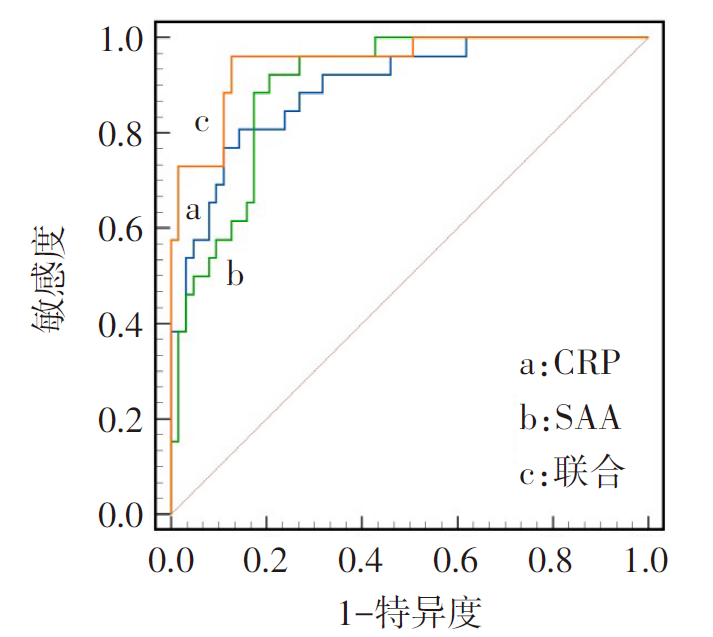
Fig.2 ROC curves of serum CRP, SAA and their combination for predicting NEC in preterm infants
| 指标 | AUC | AUC95%CI | 特异度/ % | 敏感度/ % | 约登 指数 | 截断值 |
|---|---|---|---|---|---|---|
| CRP | 0.896 | 0.813~0.951 | 85.71 | 80.77 | 0.665 | 24.51 mg/L |
| SAA | 0.889 | 0.817~0.953 | 79.37 | 92.31 | 0.717 | 345.00 mg/L |
| 联合预测 | 0.951 | 0.884~0.986 | 87.30 | 96.15 | 0.835 |
Tab.7 Predictive efficacy of serum CRP and SAA for NEC in preterm infants
| 指标 | AUC | AUC95%CI | 特异度/ % | 敏感度/ % | 约登 指数 | 截断值 |
|---|---|---|---|---|---|---|
| CRP | 0.896 | 0.813~0.951 | 85.71 | 80.77 | 0.665 | 24.51 mg/L |
| SAA | 0.889 | 0.817~0.953 | 79.37 | 92.31 | 0.717 | 345.00 mg/L |
| 联合预测 | 0.951 | 0.884~0.986 | 87.30 | 96.15 | 0.835 |
| [1] | Butler V, Treluyer L, Patkaï J, et al. Mortality and neurodevelopmental outcomes at 2 years' corrected age of very preterm infants with necrotising enterocolitis or spontaneous intestinal perforation:the EPIPAGE-2 cohort study[J]. Eur J Pediatr, 2024, 183(9):4019-4028. doi:10.1007/s00431-024-05675-4. |
| [2] | Roberts A G, Younge N, Greenberg R G. Neonatal necrotizing enterocolitis:an update on pathophysiology, treatment, and prevention[J]. Paediatr Drugs, 2024, 26(3):259-275. doi:10.1007/s40272-024-00626-w. |
| [3] | Liu S, Liu Y, Lai S, et al. Values of serum intestinal fatty acid-binding protein, fecal calprotectin,and fecal human β-defensin 2 for predicting necrotizing enterocolitis[J]. BMC Pediatr, 2024, 24(1):183. doi:10.1186/s12887-024-04667-5. |
| [4] | Jones I H, Hall N J. Contemporary outcomes for infants with necrotizing enterocolitis-a systematic review[J]. J Pediatr, 2020, 220:86-92. doi:10.1016/j.jpeds.2019.11.011. |
| [5] | Frazer L C, Orgel K A, Good M. Dysbiotic microbiota in necrotizing enterocolitis:insights into pathogenesis,treatment,and prevention[J]. Gastroenterol Clin North Am, 2025, 54(2):415-427. doi:10.1016/j.gtc.2024.11.001. |
| [6] | Cheng H, Yu J, Dai L. A meta-analysis on the predictive role of CRP in NEC diagnosis and prognosis[J]. Ital J Pediatr, 2025, 51(1):244. doi:10.1186/s13052-025-02081-w. |
| [7] | Erickson M A, Mahankali A P. Interactions of serum amyloid a proteins with the blood-brain barrier:implications for central nervous system disease[J]. Int J Mol Sci, 2024, 25(12):6607. doi:10.3390/ijms25126607. |
| [8] | Nowak J, Ssanyu J N, Namiiro F, et al. Diagnosis of neonatal and adult sepsis using a serum amyloid a lateral flow test.[J]. PLoS One, 2025, 20(2):e0314702. doi:10.3390/ijms25126607. |
| [9] | Xie M, Min Z, Jiang W, et al. Prognostic value of multivariate logistic regression analysis and amyloid A lactate monitoring in patients with severe pneumonia-associated sepsis[J]. BMC Pulm Med, 2025, 25(1):191. doi:10.3390/ijms25126607. |
| [10] | Papareddy P, Herwald H. From immune activation to disease progression:unraveling the complex role of serum amyloid a proteins[J]. Cytokine Growth Factor Rev, 2025, 83:77-84. doi:10.1016/j.cytogfr.2025.03.003. |
| [11] | 尹芳, 高喜容, 刘新晖, 等. SNAPPE-Ⅱ评分结合Bell分期预测新生儿坏死性小肠结肠炎预后的相关研究[J]. 儿科药学杂志, 2015, 21(11):1-4. |
| Yin F, Gao X R, Liu X H, et al. The related research of the SNAPPE-II combined with bell stage to predict the prognosis of neonatal necrotizing enterocolitis[J]. Journal of Pediatric Pharmacy, 2015, 21(11):1-4. doi:10.13407/j.cnki.jpp. | |
| [12] | 黄兰, 熊涛, 唐军, 等. 新生儿坏死性小肠结肠炎临床诊疗指南(2020)[J]. 中国当代儿科杂志, 2021, 23(1):1-11. |
| Huang L, Xiong T, Tang J, et al. Clinical guidelines for the diagnosis and treatment of neonatal necrotizing enterocolitis (2020)[J]. Chin J Contemp Pediatr, 2021, 23(1):1-11. doi:10.7499/j.issn.1008-8830.2011145. | |
| [13] | Zhang Y, Jing Y, He J, et al. Bile acid receptor FXR promotes intestinal epithelial ferroptosis and subsequent ILC3 dysfunction in neonatal necrotizing enterocolitis[J]. Immunity, 2025, 58(3):683-700. doi:10.1016/j.immuni.2025.02.003. |
| [14] | Chen Y, Duan Y, Wei B, et al. Value of portal venous gas and a nomogram for predicting severe neonatal necrotizing enterocolitis[J]. Pediatr Res, 2025, 97(5):1636-1643. doi:10.1038/s41390-024-03605-6. |
| [15] | 蔡冬, 周丽霞, 许花芬. MiR-223-3p通过靶向NLRP3对坏死性小肠结肠炎新生大鼠肠组织的炎症反应和细胞损伤的影响[J]. 中国儿童保健杂志, 2023, 31(1):46-51. |
| Cai D, Zhou L X, Xu H F, et al. The effects of MiR-223-3p on the inflammatory response and cell damage in the intestinal tissue of neonatal rats with necrotizing enterocolitis by targeting NLRP3[J]. Chin J Child Health Care, 2023, 31(1):46-51. doi:10.11852/zgetbjzz2022-0252. | |
| [16] | Liu K, Zhu Y, Guo J, et al. Predictive value of C-reactive protein/albumin ratio for necrotizing enterocolitis in preterm infants with neonatal sepsis[J]. Nurs Crit Care, 2025, 30(4):e70071. doi:10.1111/nicc.70071. |
| [17] | 赵媛媛, 王帅力, 高晓莉. 重症肺炎患儿血清PCT、IL-6、CRP、SAA水平变化及其与CK-MB、cTnT、NT-proBNP的相关性分析[J]. 检验医学与临床, 2022, 19(21):2984-2987. |
| Zhao Y Y, Wang S L, Gao X L. Changes in serum PCT,IL-6,CRP,SAA levels and their correlation with CK-MB,cTnT,NT proBNP in children with severe pneumonia[J]. Laboratory Medicine and Clinical Practice, 2022, 19(21):2984-2987. doi:10.3969/j.issn.1672-9455.2022.21.025. | |
| [18] | Tian J, Yan C, Jiang Y, et al. Peripheral and intestinal mucosal-associated invariant T cells in premature infants with necrotizing enterocolitis[J]. Front Pharmacol, 2022, 13:1008080. doi:10.3389/fphar.2022.1008080. |
| [19] | Hu Y, Hua Z, Liu K, et al. Differentiating clinical characteristics between necrotizing enterocolitis and food protein-induced enterocolitis when both have pneumatosis intestinalis:a single-centre study[J]. J Coll Physicians Surg Pak, 2022, 32(5):646-651. doi:10.29271/jcpsp.2022.05.646. |
| [20] | Wang Q, Jin K, Su X, et al. Predictive value of serum markers in the operation evaluation of neonatal necrotizing enterocolitis[J]. Transl Pediatr, 2023, 12(5):897-906. doi:10.21037/tp-23-56. |
| Viewed | ||||||
|
Full text |
|
|||||
|
Abstract |
|
|||||
