
Tianjin Medical Journal ›› 2026, Vol. 54 ›› Issue (9): 962-966.doi: 10.11958/20253748
• Clinical Research • Previous Articles Next Articles
SUN Changcheng1( ), WU Jianlin2, CHEN Yiqiao3, TENG Yanmei1, HAN Yubing4, LIU Zhenyu5
Received:2025-12-26
Revised:2026-03-26
Published:2026-09-15
Online:2026-09-14
SUN Changcheng, WU Jianlin, CHEN Yiqiao, TENG Yanmei, HAN Yubing, LIU Zhenyu. Role of CysLTs and NLRP3 inflammasome pathways in mucous plug formation in children with severe Mycoplasma pneumoniae pneumonia and construction of a combined early-warning model[J]. Tianjin Medical Journal, 2026, 54(9): 962-966.
CLC Number:
| 组别 | n | 年龄/ 岁 | 性别 (男/女) | 病程/ d | BMI/ (kg/m2) | 发热情况 | 咳嗽情况 | 肺外 并发症 | ||||||||||||
|---|---|---|---|---|---|---|---|---|---|---|---|---|---|---|---|---|---|---|---|---|
| 高热(≥39 ℃) | 中低热(<39 ℃) | 剧烈咳嗽 | 轻中度咳嗽 | |||||||||||||||||
| 非黏液栓组 | 148 | 8.48±3.05 | 78/70 | 13.18±2.98 | 20.51±1.44 | 44(29.73) | 104(70.27) | 55(37.16) | 93(62.84) | 34(22.97) | ||||||||||
| 黏液栓组 | 54 | 8.67±3.10 | 26/28 | 12.87±2.67 | 20.17±1.35 | 16(29.63) | 38(70.37) | 18(33.33) | 36(66.67) | 12(22.22) | ||||||||||
| t或χ2 | 0.384 | 0.329 | 0.676 | 1.525 | 0.000 | 0.251 | 0.013 | |||||||||||||
| 组别 | 机械 通气 | 气管镜检查前 使用激素 | PaO2/FiO2/ mmHg | PRISMⅢ 评分/分 | CRP/ (mg/L) | PCT/ (μg/L) | IgE/ (IU/mL) | WBC/ (×109/L) | PLT/ (×109/L) | LYM/ (×109/L) | ||||||||||
| 非黏液栓组 | 46(31.08) | 62(41.89) | 321.47±56.30 | 12.55±3.28 | 23.82±10.60 | 0.85±0.23 | 236.71±80.19 | 10.36±4.66 | 289.64±80.49 | 1.42±0.46 | ||||||||||
| 黏液栓组 | 15(27.78) | 20(37.04) | 218.53±52.44 | 14.69±3.12 | 34.77±10.37 | 0.86±0.22 | 245.49±79.42 | 10.68±4.60 | 293.70±80.40 | 1.46±0.49 | ||||||||||
| t或χ2 | 0.205 | 0.387 | 11.707** | 4.139** | 6.536** | 0.345 | 0.690 | 0.432 | 0.318 | 0.521 | ||||||||||
Tab.1 Comparison of baseline data between the two groups of children
| 组别 | n | 年龄/ 岁 | 性别 (男/女) | 病程/ d | BMI/ (kg/m2) | 发热情况 | 咳嗽情况 | 肺外 并发症 | ||||||||||||
|---|---|---|---|---|---|---|---|---|---|---|---|---|---|---|---|---|---|---|---|---|
| 高热(≥39 ℃) | 中低热(<39 ℃) | 剧烈咳嗽 | 轻中度咳嗽 | |||||||||||||||||
| 非黏液栓组 | 148 | 8.48±3.05 | 78/70 | 13.18±2.98 | 20.51±1.44 | 44(29.73) | 104(70.27) | 55(37.16) | 93(62.84) | 34(22.97) | ||||||||||
| 黏液栓组 | 54 | 8.67±3.10 | 26/28 | 12.87±2.67 | 20.17±1.35 | 16(29.63) | 38(70.37) | 18(33.33) | 36(66.67) | 12(22.22) | ||||||||||
| t或χ2 | 0.384 | 0.329 | 0.676 | 1.525 | 0.000 | 0.251 | 0.013 | |||||||||||||
| 组别 | 机械 通气 | 气管镜检查前 使用激素 | PaO2/FiO2/ mmHg | PRISMⅢ 评分/分 | CRP/ (mg/L) | PCT/ (μg/L) | IgE/ (IU/mL) | WBC/ (×109/L) | PLT/ (×109/L) | LYM/ (×109/L) | ||||||||||
| 非黏液栓组 | 46(31.08) | 62(41.89) | 321.47±56.30 | 12.55±3.28 | 23.82±10.60 | 0.85±0.23 | 236.71±80.19 | 10.36±4.66 | 289.64±80.49 | 1.42±0.46 | ||||||||||
| 黏液栓组 | 15(27.78) | 20(37.04) | 218.53±52.44 | 14.69±3.12 | 34.77±10.37 | 0.86±0.22 | 245.49±79.42 | 10.68±4.60 | 293.70±80.40 | 1.46±0.49 | ||||||||||
| t或χ2 | 0.205 | 0.387 | 11.707** | 4.139** | 6.536** | 0.345 | 0.690 | 0.432 | 0.318 | 0.521 | ||||||||||
| 组别 | n | CysLTs/(ng/L) | NLRP3/(μg/L) | Caspase-1/(U/L) |
|---|---|---|---|---|
| 非黏液栓组 | 148 | 95.67±10.86 | 6.15±1.22 | 35.64±5.96 |
| 黏液栓组 | 54 | 120.57±15.41 | 8.60±1.18 | 45.35±6.72 |
| t | 10.921** | 12.710** | 9.897** |
Tab.2 Comparison of serum levels of CysLTs, NLRP3 and Caspase-1 between the two groups of children
| 组别 | n | CysLTs/(ng/L) | NLRP3/(μg/L) | Caspase-1/(U/L) |
|---|---|---|---|---|
| 非黏液栓组 | 148 | 95.67±10.86 | 6.15±1.22 | 35.64±5.96 |
| 黏液栓组 | 54 | 120.57±15.41 | 8.60±1.18 | 45.35±6.72 |
| t | 10.921** | 12.710** | 9.897** |
| 变量 | β | SE | Wald χ2 | P | OR(95%CI) |
|---|---|---|---|---|---|
| CysLTs | 0.148 | 0.051 | 8.522 | 0.004 | 1.159(1.050~1.280) |
| NLRP3 | 1.764 | 0.677 | 6.795 | 0.009 | 5.833(1.549~21.965) |
| Caspase-1 | 0.213 | 0.103 | 4.316 | 0.038 | 1.238(1.012~1.514) |
| PaO2/FiO2 | -0.022 | 0.009 | 5.618 | 0.018 | 0.979(0.961~0.996) |
| PRISMⅢ评分 | 0.195 | 0.161 | 1.466 | 0.226 | 1.216(0.886~1.668) |
| CRP | 0.131 | 0.063 | 4.334 | 0.037 | 1.140(1.008~1.290) |
| 常数项 | -38.849 | 10.464 | 13.784 | <0.001 | 0.000 |
Tab.3 Multivariate Logistic regression analysis of factors affecting mucous plug formation in SMPP patients
| 变量 | β | SE | Wald χ2 | P | OR(95%CI) |
|---|---|---|---|---|---|
| CysLTs | 0.148 | 0.051 | 8.522 | 0.004 | 1.159(1.050~1.280) |
| NLRP3 | 1.764 | 0.677 | 6.795 | 0.009 | 5.833(1.549~21.965) |
| Caspase-1 | 0.213 | 0.103 | 4.316 | 0.038 | 1.238(1.012~1.514) |
| PaO2/FiO2 | -0.022 | 0.009 | 5.618 | 0.018 | 0.979(0.961~0.996) |
| PRISMⅢ评分 | 0.195 | 0.161 | 1.466 | 0.226 | 1.216(0.886~1.668) |
| CRP | 0.131 | 0.063 | 4.334 | 0.037 | 1.140(1.008~1.290) |
| 常数项 | -38.849 | 10.464 | 13.784 | <0.001 | 0.000 |
| 指标 | AUC(95%CI) | 截断值 | 约登 指数 | 敏感度/ % | 特异度/ % |
|---|---|---|---|---|---|
| CysLTs | 0.902(0.853~0.951) | 107.46 ng/L | 0.668 | 79.6 | 87.2 |
| NLRP3 | 0.937(0.904~0.971) | 7.82 μg/L | 0.752 | 83.3 | 91.9 |
| Caspase-1 | 0.856(0.797~0.915) | 38.15 U/L | 0.561 | 85.2 | 70.9 |
| PaO2/FiO2 | 0.906(0.857~0.954) | 254.26 mmHg | 0.720 | 90.5 | 81.5 |
| CRP | 0.759(0.688~0.831) | 29.51 mg/L | 0.386 | 70.4 | 68.2 |
| 联合预测 | 0.972(0.947~0.996) | - | 0.883 | 94.4 | 93.9 |
Tab.4 ROC analysis of the predictive efficacy of each indicator for the formation of mucus plugs in children with SMPP
| 指标 | AUC(95%CI) | 截断值 | 约登 指数 | 敏感度/ % | 特异度/ % |
|---|---|---|---|---|---|
| CysLTs | 0.902(0.853~0.951) | 107.46 ng/L | 0.668 | 79.6 | 87.2 |
| NLRP3 | 0.937(0.904~0.971) | 7.82 μg/L | 0.752 | 83.3 | 91.9 |
| Caspase-1 | 0.856(0.797~0.915) | 38.15 U/L | 0.561 | 85.2 | 70.9 |
| PaO2/FiO2 | 0.906(0.857~0.954) | 254.26 mmHg | 0.720 | 90.5 | 81.5 |
| CRP | 0.759(0.688~0.831) | 29.51 mg/L | 0.386 | 70.4 | 68.2 |
| 联合预测 | 0.972(0.947~0.996) | - | 0.883 | 94.4 | 93.9 |
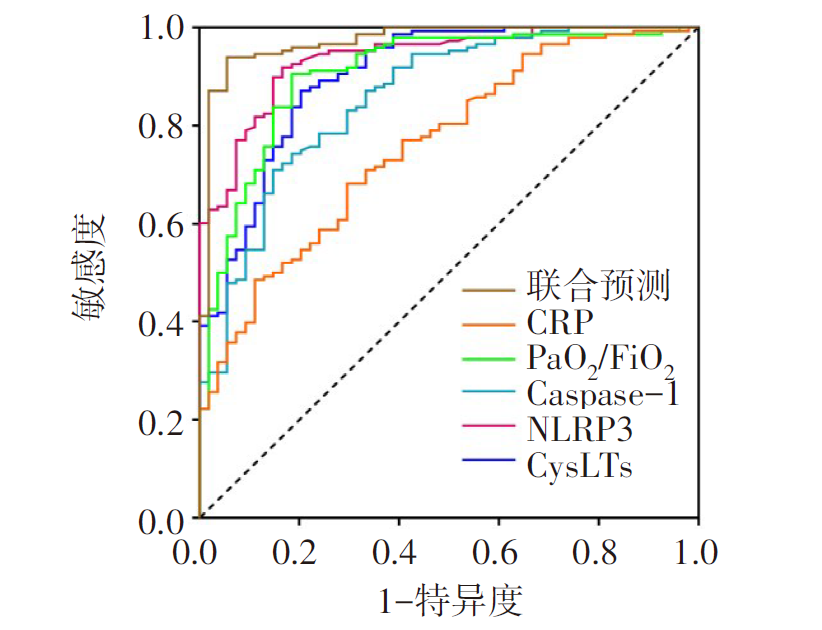
Fig.1 ROC curve of multiple indicators for predicting mucus plug formation in children with SMPP
| [1] | Gao L, Sun Y. Laboratory diagnosis and treatment of Mycoplasma pneumoniae infection in children:a review[J]. Ann Med, 2024, 56(1):2386636. doi:10.1080/07853890.2024.2386636. |
| [2] | 吕国锋, 连丽英, 吕文丽, 等. 儿童重症肺炎支原体肺炎与NLRP3炎症小体通路的关联[J]. 中华医院感染学杂志, 2024, 34(2):258-262. |
| Lyu G F, Lian L Y, Lyu W L, et al. Association between severe Mycoplasma pneumoniae pneumonia in children and NLRP3 inflammasome pathway[J]. Chin J Nosocomiol, 2024, 34(2):258-262. doi:10.11816/cn.ni.2024-230632. | |
| [3] | Sunata K, Miyata J, Kawashima Y, et al. Multiomics analysis identified IL-4-induced IL1RL1(high)eosinophils characterized by prominent cysteinyl leukotriene metabolism[J]. J Allergy Clin Immunol, 2024, 154(5):1277-1288. doi:10.1016/j.jaci.2024.07.012. |
| [4] | 陈艳, 姚欢迎, 林健楠, 等. 儿童肺炎支原体肺炎伴气道阻塞的免疫机制研究进展[J]. 中国当代医药, 2023, 30(25):23-26. |
| Chen Y, Yao H Y, Lin J N, et al. Research progress on immune mechanism of Mycoplasma pneumoniae pneumonia with airway obstruction in children[J]. China Modern Medicine, 2023, 30(25):23-26. doi:10.3969/j.issn.1674-4721.2023.25.007. | |
| [5] | Wu Y, Wang Q, Zhu W, et al. NOTCH pathway was involved in Kaempferol 3-O-gentiobioside attenuated airway inflammation and mucus hypersecretion[J]. Sci Rep, 2025, 15(1):10383. doi:10.1038/s41598-025-95280-8. |
| [6] | 中华人民共和国国家卫生健康委员会. 儿童肺炎支原体肺炎诊疗指南(2023年版)[J]. 国际流行病学传染病学杂志, 2023, 50(2):79-85. |
| National Health Commission of the People’s Republic of China. Guidelines for the diagnosis and treatment of Mycoplasma pneumoniae pneumonia in children(2023 edition)[J]. Inter J of Epidemiol Infect Dis, 2023, 50(2):79-85. doi:10.3760/cma.j.cn331340-20230217-00023. | |
| [7] | Hamshary A, Sherbini S, Elgebaly H F, et al. Prevalence of multiple organ dysfunction in the pediatric intensive care unit:pediatric risk of mortality Ⅲ versus pediatric logistic organ dysfunction scores for mortality prediction[J]. Rev Bras Ter Intensiva, 2017, 29(2):206-212. doi:10.5935/0103-507X.20170029. |
| [8] | 吴苏南, 孙兴珍. 全身免疫炎症指数和C反应蛋白与白蛋白比值在儿童肺炎支原体肺炎并发支气管黏液栓中的预测价值[J]. 中国医药导报, 2025, 22(14):122-125. |
| Wu S N, Sun X Z. Predictive value of systemic immune-inflammation index and C-reactive protein to albumin ratio in children with Mycoplasma pneumoniae pneumonia complicated with bronchial mucus plugs[J]. China Medical Heral, 2025, 22(14):122-125. doi:10.20047/j.issn1673-7210.2025.14.24. | |
| [9] | Liu F, Wang Q, cheng Q, et al. Immune activation and mucin dysregulation in pediatric refractory mycoplasma pneumoniae pneumonia with mucus plugs[J]. Front Cell Infect Microbiol, 2025, 15:1706340. doi:10.3389/fcimb.2025.1706340. |
| [10] | Liu X R, Li M, Hao Q Q, et al. Unraveling cysteinyl leukotrienes and their receptors in inflammation through the brain-gut-lung axis[J]. Virulence, 2025, 16(1):2502555. doi:10.1080/21505594.2025.2502555. |
| [11] | Zarini S, Gijón M A, Ransome A E, et al. Transcellular biosynthesis of cysteinyl leukotrienes in vivo during mouse peritoneal inflammation[J]. Proc Natl Acad Sci U S A, 2009, 106(20):8296-8301. doi:10.1073/pnas.0903851106. |
| [12] | Parker D T, Bentley J K, Lei J, et al. Tuft cell cysteinyl leukotrienes are necessary for rhinovirus-induced mucus metaplasia,type 2 inflammation and airway hyperresponsiveness in immature mice[J]. Front Immunol, 2025, 16:1709008. doi:10.3389/fimmu.2025.1709008. |
| [13] | 彭力, 钟礼立, 黄寒, 等. 肺炎支原体膜脂质诱导人支气管上皮细胞分泌MUC5AC的机制研究[J]. 热带医学杂志, 2024, 24(7):922-925. |
| Peng L, Zhong L L, Huang H, et al. Mechanism of MUC5AC secretion induced by lipid-associated membrane protein of Mycoplasma pneumoniae in human bronchial epithelial cells[J]. J Trop Med, 2024, 24(7):922-925. doi:10.3969/j.issn.1672-3619.2024.07.002. | |
| [14] | Lee M, Boyce J A, Barrett N A. Cysteinyl leukotrienes in allergic inflammation[J]. Annu Rev Pathol, 2025, 20(1):115-141. doi:10.1146/annurev-pathmechdis-111523-023509. |
| [15] | 王哲, 马欣, 黄芳, 等. 重症肺炎患者NLRP3信号通路及相关细胞因子表达及其诊断价值[J]. 中华医院感染学杂志, 2024, 34(9):1295-1298. |
| Wang Z, Ma X, Huang F, et al. Expressions of NLRP3 signaling pathways and related cytokines in severe pneumonia patients and their diagnostic value[J]. Chin J Nosocomiol, 2024, 34(9):1295-1298. doi:10.11816/cn.ni.2024-231429. | |
| [16] | Yang L, Zhang C, Liu Y, et al. The therapeutic potential of neutrophil extracellular traps and NLRP3 inflammasomes in mycoplasma pneumoniae pneumonia[J]. Immunol Invest, 2024, 53(6):975-988. doi:10.1080/08820139.2024.2364796. |
| [17] | 梁瀛今, 张康, 贾茗棪, 等. 探讨清肺解毒化痰方抑制核苷酸结合寡聚化结构域样受体蛋白3炎症小体活化减轻重症肺炎大鼠肺肠免疫损伤的机制[J]. 中华中医药杂志, 2025, 40(5):2579-2586. |
| Liang Y J, Zhang K, Jia M Y, et al. Discussion on mechanism of Qingfei Jiedu Huatan Formula on lung and intestinal immune damage in severe pneumonia rats by inhibiting NLRP3 inflammasome activation[J]. CJTCMP, 2025, 40(5):2579-2586. | |
| [18] | Zhou L, Zhang H, Liu L, et al. Intermittent hypoxia aggravates asthma inflammation via NLRP3/IL-1β-dependent pyroptosis mediated by HIF-1α signalling pathway[J]. Chin Med J(Engl), 2025, 138(14):1714-1729. doi:10.1097/CM9.0000000000003608. |
| [19] | 杨雪妮, 胡宜航, 纪敏, 等. 中性粒细胞胞外诱捕网标记物游离DNA与儿童肺炎支原体肺炎的关系[J]. 实用医学杂志, 2025, 41(23):3711-3716. |
| Yang X N, Hu Y H, Ji M, et al. Relationship between neutrophil extracellular trap marker cell-free DNA and Mycoplasma pneumoniae pneumonia in children[J]. The Journal of Practical Medicine, 2025, 41(23):3711-3716. doi:10.3969/j.issn.1006-5725.2025.23.012. | |
| [20] | Xu S, Zhu T, Mou H, et al. Weakened airway epithelial junctions and enhanced neutrophil elastase release contribute to age-dependent bacteremia risk following pneumococcal pneumonia[J]. Aging Cell, 2025, 24(5):e14474. doi:10.1111/acel.14474. |
| [21] | 乜明金, 刘丽娟, 李莉, 等. 肺炎支原体感染患儿合并支气管黏液堵塞的危险因素及其列线图模型构建与验证[J]. 中华医院感染学杂志, 2023, 33(19):3009-3012. |
| Nie M J, Liu L J, Li L, et al. Risk factors for bronchial mucus plugging in children with Mycoplasma pneumoniae infection and construction and validation of a nomogram model[J]. Chin J Nosocomiol, 2023, 33(19):3009-3012. doi:10.11816/cn.ni.2023-221340. | |
| [22] | 杨菊萍, 丁春杰, 陈静, 等. 小儿MPP并发塑型性支气管炎的临床特点、胸部CT影像学特征及相关因素分析[J]. 中国CT和MRI杂志, 2024, 22(2):61-63. |
| Yang J P, Ding C J, Chen J, et al. Clinical characteristics,chest CT imaging characteristics and related factors of plastic bronchitis in children with MPP[J]. Chinese Journal of CT and MRI, 2024, 22(2):61-63. doi:10.3969/j.issn.1672-5131.2024.02.019. |
| Viewed | ||||||
|
Full text |
|
|||||
|
Abstract |
|
|||||
