
Tianjin Medical Journal ›› 2025, Vol. 53 ›› Issue (11): 1152-1157.doi: 10.11958/20251656
• Clinical Research • Previous Articles Next Articles
LI Yan( ), JIAO Haitao, HUA Haiyang, LIU Wei, LIU Shuling, CAO Xinju, HAO Xin, WANG Aimin△()
Received:2025-05-08
Revised:2025-08-01
Published:2025-11-15
Online:2025-11-19
Contact:
△E-mail:LI Yan, JIAO Haitao, HUA Haiyang, LIU Wei, LIU Shuling, CAO Xinju, HAO Xin, WANG Aimin. The clinical value of NHR combined with MLR for predicting early rebleeding after endoscopic treatment in patients with cirrhosis complicated by acute esophageal-gastric variceal rupture and bleeding[J]. Tianjin Medical Journal, 2025, 53(11): 1152-1157.
CLC Number:
| 组别 | n | 性别 (男/女) | 年龄/ 岁 | 心率/ (次/min) | SBP/ mmHg | 肝癌 病史 | 呕血为 首发表现 | 黑便为 首发表现 | 吸烟史 | 饮酒史 | |||||||
|---|---|---|---|---|---|---|---|---|---|---|---|---|---|---|---|---|---|
| 未再出血组 | 132 | 84/48 | 57.05±10.80 | 85.50(75.25,93.75) | 124.00(111.00,135.00) | 26(19.7) | 82(62.1) | 96(72.7) | 60(45.5) | 65(49.2) | |||||||
| 再出血组 | 96 | 67/29 | 55.07±11.11 | 82.00(72.25,97.75) | 116.50(106.25,126.00) | 20(20.8) | 57(59.4) | 67(69.8) | 47(49.0) | 51(53.1) | |||||||
| t、Z或χ2 | 0.941 | 1.351 | 0.699 | 2.604* | 0.045 | 0.176 | 0.235 | 0.274 | 0.335 | ||||||||
| 组别 | 肝硬化病因 | ||||||||||||||||
| 慢性乙型病毒性 | 慢性丙型病毒性 | 酒精性 | 自身免疫性 | 药物性 | 非酒精脂肪性 | 其他 | |||||||||||
| 未再出血组 | 64(48.5) | 16(12.1) | 24(18.2) | 14(10.6) | 3(2.3) | 0(0.0) | 11(8.3) | ||||||||||
| 再出血组 | 41(42.7) | 13(13.6) | 19(19.8) | 15(15.6) | 0(0.0) | 1(1.0) | 7(7.3) | ||||||||||
| χ2 | 5.301 | ||||||||||||||||
Tab.1 Comparison of general information between the two groups
| 组别 | n | 性别 (男/女) | 年龄/ 岁 | 心率/ (次/min) | SBP/ mmHg | 肝癌 病史 | 呕血为 首发表现 | 黑便为 首发表现 | 吸烟史 | 饮酒史 | |||||||
|---|---|---|---|---|---|---|---|---|---|---|---|---|---|---|---|---|---|
| 未再出血组 | 132 | 84/48 | 57.05±10.80 | 85.50(75.25,93.75) | 124.00(111.00,135.00) | 26(19.7) | 82(62.1) | 96(72.7) | 60(45.5) | 65(49.2) | |||||||
| 再出血组 | 96 | 67/29 | 55.07±11.11 | 82.00(72.25,97.75) | 116.50(106.25,126.00) | 20(20.8) | 57(59.4) | 67(69.8) | 47(49.0) | 51(53.1) | |||||||
| t、Z或χ2 | 0.941 | 1.351 | 0.699 | 2.604* | 0.045 | 0.176 | 0.235 | 0.274 | 0.335 | ||||||||
| 组别 | 肝硬化病因 | ||||||||||||||||
| 慢性乙型病毒性 | 慢性丙型病毒性 | 酒精性 | 自身免疫性 | 药物性 | 非酒精脂肪性 | 其他 | |||||||||||
| 未再出血组 | 64(48.5) | 16(12.1) | 24(18.2) | 14(10.6) | 3(2.3) | 0(0.0) | 11(8.3) | ||||||||||
| 再出血组 | 41(42.7) | 13(13.6) | 19(19.8) | 15(15.6) | 0(0.0) | 1(1.0) | 7(7.3) | ||||||||||
| χ2 | 5.301 | ||||||||||||||||
| 组别 | PLT/(×109/L) | TBA/(μmol/L) | ALT/(U/L) | AST/(U/L) | TBIL/(μmol/L) | A/G |
|---|---|---|---|---|---|---|
| 未再出血组 | 82.50(64.00,131.75) | 19.90(6.58,34.88) | 21.00(14.00,30.00) | 27.50(20.00,41.75) | 16.85(11.03,30.95) | 1.29(1.08,1.47) |
| 再出血组 | 57.50(38.25,82.00) | 36.20(12.45,56.28) | 24.00(17.00,44.75) | 35.00(23.25,70.50) | 30.30(18.63,38.55) | 1.08(0.81,1.27) |
| Z | 5.316* | 3.364* | 2.597* | 3.251* | 5.098* | 4.858* |
| 组别 | Cr/(μmol/L) | CEA/(μg/L) | AFP/(μg/L) | Na+/(mmol/L) | K+/(mmol/L) | LDL-C/(mmol/L) |
| 未再出血组 | 61.50(51.00,73.00) | 1.89(1.23,2.69) | 2.40(1.43,3.60) | 138.00(135.00,140.00) | 3.86(3.59,4.20) | 1.47(1.13,1.73) |
| 再出血组组 | 64.00(52.50,78.00) | 2.09(1.39,3.05) | 2.30(1.70,4.20) | 137.50(135.00,139.00) | 3.82(3.55,4.20) | 1.31(0.96,1.56) |
| Z | 1.334 | 1.800 | 0.497 | 1.791 | 0.160 | 2.417* |
| 组别 | APTT/s | TT/s | INR | FIB-4 | ||
| 未再出血组 | 30.45(28.10,33.95) | 18.20(16.93,19.90) | 1.28(1.19,1.42) | 1.62(1.18,2.04) | ||
| 再出血组 | 32.45(28.73,34.80) | 19.20(17.53,20.95) | 1.36(1.23,1.58) | 1.75(1.30,2.10) | ||
| Z | 2.021* | 2.430* | 3.089* | 3.805* | ||
Tab.2 Comparison of laboratory indicators between the two groups
| 组别 | PLT/(×109/L) | TBA/(μmol/L) | ALT/(U/L) | AST/(U/L) | TBIL/(μmol/L) | A/G |
|---|---|---|---|---|---|---|
| 未再出血组 | 82.50(64.00,131.75) | 19.90(6.58,34.88) | 21.00(14.00,30.00) | 27.50(20.00,41.75) | 16.85(11.03,30.95) | 1.29(1.08,1.47) |
| 再出血组 | 57.50(38.25,82.00) | 36.20(12.45,56.28) | 24.00(17.00,44.75) | 35.00(23.25,70.50) | 30.30(18.63,38.55) | 1.08(0.81,1.27) |
| Z | 5.316* | 3.364* | 2.597* | 3.251* | 5.098* | 4.858* |
| 组别 | Cr/(μmol/L) | CEA/(μg/L) | AFP/(μg/L) | Na+/(mmol/L) | K+/(mmol/L) | LDL-C/(mmol/L) |
| 未再出血组 | 61.50(51.00,73.00) | 1.89(1.23,2.69) | 2.40(1.43,3.60) | 138.00(135.00,140.00) | 3.86(3.59,4.20) | 1.47(1.13,1.73) |
| 再出血组组 | 64.00(52.50,78.00) | 2.09(1.39,3.05) | 2.30(1.70,4.20) | 137.50(135.00,139.00) | 3.82(3.55,4.20) | 1.31(0.96,1.56) |
| Z | 1.334 | 1.800 | 0.497 | 1.791 | 0.160 | 2.417* |
| 组别 | APTT/s | TT/s | INR | FIB-4 | ||
| 未再出血组 | 30.45(28.10,33.95) | 18.20(16.93,19.90) | 1.28(1.19,1.42) | 1.62(1.18,2.04) | ||
| 再出血组 | 32.45(28.73,34.80) | 19.20(17.53,20.95) | 1.36(1.23,1.58) | 1.75(1.30,2.10) | ||
| Z | 2.021* | 2.430* | 3.089* | 3.805* | ||
| 组别 | NHR | MLR |
|---|---|---|
| 未再出血组 | 2.25(1.62,3.61) | 0.27(0.19,0.46) |
| 再出血组 | 4.59(2.59,8.96) | 0.54(0.38,0.84) |
| Z | 6.233* | 7.217* |
| 组别 | MELD评分 | CTP评分 |
| 未再出血组 | 9.35(7.29,10.91) | 5.00(4.00,6.00) |
| 再出血组 | 10.83(7.77,13.97) | 5.00(5.00,7.00) |
| Z | 3.087* | 3.690* |
Tab.3 Comparison of inflammatory markers and prognosis scores of liver cirrhosis between the two groups
| 组别 | NHR | MLR |
|---|---|---|
| 未再出血组 | 2.25(1.62,3.61) | 0.27(0.19,0.46) |
| 再出血组 | 4.59(2.59,8.96) | 0.54(0.38,0.84) |
| Z | 6.233* | 7.217* |
| 组别 | MELD评分 | CTP评分 |
| 未再出血组 | 9.35(7.29,10.91) | 5.00(4.00,6.00) |
| 再出血组 | 10.83(7.77,13.97) | 5.00(5.00,7.00) |
| Z | 3.087* | 3.690* |
| 指标 | SBP | PLT | AST | TBIL |
|---|---|---|---|---|
| NHR | -0.090 | 0.223 | 0.147* | 0.252** |
| MLR | -0.076 | -0.152* | 0.163* | 0.334* |
| 指标 | APTT | INR | A/G | FIB-4 |
| NHR | -0.128 | 0.181* | -0.103 | -0.121 |
| MLR | 0.063 | 0.154 | -0.246 | 0.147* |
Tab.4 Correlation analysis of NHR, MLR and relevant clinical indiccators
| 指标 | SBP | PLT | AST | TBIL |
|---|---|---|---|---|
| NHR | -0.090 | 0.223 | 0.147* | 0.252** |
| MLR | -0.076 | -0.152* | 0.163* | 0.334* |
| 指标 | APTT | INR | A/G | FIB-4 |
| NHR | -0.128 | 0.181* | -0.103 | -0.121 |
| MLR | 0.063 | 0.154 | -0.246 | 0.147* |
| 变量 | β | SE | Wald χ2 | P | OR(95%CI) |
|---|---|---|---|---|---|
| SBP | -0.017 | 0.009 | 3.745 | 0.053 | 0.983(0.966~1.000) |
| TBA | 0.002 | 0.004 | 0.167 | 0.683 | 1.002(0.994~1.009) |
| ALT | 0.010 | 0.007 | 2.178 | 0.140 | 1.010(0.997~1.023) |
| LDL-C | -0.187 | 0.278 | 0.449 | 0.503 | 0.830(0.481~1.432) |
| APTT | 0.080 | 0.044 | 3.253 | 0.071 | 1.083(0.993~1.182) |
| TT | 0.127 | 0.063 | 4.029 | 0.045 | 1.136(1.003~1.286) |
| NHR | 0.121 | 0.045 | 7.350 | 0.007 | 1.129(1.034~1.232) |
| MLR | 3.496 | 0.732 | 22.813 | <0.001 | 32.997(7.859~138.543) |
| 常数项 | -5.440 | 2.171 | 6.278 | 0.012 | 0.004 |
Tab.5 Multivariate Logistic regression analysis of factors influencing rebleeding in patients
| 变量 | β | SE | Wald χ2 | P | OR(95%CI) |
|---|---|---|---|---|---|
| SBP | -0.017 | 0.009 | 3.745 | 0.053 | 0.983(0.966~1.000) |
| TBA | 0.002 | 0.004 | 0.167 | 0.683 | 1.002(0.994~1.009) |
| ALT | 0.010 | 0.007 | 2.178 | 0.140 | 1.010(0.997~1.023) |
| LDL-C | -0.187 | 0.278 | 0.449 | 0.503 | 0.830(0.481~1.432) |
| APTT | 0.080 | 0.044 | 3.253 | 0.071 | 1.083(0.993~1.182) |
| TT | 0.127 | 0.063 | 4.029 | 0.045 | 1.136(1.003~1.286) |
| NHR | 0.121 | 0.045 | 7.350 | 0.007 | 1.129(1.034~1.232) |
| MLR | 3.496 | 0.732 | 22.813 | <0.001 | 32.997(7.859~138.543) |
| 常数项 | -5.440 | 2.171 | 6.278 | 0.012 | 0.004 |
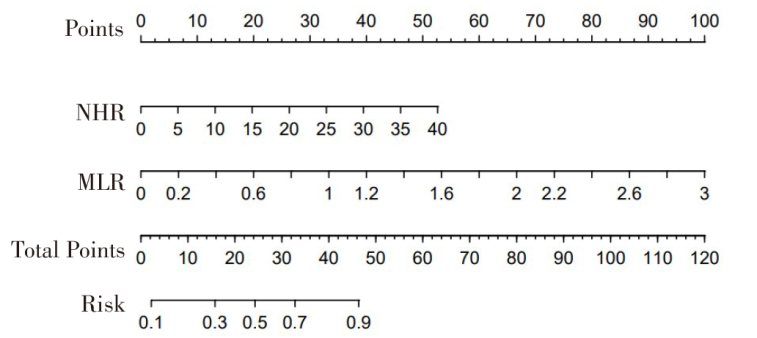
Fig.1 Nomogram for predicting rebleeding in patients with cirrhosis complicated by AEVB
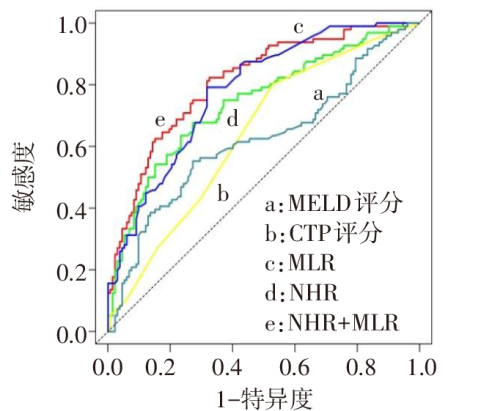
Fig.2 ROC curves of MELD score, CTP score, NHR, MLR and NHR combined with MLR for predicting rebleeding in cirrhosis patients with AEVB
| 指标 | AUC | 95%CI | 敏感度/ % | 特异度/ % | 截断值 | 约登 指数 |
|---|---|---|---|---|---|---|
| MELD评分 | 0.620 | 0.544~0.696 | 55.2 | 72.1 | 10.526分 | 0.273 |
| CTP评分 | 0.643 | 0.568~0.711 | 80.2 | 47.0 | 4.500分 | 0.272 |
| NHR | 0.741 | 0.676~0.807 | 67.7 | 72.7 | 3.396 | 0.404 |
| MLR | 0.780 | 0.721~0.839 | 79.2 | 68.2 | 0.365 | 0.474 |
| NHR+MLR | 0.810 | 0.754~0.866 | 82.3 | 67.4 | - | 0.497 |
Tab.6 Predictive efficacy of MELD score,CTP score,NHR,MLR and NHR combined with MLR for rebleeding in cirrhosis patients with AEVB
| 指标 | AUC | 95%CI | 敏感度/ % | 特异度/ % | 截断值 | 约登 指数 |
|---|---|---|---|---|---|---|
| MELD评分 | 0.620 | 0.544~0.696 | 55.2 | 72.1 | 10.526分 | 0.273 |
| CTP评分 | 0.643 | 0.568~0.711 | 80.2 | 47.0 | 4.500分 | 0.272 |
| NHR | 0.741 | 0.676~0.807 | 67.7 | 72.7 | 3.396 | 0.404 |
| MLR | 0.780 | 0.721~0.839 | 79.2 | 68.2 | 0.365 | 0.474 |
| NHR+MLR | 0.810 | 0.754~0.866 | 82.3 | 67.4 | - | 0.497 |
| 指标 | NRI | PNRI | IDI | PIDI |
|---|---|---|---|---|
| NHR+MLR vs. NHR | 0.663 | <0.001 | 0.116 | <0.001 |
| NHR+MLR vs. MLR | 0.487 | <0.001 | 0.051 | <0.001 |
| NHR+MLR vs. MELD | 0.869 | <0.001 | 0.225 | <0.001 |
| NHR+MLR vs. CTP | 0.750 | <0.001 | 0.216 | <0.001 |
Tab.7 NRI and IDI analysis of NHR combined with MLR and other indicators
| 指标 | NRI | PNRI | IDI | PIDI |
|---|---|---|---|---|
| NHR+MLR vs. NHR | 0.663 | <0.001 | 0.116 | <0.001 |
| NHR+MLR vs. MLR | 0.487 | <0.001 | 0.051 | <0.001 |
| NHR+MLR vs. MELD | 0.869 | <0.001 | 0.225 | <0.001 |
| NHR+MLR vs. CTP | 0.750 | <0.001 | 0.216 | <0.001 |
| [1] | GINÈS P, KRAG A, ABRALDES J G, et al. Liver cirrhosis[J]. Lancet, 2021, 398(10308):1359-1376. doi:10.1016/S0140-6736(21)01374-X. |
| [2] | CHANDNA S, ZARATE E R, GALLEGOS-OROZCO J F. Management of decompensated cirrhosis and associated syndromes[J]. Surg Clin North Am, 2022, 102(1):117-137. doi:10.1016/j.suc.2021.09.005. |
| [3] | PALLIO S, MELITA G, SHAHINI E, et al. Diagnosis and management of esophagogastric varices[J]. Diagnostics(Basel), 2023, 13(6):1031. doi:10.1016/j.suc.2021.09.005. |
| [4] | 中华医学会肝病学分会, 中华医学会消化病学分会, 中华医学会消化内镜学分会. 肝硬化门静脉高压食管胃静脉曲张出血的防治指南[J]. 中华内科杂志, 2023, 62(1):7-22. |
| Chinese Society of Hepatology, Chinese Society of Gastroenterology, Chinese Society of Digestive Endoscopy. Guidelines on the management of esophagogastric variceal bleeding in cirrhotic portal hypertension[J]. Chinese Journal of Internal Medicine, 2023, 62(1):7-22. doi:10.3760/cma.j.cn501113-20220824-00436. | |
| [5] | 游平飞, 金红旭. LAR联合MHR对急性上消化道出血患者预后的预测价值[J]. 中国医科大学学报, 2024, 53(7):640-645. |
| YOU P F, JIN H X. Predictive value of LAR plus MHR for prognosis of patients with acute upper gastrointestinal bleeding[J]. Journal of China Medical University, 2024, 53(7):640-645. doi:10.12007/j.issn.0258-4646.2024.07.011. | |
| [6] | ENGELMANN C, CLÀRIA J, SZABO G, et al. Pathophysiology of decompensated cirrhosis:portal hypertension,circulatory dysfunction,inflammation,metabolism and mitochondrial dysfunction[J]. J Hepatol, 2021, 75 (Suppl 1):S49-S66. doi:10.1016/j.jhep.2021.01.002. |
| [7] | FREEMAN R B J R, WIESNER R H, HARPER A, et al. The new liver allocation system:moving toward evidence-based transplantation policy[J]. Liver Transpl, 2002, 8(9):851-858. doi:10.1053/jlts.2002.35927. |
| [8] | CHILD C G, TURCOTTE J G. Surgery and portal hypertension[J]. Major Probl Clin Surg, 1964, 1:1-85. |
| [9] | 徐爱强, 张丽. 中国病毒性肝炎血清流行病学调查的回顾与意义[J]. 中华预防医学杂志, 2017, 51(6):457-461. |
| XU A Q, ZHANG L. The review and significance of national seroepidemiological surveys on viral hepatitis in China[J]. Chinese Journal of Preventive Medicine, 2017, 51(6):457-461. doi:10.3760/cma.j.issn.0253-9624.2017.06.001. | |
| [10] | 戴天骄, 李静. 血小板-白蛋白-胆红素指数(PALBI)联合AIMS65评分对肝硬化并发急性上消化道出血患者短期预后的预测价值[J]. 临床肝胆病杂志, 2024, 40(2):298-305. |
| DAI T J, LI J. Value of platelet-albumin-bilirubin index combined with AIMS65 score in predicting the short-term prognosis of patients with liver cirrhosis and acute upper gastrointestinal bleeding[J]. Journal of Clinical Hepatology and Biliary Diseases, 2024, 40(2):298-305. doi:10.12449/JCH240213. | |
| [11] | TIAN C, WANG X, TAO L, et al. Association of neutrophil to high density lipoprotein cholesterol ratio with aortic dissection and aneurysm risk:epidemiological insights from prospective cohort study based on UK biobank[J]. BMC Public Health, 2025, 25(1):886. doi:10.1186/s12889-025-22061-3. |
| [12] | CHEN J, LIU A, ZHANG D, et al. Neutrophil to high-density lipoprotein cholesterol ratio predicts left ventricular remodeling and MACE after PCI in patients with acute ST-segment elevation myocardial infarction[J]. Front Cardiovasc Med, 2025, 12:1497255. doi:10.3389/fcvm.2025.1497255. |
| [13] | CHROSTEK L, SUPRONOWICZ L, PANASIUK A, et al. The effect of the severity of liver cirrhosis on the level of lipids and lipoproteins[J]. Clin Exp Med, 2014, 14(4):417-421. doi:10.1007/s10238-013-0262-5. |
| [14] | ZHU N, LI Y, LIN Y, et al. Association between neutrophil-to-high-density lipoprotein cholesterol ratio and non-alcoholic fatty liver disease or metabolic dysfunction-associated steatotic liver disease:evidence from NHANES 2017-2020[J]. Front Med(Lausanne), 2024, 11:1491858. doi:10.3389/fmed.2024.1491858. |
| [15] | ZHU Z, ZHOU S, LI S, et al. Neutrophil extracellular traps in wound healing[J]. Trends Pharmacol Sci, 2024, 45(11):1033-1045. doi:10.1016/j.tips.2024.09.007. |
| [16] | ZHANG H, WANG Y, QU M, et al. Neutrophil,neutrophil extracellular traps and endothelial cell dysfunction in sepsis[J]. Clin Transl Med, 2023, 13(1):e1170. doi:10.1002/ctm2.1170. |
| [17] | 喻洪, 杨朝栋, 刘丹. ALT/ALP比值、PLR与老年脓毒症休克患者并发肝损伤的关系[J]. 天津医药, 2024, 52(11):1211-1215. |
| YU H, YANG Z D, LIU D. The relationship between ALT/ALP ratio,PLR and hepatic injury in elderly patients with septic shock[J]. Tianjin Med J, 2024, 52(11):1211-1215. doi:10.11958/20240637. | |
| [18] | HE H, ADILI R, LIU L, et al. Synthetic high-density lipoproteins loaded with an antiplatelet drug for efficient inhibition of thrombosis in mice[J]. Sci Adv, 2020, 6(49):eabd0130. doi:10.1126/sciadv.abd0130. |
| [19] | HABIB A, MIHAS A A, ABOU-ASSI S G, et al. High-density lipoprotein cholesterol as an indicator of liver function and prognosis in noncholestatic cirrhotics[J]. Clin Gastroenterol Hepatol, 2005, 3(3):286-291. doi:10.1016/s1542-3565(04)00622-6. |
| [20] | LIU K, TANG S Y, LIU C H, et al. Systemic immune-inflammatory biomarkers (SII,NLR,PLR and LMR)linked to non-alcoholic fatty liver disease risk[J]. Front Immunol, 2024, 15:1337241. doi:10.3389/fimmu.2024.1337241. |
| [21] | HE Z J, HU T, ZHANG Z S, et al. Combined bone mineral density(BMD)and monocyte-to-lymphocyte ratio(MLR)predicts recurrence and prognosis in hepatocellular carcinoma patients following liver resection[J]. Risk Manag Healthc Policy, 2024, 17:2741-2754. doi:10.2147/RMHP.S473247. |
| [22] | ZHOU T, FANG J, HUANG J, et al. Prognostic value of inflammatory markers in HBV-related HCC after hepatectomy based on a clinical database[J]. J Invest Surg, 2025, 38(1):2475020. doi:10.1080/08941939.2025.2475020. |
| [23] | 王满, 王树俊, 徐侠. MLR联合MELD评分对乙型肝炎相关慢加急性肝衰竭预后的预测价值[J]. 现代临床医学, 2023, 49(6):417-420. |
| WANG M, WANG S J, XU X. Predictive effect of monocyte lymphocyte ratio combined with MELD score on prognosis of hepatitis B virus-related acute-on-chronic liver failure[J]. Modern Clinical Medicine, 2023, 49(6):417-420. doi:10.11851/j.issn.1673-1557.2023.06.005. | |
| [24] | BERNSMEIER C, CAVAZZA A, FATOUROU E M, et al. Leucocyte ratios are biomarkers of mortality in patients with acute decompensation of cirrhosis and acute-on-chronic liver failure[J]. Aliment Pharmacol Ther, 2020, 52(5):855-865. doi:10.1111/apt.15932. |
| [25] | BEZHAEVA T, KARPER J, QUAX P H A, et al. The intriguing role of TLR accessory molecules in cardiovascular health and disease[J]. Front Cardiovasc Med, 2022, 9:820962. doi:10.3389/fcvm.2022.820962. |
| [26] | ZHUANG D Z, LI T, WU X Q, et al. Low serum calcium promotes traumatic intracerebral hematoma expansion by the response of immune cell:a multicenter retrospective cohort study[J]. Sci Rep, 2025, 15(1):8639. doi:10.3389/fcvm.2022.820962. |
| [27] | MOHME M, SAUVIGNY T, MADER M M, et al. Immune characterization in aneurysmal subarachnoid hemorrhage reveals distinct monocytic activation and chemokine patterns[J]. Transl Stroke Res, 2020, 11(6):1348-1361. doi:10.1007/s12975-019-00764-1. |
| [28] | GARCIA-TSAO G, BOSCH J. Varices and variceal hemorrhage in cirrhosis:a new view of an old problem[J]. Clin Gastroenterol Hepatol, 2015, 13(12):2109-2117. doi:10.1016/j.cgh.2015.07.012. |
| Viewed | ||||||
|
Full text |
|
|||||
|
Abstract |
|
|||||
