
Tianjin Medical Journal ›› 2026, Vol. 54 ›› Issue (10): 1045-1049.doi: 10.11958/20260146
• Clinical Research • Previous Articles Next Articles
LIU Shuai1( ), LI Bao1,△(), SHANG Heng2, SUN Yazhao3
Received:2026-01-10
Revised:2026-03-23
Published:2026-10-15
Online:2026-10-10
Contact:
△E-mail:18131798670@163.com
LIU Shuai, LI Bao, SHANG Heng, SUN Yazhao. Evaluation value of serum adiponectin and pancreatic β-cell function index for diabetic cardiomyopathy and cardiac dysfunction[J]. Tianjin Medical Journal, 2026, 54(10): 1045-1049.
CLC Number:
| 组别 | 年龄/岁 | 性别(男/女) | BMI/(kg/m2) | 吸烟史 | 饮酒史 | 糖尿病病程/年 | 合并症 | HDL-C/(mmol/L) | ||||||||||||
|---|---|---|---|---|---|---|---|---|---|---|---|---|---|---|---|---|---|---|---|---|
| 高血压 | 高血脂 | |||||||||||||||||||
| 对照组 | 66.15±4.54 | 63(59.43)/43(40.57) | 25.11±1.97 | 38(35.85) | 40(37.74) | 9.40±3.86 | 47(44.34) | 22(20.75) | 1.38±0.30 | |||||||||||
| 观察组 | 64.85±5.27 | 62(58.49)/44(41.51) | 24.68±2.11 | 34(32.08) | 38(35.85) | 15.32±5.11 | 46(43.40) | 21(19.81) | 1.37±0.29 | |||||||||||
| t或χ2 | 1.928 | 0.019 | 1.502 | 0.337 | 0.081 | 9.491** | 0.006 | 0.029 | 0.247 | |||||||||||
| 组别 | 降糖药物使用情况 | LDL-C/ (mmol/L) | TC/ (mmol/L) | TG/ (mmol/L) | HbA1c/ % | Scr/ (μmol/L) | UA/ (μmol/L) | |||||||||||||
| 二甲双胍 | SGLT2i | GLP-1RA | 胰岛素 | |||||||||||||||||
| 对照组 | 85(80.19) | 30(28.30) | 22(20.75) | 25(23.58) | 2.95±0.70 | 3.84±0.49 | 1.72±0.38 | 8.60±2.21 | 82.15±16.89 | 352.12±64.11 | ||||||||||
| 观察组 | 88(83.02) | 32(30.19) | 25(23.58) | 28(26.42) | 2.93±0.61 | 3.70±0.55 | 1.66±0.40 | 8.68±2.15 | 80.25±11.20 | 350.21±65.12 | ||||||||||
| t或χ2 | 0.283 | 0.091 | 0.246 | 0.226 | 0.223 | 1.959 | 1.119 | 0.267 | 0.960 | 0.215 | ||||||||||
Tab.1 Comparison of baseline data between the two groups of patients
| 组别 | 年龄/岁 | 性别(男/女) | BMI/(kg/m2) | 吸烟史 | 饮酒史 | 糖尿病病程/年 | 合并症 | HDL-C/(mmol/L) | ||||||||||||
|---|---|---|---|---|---|---|---|---|---|---|---|---|---|---|---|---|---|---|---|---|
| 高血压 | 高血脂 | |||||||||||||||||||
| 对照组 | 66.15±4.54 | 63(59.43)/43(40.57) | 25.11±1.97 | 38(35.85) | 40(37.74) | 9.40±3.86 | 47(44.34) | 22(20.75) | 1.38±0.30 | |||||||||||
| 观察组 | 64.85±5.27 | 62(58.49)/44(41.51) | 24.68±2.11 | 34(32.08) | 38(35.85) | 15.32±5.11 | 46(43.40) | 21(19.81) | 1.37±0.29 | |||||||||||
| t或χ2 | 1.928 | 0.019 | 1.502 | 0.337 | 0.081 | 9.491** | 0.006 | 0.029 | 0.247 | |||||||||||
| 组别 | 降糖药物使用情况 | LDL-C/ (mmol/L) | TC/ (mmol/L) | TG/ (mmol/L) | HbA1c/ % | Scr/ (μmol/L) | UA/ (μmol/L) | |||||||||||||
| 二甲双胍 | SGLT2i | GLP-1RA | 胰岛素 | |||||||||||||||||
| 对照组 | 85(80.19) | 30(28.30) | 22(20.75) | 25(23.58) | 2.95±0.70 | 3.84±0.49 | 1.72±0.38 | 8.60±2.21 | 82.15±16.89 | 352.12±64.11 | ||||||||||
| 观察组 | 88(83.02) | 32(30.19) | 25(23.58) | 28(26.42) | 2.93±0.61 | 3.70±0.55 | 1.66±0.40 | 8.68±2.15 | 80.25±11.20 | 350.21±65.12 | ||||||||||
| t或χ2 | 0.283 | 0.091 | 0.246 | 0.226 | 0.223 | 1.959 | 1.119 | 0.267 | 0.960 | 0.215 | ||||||||||
| 组别 | APN/(mg/L) | HOMA-β/% | E/A | LVEF/% | LVEDV/mL | NT-proBNP/(ng/L) |
|---|---|---|---|---|---|---|
| 对照组 | 4.38±0.51 | 70.87±9.57 | 1.13±0.21 | 54.75±2.94 | 53.12±2.57 | 885.29±141.12 |
| 观察组 | 3.86±0.42 | 64.12±9.15 | 0.84±0.18 | 52.86±2.41 | 62.45±4.85 | 1 782.14±352.12 |
| t | 8.317** | 5.246** | 10.764** | 5.120** | 17.480** | 24.341** |
Tab.2 Comparison of serum APN, HOMA-β and cardiac function indicators between the two groups
| 组别 | APN/(mg/L) | HOMA-β/% | E/A | LVEF/% | LVEDV/mL | NT-proBNP/(ng/L) |
|---|---|---|---|---|---|---|
| 对照组 | 4.38±0.51 | 70.87±9.57 | 1.13±0.21 | 54.75±2.94 | 53.12±2.57 | 885.29±141.12 |
| 观察组 | 3.86±0.42 | 64.12±9.15 | 0.84±0.18 | 52.86±2.41 | 62.45±4.85 | 1 782.14±352.12 |
| t | 8.317** | 5.246** | 10.764** | 5.120** | 17.480** | 24.341** |
| 指标 | E/A | LVEF | LVEDV | NT-proBNP |
|---|---|---|---|---|
| APN | 0.667** | 0.662** | -0.313** | -0.352** |
| HOMA-β | 0.420** | 0.367** | -0.395** | -0.418** |
Tab.3 Correlation of serum APN, HOMA-β and cardiac function indicators in patients with diabetic cardiomyopathy
| 指标 | E/A | LVEF | LVEDV | NT-proBNP |
|---|---|---|---|---|
| APN | 0.667** | 0.662** | -0.313** | -0.352** |
| HOMA-β | 0.420** | 0.367** | -0.395** | -0.418** |
| 变量 | β | SE | Wald χ2 | P | OR | OR(95%CI) |
|---|---|---|---|---|---|---|
| 糖尿病病程 | 0.117 | 0.041 | 8.143 | 0.004 | 1.124 | 1.037~1.218 |
| APN | -0.101 | 0.038 | 7.064 | 0.008 | 0.904 | 0.839~0.974 |
| HOMA-β | -0.102 | 0.041 | 6.189 | <0.001 | 0.903 | 0.833~0.979 |
| 常数项 | -1.401 | 0.255 | 30.185 | <0.001 | 0.246 |
Tab.4 Results of multivariate Logistic regression analysis on factors affecting DCM
| 变量 | β | SE | Wald χ2 | P | OR | OR(95%CI) |
|---|---|---|---|---|---|---|
| 糖尿病病程 | 0.117 | 0.041 | 8.143 | 0.004 | 1.124 | 1.037~1.218 |
| APN | -0.101 | 0.038 | 7.064 | 0.008 | 0.904 | 0.839~0.974 |
| HOMA-β | -0.102 | 0.041 | 6.189 | <0.001 | 0.903 | 0.833~0.979 |
| 常数项 | -1.401 | 0.255 | 30.185 | <0.001 | 0.246 |
| 指标 | 阈值 | 敏感度/% | 特异度/% | AUC(95%CI) | 约登指数 |
|---|---|---|---|---|---|
| APN | 4.01 mg/L | 70.75 | 76.14 | 0.790(0.729~0.843) | 0.463 |
| HOMA-β | 67.19% | 73.58 | 68.87 | 0.761(0.697~0.816) | 0.425 |
| 联合 | - | 91.51 | 81.13 | 0.903(0.855~0.940) | 0.726 |
Tab.5 Evaluation value of serum APN, HOMA-β alone and combined for DCM
| 指标 | 阈值 | 敏感度/% | 特异度/% | AUC(95%CI) | 约登指数 |
|---|---|---|---|---|---|
| APN | 4.01 mg/L | 70.75 | 76.14 | 0.790(0.729~0.843) | 0.463 |
| HOMA-β | 67.19% | 73.58 | 68.87 | 0.761(0.697~0.816) | 0.425 |
| 联合 | - | 91.51 | 81.13 | 0.903(0.855~0.940) | 0.726 |
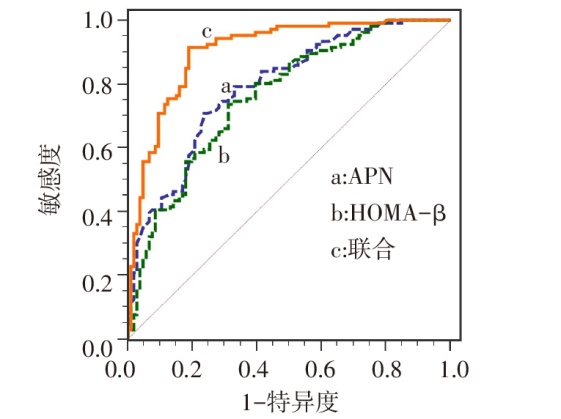
Fig.1 ROC curves for the individual and combined assessment of DCM using serum APN and HOMA-β
| [1] | Lorenzo-almorós A, Cepeda-rodrigo J M, Lorenzo Ó. Diabetic cardiomyopathy[J]. Rev Clin Esp (Barc), 2022, 222(2):100-111. doi:10.1016/j.rceng.2019.10.012. |
| [2] | Nakamura K, Miyoshi T, Yoshida M, et al. Pathophysiology and treatment of diabetic cardiomyopathy and heart failure in patients with diabetes mellitus[J]. Int J Mol Sci, 2022, 23(7):3587. doi:10.3390/ijms23073587. |
| [3] | Zhang C, Han M, Zhang X, et al. Ginsenoside Rb1 protects against diabetic cardiomyopathy by regulating the adipocytokine pathway[J]. J Inflamm Res, 2022, 15:71-83. doi:10.2147/JIR.S348866. |
| [4] | Zhou Z, Liu C, Xu S, et al. Metabolism regulator adiponectin prevents cardiac remodeling and ventricular arrhythmias via sympathetic modulation in a myocardial infarction model[J]. Basic Res Cardiol, 2022, 117(1):34. doi:10.1007/s00395-022-00939-2. |
| [5] | Pan S, Wang Y, Zhang Y, et al. The relationship between the serum NLRP3 and adiponectin levels and coronary lesions in patients with unstable angina with type 2 diabetes[J]. Clin Interv Aging, 2024, 19:1301-1308. doi:10.2147/CIA.S467291. |
| [6] | Lv Y, Zheng Y, Zhao X, et al. The relationship between islet β-cell function and metabolomics in overweight patients with Type 2 diabetes[J]. Biosci Rep, 2023, 43(2):20221430. doi:10.1042/BSR20221430. |
| [7] | 中华医学会糖尿病学分会. 中国糖尿病防治指南(2024版)[J]. 中华糖尿病杂志, 2025, 17(1):16-139. |
| Chinese Diabetes Society of the Chinese Medical association. Guideline for the prevention and treatment of diabetes mellitus in China (2024 edition)[J]. Chin J Diabetes Mellitus, 2025, 17(1):16-139. doi:10.3760/cma.j.cn115791-20241203-00705. | |
| [8] | 国家心血管病中心心肌病专科联盟, 中国医疗保健国际交流促进会心血管病精准医学分会, 宋雷, 等. 中国心肌病综合管理指南2025[J]. 中国循环杂志, 2025, 40(5):420-462. |
| National Cardiovascular Disease Center Myocardial Disease Specialized Alliance, China Medical and Health International Exchange Promotion Association Cardiovascular Disease Precision Medicine Branch, Song L, et al. 2025 Chinese Guideline for the Management of Cardiomyopathies[J]. Chin Circ J,2025, 40(5):420-462. doi:10.3969/j.issn.1000-3614.2025.05.002. | |
| [9] | Hannah S, Kamran Q Y, Mario R, et al. Diabetic cardiomyopathy: what clinicians should know[J]. Am J Med, 2025, 138(3):387-395. doi:10.1016/j.amjmed.2024.10.026. |
| [10] | Fornari L L, Fornari L L, Dogani R V, et al. Unraveling the rationale and conducting a comprehensive assessment of AdipoRon (adiponectin receptor agonist) as a candidate drug for diabetic nephropathy and cardiomyopathy prevention and intervention-a systematic review[J]. Naunyn Schmiedebergs Arch Pharmacol, 2025, 398(1):165-177. doi:10.1007/s00210-024-03362-7. |
| [11] | Li D K, Smith L E, Rookyard A W, et al. Multi-omics of a pre-clinical model of diabetic cardiomyopathy reveals increased fatty acid supply impacts mitochondrial metabolic selectivity[J]. J Mol Cell Cardiol, 2022, 164:92-109. doi:10.1016/j.yjmcc.2021.11.009. |
| [12] | 程清, 徐艳, 陈国飞, 等. 急性失代偿性心力衰竭病人血清脂联素水平与炎症反应及短期预后的关系[J]. 中西医结合心脑血管病杂志, 2024, 22(23):4326-4329. |
| Cheng Q, Xu Y, Chen G F, et al. The relationship between serum adiponectin levels and inflammatory response as well as short-term prognosis in patients with acute decompensated heart failure[J]. Chin J Integr Med Cardiovasc Cerebrovasc Dis, 2024, 22(23):4326-4329. doi:10.12102/j.issn.1672-1349.2024.23.016. | |
| [13] | 茆文群, 张翥, 范修才, 等. 急性心肌梗死后血清脂联素水平变化及其与心力衰竭和主要不良心血管事件的关系[J]. 实用临床医药杂志, 2024, 28(22):78-81. |
| Mao W Q, Zhang Z, Fan X C, et al. Changes in serum adiponectin levels after acute myocardial infarction and its relationships with heart failure and major adverse cardiac events[J]. J Clin Med Pract, 2024, 28(22):78-81. doi:10.7619/jcmp.20242829. | |
| [14] | 祖晓麟, 屈超, 叶明, 等. 卡格列净对老年2型糖尿病合并射血分数保留型心力衰竭患者胰岛素抵抗和心脏舒张功能的影响及心血管结局[J]. 中国医药, 2023, 18(6):810-814. |
| Zu X L, Qu C, Ye M, et al. Effects of canagliflozin on insulin resistance and cardiac diastolic function in elderly patients with type 2 diabetes mellitus and heart failure with preserved ejection fraction and cardiovascular outcomes[J]. China Medicine, 2023, 18(6):810-814. doi:10.3760/j.issn.1673-4777.2023.06.003. | |
| [15] | 李汶珊, 易晓利, 卜献春, 等. 滋膵通脉饮对糖尿病心肌病大鼠糖脂代谢及氧化应激的影响[J]. 中医药导报, 2023, 29(1):12-18. |
| Li W S, Yi X L, Bu X C, et al. Effects of Zicui Tongmai Yin on glucose and lipid metabolism and oxidative stress in rats with diabetes cardiomyopathy[J]. Guid J Tradit Chin Med Pharm, 2023, 29(1):12-18. doi:10.13862/j.cn43-1446/r.2023.01.003. | |
| [16] | Yu P, Yu Y, Li S, et al. Dapagliflozin in heart failure and type 2 diabetes:efficacy,cardiac and renal effects,safety[J]. World J Diabetes, 2024, 15(7):1518-1530. doi:10.4239/wjd.v15.i7.1518. |
| [17] | 周拥志, 彭筱平, 赵彬, 等. 血清CX3CL1,APN,Hcy及hs-CRP水平对急性心肌梗死患者PCI术后心肌低灌注的预测价值及其模型构建[J]. 现代生物医学进展, 2023, 23(10):1934-1939. |
| Zhou Y Z, Peng X P, Zhao B, et al. Predictive value of serum CX3CL1,APN,Hcy and hs-CRP levels on myocardial hypoperfusion after PCI in patients with acute myocardial infarction and its model construction[J]. Prog Mod Biomed, 2023, 23(10):1934-1939. doi:10.13241/j.cnki.pmb.2023.10.025. | |
| [18] | 冯克娜, 张淼, 陈雅静. 2型糖尿病患者血清C1q肿瘤坏死因子相关蛋白5、脂联素水平与颈动脉粥样硬化关系研究[J]. 陕西医学杂志, 2024, 53(3):357-360. |
| Feng K N, Zhang M, Chen Y J. Relationship between serum CTRP5,APN levels and carotid atherosclerosis in T2DM patients[J]. Shaanxi Med J, 2024, 53(3):357-360. doi:10.3969/j.issn.1000-7377.2024.03.015. | |
| [19] | 吴卫明, 韩佳妮, 钱玲玲, 等. 桑枝总生物碱片联合西药治疗糖尿病合并冠心病的效果[J]. 西北药学杂志, 2024, 39(6):207-211. |
| Wu W M, Han J N, Qian L L, et al. Curative effect of sangzhi alkaloids combined with western medicines on diabetes mellitus combined with coronary heart disease[J]. Northwest Pharm J, 2024, 39(6):207-211. doi:10.3969/j.issn.1004-2407.2024.06.035. | |
| [20] | 荆亚倩, 张贺芳, 张庚良, 等. 养阴益气活血方治疗老年糖尿病心肌病合并心力衰竭疗效观察[J]. 现代中西医结合杂志, 2023, 32(6):802-805. |
| Jing Y Q, Zhang H F, Zhang G L, et al. Observation on the therapeutic effect of the nourishing yin,strengthening qi and activating blood circulation formula in the treatment of elderly diabetic cardiomyopathy complicated with heart failure[J]. Mod J Integr Tradit Chin West Med, 2023, 32(6):802-805. doi:10.3969/j.issn.1008-8849.2023.06.013. | |
| [21] | 陈艳艳, 周洁, 卢作维, 等. 糖尿病心肌病发病机制及治疗研究进展[J]. 解放军医学杂志, 2023, 48(8):957-964. |
| Chen Y Y, Zhou J, Lu Z W, et al. Research progress on pathogenesis and treatment of diabetes cardiomyopathy[J]. Med J Chin PLA, 2023, 48(8):957-964. doi:10.11855/j.issn.0577-7402.0901.2022.1017. | |
| [22] | 阚傲, 李淑豪, 刘巧, 等. 2型糖尿病对非缺血性扩张型心肌病患者左心室应变影响[J]. 放射学实践, 2024, 39(3):364-370. |
| Kan A, Li S H, Liu Q, et al. The effect of type 2 diabetes mellitus on left ventricular myocardial strain in non-ischemic dilated cardio-myopathy[J]. Radiol Prac, 2024, 39(3):364-370. doi:10.13609/j.cnki.1000-0313.2024.03.011. |
| [1] | ZHANG Jing, ZHANG Ming, WEI Wei, NING Haihong, WEI Hongmei, LI Haiyan, WU Bin. Protective effect and mechanism of miR-194-5p inhibitor on myocardial injury in mice with type 2 diabetic cardiomyopathy [J]. Tianjin Medical Journal, 2026, 54(6): 577-584. |
| [2] | SONG Jinping, CUI Yanjie, WANG Changmin. The effect of miR-493-3p on high glucose-induced myocardial cell injury and apoptosis via the lncRNA CCAT2/TCF7L2 axis [J]. Tianjin Medical Journal, 2026, 54(4): 344-351. |
| [3] | ZHANG Jing, WEI Yuying, NING Haihong, WEI Hongmei, WANG Jiawei, CAO Wei, WU Bin. Protective effect and mechanism of dual-specificity phosphatase 9 on myocardial injury in mice with type 2 diabetic cardiomyopathy [J]. Tianjin Medical Journal, 2026, 54(3): 238-244. |
| [4] | LIU Junfen, GUO Baozhu, CHENG Zhihua, WEI Zhifeng, LIU Shengjun. The predictive value of uric acid, adiponectin and edema index for major adverse cardiovascular events in peritoneal dialysis patients [J]. Tianjin Medical Journal, 2026, 54(3): 274-278. |
| [5] | XIE Youcheng, WANG Fei, XU Jin, YU Xiaohui. Research progress of SIRT1 in the pathogenesis of diabetic cardiomyopathy [J]. Tianjin Medical Journal, 2024, 52(4): 443-448. |
| [6] | GAO Guangren, FENG Lianrong, FU Jinguo, GUO Run, NIU Heping, LI Fengpeng, ZHANG Qianyu, ZHANG Jun. Characteristics of myocardial injury in patients with acute myocardial infarction complicated with pleural effusion and its influence on long-term prognosis [J]. Tianjin Medical Journal, 2024, 52(2): 197-200. |
| [7] | MA Yunting, ZHENG Yue, WANG Lujing, SHA Lihui, ZHAO Xinxiang. Research progress of myocardial strain detection technique in myocardial injury of non-alcoholic fatty liver disease [J]. Tianjin Medical Journal, 2023, 51(8): 888-891. |
| [8] | CHEN Xu, SHI Kaijia, WANG Jiao, YAO Shan, ZHOU Tian, JIANG Chenglong, CHEN Xiaopan. The effect and underlying mechanisms of pioglitazone on apoptosis of H9C2 cardiomyocytes induced by high glucose/palmitic acid [J]. Tianjin Medical Journal, 2022, 50(4): 337-342. |
| [9] | DAI Min, WANG Yun-le, PENG Li-juan, DANG Shi-peng, QIAN Da-jun, MA Fang-shan . The quantitative evaluation of left atrial volume and function by four-dimensional echocardiography in patients with different grades of liver cirrhosis [J]. Tianjin Medical Journal, 2021, 49(6): 636-641. |
| [10] | WANG Xiao-yan, ZHU Xue-feng, LU Zhao-yang, ZAN Ling-juan, XU Bin, CHEN Xin. The predictive value of two-dimensional ultrasonic speckle tracking imaging technology for ventricular arterial coupling in uremic patients [J]. Tianjin Medical Journal, 2021, 49(11): 1203-1206. |
| [11] | MIAO Yu-xia, XU Min△, ZHU Yun, WANG Xing, JIANG Shu, GE Zhi-xiang. The diagnostic value of improved Cornell voltage for hypertensive left ventricular hypertrophy [J]. Tianjin Medical Journal, 2020, 48(9): 843-847. |
| [12] | ZHANG Jin-lian, ZHANG Ying△, LIU Yu-jie, SUN Yu-zhen. Clinical value of 3D-STI in elderly NSTEMI patients with chronic renal insufficiency [J]. Tianjin Medical Journal, 2020, 48(8): 769-772. |
| [13] | ZHONG Chong-qi , SUN Wen-hui , YANG Jun-qiang , WANG Meng , SHANG Rui-zhu , ZHANG Mei-le , WEI Xiu-fang , YUAN Xiao-huan△. The protective effect of curcumin analogue H8 on the heart of diabetic rats [J]. Tianjin Medical Journal, 2020, 48(7): 630-634. |
| [14] | WANG Yi-chun, WANG Li-juan, LIU Ping. Effects of ferulic acid on myocardial injury in type 2 diabetic mice [J]. Tianjin Medical Journal, 2020, 48(3): 182-186. |
| [15] | JIANG Wei, SUN Wei, GUAN Ying-ying, CHENG Xiao-lei. 2D-STI technique in evaluating the changes of papillary muscle function before and after PCI in patients with ischemic mitral regurgitation [J]. Tianjin Medical Journal, 2020, 48(2): 124-127. |
| Viewed | ||||||
|
Full text |
|
|||||
|
Abstract |
|
|||||
