
Tianjin Medical Journal ›› 2026, Vol. 54 ›› Issue (3): 303-308.doi: 10.11958/20252816
• Applied Research • Previous Articles Next Articles
LIU Xiaohua1( ), HAN Tingting2, GAO Yujie2,△()
Received:2025-09-01
Revised:2025-11-11
Published:2026-03-15
Online:2026-03-17
Contact:
E-mail:LIU Xiaohua, HAN Tingting, GAO Yujie. The predictive value of refractory diffuse large B-cell lymphoma based on enhanced CT lymph node marginal features combined with IPI score[J]. Tianjin Medical Journal, 2026, 54(3): 303-308.
CLC Number:
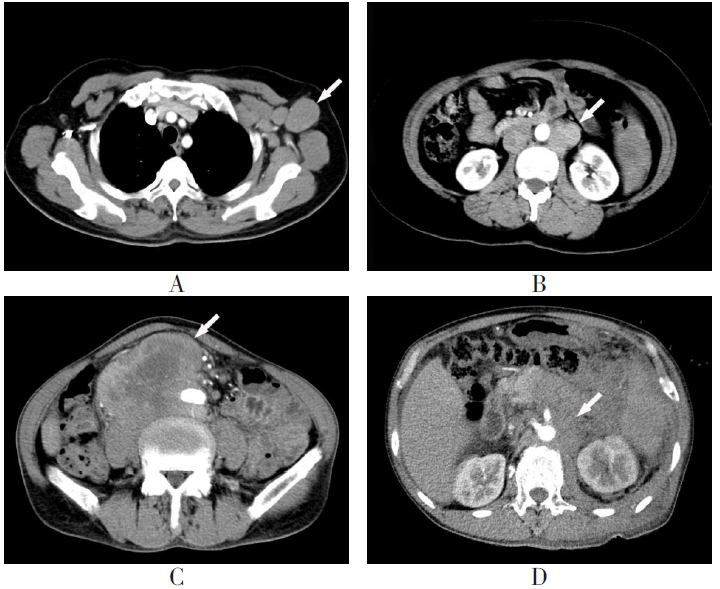
Fig.1 Criteria for 4-grade classification of lymph node marginal features and typical CT illustrations
| 组别 | n | 年龄/岁 | 男性 | BMI/(kg/m2) | Dmax/mm | Ann arbor分期(Ⅲ—Ⅳ) | IPI/分 | WBC/(×109/L) | NEUT/(×109/L) | ||||||||||||||||||||
|---|---|---|---|---|---|---|---|---|---|---|---|---|---|---|---|---|---|---|---|---|---|---|---|---|---|---|---|---|---|
| 非难治组 | 69 | 60.19±13.59 | 33(47.83) | 24.81±3.67 | 35.00(24.50,57.25) | 39(56.52) | 2(1,3) | 5.54(4.74,7.41) | 3.42(2.48,4.27) | ||||||||||||||||||||
| 难治组 | 29 | 59.31±11.84 | 17(58.62) | 23.41±4.10 | 51.00(39.00,58.00) | 20(68.97) | 3(3,4) | 5.75(4.35,6.89) | 3.40(2.67,3.88) | ||||||||||||||||||||
| t、Z或χ2 | 0.303 | 0.569 | 1.671 | 1.803 | 2.514 | 3.826** | 0.269 | 0.397 | |||||||||||||||||||||
| 组别 | Lym/(×109/L) | Mon/(×109/L) | PLT/(×109/L) | PLR | LMR | NLR | Hb/(g/L) | ||||||||||||||||||||||
| 非难治组 | 1.38(1.02,1.97) | 0.48(0.37,0.65) | 208.3(142.6,286.0) | 139.72(94.24,225.00) | 2.85(1.85,4.45) | 2.43(1.63,3.45) | 125.7(107.0,137.0) | ||||||||||||||||||||||
| 难治组 | 1.17(0.93,1.86) | 0.53(0.39,0.62) | 213.0(134.9,324.5) | 151.97(95.39,244.78) | 2.82(1.89,4.74) | 2.10(1.59,3.40) | 116.0(100.0,124.0) | ||||||||||||||||||||||
| Z | 0.673 | 0.452 | 0.553 | 0.136 | 0.082 | 0.634 | 1.460 | ||||||||||||||||||||||
| 组别 | ALB/(g/L) | CRP/(mg/L) | PCT/(μg/L) | LDH/(U/L) | C-MYC | BCL-2 | |||||||||||||||||||||||
| 非难治组 | 39.00(35.68,43.00) | 19.60(5.23,34.70) | 0.05(0.03,0.09) | 238.0(174.0,342.0) | 35(50.72) | 52(75.36) | |||||||||||||||||||||||
| 难治组 | 37.00(33.00,40.30) | 19.70(4.86,54.36) | 0.09(0.06,0.15) | 249.0(185.0,305.4) | 17(58.62) | 22(75.86) | |||||||||||||||||||||||
| Z或χ2 | 0.832 | 0.798 | 2.966** | 0.097 | 0.511 | 0.003 | |||||||||||||||||||||||
| 组别 | 病理亚型 | BCL-6 | Ki-67 | 淋巴结边缘 特征评分/分 | |||||||||||||||||||||||||
| 生发中心型 | 非生发中心型 | 非特指型 | |||||||||||||||||||||||||||
| 非难治组 | 5(7.25) | 27(39.13) | 37(53.62) | 46(66.67) | 62(89.86) | 1(0,2) | |||||||||||||||||||||||
| 难治组 | 4(13.79) | 11(37.93) | 14(48.28) | 21(72.41) | 22(75.86) | 2(2,3) | |||||||||||||||||||||||
| χ2或Z | 1.073 | 0.312 | 2.222 | 4.517** | |||||||||||||||||||||||||
Tab.1 Comparison of baseline, clinical, pathological and imaging characteristics between the two groups of DLBCL patients
| 组别 | n | 年龄/岁 | 男性 | BMI/(kg/m2) | Dmax/mm | Ann arbor分期(Ⅲ—Ⅳ) | IPI/分 | WBC/(×109/L) | NEUT/(×109/L) | ||||||||||||||||||||
|---|---|---|---|---|---|---|---|---|---|---|---|---|---|---|---|---|---|---|---|---|---|---|---|---|---|---|---|---|---|
| 非难治组 | 69 | 60.19±13.59 | 33(47.83) | 24.81±3.67 | 35.00(24.50,57.25) | 39(56.52) | 2(1,3) | 5.54(4.74,7.41) | 3.42(2.48,4.27) | ||||||||||||||||||||
| 难治组 | 29 | 59.31±11.84 | 17(58.62) | 23.41±4.10 | 51.00(39.00,58.00) | 20(68.97) | 3(3,4) | 5.75(4.35,6.89) | 3.40(2.67,3.88) | ||||||||||||||||||||
| t、Z或χ2 | 0.303 | 0.569 | 1.671 | 1.803 | 2.514 | 3.826** | 0.269 | 0.397 | |||||||||||||||||||||
| 组别 | Lym/(×109/L) | Mon/(×109/L) | PLT/(×109/L) | PLR | LMR | NLR | Hb/(g/L) | ||||||||||||||||||||||
| 非难治组 | 1.38(1.02,1.97) | 0.48(0.37,0.65) | 208.3(142.6,286.0) | 139.72(94.24,225.00) | 2.85(1.85,4.45) | 2.43(1.63,3.45) | 125.7(107.0,137.0) | ||||||||||||||||||||||
| 难治组 | 1.17(0.93,1.86) | 0.53(0.39,0.62) | 213.0(134.9,324.5) | 151.97(95.39,244.78) | 2.82(1.89,4.74) | 2.10(1.59,3.40) | 116.0(100.0,124.0) | ||||||||||||||||||||||
| Z | 0.673 | 0.452 | 0.553 | 0.136 | 0.082 | 0.634 | 1.460 | ||||||||||||||||||||||
| 组别 | ALB/(g/L) | CRP/(mg/L) | PCT/(μg/L) | LDH/(U/L) | C-MYC | BCL-2 | |||||||||||||||||||||||
| 非难治组 | 39.00(35.68,43.00) | 19.60(5.23,34.70) | 0.05(0.03,0.09) | 238.0(174.0,342.0) | 35(50.72) | 52(75.36) | |||||||||||||||||||||||
| 难治组 | 37.00(33.00,40.30) | 19.70(4.86,54.36) | 0.09(0.06,0.15) | 249.0(185.0,305.4) | 17(58.62) | 22(75.86) | |||||||||||||||||||||||
| Z或χ2 | 0.832 | 0.798 | 2.966** | 0.097 | 0.511 | 0.003 | |||||||||||||||||||||||
| 组别 | 病理亚型 | BCL-6 | Ki-67 | 淋巴结边缘 特征评分/分 | |||||||||||||||||||||||||
| 生发中心型 | 非生发中心型 | 非特指型 | |||||||||||||||||||||||||||
| 非难治组 | 5(7.25) | 27(39.13) | 37(53.62) | 46(66.67) | 62(89.86) | 1(0,2) | |||||||||||||||||||||||
| 难治组 | 4(13.79) | 11(37.93) | 14(48.28) | 21(72.41) | 22(75.86) | 2(2,3) | |||||||||||||||||||||||
| χ2或Z | 1.073 | 0.312 | 2.222 | 4.517** | |||||||||||||||||||||||||
| 因素 | β | SE | Wald χ2 | P | OR(95%CI) |
|---|---|---|---|---|---|
| 淋巴结边缘 特征评分 | 1.235 | 0.300 | 16.916 | <0.001 | 3.439(1.909~6.196) |
| IPI | 0.852 | 0.245 | 12.111 | 0.001 | 2.344(1.451~3.787) |
| PCT | 0.346 | 0.499 | 0.480 | 0.488 | 1.413(0.531~3.761) |
Tab.2 Univariate binary Logistic regression analysis for predicting refractoriness of DLBCL
| 因素 | β | SE | Wald χ2 | P | OR(95%CI) |
|---|---|---|---|---|---|
| 淋巴结边缘 特征评分 | 1.235 | 0.300 | 16.916 | <0.001 | 3.439(1.909~6.196) |
| IPI | 0.852 | 0.245 | 12.111 | 0.001 | 2.344(1.451~3.787) |
| PCT | 0.346 | 0.499 | 0.480 | 0.488 | 1.413(0.531~3.761) |
| 因素 | β | SE | Wald χ2 | P | OR(95%CI) |
|---|---|---|---|---|---|
| 淋巴结边缘 特征评分 | 1.207 | 0.321 | 14.122 | <0.001 | 3.342(1.781~6.271) |
| IPI | 0.843 | 0.275 | 9.399 | 0.002 | 2.323(1.355~3.982) |
| 常数项 | -5.280 | 1.106 | 22.775 | <0.001 | 0.005 |
Tab.3 Multivariate binary Logistic regression analysis for predicting refractoriness of DLBCL
| 因素 | β | SE | Wald χ2 | P | OR(95%CI) |
|---|---|---|---|---|---|
| 淋巴结边缘 特征评分 | 1.207 | 0.321 | 14.122 | <0.001 | 3.342(1.781~6.271) |
| IPI | 0.843 | 0.275 | 9.399 | 0.002 | 2.323(1.355~3.982) |
| 常数项 | -5.280 | 1.106 | 22.775 | <0.001 | 0.005 |
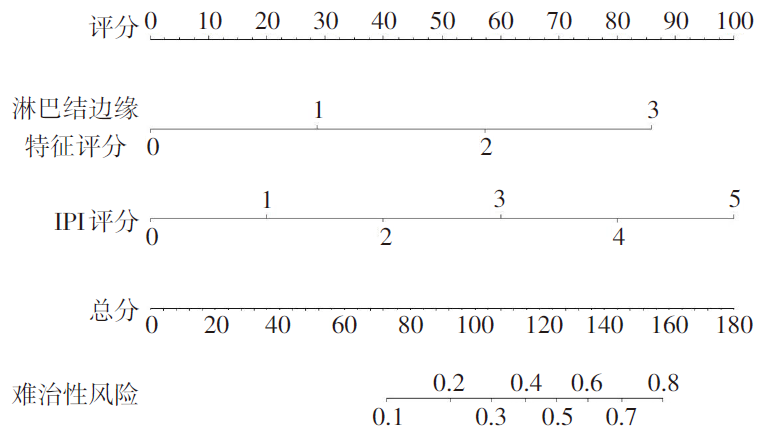
Fig.2 Nomogram prediction for the development of refractory DLBCL
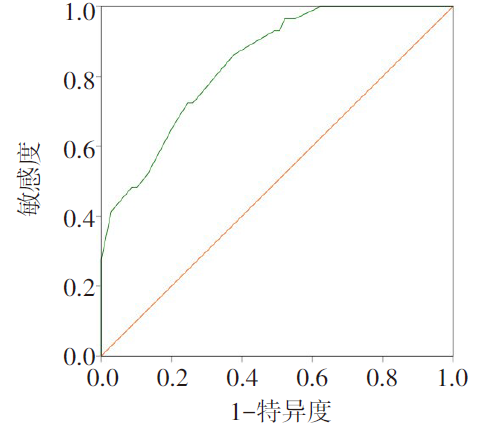
Fig.3 The ROC curve of the nomogram model for predicting refractory DLBCL
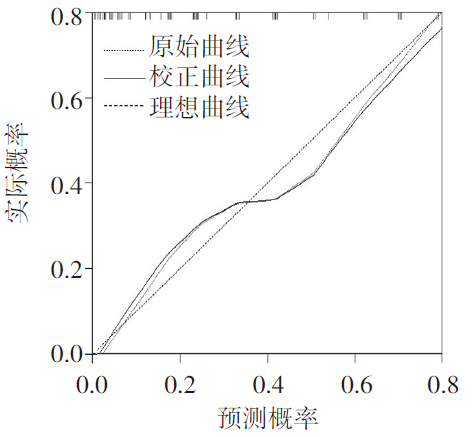
Fig.4 Calibration curve of the nomogram model for predicting the risk of developing into refractory DLBCL
| [1] | WARNNISSORN N, KANITSAP N, NIPARUCK P, et al. External validation and comparison of IPI,R-IPI,and NCCN-IPI in diffuse large B-cell lymphoma patients treated with R-CHOP to predict 2-year progression-free survival[J]. Hematology, 2022, 27(1):1237-1245. doi:10.1080/16078454.2022.2147916. |
| [2] | 郭宝平, 王明月, 廖成成, 等. 奥布替尼联合R-CHOP方案治疗初治高危伴结外累及的非生发中心起源的弥漫大B细胞淋巴瘤的临床研究[J]. 中华血液学杂志, 2025, 46(2):169-173. |
| GUO B P, WANG M Y, LIAO C C, et al. Clinical study of orelabrutinib combined with R-CHOP regimen for newly diagnosed high-risk nonGCB diffuse large B-cell lymphoma with extranodal involvement[J]. Chin J Hematol, 2025, 46(2):169-173. doi:10.3760/cma.j.cn121090-20240914-00347. | |
| [3] | FUJII K, INAGAKI A, MASAKI A, et al. Nomogram for predicting survival of patients with diffuse large B-cell lymphoma[J]. Ann Hematol, 2024, 103(6):2041-2050. doi:10.1007/s00277-024-05669-0. |
| [4] | 贾启琛, 白静, 张志华, 等. 指南内中国专家Ⅰ级推荐行18F-FDG PET/CT检查淋巴瘤代谢特点[J]. 中国医学影像技术, 2024, 40(12):1936-1940. |
| JIA Q C, BAI J, ZHANG Z H, et al. Metabolic characteristics of lymphomas with Chinese experts gradeⅠrecommendation for examination of 18F-FDG PET/CT guideline[J]. Chin J Med Imaging Technol, 2024, 40(12):1936-1940. doi:10.13929/j.issn.1003-3289.2024.12.027. | |
| [5] | 李娟, 赵铭, 原凌, 等. 18F-FDG PET/CT的基线代谢参数对弥漫大B细胞淋巴瘤预后评估的价值[J]. 临床放射学杂志, 2021, 40(7):1329-1334. |
| LI J, ZHAO M, YUAN L, et al. The value of baseline metabolic parameters of 18F-FDGPET/CT for prognostic assessment of diffuse large B-cell lymphoma[J]. Journal of Clinical Radiology, 2021, 40(7):1329-1334. doi:10.13437/j.cnki.jcr.2021.07.019. | |
| [6] | LIN Y, SUN Y, LI C, et al. A predictive diagnostic model for refractory diffuse large B-cell lymphoma:a single-center retrospective cohort study[J]. Ann Hematol, 2025, 104(3):1697-1704. doi:10.1007/s00277-025-06299-w. |
| [7] | HUI D, PROCTOR B, DONALDSON J, et al. Prognostic implications of extranodal involvement in patients with diffuse large B-cell lymphoma treated with rituximab and cyclophosphamide,doxorubicin,vincristine, and prednisone[J]. Leuk Lymphoma, 2010, 51(9):1658-1667. doi:10.3109/10428194.2010.504872. |
| [8] | GODA J S, PUNWATKAR D, JHA A, et al. CT based tumor radiomics with machine learning classifiers for molecular subtyping of diffuse large B cell lymphoma[J]. International journal of radiation oncology,biology,physics, 2023, 117(2):e467. doi:10.1016/j.ijrobp.2023.06.1670. |
| [9] | JELICIC J, JUUL-JENSEN K, BUKUMIRIC Z, et al. Prognostic indices in diffuse large B-cell lymphoma:a population-based comparison and validation study of multiple models[J]. Blood Cancer J, 2023, 13(1):157. doi:10.1038/s41408-023-00930-7. |
| [10] | WANG Y, SHI Q, SHI Z Y, et al. Biological signatures of the International Prognostic Index in diffuse large B-cell lymphoma[J]. Blood Adv, 2024, 8(7):1587-1599. doi:10.1182/bloodadvances.2023011425. |
| [11] | ZHOU Z, SEHN L H, RADEMAKER A W, et al. An enhanced International Prognostic Index(NCCN-IPI)for patients with diffuse large B-cell lymphoma treated in the rituximab era[J]. Blood, 2014, 123(6):837-842. doi:10.1182/blood-2013-09-524108. |
| [12] | SHEN Z, ZHANG S, JIAO Y, et al. LASSO model better predicted the prognosis of DLBCL than random forest model:A retrospective multicenter analysis of HHLWG[J]. J Oncol, 2022,2022:1618272. doi:10.1155/2022/1618272. |
| [13] | NIU J Y, TIAN T, ZHU H Y, et al. Hyperfibrinogenemia is a poor prognostic factor in diffuse large B cell lymphoma[J]. Ann Hematol, 2018, 97(10):1841-1849. doi:10.1007/s00277-018-3382-x. |
| [14] | SHI Z, TANG X, SHEN Q, et al. Clinical characteristics,treatment patterns and outcomes of patients older than 80 years diagnosed with DLBCL in China over a 10-year period[J]. Cancer Chemother Pharmacol, 2019, 84(1):127-137. doi:10.1007/s00280-019-03859-6. |
| [15] | OREIRO M B, SANZ-VILLANUEVA L, CRESPO F D, et al. Cell-free DNA dynamic concentration,CRP and LDH pre-infusion are predictors of early progression after CAR T-cell therapy in DLBCL patients[J]. Blood, 2021, 138(Sup1):1761. doi:10.1182/blood-2021-144896. |
| [16] | SARKOZY C, MOUNIER N, DELMER A, et al. Impact of BMI and gender on outcomes in DLBCL patients treated with R-CHOP:A pooled study from the LYSA[J]. Lymphoma, 2014,2014:1-12. doi:10.1155/2014/205215. |
| [17] | CHAGANTI S, ILLIDGE T, BARRINGTON S, et al. Guidelines for the management of diffuse large B-cell lymphoma[J]. Br J Haematol, 2016, 174(1):43-56.doi: 10.1111/bjh.14136. |
| [18] | 胡静, 代岳, 徐凯. 18F-FDG PET/CT预测淋巴瘤患者CAR-T细胞治疗后短期疗效的价值研究[J]. 实用放射学杂志, 2025, 41(1):147-150. |
| HU J, DAI Y, XU K. Study on the value of 18F-FDG PET/CT in predicting short-term efficacy of CAR-T cell treatment in lymphoma patients[J]. J Pract Radiol, 2025, 41(1):147-150. doi:10.3969/j.issn.1002-1671.2025.01.033. | |
| [19] | PARVEZ A, TAU N, HUSSEY D, et al. 18F-FDG PET/CT metabolic tumor parameters and radiomics features in aggressive non-Hodgkin's lymphoma as predictors of treatment outcome and survival[J]. Ann Nucl Med, 2018, 32(6):410-416. doi:10.1007/s12149-018-1260-1. |
| [20] | 罗与, 白岩, 王梅云. 影像组学在非霍奇金淋巴瘤诊断、疗效及预后评估中的研究进展[J]. 临床放射学杂志, 2024, 43(4):658-661. |
| LUO Y, BAI Y, WANG M Y. Research progress of radiomics in the diagnosis,therapeutic effect and prognosis evaluation of non-Hodgkin's lymphoma[J]. Journal of Clinical Radiology, 2024, 43(4):658-661. doi:10.13437/j.cnki.jcr.2024.04.032. |
| Viewed | ||||||
|
Full text |
|
|||||
|
Abstract |
|
|||||
