
Tianjin Medical Journal ›› 2026, Vol. 54 ›› Issue (4): 390-394.doi: 10.11958/20253187
• Clinical Research • Previous Articles Next Articles
WANG Jingyan1( ), WANG Yan2, WANG Jing2, SU Wei2, WANG Honglei2△()
Received:2025-10-22
Revised:2026-01-22
Published:2026-04-15
Online:2026-04-14
Contact:
△E-mail:WANG Jingyan, WANG Yan, WANG Jing, SU Wei, WANG Honglei. Drug resistance and risk factors of Staphylococcus aureus in skin and soft tissue infections[J]. Tianjin Medical Journal, 2026, 54(4): 390-394.
CLC Number:
| 基因名称 | 引物序列(5′→3′) | 产物 大小/bp |
|---|---|---|
| mecA | 上游:AAAATCGATGGTAAAGGTTGGC 下游:AGTTCTGCAGTACCGGATTTGC | 532 |
| aph(3')-Ⅲa | 上游:CCGCTGCGTAAAAGATAC 下游:GTCATACCACTTGTCCGC | 609 |
| aac(A)-aph(D) | 上游:CAGAGCCTTGGGAAGATGAAG 下游:CCTCGTGTAATTCATGTTCTGGC | 348 |
Tab.1 Primer sequences
| 基因名称 | 引物序列(5′→3′) | 产物 大小/bp |
|---|---|---|
| mecA | 上游:AAAATCGATGGTAAAGGTTGGC 下游:AGTTCTGCAGTACCGGATTTGC | 532 |
| aph(3')-Ⅲa | 上游:CCGCTGCGTAAAAGATAC 下游:GTCATACCACTTGTCCGC | 609 |
| aac(A)-aph(D) | 上游:CAGAGCCTTGGGAAGATGAAG 下游:CCTCGTGTAATTCATGTTCTGGC | 348 |
| 组别 | n | 性别 | 年龄 | 菌株分离部位 | ||||||||||||||||||
|---|---|---|---|---|---|---|---|---|---|---|---|---|---|---|---|---|---|---|---|---|---|---|
| 男 | 女 | ≤65岁 | >65岁 | 足部 | 头颈部 | 上肢 | 下肢 | 其他 | ||||||||||||||
| MSSA组 | 83 | 56(67.5) | 27(32.5) | 48(57.8) | 35(42.2) | 59(71.1) | 7(8.4) | 6(7.2) | 5(6.0) | 6(7.2) | ||||||||||||
| MRSA组 | 27 | 22(81.5) | 5(18.5) | 14(51.9) | 13(48.1) | 22(81.5) | 3(11.1) | 1(3.7) | 1(3.7) | 0(0.0) | ||||||||||||
| χ2 | 1.939 | 0.296 | 1.134 | 0.001 | 0.039 | 0.000 | 0.901 | |||||||||||||||
| 组别 | 合并症 | 入院前抗生素治疗史 | 临床表现 | |||||||||||||||||||
| 糖尿病 | 高血压 | 慢性 肾脏病 | 癌症 | 无 | 门诊 | 其他医疗 机构住院 | 发热 | 水肿 | 流脓 | 疼痛 | ||||||||||||
| MSSA组 | 68(81.9) | 67(80.7) | 11(13.3) | 5(6.0) | 53(63.9) | 13(15.7) | 17(20.5) | 8(9.6) | 80(96.4) | 48(57.8) | 68(81.9) | |||||||||||
| MRSA组 | 24(88.9) | 19(70.4) | 2(7.4) | 2(7.4) | 14(51.9) | 9(33.3) | 4(14.8) | 7(25.9) | 26(96.3) | 15(55.6) | 20(74.1) | |||||||||||
| χ2或P | 0.302 | 1.568 | 0.225 | 0.000 | 1.223 | 3.976* | 0.424 | 3.310 | 1.000▲ | 0.043 | 0.785 | |||||||||||
Tab.2 Comparison of general clinical data between the MSSA group and the MRSA group
| 组别 | n | 性别 | 年龄 | 菌株分离部位 | ||||||||||||||||||
|---|---|---|---|---|---|---|---|---|---|---|---|---|---|---|---|---|---|---|---|---|---|---|
| 男 | 女 | ≤65岁 | >65岁 | 足部 | 头颈部 | 上肢 | 下肢 | 其他 | ||||||||||||||
| MSSA组 | 83 | 56(67.5) | 27(32.5) | 48(57.8) | 35(42.2) | 59(71.1) | 7(8.4) | 6(7.2) | 5(6.0) | 6(7.2) | ||||||||||||
| MRSA组 | 27 | 22(81.5) | 5(18.5) | 14(51.9) | 13(48.1) | 22(81.5) | 3(11.1) | 1(3.7) | 1(3.7) | 0(0.0) | ||||||||||||
| χ2 | 1.939 | 0.296 | 1.134 | 0.001 | 0.039 | 0.000 | 0.901 | |||||||||||||||
| 组别 | 合并症 | 入院前抗生素治疗史 | 临床表现 | |||||||||||||||||||
| 糖尿病 | 高血压 | 慢性 肾脏病 | 癌症 | 无 | 门诊 | 其他医疗 机构住院 | 发热 | 水肿 | 流脓 | 疼痛 | ||||||||||||
| MSSA组 | 68(81.9) | 67(80.7) | 11(13.3) | 5(6.0) | 53(63.9) | 13(15.7) | 17(20.5) | 8(9.6) | 80(96.4) | 48(57.8) | 68(81.9) | |||||||||||
| MRSA组 | 24(88.9) | 19(70.4) | 2(7.4) | 2(7.4) | 14(51.9) | 9(33.3) | 4(14.8) | 7(25.9) | 26(96.3) | 15(55.6) | 20(74.1) | |||||||||||
| χ2或P | 0.302 | 1.568 | 0.225 | 0.000 | 1.223 | 3.976* | 0.424 | 3.310 | 1.000▲ | 0.043 | 0.785 | |||||||||||
| 组别 | n | 青霉素 | 苯唑西林 | 庆大霉素 | 四环素 | 米诺环素 | 红霉素 | |||||
|---|---|---|---|---|---|---|---|---|---|---|---|---|
| MSSA组 | 83 | 77(92.8) | 0(0.0) | 14(16.9) | 9(10.8) | 1(1.2) | 48(57.8) | |||||
| MRSA组 | 27 | 27(100.0) | 27(100.0) | 4(14.8) | 8(29.6) | 5(18.5) | 16(59.3) | |||||
| χ2 | 0.901 | 110.000** | 0.000 | 4.159* | 8.723** | 0.017 | ||||||
| 组别 | 克林霉素 | 环丙沙星 | 左氧氟沙星 | 利福平 | 甲氧苄啶-磺胺甲噁唑 | |||||||
| MSSA组 | 22(26.5) | 8(9.6) | 5(6.0) | 0(0.0) | 27(32.5) | |||||||
| MRSA组 | 10(37.0) | 7(25.9) | 6(22.2) | 1(3.7) | 6(22.2) | |||||||
| χ2或P | 1.095 | 3.310 | 4.276* | 0.245▲ | 1.031 | |||||||
Tab.3 Comparison of the drug resistance between the two groups
| 组别 | n | 青霉素 | 苯唑西林 | 庆大霉素 | 四环素 | 米诺环素 | 红霉素 | |||||
|---|---|---|---|---|---|---|---|---|---|---|---|---|
| MSSA组 | 83 | 77(92.8) | 0(0.0) | 14(16.9) | 9(10.8) | 1(1.2) | 48(57.8) | |||||
| MRSA组 | 27 | 27(100.0) | 27(100.0) | 4(14.8) | 8(29.6) | 5(18.5) | 16(59.3) | |||||
| χ2 | 0.901 | 110.000** | 0.000 | 4.159* | 8.723** | 0.017 | ||||||
| 组别 | 克林霉素 | 环丙沙星 | 左氧氟沙星 | 利福平 | 甲氧苄啶-磺胺甲噁唑 | |||||||
| MSSA组 | 22(26.5) | 8(9.6) | 5(6.0) | 0(0.0) | 27(32.5) | |||||||
| MRSA组 | 10(37.0) | 7(25.9) | 6(22.2) | 1(3.7) | 6(22.2) | |||||||
| χ2或P | 1.095 | 3.310 | 4.276* | 0.245▲ | 1.031 | |||||||
| 组别 | n | mecA | aph(3')-Ⅲa | aac(A)-aph(D) |
|---|---|---|---|---|
| MSSA组 | 83 | 0(0.0) | 7(8.4) | 3(3.6) |
| MRSA组 | 27 | 27(100.0) | 6(22.2) | 2(7.4) |
| χ2 | 110.000** | 2.511 | 0.084 |
Tab.4 Comparison of detection of drug resistance genes between the two groups
| 组别 | n | mecA | aph(3')-Ⅲa | aac(A)-aph(D) |
|---|---|---|---|---|
| MSSA组 | 83 | 0(0.0) | 7(8.4) | 3(3.6) |
| MRSA组 | 27 | 27(100.0) | 6(22.2) | 2(7.4) |
| χ2 | 110.000** | 2.511 | 0.084 |
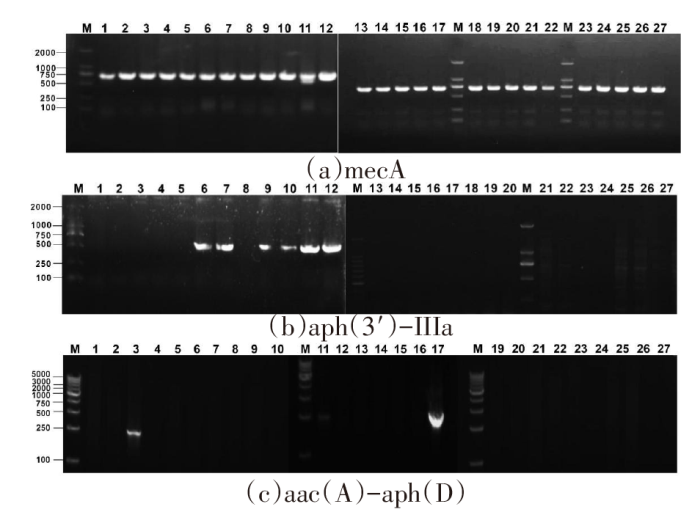
Fig.1 PCR results of drug resistance genes in MRSA isolates
| 因素 | β | SE | Wald χ2 | P | OR(95%CI) |
|---|---|---|---|---|---|
| 抗生素治疗史 | 4.601 | 0.100 | |||
| 门诊 | 1.129 | 0.550 | 4.220 | 0.040 | 3.092(1.053~9.078) |
| 其他医疗机构 | -0.001 | 0.649 | 0.000 | 0.998 | 0.999(0.280~3.563) |
| 发热 | 1.340 | 0.598 | 5.022 | 0.025 | 3.818(1.183~12.324) |
| 常数项 | -1.619 | 0.346 | 21.867 | <0.001 | 0.198 |
Tab.5 Multivariate Logistic regression analysis of risk factors associated with MRSA SSTIs
| 因素 | β | SE | Wald χ2 | P | OR(95%CI) |
|---|---|---|---|---|---|
| 抗生素治疗史 | 4.601 | 0.100 | |||
| 门诊 | 1.129 | 0.550 | 4.220 | 0.040 | 3.092(1.053~9.078) |
| 其他医疗机构 | -0.001 | 0.649 | 0.000 | 0.998 | 0.999(0.280~3.563) |
| 发热 | 1.340 | 0.598 | 5.022 | 0.025 | 3.818(1.183~12.324) |
| 常数项 | -1.619 | 0.346 | 21.867 | <0.001 | 0.198 |
| [1] | GBD 2021 ANTIMICROBIAL RESISTANCE COLLABORATORS. Global burden of bacterial antimicrobial resistance 1990-2021:a systematic analysis with forecasts to 2050[J]. Lancet, 2024, 404(10459):1199-1226. doi:10.1016/S0140-6736(24)01867-1. |
| [2] | TONG S Y, DAVIS J S, EICHENBERGER E, et al. Staphylococcus aureus infections:epidemiology,pathophysiology,clinical manifestations,and management[J]. Clin Microbiol Rev, 2015, 28(3):603-661. doi:10.1128/CMR.00134-14. |
| [3] | JI X, ZHU W, LU H, et al. Antibiotic resistance profiles and MLST typing of staphylococcus aureus clone associated with skin and soft tissue infections in a hospital of China[J]. Infect Drug Resist, 2024, 17:2555-2566. doi:10.2147/IDR.S465951. |
| [4] | GALFO V, TISEO G, RICCARDI N, et al. Therapeutic drug monitoring of antibiotics for methicillin-resistant Staphylococcus aureus infections:an updated narrative review for clinicians[J]. Clin Microbiol Infect, 2025, 31(2):194-200. doi:10.1016/j.cmi.2024.08.021. |
| [5] | LIU Y, XU Z, YANG Z, et al. Characterization of community-associated Staphylococcus aureus from skin and soft-tissue infections:a multicenter study in China[J]. Emerg Microbes Infect, 2016, 5(12):e127. doi:10.1038/emi.2016.128. |
| [6] | POLK C, SAMPSON M M, ROSHDY D, et al. Skin and soft tissue infections in patients with diabetes mellitus[J]. Infect Dis Clin North Am, 2021, 35(1):183-197. doi:10.1016/j.idc.2020.10.007. |
| [7] | LINZ M S, MATTAPPALLIL A, FINKEL D, et al. Clinical impact of staphylococcus aureus skin and soft tissue infections[J]. Antibiotics(Basel), 2023, 12(3):557. doi:10.3390/antibiotics12030557. |
| [8] | GBD 2019 ANTIMICROBIAL RESISTANCE COLLABORATORS. Global mortality associated with 33 bacterial pathogens in 2019:a systematic analysis for the Global Burden of Disease Study 2019[J]. Lancet, 2022, 400(10369):2221-2248. doi:10.1016/S0140-6736(22)02185-7. |
| [9] | 杨雪, 李小波, 韩婧, 等. 中国健康人群中MRSA检出率的Meta分析[J]. 中国循证医学杂志, 2019, 19(9):1037-1043. |
| YANG X, LI X B, HAN J, et al. Prevalence of methicillin-resistant staphylococcus aureus in healthy population in China:a meta-analysis[J]. Chinese Journal of Evidence-based Medicine, 2019, 19(9):1037-1043. doi:10.7507/1672-2531.201904042. | |
| [10] | WEI R, WANG X, WANG Q, et al. Hyperglycemia in diabetic skin infections promotes staphylococcus aureus virulence factor aureolysin:Visualization by molecular imaging[J]. ACS Sens, 2022, 7(11):3416-3421. doi:10.1021/acssensors.2c01565. |
| [11] | TITÉCAT M, LOÏEZ C, DEMAEGHT F, et al. Challenging methicillin resistance detection in bone and joint infections:Focus on the MRSA/SA SSTI® Strategy[J]. Front Med(Lausanne), 2021, 8:553965. doi:10.3389/fmed.2021.553965. |
| [12] | SHETTIGAR K, MURALI T S. Virulence factors and clonal diversity of Staphylococcus aureus in colonization and wound infection with emphasis on diabetic foot infection[J]. Eur J Clin Microbiol Infect Dis, 2020, 39(12):2235-2246. doi:10.1007/s10096-020-03984-8. |
| [13] | 胡继梅, 张红芳, 陈名霞. 2016-2023年某院糖尿病皮肤软组织感染病原菌分布及耐药性[J]. 中华医院感染学杂志, 2025, 35(21):3266-3270. |
| HU J M, ZHANG H F, CHEN M X. Distribution and drug resistance of pathogens isolated from diabetes mellitus patients with skin soft tissue infections from 2016 to 2023[J]. Chin J Nosocomiol, 2025, 35(21):3266-3270. doi:10.11816/cn.ni.2025-242024. | |
| [14] | 肖敏, 钮晖, 赵燕, 等. 住院患者耐甲氧西林金黄色葡萄球菌皮肤和软组织感染的耐药性及危险因素分析[J]. 宁夏医学杂志, 2022, 44(8):754-756. |
| XIAO M, NIU H, ZHAO Y, et al. Analysis of drug resistance and risk factors of skin and soft tissue infections caused by MRSA in hospitalized patients[J]. Ningxia Med J, 2022, 44(8):754-756. doi:10.13621/j.1001-5949.2022.08.0754. | |
| [15] | VALDERRAMA-BELTRáN S, GUALTERO S, ÁLVAREZ-MORENO C, et al. Risk factors associated with methicillin-resistant Staphylococcus aureus skin and soft tissue infections in hospitalized patients in Colombia[J]. Int J Infect Dis, 2019, 87:60-66. doi:10.1016/j.ijid.2019.07.007. |
| [16] | 郭燕, 丁丽, 胡付品, 等. 2024年CHINET中国细菌耐药监测[J]. 中国感染与化疗杂志, 2025, 25(6):597-607. |
| GUO Y, DING L, HU F P, et al. Antimicrobial resistance profile of clinical isolates in hospitals across China:report from the CHINET Antimicrobial Resistance Surveillance Program,2024[J]. Chin J Infect Chemother, 2025, 25(6):597-607. doi:10.16718/j.1009-7708.2025.06.002. | |
| [17] | KARIUKI S, KERING K, WAIRIMU C, et al. Antimicrobial resistance rates and surveillance in Sub-Saharan Africa:Where are we now?[J]. Infect Drug Resist, 2022, 15:3589-3609. doi:10.2147/IDR.S342753. |
| [18] | 冉德琳, 张朝霞, 吴梅, 等. 2018-2020年皮肤科住院患者金黄色葡萄球菌感染状况及MRSA与MSSA耐药性分析[J]. 中国麻风皮肤病杂志, 2024, 46(3):181-185. |
| RAN D L, ZHANG C X, WU M, et al. Analysis of Staphylococcus aureus infection status and drug-resistance of MRSA and MSSA in dermatological inpatients from 2018 to 2020[J]. Chin J Lepr Skin Dis, 2024, 46(3):181-185. doi:10.12144/zgmfskin202207430. | |
| [19] | BIDELL M R, LODISE T P. Use of oral tetracyclines in the treatment of adult outpatients with skin and skin structure infections:Focus on doxycycline, minocycline,and omadacycline[J]. Pharmacotherapy, 2021, 41(11):915-931. doi:10.1002/phar.2625. |
| [20] | KOUMAKI D, MARAKI S, EVANGELOU G, et al. Clinical features and antibiotic susceptibility of staphylococcus aureus-infected dermatoses[J]. J Clin Med, 2025, 14(4):1084. doi:10.3390/jcm14041084. |
| [21] | MONK E, JONES T, BONGOMIN F, et al. Antimicrobial resistance in bacterial wound, skin, soft tissue and surgical site infections in Central,Eastern,Southern and Western Africa:A systematic review and meta-analysis[J]. PLOS Glob Public Health, 2024, 4(4):e0003077. doi:10.1371/journal.pgph.0003077. |
| [22] | DE JONG Y, SINGHAL R, ALIMI Y, et al. Antibiotic consumption in 14 countries of sub-Saharan Africa: Findings from a retrospective analysis[J]. PLoS One, 2025, 20(10):e0333842. doi:10.1371/journal.pone.0333842. |
| [23] | NNADOZIE U U, UMEOKONKWO C D, MADUBA C C, et al. Patterns of antimicrobial use in a specialized surgical hospital in Southeast Nigeria:Need for a standardized protocol of antimicrobial use in the tropics[J]. Nigerian Journal of Medicine, 2021, 30(2):187-191. doi:10.4103/NJM.NJM_225_20. |
| [24] | KISTLER J M, VROOME C M, RAMSEY F V, et al. Increasing multidrug antibiotic resistance in MRSA infections of the hand:A 10-year analysis of risk factors[J]. Hand(N Y), 2020, 15(6):877-881. doi:10.1177/1558944719837693. |
| [25] | WU Y, WU H, WU M, et al. The clinical characteristics and antimicrobial resistance of staphylococcus aureus isolated from patients with staphylococcal scalded skin syndrome(SSSS)in Southwestern China[J]. Antibiotics(Basel), 2024, 13(6):516. doi:10.3390/antibiotics13060516. |
| [26] | SADER H S, STREIT J M, CARVALHAES C G, et al. Frequency and antimicrobial susceptibility of bacterial isolates from patients hospitalised with community-acquired skin and skin-structure infection in Europe,Asia and Latin America[J]. J Glob Antimicrob Resist, 2019, 17:103-108. doi:10.1016/j.jgar.2018.11.013. |
| [27] | DIEKEMA D J, PFALLER M A, SHORTRIDGE D, et al. Twenty-year trends in antimicrobial susceptibilities among staphylococcus aureus from the SENTRY antimicrobial surveillance program[J]. Open Forum Infect Dis, 2019, 6(Suppl 1):S47-S53. doi:10.1093/ofid/ofy270. |
| [28] | ADEDEJI-OLULANA A F, WACNIK K, LAFAGE L, et al. Two codependent routes lead to high-level MRSA[J]. Science, 2024, 386(6721):573-580. doi:10.1126/science.adn1369. |
| Viewed | ||||||
|
Full text |
|
|||||
|
Abstract |
|
|||||
