
Tianjin Medical Journal ›› 2026, Vol. 54 ›› Issue (6): 618-622.doi: 10.11958/20252920
• Clinical Research • Previous Articles Next Articles
CAO Yang( ), DUAN Pengcang, LI Mengyu, SHI Fangkun, HU Chen, XING Fangyuan, LI Hualian
Received:2025-09-16
Revised:2025-12-31
Published:2026-06-15
Online:2026-06-15
CAO Yang, DUAN Pengcang, LI Mengyu, SHI Fangkun, HU Chen, XING Fangyuan, LI Hualian. Predictive value of total load of cerebral small vessel disease combined with serum 8-OHDG and Ficolin-3 for prognosis in elderly patients with branch atheromatous disease[J]. Tianjin Medical Journal, 2026, 54(6): 618-622.
CLC Number:
| 组别 | n | 男性 | 年龄/岁 | 高血压 | 糖尿病 | 高脂血症 | 吸烟史 | 收缩压/mmHg | |||||||
|---|---|---|---|---|---|---|---|---|---|---|---|---|---|---|---|
| 预后良好组 | 52 | 31(59.62) | 68.13±7.71 | 36(69.23) | 10(19.23) | 15(28.85) | 29(55.77) | 160.42±16.82 | |||||||
| 预后不良组 | 33 | 19(57.58) | 67.24±7.02 | 22(66.67) | 6(18.18) | 7(21.21) | 20(60.61) | 163.42±17.29 | |||||||
| t或χ2 | 0.035 | 0.538 | 0.061 | 0.015 | 0.613 | 0.193 | 0.793 | ||||||||
| 组别 | 舒张压/ mmHg | 空腹血糖/ (mmol/L) | 糖化血红 蛋白/% | TC/ (mmol/L) | TG/ (mmol/L) | LDL-C/(mmol/L) | 入院时 NIHSS/分 | ||||||||
| 预后良好组 | 92.23±10.83 | 5.82±1.73 | 6.02±1.47 | 4.39±1.18 | 1.79±0.33 | 2.89±0.51 | 5.73±1.29 | ||||||||
| 预后不良组 | 91.36±12.71 | 5.77±1.64 | 5.93±1.23 | 4.68±1.22 | 1.82±0.36 | 2.85±0.47 | 10.94±4.15 | ||||||||
| t | 0.336 | 0.133 | 0.260 | 1.125 | 0.392 | 0.328 | 7.008** | ||||||||
Tab.1 Comparison of baseline data between the two groups of patients
| 组别 | n | 男性 | 年龄/岁 | 高血压 | 糖尿病 | 高脂血症 | 吸烟史 | 收缩压/mmHg | |||||||
|---|---|---|---|---|---|---|---|---|---|---|---|---|---|---|---|
| 预后良好组 | 52 | 31(59.62) | 68.13±7.71 | 36(69.23) | 10(19.23) | 15(28.85) | 29(55.77) | 160.42±16.82 | |||||||
| 预后不良组 | 33 | 19(57.58) | 67.24±7.02 | 22(66.67) | 6(18.18) | 7(21.21) | 20(60.61) | 163.42±17.29 | |||||||
| t或χ2 | 0.035 | 0.538 | 0.061 | 0.015 | 0.613 | 0.193 | 0.793 | ||||||||
| 组别 | 舒张压/ mmHg | 空腹血糖/ (mmol/L) | 糖化血红 蛋白/% | TC/ (mmol/L) | TG/ (mmol/L) | LDL-C/(mmol/L) | 入院时 NIHSS/分 | ||||||||
| 预后良好组 | 92.23±10.83 | 5.82±1.73 | 6.02±1.47 | 4.39±1.18 | 1.79±0.33 | 2.89±0.51 | 5.73±1.29 | ||||||||
| 预后不良组 | 91.36±12.71 | 5.77±1.64 | 5.93±1.23 | 4.68±1.22 | 1.82±0.36 | 2.85±0.47 | 10.94±4.15 | ||||||||
| t | 0.336 | 0.133 | 0.260 | 1.125 | 0.392 | 0.328 | 7.008** | ||||||||
| 组别 | n | CSVD总负荷 | 8-OHDG/(ng/L) | Ficolin-3/(μg/L) | |||
|---|---|---|---|---|---|---|---|
| 1分 | 2分 | 3分 | 4分 | ||||
| 预后良好组 | 52 | 2(3.85) | 30(57.69) | 20(38.46) | 0(0.00) | 43.92±9.14 | 22.57±3.46 |
| 预后不良组 | 33 | 0(0.00) | 5(15.15) | 18(54.55) | 10(30.30) | 61.37±10.81 | 17.39±2.54 |
| t或Z | 27.068** | 7.990** | 7.947** | ||||
Tab.2 Comparison of total CSVD burden, serum 8-OHDG and Ficolin-3 levels between BAD patients with different prognostic conditions
| 组别 | n | CSVD总负荷 | 8-OHDG/(ng/L) | Ficolin-3/(μg/L) | |||
|---|---|---|---|---|---|---|---|
| 1分 | 2分 | 3分 | 4分 | ||||
| 预后良好组 | 52 | 2(3.85) | 30(57.69) | 20(38.46) | 0(0.00) | 43.92±9.14 | 22.57±3.46 |
| 预后不良组 | 33 | 0(0.00) | 5(15.15) | 18(54.55) | 10(30.30) | 61.37±10.81 | 17.39±2.54 |
| t或Z | 27.068** | 7.990** | 7.947** | ||||
| 指标 | 敏感度/ % | 特异度/ % | 截断值 | AUC | 95%CI | 约登 指数 |
|---|---|---|---|---|---|---|
| CSVD总负荷 | 84.85 | 63.46 | 3.00分 | 0.793 | 0.694~0.892 | 0.483 |
| 8-OHDG | 66.67 | 71.15 | 52.49 ng/L | 0.713 | 0.602~0.823 | 0.378 |
| Ficolin-3 | 66.67 | 69.23 | 20.14 μg/L | 0.735 | 0.626~0.844 | 0.359 |
| 联合预测 | 90.91 | 61.54 | 0.875 | 0.798~0.951 | 0.525 |
Tab.3 Predictive performance of total CSVD burden combined with serum 8-OHDG and Ficolin-3 levels for poor prognosis in BAD patients
| 指标 | 敏感度/ % | 特异度/ % | 截断值 | AUC | 95%CI | 约登 指数 |
|---|---|---|---|---|---|---|
| CSVD总负荷 | 84.85 | 63.46 | 3.00分 | 0.793 | 0.694~0.892 | 0.483 |
| 8-OHDG | 66.67 | 71.15 | 52.49 ng/L | 0.713 | 0.602~0.823 | 0.378 |
| Ficolin-3 | 66.67 | 69.23 | 20.14 μg/L | 0.735 | 0.626~0.844 | 0.359 |
| 联合预测 | 90.91 | 61.54 | 0.875 | 0.798~0.951 | 0.525 |
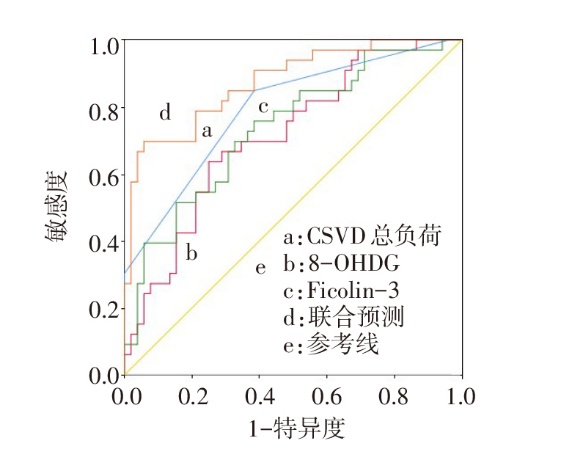
Fig.1 ROC curve of the CSVD total burden combined with serum 8-OHDG and Ficolin-3 for predicting poor prognosis in BAD patients
| 变量 | β | SE | Wald χ2 | P | OR | OR95%CI |
|---|---|---|---|---|---|---|
| CSVD总负荷 | 1.070 | 0.261 | 16.792 | <0.001 | 2.914 | 1.747~4.860 |
| 8-OHDG | 1.055 | 0.275 | 14.728 | <0.001 | 2.873 | 1.676~4.925 |
| Ficolin-3 | -0.368 | 0.104 | 12.532 | <0.001 | 0.692 | 0.564~0.848 |
| 常数项 | -6.725 | 0.906 | 47.295 | <0.001 | 0.005 | - |
Tab.4 Multivariate Logistic regression analysis of poor prognosis in BAD patients
| 变量 | β | SE | Wald χ2 | P | OR | OR95%CI |
|---|---|---|---|---|---|---|
| CSVD总负荷 | 1.070 | 0.261 | 16.792 | <0.001 | 2.914 | 1.747~4.860 |
| 8-OHDG | 1.055 | 0.275 | 14.728 | <0.001 | 2.873 | 1.676~4.925 |
| Ficolin-3 | -0.368 | 0.104 | 12.532 | <0.001 | 0.692 | 0.564~0.848 |
| 常数项 | -6.725 | 0.906 | 47.295 | <0.001 | 0.005 | - |
| [1] | DUAN H, YUN H J, GENG X, et al. Branch atheromatous disease and treatment[J]. Brain Circ, 2022, 8(4):169-171. doi:10.4103/bc.bc_56_22. |
| [2] | DEGUCHI I, TAKAHASHI S. Pathophysiology and optimal treatment of intracranial branch atheromatous disease[J]. J Atheroscler Thromb, 2023, 30(7):701-709. doi:10.5551/jat.RV22003. |
| [3] | PAN Y, JING J, CAI X, et al. Prevalence and vascular distribution of multiterritorial atherosclerosis among community-dwelling adults in Southeast China[J]. JAMA Netw Open, 2022, 5(6):e2218307. doi:10.1001/jamanetworkopen.2022.18307. |
| [4] | CHEN L H, SPAGNOLO-ALLENDE A, YANG D, et al. Epidemiology,pathophysiology,and imaging of atherosclerotic intracranial disease[J]. Stroke, 2024, 55(2):311-323. doi:10.1161/STROKEAHA.123.043630. |
| [5] | LI X, YUAN J, QIN W, et al. Higher total cerebral small vessel disease burden was associated with mild cognitive impairment and overall cognitive dysfunction:a propensity score-matched case-control study[J]. Front Aging Neurosci, 2021, 13:695732. doi:10.3389/fnagi.2021.695732. |
| [6] | JELIC M D, MANDIC A D, MARICIC S M, et al. Oxidative stress and its role in cancer[J]. J Cancer Res Ther, 2021, 17(1):22-28. doi:10.4103/jcrt.JCRT_862_16. |
| [7] | ARAPI B, UNAL S, MALIKOVA N, et al. A cross-sectional study comparing the expression of DNA repair molecules in subjects with and without atherosclerotic plaques[J]. Mol Biol Rep, 2024, 51(1):953. doi:10.1007/s11033-024-09886-8. |
| [8] | ZHANG Z, YIN M, GENG X, et al. Ficolin-3 activates complement and triggers necroptosis in cholangiocarcinoma cells via the RIPK1/RIPK3/MLKL signaling pathway[J]. FASEB J, 2025, 39(10):e70673. doi:10.1096/fj.202403313R. |
| [9] | 马战友, 张建娥, 强蓓蓓, 等. 急性脑梗死病人血清Ficolin-3、Ficolin-2表达与90d预后的关系[J]. 中西医结合心脑血管病杂志, 2023, 21(15):2866-2869. |
| MA Z Y, ZHANG J E, QIANG B B, et al. Relationship between serum Ficolin-3,Ficolin-2 expressions and 90-day prognosis in patients with acute cerebral infarction[J]. Chinese Journal of Integrative Medicine on Cardio-Cerebrovascular Disease, 2023, 21(15):2866-2869. doi:10.12102/j.issn.1672-1349.2023.15.032. | |
| [10] | 门雪娇, 陈玮琪, 许玉园, 等. 穿支动脉粥样硬化病中国专家共识[J]. 中国卒中杂志, 2021, 16(5):508-514. |
| MEN X J, CHEN W Q, XU Y Y, et al. Chinese experts consensus on branch atheromatous disease[J]. Chinese Journal of Stroke, 2021, 16(5):508-514. doi:10.3969/j.issn.1673-5765.2021.05.016. | |
| [11] | 中华医学会神经病学分会, 中华医学会神经病学分会脑血管病学组. 中国脑小血管病诊治指南2020[J]. 中华神经科杂志, 2022, 55(8):807-818. |
| Cerebrovascular Disease Group of the Neurology Branch of Chinese Medical Association,Neurology Branch of Chinese Medical Association. Chinese guideline for diagnosis and treatment of cerebral small vessel disease 2020[J]. Chinese Journal of Neurology, 2022, 55(8):807-818. doi:10.3760/cma.j.cn113694-20220321-00220. | |
| [12] | 尤佳, 卢洪志. 急诊预检分诊NIHSS评分应用的效果观察[J]. 岭南急诊医学杂志, 2024, 29(1):46-48. |
| YOU J, LU H Z. Observation on the application effect of NIHSS score in emergency triage[J]. Lingnan Journal of Emergency Medicine, 2024, 29(1):46-48. doi:10.3969/j.issn.1671-301X.2024.01.018. | |
| [13] | 路秋云, 李强, 曹立梅, 等. 老年脑小血管病总负荷与穿支动脉粥样硬化病预后不良的相关性研究[J]. 中华老年心脑血管病杂志, 2024, 26(1):46-49. |
| LU Q Y, LI Q, CAO L M, et al. Correlation between total burden of cerebral small vessel disease and poor prognosis of branch atheromatous disease in the elderly[J]. Chinese Journal of Geriatric Heart Brain and Vessel Diseases, 2024, 26(1):46-49. doi:10.3969/j.issn.1009-0126.2024.01.012. | |
| [14] | HAGGAG H, HODGSON C. Clinimetrics:modified rankin scale (mRS)[J]. J Physiother, 2022, 68(4):281. doi:10.1016/j.jphys.2022.05.017. |
| [15] | LI S, WANG L, LIU B, et al. Clinical and prognostic characteristics of acute BAD-related stroke:a multicenter MRI-based prospective study[J]. Stroke, 2024, 55(10):2431-2438. doi:10.1161/STROKEAHA.124.047688. |
| [16] | GAO Y, LI D, LIN J, et al. Cerebral small vessel disease:pathological mechanisms and potential therapeutic targets[J]. Front Aging Neurosci, 2022, 14:961661. doi:10.3389/fnagi.2022.961661. |
| [17] | HUA M, MA A J, LIU Z Q, et al. Arteriolosclerosis CSVD:a common cause of dementia and stroke and its association with cognitive function and total MRI burden[J]. Front Aging Neurosci, 2023, 15:1163349. doi:10.3389/fnagi.2023.1163349. |
| [18] | CHEN B, JI J, LV M, et al. Relationship between cognitive dysfunction and urinary 8-OHDG levels in children with obstructive sleep apnea[J]. Front Neurol, 2025, 16:1502906. doi:10.3389/fneur.2025.1502906. |
| [19] | 刘懿, 刘美香, 刘辉, 等. 脑小血管病患者血清8-OHDG、CX3CL1水平与认知功能障碍的相关性[J]. 中国动脉硬化杂志, 2024, 32(6):521-526. |
| LIU Y, LIU M X, LIU H, et al. Correlation between serum 8-OHDG, CX3CL1 levels and cognitive impairment in patients with cerebral small vessel disease[J]. Chinese Journal of Arteriosclerosis, 2024, 32(6):521-526. doi:10.20039/j.cnki.1007-3949.2024.06.009. | |
| [20] | 郑文华, 王学仕, 王明达, 等. Ficolin-3水平对老年急性脑梗死患者颈动脉粥样硬化斑块形成的预测价值[J]. 中国老年学杂志, 2023, 43(18):4368-4372. |
| ZHENG W H, WANG X S, WANG M D, et al. Predictive value of Ficolin-3 level for carotid atherosclerotic plaque formation in elderly patients with acute cerebral infarction[J]. Chinese Journal of Gerontology, 2023, 43(18):4368-4372.doi:10.3969/j.issn.1005-9202.2023.18.006. |
| Viewed | ||||||
|
Full text |
|
|||||
|
Abstract |
|
|||||
