
Tianjin Medical Journal ›› 2026, Vol. 54 ›› Issue (2): 173-178.doi: 10.11958/20252398
• Clinical Research • Previous Articles Next Articles
WEN Yi( ), ZHANG Jun, WANG Yingjun, WANG Tiefeng, DONG Yubin()
Received:2025-07-01
Revised:2025-09-03
Published:2026-02-15
Online:2026-02-12
Contact:
△E-mail:WEN Yi, ZHANG Jun, WANG Yingjun, WANG Tiefeng, DONG Yubin. Correlation analysis of lung ultrasound score, serum pulmonary surfactant protein A and IL-6 levels with disease severity and prognosis in neonatal respiratory distress syndrome[J]. Tianjin Medical Journal, 2026, 54(2): 173-178.
CLC Number:
| 组别 | n | LUS评分/分 | SP-A/(mg/L) | IL-6/(ng/L) |
|---|---|---|---|---|
| 轻度组 | 72 | 8.65±2.14 | 23.69±7.58 | 16.64±3.61 |
| 中度组 | 78 | 16.26±3.32a | 49.72±13.46a | 21.55±4.48a |
| 重度组 | 55 | 25.47±5.09ab | 68.24±15.35ab | 28.79±4.23ab |
| F | 282.208** | 210.263** | 135.133** |
Tab.1 Comparison of LUS score, serum SP-A and IL-6 levels between neonates with NRDS of different disease severity
| 组别 | n | LUS评分/分 | SP-A/(mg/L) | IL-6/(ng/L) |
|---|---|---|---|---|
| 轻度组 | 72 | 8.65±2.14 | 23.69±7.58 | 16.64±3.61 |
| 中度组 | 78 | 16.26±3.32a | 49.72±13.46a | 21.55±4.48a |
| 重度组 | 55 | 25.47±5.09ab | 68.24±15.35ab | 28.79±4.23ab |
| F | 282.208** | 210.263** | 135.133** |
| 组别 | n | 性别(男/女) | 胎龄/周 | 出生体质量/kg | 败血症 | 肺炎 | 胎粪吸入综合征 | ||||||||||||
|---|---|---|---|---|---|---|---|---|---|---|---|---|---|---|---|---|---|---|---|
| 预后良好组 | 143 | 78/65 | 33.53±3.17 | 2.26±0.55 | 13(9.0) | 25(17.5) | 37(25.9) | ||||||||||||
| 预后不良组 | 62 | 32/30 | 32.16±3.50 | 2.14±0.61 | 7(11.3) | 12(19.4) | 10(16.1) | ||||||||||||
| t或χ2 | 0.150 | 2.753** | 1.446 | 0.238 | 0.103 | 2.324 | |||||||||||||
| 组别 | 窒息 | 5 min Apgar评分/分 | 正压通气 | 产妇年龄/岁 | 分娩方式(顺产/剖宫产) | 产次/次 | 妊娠期糖尿病 | ||||||||||||
| 预后良好组 | 68(47.6) | 7.11±1.25 | 131(91.6) | 29.35±5.62 | 38/105 | 1.96±0.68 | 18(12.6) | ||||||||||||
| 预后不良组 | 33(53.2) | 6.79±1.38 | 59(95.2) | 30.63±4.27 | 18/44 | 2.13±0.74 | 10(16.1) | ||||||||||||
| t或χ2 | 0.557 | 1.643 | 0.805 | 1.601 | 0.132 | 1.613 | 0.460 | ||||||||||||
| 组别 | OI/(mmHg) | WBC/(×109/L) | Hb(g/L) | PLT/(×109/L) | ALB/(g/L) | ||||||||||||||
| 预后良好组 | 10.43±3.22 | 12.38±2.49 | 179.57±41.28 | 186.56±46.34 | 23.28±4.69 | ||||||||||||||
| 预后不良组 | 14.18±3.57 | 15.74±3.63 | 172.94±40.64 | 179.41±45.17 | 22.43±4.35 | ||||||||||||||
| t | 7.400** | 7.636** | 1.063 | 1.021 | 1.205 | ||||||||||||||
Tab.2 Comparison of baseline data in neonates with NRDS between different prognostic groups
| 组别 | n | 性别(男/女) | 胎龄/周 | 出生体质量/kg | 败血症 | 肺炎 | 胎粪吸入综合征 | ||||||||||||
|---|---|---|---|---|---|---|---|---|---|---|---|---|---|---|---|---|---|---|---|
| 预后良好组 | 143 | 78/65 | 33.53±3.17 | 2.26±0.55 | 13(9.0) | 25(17.5) | 37(25.9) | ||||||||||||
| 预后不良组 | 62 | 32/30 | 32.16±3.50 | 2.14±0.61 | 7(11.3) | 12(19.4) | 10(16.1) | ||||||||||||
| t或χ2 | 0.150 | 2.753** | 1.446 | 0.238 | 0.103 | 2.324 | |||||||||||||
| 组别 | 窒息 | 5 min Apgar评分/分 | 正压通气 | 产妇年龄/岁 | 分娩方式(顺产/剖宫产) | 产次/次 | 妊娠期糖尿病 | ||||||||||||
| 预后良好组 | 68(47.6) | 7.11±1.25 | 131(91.6) | 29.35±5.62 | 38/105 | 1.96±0.68 | 18(12.6) | ||||||||||||
| 预后不良组 | 33(53.2) | 6.79±1.38 | 59(95.2) | 30.63±4.27 | 18/44 | 2.13±0.74 | 10(16.1) | ||||||||||||
| t或χ2 | 0.557 | 1.643 | 0.805 | 1.601 | 0.132 | 1.613 | 0.460 | ||||||||||||
| 组别 | OI/(mmHg) | WBC/(×109/L) | Hb(g/L) | PLT/(×109/L) | ALB/(g/L) | ||||||||||||||
| 预后良好组 | 10.43±3.22 | 12.38±2.49 | 179.57±41.28 | 186.56±46.34 | 23.28±4.69 | ||||||||||||||
| 预后不良组 | 14.18±3.57 | 15.74±3.63 | 172.94±40.64 | 179.41±45.17 | 22.43±4.35 | ||||||||||||||
| t | 7.400** | 7.636** | 1.063 | 1.021 | 1.205 | ||||||||||||||
| 组别 | n | LUS评分/分 | SP-A/(mg/L) | IL-6/(ng/L) |
|---|---|---|---|---|
| 预后良好组 | 143 | 12.06±3.57 | 40.15±6.43 | 19.62±3.59 |
| 预后不良组 | 62 | 25.27±4.12 | 57.99±7.16 | 26.72±4.71 |
| t | 23.700** | 15.213** | 14.456** |
Tab.3 Comparison of LUS score, serum SP-A and IL-6 levels in NRDS neonates between different prognoses groups
| 组别 | n | LUS评分/分 | SP-A/(mg/L) | IL-6/(ng/L) |
|---|---|---|---|---|
| 预后良好组 | 143 | 12.06±3.57 | 40.15±6.43 | 19.62±3.59 |
| 预后不良组 | 62 | 25.27±4.12 | 57.99±7.16 | 26.72±4.71 |
| t | 23.700** | 15.213** | 14.456** |
| 变量 | β | SE | Wald χ2 | P | OR(95%CI) |
|---|---|---|---|---|---|
| OI | 1.216 | 0.251 | 23.470 | <0.001 | 3.374(2.063~5.518) |
| LUS | 1.121 | 0.354 | 10.028 | <0.001 | 3.068(1.533~6.140) |
| SP-A | 0.857 | 0.293 | 8.555 | <0.001 | 2.356(1.327~4.184) |
| IL-6 | 0.657 | 0.183 | 6.209 | <0.001 | 1.929(1.348~2.761) |
| 常数项 | -0.429 | 0.185 | 5.377 | 0.006 | 0.651 |
Tab.4 Multivariate Logistic regression analysis of poor prognosis in NRDS neonates
| 变量 | β | SE | Wald χ2 | P | OR(95%CI) |
|---|---|---|---|---|---|
| OI | 1.216 | 0.251 | 23.470 | <0.001 | 3.374(2.063~5.518) |
| LUS | 1.121 | 0.354 | 10.028 | <0.001 | 3.068(1.533~6.140) |
| SP-A | 0.857 | 0.293 | 8.555 | <0.001 | 2.356(1.327~4.184) |
| IL-6 | 0.657 | 0.183 | 6.209 | <0.001 | 1.929(1.348~2.761) |
| 常数项 | -0.429 | 0.185 | 5.377 | 0.006 | 0.651 |
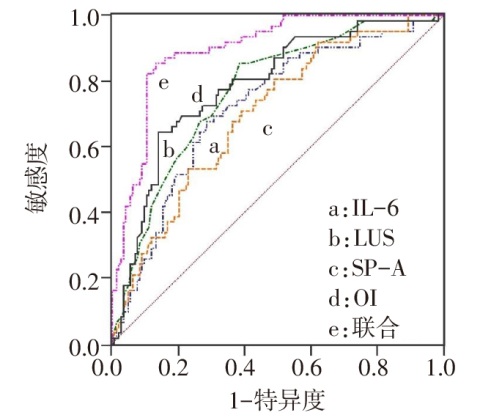
Fig.1 ROC curves of LUS, SP-A, IL-6, OI and the combined model for predicting poor prognosis in neonates with NRDS
| 指标 | AUC(95%CI) | 最佳 截断值 | 敏感 度/% | 特异 度/% | 约登 指数 | Z |
|---|---|---|---|---|---|---|
| LUS | 0.769(0.705~0.825) | 14分 | 85.48 | 61.54 | 0.470 | 3.171** |
| SP-A | 0.698(0.630~0.760) | 40.26 mg/L | 70.97 | 60.84 | 0.318 | 4.457** |
| IL-6 | 0.721(0.654~0.781) | 24.32 ng/L | 67.74 | 71.33 | 0.391 | 3.699** |
| OI | 0.785(0.722~0.839) | 16 mmHg | 64.52 | 86.01 | 0.505 | 2.696** |
| 联合 | 0.896(0.846~0.934) | 85.48 | 86.71 | 0.722 |
Tab.5 Predictive value of LUS, SP-A, IL-6 and OI in the prognosis of NRDS
| 指标 | AUC(95%CI) | 最佳 截断值 | 敏感 度/% | 特异 度/% | 约登 指数 | Z |
|---|---|---|---|---|---|---|
| LUS | 0.769(0.705~0.825) | 14分 | 85.48 | 61.54 | 0.470 | 3.171** |
| SP-A | 0.698(0.630~0.760) | 40.26 mg/L | 70.97 | 60.84 | 0.318 | 4.457** |
| IL-6 | 0.721(0.654~0.781) | 24.32 ng/L | 67.74 | 71.33 | 0.391 | 3.699** |
| OI | 0.785(0.722~0.839) | 16 mmHg | 64.52 | 86.01 | 0.505 | 2.696** |
| 联合 | 0.896(0.846~0.934) | 85.48 | 86.71 | 0.722 |
| [1] | YANG F, LIU H, DING C X. Gestational diabetes mellitus and risk of neonatal respiratory distress syndrome: a systematic review and meta-analysis[J]. Diabetol Metab Syndr, 2024, 16(1):294. doi:10.1186/s13098-024-01539-x. |
| [2] | DONG S, PANG H Y, LI F, et al. Immunoregulatory function of SP-A[J]. Mol Immunol, 2024, 166:58-64. doi:10.1016/j.molimm.2024.01.005. |
| [3] | ZHANG Y H, CHEN A L, YU R Q, et al. MiR-296-5p inhibits the secretion of pulmonary surfactants in pulmonary epithelial cells via the downregulation of wnt7b/β-catenin signaling[J]. Biomed Res Int, 2021, 2021:4051504. doi:10.1155/2021/4051504. |
| [4] | DANIELE L D, ANTON H V K, TINGAY D G, et al. The Montreux definition of neonatal ARDS:biological and clinical background behind the description of a new entity[J]. Lancet Respir Med, 2017, 5(8):657-666. doi:10.1016/S2213-2600(17)30214-X. |
| [5] | SWEET D G, CARNIELLI V, GREISEN G, et al. European consensus guidelines on the management of respiratory distress syndrome - 2019 update[J]. Neonatology, 2019, 115(4):432-450. doi:10.1159/000499361. |
| [6] | 中华医学会儿科学分会新生儿学组, 中华儿科杂志编辑委员会. 中国新生儿肺表面活性物质临床应用专家共识(2021版)[J]. 中华儿科杂志, 2021, 59(8):627-632. |
| The Subspecialty Group of Neonatology,Society of Pediatrics, Chinese Medical Association,Editorial Board of Chinese Journal of Pediatrics. Consensus for pulmonary surfactant therapy in neonates in China(2021)[J]. Chinese Journal of Pediatrics, 2021, 59(8):627-632. doi:10.3760/cma.j.cn112140-20210329-00261. | |
| [7] | 王卫卫, 张红伟, 崔清洋, 等. 肺部12分区超声评分法在新生儿呼吸窘迫综合征中的应用价值[J]. 新乡医学院学报, 2022, 39(3):252-257. |
| WANG W W, ZHANG H W, CUI Q Y, et al. Application value of lung 12 zone ultrasound score in evaluating neonatal respiratory distress syn-drome[J]. Journal of Xinxiang Medical University, 2022, 39(3):252-257. doi:10.7683/xxyxyxb.2022.03.011. | |
| [8] | RITE GRACIA S, AGÜERA ARENAS J J, GINOVART GALIANA G, et al. Management of respiratory distress syndrome in moderate/late preterm neonates:a Delphi consensus[J]. An Pediatr (Engl Ed), 2024, 101(5):319-330. doi:10.1016/j.anpede.2024.10.003. |
| [9] | RUAN Q Q, WANG J H, SHI Y. Clinical characteristics and outcomes until 2 years of age in preterm infants with typical chest imaging findings of bronchopulmonary dysplasia:A propensity score analysis[J]. Front Pediatr, 2021, 9:712516. doi:10.3389/fped.2021.712516. |
| [10] | LIU W L, ZHOU Y, ZHANG C, et al. Relationship between chorioamnionitis or funisitis and lung injury among preterm infants:meta-analysis involved 16 observational studies with 68,397 participants[J]. BMC Pediatr, 2024, 24(1):157. doi:10.1186/s12887-024-04626-0. |
| [11] | LIANG M X, PAN T, HOU Y N, et al. MiR-221-3p,arterial blood gas,and lung ultrasound: a multimodal approach for predicting neonatal respiratory distress syndrome outcomes[J]. J Cardiothorac Surg, 2025, 20(1):232. doi:10.1186/s13019-025-03445-3. |
| [12] | CHO E J, HONG J Y, HYUN J W, et al. Usefulness and performance evaluation of serum KL-6 and SP-A assays in healthy individuals and patients with interstitial lung disease[J]. Clin Biochem, 2023, 118:110609. doi:10.1016/j.clinbiochem. |
| [13] | 宫秀娟, 赵慧霞, 张小庆, 等. 重症社区获得性肺炎患者PIV、IL-6、HBP、PAB水平对疗效的评估价值[J]. 天津医药, 2024, 52(11):1216-1220. |
| GONG X J, ZHAO H X, ZHANG X Q, et al. Evaluation values of PIV,IL-6,HBP and PAB levels in patients with servere community-acquired pneumonia[J]. Tianjin Med J, 2024, 52(11):1216-1220. doi:10.11958/20240710. | |
| [14] | 聂少风, 何丹平. 血清CC-16、SP-A及NT-proBNP、IL-17在新生儿呼吸窘迫综合征中的表达及意义观察[J]. 河北医科大学学报, 2025, 46(4):418-423. |
| NIE S F, HE D P. Observation of the expression and significance of serum CC-16,SP-A,NT-proBNP,and IL-17 in neonatal respiratory distress syndrome[J]. Journal of Hebei Medical University, 2025, 46(4):418-423. doi:10.3969/j.issn.1007-3205.2025.04.008. | |
| [15] | 包志丹, 万俊. 不同程度新生儿呼吸窘迫综合征患儿血清细胞因子水平的临床分析[J]. 中国妇幼健康研究, 2022, 33(9):110-114. |
| BAO Z D, WAN J. Clinical analysis of serum cytokine levels of premature infants with different severity of neonatal respiratory distress syndrome[J]. Chinese Journal of Woman and Child Health Research, 2022, 33(9):110-114. doi:10.3969/j.issn.1673-5293.2022.09.018. | |
| [16] | HUANG C Y, ZHANG S Q, HA X M, et al. The value of lung ultrasound score in neonatal respiratory distress syndrome: a prospective diagnostic cohort study[J]. Front Med (Lausanne), 2024, 11:1357944. doi:10.3389/fmed.2024.1357944. |
| [17] | POPA A E, POPESCU S D, TECUCI A, et al. Current trends in the imaging diagnosis of neonatal respiratory distress syndrome(NRDS):chest X-ray versus lung ultrasound[J]. Cureus, 2024, 16(9):e69787. doi:10.7759/cureus.69787. |
| [18] | WANG T Y, ZHU Y, YIN J L, et al. The effect of high-frequency oscillatory ventilator combined with pulmonary surfactant in the treatment of neonatal respiratory distress syndrome[J]. Medicine (Baltimore), 2022, 101(32):e29940. doi:10.1097/MD.0000000000029940. |
| [19] | ZHANG J H, LIU H Q, ZHANG Y H, et al. Prospective,non-blinded,randomized controlled trial on early administration of pulmonary surfactant guided by lung ultrasound scores in very preterm infants:study protocol[J]. Front Pediatr, 2024, 12:1411068. doi:10.3389/fped.2024.1411068. |
| [20] | 王士杰, 朱良梅, 戴玉腾, 等. 不同剂量N-乙酰半胱氨酸联合肺表面活性物质治疗新生儿呼吸窘迫综合征的临床研究[J]. 中国优生与遗传杂志, 2022, 30(1):91-94. |
| WANG S J, ZHU L M, DAI Y T, et al. Clinical study of different doses of N-acetylcysteine combined with pulmonary surfactant in the treatment of neonatal respiratory distress syndrome[J]. Chinese Journal of Birth Health & Heredity, 2022, 30(1):91-94. | |
| [21] | 周英, 刘玲, 张雪霜. 新生儿呼吸窘迫综合征患儿血清IL-6、HMGB1、BMP-7水平与病情严重程度及预后的关系[J]. 国际检验医学杂志, 2022, 43(18):2228-2231,2237. |
| ZHOU Y, LIU L, ZHANG X S. Relationship between serum IL-6,HMGB1 and BMP-7 levels in children patients of neonatal respiratory distress syndrome with disease severity and prognosis[J]. International Journal of Laboratory Medicine, 2022, 43(18):2228-2231,2237. doi:10.3969/j.issn.1673-4130.2022.18.011. | |
| [22] | 刘慧, 程伟, 伍莉, 等. 新生儿急性呼吸窘迫综合征的临床特征及预后相关性分析[J]. 医学研究杂志, 2020, 49(12):79-82,108. |
| LIU H, CHENG W, WU L, et al. Clinical features of neonatal acute respiratory distress syndrome and its prognostic correlation analysis[J]. Journal of Medical Research, 2020, 49(12):79-82,108. doi:10.11969/j.issn.1673-548X.2020.12.020. | |
| [23] | 刘凌凌, 杨超, 郭静利, 等. 血清miR-34a及Ang-1水平变化与新生儿呼吸窘迫综合征患儿预后关系研究[J]. 中国实验诊断学, 2024, 28(5):531-535. |
| LIU L L, YANG C, GUO J L, et al. Relationship between changes of serum miR-34a and Ang-1 levels and prognosis of neonatal children with respiratory dis-tress syndrome[J]. Chinese Journal of Laboratory Diagnosis, 2024, 28(5):531-535. doi:10.3969/j.issn.1007-4287.2024.05.007. | |
| [24] | HUANG C Y, HA X M, CUI Y F, et al. A study of machine learning to predict NRDS severity based on lung ultrasound score and clinical indicators[J]. Front Med(Lausanne), 2024, 11:1481830. doi:10.3389/fmed.2024.1481830. |
| Viewed | ||||||
|
Full text |
|
|||||
|
Abstract |
|
|||||
