
Tianjin Medical Journal ›› 2026, Vol. 54 ›› Issue (10): 1075-1080.doi: 10.11958/20260422
• Clinical Research • Previous Articles Next Articles
ZHANG Litong( ), SUN Meng△(), XU Zhuanzhuan, ZHANG Lianxia, GONG Xiujuan
Received:2026-02-05
Revised:2026-05-29
Published:2026-10-15
Online:2026-10-10
Contact:
△E-mail:1759886503@qq.com
ZHANG Litong, SUN Meng, XU Zhuanzhuan, ZHANG Lianxia, GONG Xiujuan. The impact of blood LAR, HBP/ALB and SIRI levels on disease condition and prognosis in patients with AECOPD[J]. Tianjin Medical Journal, 2026, 54(10): 1075-1080.
CLC Number:
| 组别 | n | 年龄/岁 | 男性 | COPD病程/年 |
|---|---|---|---|---|
| 轻症组 | 142 | 63.71±5.21 | 85(59.86) | 10.56±2.08 |
| 重症组 | 73 | 67.78±6.03 | 45(61.64) | 12.52±2.16 |
| χ2或t | 5.135** | 0.064 | 6.451** | |
| 组别 | 吸烟史 | 高血压病 | 糖尿病 | 高脂血症 |
| 轻症组 | 91(64.08) | 48(33.80) | 34(23.94) | 39(27.46) |
| 重症组 | 56(76.71) | 31(42.47) | 21(28.77) | 27(36.99) |
| χ2 | 3.555 | 1.557 | 0.589 | 2.055 |
Tab.1 Comparison of general clinical data between the severe group and the mild group
| 组别 | n | 年龄/岁 | 男性 | COPD病程/年 |
|---|---|---|---|---|
| 轻症组 | 142 | 63.71±5.21 | 85(59.86) | 10.56±2.08 |
| 重症组 | 73 | 67.78±6.03 | 45(61.64) | 12.52±2.16 |
| χ2或t | 5.135** | 0.064 | 6.451** | |
| 组别 | 吸烟史 | 高血压病 | 糖尿病 | 高脂血症 |
| 轻症组 | 91(64.08) | 48(33.80) | 34(23.94) | 39(27.46) |
| 重症组 | 56(76.71) | 31(42.47) | 21(28.77) | 27(36.99) |
| χ2 | 3.555 | 1.557 | 0.589 | 2.055 |
| 组别 | n | WBC/(×109/L) | hs-CRP/(mg/L) | PCT/(μg/L) | ||||||
|---|---|---|---|---|---|---|---|---|---|---|
| 轻症组 | 142 | 7.52±1.64 | 19.09±6.41 | 0.17±0.06 | ||||||
| 重症组 | 73 | 13.57±3.48 | 65.44±22.09 | 1.61±0.55 | ||||||
| t | 14.062** | 17.549** | 22.179** | |||||||
| 组别 | PLT/(×109/L) | BASO/(×109/L) | EOS/(×109/L) | |||||||
| 轻症组 | 190.83±41.40 | 0.03±0.02 | 0.21(0.08,0.30) | |||||||
| 重症组 | 193.21±48.55 | 0.03±0.01 | 0.14(0.02,0.22) | |||||||
| t或Z | 0.375 | 1.189 | 2.991** | |||||||
| 组别 | LAR | HBP/ALB | SIRI | |||||||
| 轻症组 | 0.05±0.01 | 0.38±0.14 | 2.35(1.74,3.14) | |||||||
| 重症组 | 0.06±0.02 | 0.48±0.17 | 4.55(3.20,5.99) | |||||||
| t或Z | 5.167** | 4.626** | 7.332** | |||||||
Tab.2 Comparison of laboratory indexes between the severe group and the mild group
| 组别 | n | WBC/(×109/L) | hs-CRP/(mg/L) | PCT/(μg/L) | ||||||
|---|---|---|---|---|---|---|---|---|---|---|
| 轻症组 | 142 | 7.52±1.64 | 19.09±6.41 | 0.17±0.06 | ||||||
| 重症组 | 73 | 13.57±3.48 | 65.44±22.09 | 1.61±0.55 | ||||||
| t | 14.062** | 17.549** | 22.179** | |||||||
| 组别 | PLT/(×109/L) | BASO/(×109/L) | EOS/(×109/L) | |||||||
| 轻症组 | 190.83±41.40 | 0.03±0.02 | 0.21(0.08,0.30) | |||||||
| 重症组 | 193.21±48.55 | 0.03±0.01 | 0.14(0.02,0.22) | |||||||
| t或Z | 0.375 | 1.189 | 2.991** | |||||||
| 组别 | LAR | HBP/ALB | SIRI | |||||||
| 轻症组 | 0.05±0.01 | 0.38±0.14 | 2.35(1.74,3.14) | |||||||
| 重症组 | 0.06±0.02 | 0.48±0.17 | 4.55(3.20,5.99) | |||||||
| t或Z | 5.167** | 4.626** | 7.332** | |||||||
| 指标 | β | SE | Wald χ2 | P | OR | OR95%CI |
|---|---|---|---|---|---|---|
| 年龄 | -0.047 | 0.026 | 3.268 | 0.071 | 0.954 | 0.907~1.004 |
| COPD病程 | 0.142 | 0.085 | 2.791 | 0.095 | 1.153 | 0.976~1.362 |
| WBC | 0.034 | 0.059 | 0.332 | 0.565 | 1.035 | 0.922~1.161 |
| hs-CRP | 0.005 | 0.010 | 0.250 | 0.617 | 1.005 | 0.986~1.025 |
| PCT | 0.192 | 0.248 | 0.599 | 0.439 | 1.212 | 0.745~1.970 |
| EOS | -1.652 | 1.117 | 2.187 | 0.139 | 0.192 | 0.021~1.711 |
| LAR | 52.436 | 13.081 | 16.069 | <0.001 | 5.926× 10²² | 4.344×10¹¹~ 8.080×10³³ |
| HBP/ALB | 5.117 | 1.339 | 14.604 | <0.001 | 166.834 | 12.092~2 301.785 |
| SIRI | 0.611 | 0.106 | 33.225 | <0.001 | 1.842 | 1.497~2.268 |
| 常数项 | -8.327 | 1.225 | 46.207 | <0.001 | 0.000 | - |
Tab.3 Multivariate Logistic regression analysis of severe AECOPD
| 指标 | β | SE | Wald χ2 | P | OR | OR95%CI |
|---|---|---|---|---|---|---|
| 年龄 | -0.047 | 0.026 | 3.268 | 0.071 | 0.954 | 0.907~1.004 |
| COPD病程 | 0.142 | 0.085 | 2.791 | 0.095 | 1.153 | 0.976~1.362 |
| WBC | 0.034 | 0.059 | 0.332 | 0.565 | 1.035 | 0.922~1.161 |
| hs-CRP | 0.005 | 0.010 | 0.250 | 0.617 | 1.005 | 0.986~1.025 |
| PCT | 0.192 | 0.248 | 0.599 | 0.439 | 1.212 | 0.745~1.970 |
| EOS | -1.652 | 1.117 | 2.187 | 0.139 | 0.192 | 0.021~1.711 |
| LAR | 52.436 | 13.081 | 16.069 | <0.001 | 5.926× 10²² | 4.344×10¹¹~ 8.080×10³³ |
| HBP/ALB | 5.117 | 1.339 | 14.604 | <0.001 | 166.834 | 12.092~2 301.785 |
| SIRI | 0.611 | 0.106 | 33.225 | <0.001 | 1.842 | 1.497~2.268 |
| 常数项 | -8.327 | 1.225 | 46.207 | <0.001 | 0.000 | - |
| 变量 | 截断值 | 敏感度/% | 特异度/% | AUC | 95%CI | P |
|---|---|---|---|---|---|---|
| LAR | 0.05 | 71.23 | 54.23 | 0.713 | 0.631~0.795 | <0.001 |
| HBP/ALB | 0.42 | 67.12 | 57.75 | 0.666 | 0.588~0.744 | <0.001 |
| SIRI | 2.75 | 82.19 | 64.79 | 0.806 | 0.739~0.872 | <0.001 |
| 三项联合 | - | 76.71 | 88.03 | 0.872 | 0.821~0.922 | <0.001 |
Tab.4 Diagnostic value of LAR, HBP/ALB and SIRI on severe AECOPD
| 变量 | 截断值 | 敏感度/% | 特异度/% | AUC | 95%CI | P |
|---|---|---|---|---|---|---|
| LAR | 0.05 | 71.23 | 54.23 | 0.713 | 0.631~0.795 | <0.001 |
| HBP/ALB | 0.42 | 67.12 | 57.75 | 0.666 | 0.588~0.744 | <0.001 |
| SIRI | 2.75 | 82.19 | 64.79 | 0.806 | 0.739~0.872 | <0.001 |
| 三项联合 | - | 76.71 | 88.03 | 0.872 | 0.821~0.922 | <0.001 |
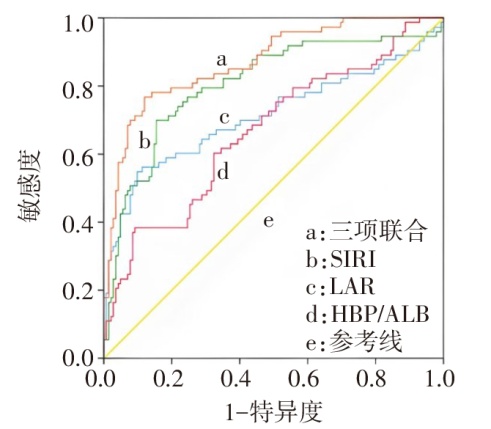
Fig.1 ROC curves of LAR, HBP/ALB and SIRI for predicting severe AECOPD
| 组别 | n | LAR | HBP/ALB | SIRI |
|---|---|---|---|---|
| 预后良好组 | 178 | 0.05±0.01 | 0.39±0.15 | 2.56(1.68,3.05) |
| 预后不良组 | 37 | 0.07±0.01 | 0.54±0.13 | 4.03(3.41,6.15) |
| t或Z | 10.057** | 5.764** | 4.365** |
Tab.5 Comparison of LAR, HBP/ALB and SIRI between patients with different prognosis conditions
| 组别 | n | LAR | HBP/ALB | SIRI |
|---|---|---|---|---|
| 预后良好组 | 178 | 0.05±0.01 | 0.39±0.15 | 2.56(1.68,3.05) |
| 预后不良组 | 37 | 0.07±0.01 | 0.54±0.13 | 4.03(3.41,6.15) |
| t或Z | 10.057** | 5.764** | 4.365** |
| 变量 | 截断值 | 敏感度/% | 特异度/% | AUC | 95%CI | P |
|---|---|---|---|---|---|---|
| LAR | 0.06 | 70.27 | 87.08 | 0.918 | 0.883~0.954 | <0.001 |
| HBP/ALB | 0.46 | 64.86 | 68.54 | 0.782 | 0.717~0.846 | <0.001 |
| SIRI | 2.75 | 78.38 | 54.50 | 0.728 | 0.655~0.801 | <0.001 |
| 三项联合 | - | 94.59 | 76.83 | 0.951 | 0.925~0.978 | <0.001 |
Tab.6 Predictive value of LAR, HBP/ALB and SIRI on poor prognosis in patients
| 变量 | 截断值 | 敏感度/% | 特异度/% | AUC | 95%CI | P |
|---|---|---|---|---|---|---|
| LAR | 0.06 | 70.27 | 87.08 | 0.918 | 0.883~0.954 | <0.001 |
| HBP/ALB | 0.46 | 64.86 | 68.54 | 0.782 | 0.717~0.846 | <0.001 |
| SIRI | 2.75 | 78.38 | 54.50 | 0.728 | 0.655~0.801 | <0.001 |
| 三项联合 | - | 94.59 | 76.83 | 0.951 | 0.925~0.978 | <0.001 |
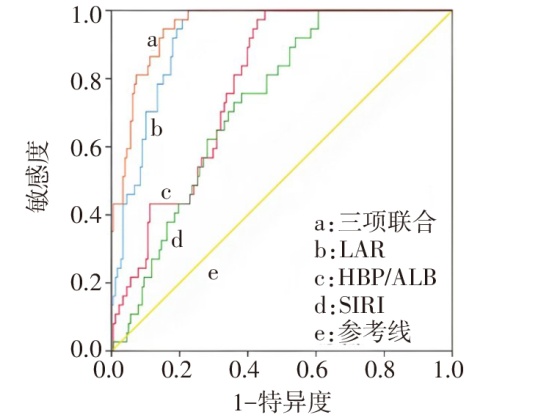
Fig.2 ROC curves of LAR, HBP/ALB and SIRI for predicting poor prognosis in AECOPD patients
| [1] | Huang Y, Wang J, Chen S, et al. Red cell distribution width related to the severity of the disease in patients with AECOPD[J]. Biomark Med, 2025, 19(5):177-186. doi:10.1080/17520363.2025.2468152. |
| [2] | Chen H, Zhou H, Luo C, et al. Efficacy of treatment with N-acetylcysteine inhalation for AECOPD:a propensity-score-matched cohort study[J]. Clin Respir J, 2023, 17(10):1038-1047. doi:10.1111/crj.13690. |
| [3] | Qi S, Li X, Jiang Y, et al. Analysis of risk factors and development of predictive model for acute myocardial injury in patients with acute exacerbation of chronic obstructive pulmonary disease[J]. J Thorac Dis, 2025, 17(4):1977-1990. doi:10.21037/jtd-2024-1992. |
| [4] | Ellingsen J, Janson C, Bröms K, et al. Fibrinogen,white blood cells,and blood cell indices as prognostic biomarkers of future COPD exacerbation frequency:the tie cohort study[J]. J Clin Med, 2024, 13(13):3855-3892. doi:10.3390/jcm13133855. |
| [5] | Wang H X, Huang X H, Ma L Q, et al. Association between lactate-to-albumin ratio and short-time mortality in patients with acute respiratory distress syndrome[J]. J Clin Anesth, 2024, 99(12):e111632. doi:10.1016/j.jclinane.2024.111632. |
| [6] | 中华医学会呼吸病学分会慢性阻塞性肺疾病学组, 中国医师协会呼吸医师分会慢性阻塞性肺疾病工作委员会. 慢性阻塞性肺疾病诊治指南(2021年修订版)[J]. 中华结核和呼吸杂志, 2021, 44(3):170-205. |
| Chronic Obstructive Pulmonary Disease Group of Chinese Thoraci Society Chronic Obstructive Pulmonary Disease,Respiratory Physicians Branch,Chinese Association. Guidelines for the diagnosis and management of chronic obstructive pulmonary disease(revised version 2021)[J]. Chin J Tuberc Respir Dis, 2021, 44(3):170-205. doi:10.3760/cma.j.cn112147-20210109-00031. | |
| [7] | 范艳妮, 王璋. 免疫炎症指数联合预后营养指数对老年慢性阻塞性肺疾病急性加重的严重程度及预后的评估价值[J]. 老年医学与保健, 2023, 29(3):475-481,492. |
| Fan Y N, Wang Z. Value of immunoinflammatory index combined with prognostic nutrition index in evaluating the severity and prognosis of AECOPD in the elderly[J]. Geriatr Health Care, 2023, 29(3):475-481,492. doi:10.3969/j.issn.1008-8296.2023.03.009. | |
| [8] | Jahn M, Rekowski J, Jánosi R A, et al. Score performance of SAPS 2 and SAPS 3 in combination with biomarkers IL-6,PCT or CRP[J]. PLoS One, 2020, 15(9):e0238587. doi:10.1371/journal.pone.0238587. |
| [9] | Murata S, Baig N, Decker K, et al. Systemic inflammatory response index (SIRI)at baseline predicts clinical response for a subset of treatment-resistant bipolar depressed patients[J]. J Pers Med, 2023, 13(9):1408-1416. doi:10.3390/jpm13091408. |
| [10] | Vukić Dugac A, Vergles M, Škrinjarić Cincar S, et al. Are we missing the opportunity to disseminate GOLD recommendations through AECOPD discharge letters[J]. Int J Chron Obstruct Pulmon Dis, 2023, 18(1):985-993. doi:10.2147/COPD.S408307. |
| [11] | Barnason S, Miller J N, Schuelke S, et al. Self-management intervention for patients following hospitalization for acute exacerbation of chronic obstructive pulmonary disease(AECOPD):a pilot randomized controlled trial[J]. Nurs Health Sci, 2024, 26(2):e13114. doi:10.1111/nhs.13114. |
| [12] | Yan D, Dai C, Xu R, et al. Predictive ability of systemic inflammation response index for the risk of pneumonia in patients with acute ischemic stroke[J]. Gerontology, 2023, 69(2):181-188. doi:10.1159/000524759. |
| [13] | Matsuda R, Tamamoto T, Inooka N, et al. Systemic inflammation response index predicts overall survival in patients undergoing stereotactic radiosurgery for brain metastasis from non-small cell lung cancer[J]. J Radiat Res, 2025, 66(2):129-136. doi:10.1093/jrr/rrae099. |
| [14] | Ye X, Dai M, Xiang Z. Prognostic role of systemic inflammation response index in patients with non-small cell lung cancer:a meta-analysis[J]. BMJ Open, 2024, 14(11):e087841. doi:10.1136/bmjopen-2024-087841. |
| [15] | Zheng Z, Yu M, Peng G, et al. Systemic immune inflammation index(SII) and prognostic nutritional index(PNI)associated with prolonged intensive care unit (ICU)stay in patients with pneumonia complicated with respiratory failure[J]. Int J Gen Med, 2025, 18(1):1765-1776. doi:10.2147/IJGM.S510659. |
| [16] | Xie J, Liu H, He Q, et al. Relationship between lactate-to-albumin ratio and 28-day mortality in patients with exacerbation of chronic obstructive pulmonary disease admitted to the Intensive Care Unit[J]. Eur J Med Res, 2024, 29(1):258-266. doi:10.1186/s40001-024-01867-8. |
| [17] | Zhao K, Zhou L, Ni Y, et al. Association between lactate-to-albumin ratio and 28-day all-cause mortality in critical care patients with COPD:can both arterial and peripheral venous lactate serve as predictors[J]. Int J Chron Obstruct Pulmon Dis, 2025, 20(5):1419-1434. doi:10.2147/COPD.S503625. |
| [18] | Wang H, Cho P S P, Kouritas V, et al. Three key factors predicting the severity of exacerbations of chronic obstructive pulmonary disease:T lymphocytes,lactate,and prealbumin[J]. J Thorac Dis, 2025, 17(4):2386-2393. doi:10.21037/jtd-2025-416. |
| [19] | Zuo L, Li X, Wang L, et al. Heparin-binding protein as a biomarker for the diagnosis of sepsis in the intensive care unit:a retrospective cross-sectional study in China[J]. BMJ Open, 2024, 14(6):e078687. doi:10.1136/bmjopen-2023-078687. |
| [20] | Xiao X, Hong Y, Wang S, et al. Diagnostic value of plasma heparin-binding protein and the heparin-binding protein-to-albumin ratio in patients with community-acquired pneumonia:a retrospective study[J]. BMC Infect Dis, 2023, 23(1):777-780. doi:10.1186/s12879-023-08762-3. |
| [21] | Yu Y, Li M. Atypical pathogen community-acquired pneumonia:an analysis of clinical characteristics,drug treatment,and prognosis in the related patients[J]. Mol Biol Rep, 2025, 52(1):309. doi:10.1007/s11033-025-10382-w. |
| [22] | Vedel-Krogh S, Nielsen S F, Lange P, et al. Blood eosinophils and exacerbations in chronic obstructive pulmonary disease:the Copenhagen general population study[J]. Am J Respir Crit Care Med, 2016, 193(9):965-974. doi:10.1164/rccm.201509-1869OC. |
| [23] | Bafadhel M, Mckenna S, Terry S, et al. Blood eosinophils to direct corticosteroid treatment of exacerbations of chronic obstructive pulmonary disease:a randomized placebo-controlled trial[J]. Am J Respir Crit Care Med, 2012, 186(1):48-55. doi:10.1164/rccm.201108-1553OC. |
| [24] | Para O, Cassataro G, Fantoni C, et al. Prognostic role of blood eosinophils in acute exacerbations of chronic obstructive pulmonary disease:systematic review and meta-analysis[J]. Monaldi Arch Chest Dis, 2026, 96(2). doi:10.4081/monaldi.2025.3298. |
| [25] | Coward-Smith M, Zakarya R, Oliver B G, et al. Extracellular vesicles in pulmonary diseases:roles and therapeutic potential[J]. BMC Pulm Med, 2025, 25(1):516-518. doi:10.1186/s12890-025-03965-7. |
| [26] | Schønberg-Moe A, Csoma B, Bikov A, et al. Platelet count and platelet-to-lymphocyte ratio at the onset of a severe COPD exacerbation are unrelated to the time till the next moderate or severe relapse[J]. Adv Med Sci, 2024, 69(1):160-166. doi:10.1016/j.advms.2024.03.003. |
| Viewed | ||||||
|
Full text |
|
|||||
|
Abstract |
|
|||||
