
Tianjin Medical Journal ›› 2026, Vol. 54 ›› Issue (10): 1087-1092.doi: 10.11958/20260051
• Clinical Research • Previous Articles Next Articles
DONG Wenpeng( ), CUI Peihe△(), ZHAO Shiyue, CUI Yan
Received:2026-01-06
Revised:2026-03-06
Published:2026-10-15
Online:2026-10-10
Contact:
△E-mail:534679177@qq.com
DONG Wenpeng, CUI Peihe, ZHAO Shiyue, CUI Yan. Observation of clinical characteristics of membranoproliferative glomerulonephritis with monoclonal immunoglobulin deposition[J]. Tianjin Medical Journal, 2026, 54(10): 1087-1092.
CLC Number:
| 病例 | 年龄/岁 | 基本病情 | 血尿/HPF | 24 h UTP/ (g/d) | ALB/ (g/L) | SCr/ (μmol/L) | eGFR/ [mL/(min·1.73m2)] | ||||||||||
|---|---|---|---|---|---|---|---|---|---|---|---|---|---|---|---|---|---|
| 1 | 54 | 颜面部水肿1年,加重1个月 | 满视野 | 5.07 | 35.00 | 85.00 | 70.17 | ||||||||||
| 2 | 73 | 发现Scr升高3个月,双下肢水肿2个月 | 57.00 | 6.30 | 26.80 | 108.00 | 46.78 | ||||||||||
| 3 | 77 | 确诊膜增生性肾炎15年,蛋白尿加重3个月 | 10.20 | 11.24 | 27.20 | 262.00 | 15.75 | ||||||||||
| 病例 | Hb/ (g/L) | 血κ轻链/(g/L) | 血λ轻链/(g/L) | κ/λ | 抗核抗体谱 | 免疫固定电泳 | 血清IgG/(g/L) | 补体C3/(g/L) | 补体C4/(g/L) | 骨髓活检浆 细胞数/个 | |||||||
| 1 | 99 | 5.44 | 2.58 | 2.11 | 抗SSA/Ro(+++)、抗Ro-52抗体(+++) | 阴性 | 23.80 | 0.60 | 0.09 | 1 | |||||||
| 2 | 108 | 1.87 | 0.68 | 2.75 | 抗SSA/Ro(+++)、抗Ro-52抗体(+++) | 阴性 | 7.70 | 0.93 | 0.30 | 2 | |||||||
| 3 | 108 | 1.35 | 1.03 | 1.31 | 抗SSA/Ro(+++)、抗Ro-52抗体(++) | 阴性 | 6.83 | 0.94 | 0.34 | 1 | |||||||
Tab.1 Clinical data of 3 patients with PGNMID
| 病例 | 年龄/岁 | 基本病情 | 血尿/HPF | 24 h UTP/ (g/d) | ALB/ (g/L) | SCr/ (μmol/L) | eGFR/ [mL/(min·1.73m2)] | ||||||||||
|---|---|---|---|---|---|---|---|---|---|---|---|---|---|---|---|---|---|
| 1 | 54 | 颜面部水肿1年,加重1个月 | 满视野 | 5.07 | 35.00 | 85.00 | 70.17 | ||||||||||
| 2 | 73 | 发现Scr升高3个月,双下肢水肿2个月 | 57.00 | 6.30 | 26.80 | 108.00 | 46.78 | ||||||||||
| 3 | 77 | 确诊膜增生性肾炎15年,蛋白尿加重3个月 | 10.20 | 11.24 | 27.20 | 262.00 | 15.75 | ||||||||||
| 病例 | Hb/ (g/L) | 血κ轻链/(g/L) | 血λ轻链/(g/L) | κ/λ | 抗核抗体谱 | 免疫固定电泳 | 血清IgG/(g/L) | 补体C3/(g/L) | 补体C4/(g/L) | 骨髓活检浆 细胞数/个 | |||||||
| 1 | 99 | 5.44 | 2.58 | 2.11 | 抗SSA/Ro(+++)、抗Ro-52抗体(+++) | 阴性 | 23.80 | 0.60 | 0.09 | 1 | |||||||
| 2 | 108 | 1.87 | 0.68 | 2.75 | 抗SSA/Ro(+++)、抗Ro-52抗体(+++) | 阴性 | 7.70 | 0.93 | 0.30 | 2 | |||||||
| 3 | 108 | 1.35 | 1.03 | 1.31 | 抗SSA/Ro(+++)、抗Ro-52抗体(++) | 阴性 | 6.83 | 0.94 | 0.34 | 1 | |||||||
| 病例 | 免疫荧光 | 超微结构 电子致密物位 | 光镜 | ||
|---|---|---|---|---|---|
| 优势蛋白类型及位置 | 补体类型 | 肾小球病变类型 | 嗜复红物质沉积位置 | ||
| 1 | IgG2-Lambda;团块状/毛细血管襻、系膜区 | C3(+)、C4(+/-)、C1q(阴性) | 系膜区、内皮下 | 膜增生性肾炎 | 系膜区、内皮下沉积 |
| 2 | IgG3-Kappa;团块状、颗粒状/毛细血管襻、系膜区 | C3(+++)、C4(阴性)、C1q(阴性) | 系膜区、内皮下,基底膜内偶见 | 膜增生性肾炎 | 系膜区、内皮下沉积 |
| 3 | IgG3-Kappa;花瓣状/毛细血管襻、系膜区 | C3(+++)、C4(阴性)、C1q(+/-) | 系膜区、内皮下,个别基底膜内 | 膜增生性肾炎 | 系膜区、内皮下沉积 |
Tab.2 Pathological examination results of renal biopsies from 3 patients
| 病例 | 免疫荧光 | 超微结构 电子致密物位 | 光镜 | ||
|---|---|---|---|---|---|
| 优势蛋白类型及位置 | 补体类型 | 肾小球病变类型 | 嗜复红物质沉积位置 | ||
| 1 | IgG2-Lambda;团块状/毛细血管襻、系膜区 | C3(+)、C4(+/-)、C1q(阴性) | 系膜区、内皮下 | 膜增生性肾炎 | 系膜区、内皮下沉积 |
| 2 | IgG3-Kappa;团块状、颗粒状/毛细血管襻、系膜区 | C3(+++)、C4(阴性)、C1q(阴性) | 系膜区、内皮下,基底膜内偶见 | 膜增生性肾炎 | 系膜区、内皮下沉积 |
| 3 | IgG3-Kappa;花瓣状/毛细血管襻、系膜区 | C3(+++)、C4(阴性)、C1q(+/-) | 系膜区、内皮下,个别基底膜内 | 膜增生性肾炎 | 系膜区、内皮下沉积 |

Fig.1 Pathological changes under light microscopy in renal biopsy of PGNMID patients
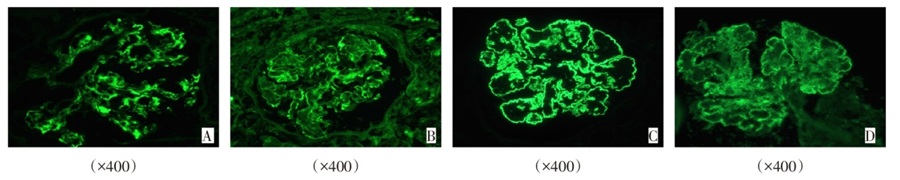
Fig.2 Pathological immunofluorescence changes in renal biopsy of PGNMID patients
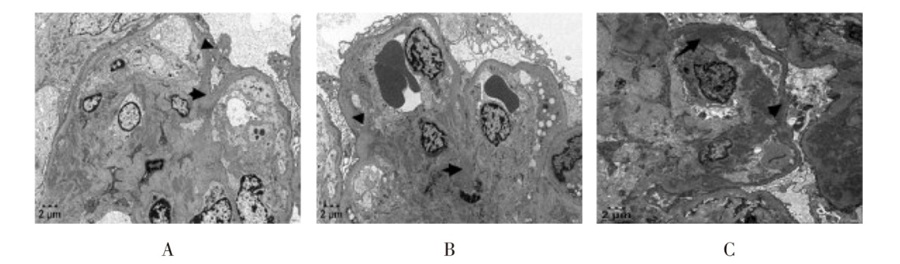
Fig.3 Pathological changes under electron microscopy in renal biopsies of PGNMID patients
| 病例 | 治疗方案 | 不良反应 | 开始缓解时间 | 部分缓解时间 | 完全缓解时间 | 随访 时间 | 目前情况 |
|---|---|---|---|---|---|---|---|
| 1 | 厄贝沙坦300 mg、达格列净10 mg每日1次口服+利妥昔单抗(第0、2周,6个月分别静脉滴注1 g)+甲泼尼龙片晨起20 mg口服,规律减量,6个月后停药+环磷酰胺每月0.8 g静脉滴注,维持1年 | 中性粒细胞、淋巴细胞轻度 下降 | 第1个月 | 第3个月 | 第6个月 | 12个月 | 24 h UTP下降至0.2 g/d以内,SCr及镜下血尿恢复正常;厄贝沙坦+达格列净口服维持治疗 |
| 2 | 沙库巴曲缬沙坦100 mg每日2次口服+硼替佐米1.3 mg/m2 第1、8、15、22天静脉滴注+环磷酰胺300 mg/m2 第1、8、15天静脉滴注+地塞米松40 mg第1~2、8~9、15~16、22~23天口服 | 无 | 第1个月 | 第2个月 | 第7个月 | 10个月 | 24 h UTP维持在0.15 g/d左右,SCr及镜下血尿恢复正常,沙库巴曲缬沙坦口服维持治疗 |
| 3 | 利妥昔单抗第0、2周分别静脉滴注1 g+环磷酰胺第0、2周分别静脉滴注0.4 g,此后每月单用环磷酰胺0.6 g静脉滴注,目前仍在维持治疗中 | 无 | 第1个月 | 第6个月 | 无 | 6个月 | 24 h UTP下降至1 g/d左右,SCr维持在200 μmol/L左右,厄贝沙坦口服维持治疗 |
Tab.3 Treatment plans and outcomes of 3 patients with PGNMID
| 病例 | 治疗方案 | 不良反应 | 开始缓解时间 | 部分缓解时间 | 完全缓解时间 | 随访 时间 | 目前情况 |
|---|---|---|---|---|---|---|---|
| 1 | 厄贝沙坦300 mg、达格列净10 mg每日1次口服+利妥昔单抗(第0、2周,6个月分别静脉滴注1 g)+甲泼尼龙片晨起20 mg口服,规律减量,6个月后停药+环磷酰胺每月0.8 g静脉滴注,维持1年 | 中性粒细胞、淋巴细胞轻度 下降 | 第1个月 | 第3个月 | 第6个月 | 12个月 | 24 h UTP下降至0.2 g/d以内,SCr及镜下血尿恢复正常;厄贝沙坦+达格列净口服维持治疗 |
| 2 | 沙库巴曲缬沙坦100 mg每日2次口服+硼替佐米1.3 mg/m2 第1、8、15、22天静脉滴注+环磷酰胺300 mg/m2 第1、8、15天静脉滴注+地塞米松40 mg第1~2、8~9、15~16、22~23天口服 | 无 | 第1个月 | 第2个月 | 第7个月 | 10个月 | 24 h UTP维持在0.15 g/d左右,SCr及镜下血尿恢复正常,沙库巴曲缬沙坦口服维持治疗 |
| 3 | 利妥昔单抗第0、2周分别静脉滴注1 g+环磷酰胺第0、2周分别静脉滴注0.4 g,此后每月单用环磷酰胺0.6 g静脉滴注,目前仍在维持治疗中 | 无 | 第1个月 | 第6个月 | 无 | 6个月 | 24 h UTP下降至1 g/d左右,SCr维持在200 μmol/L左右,厄贝沙坦口服维持治疗 |
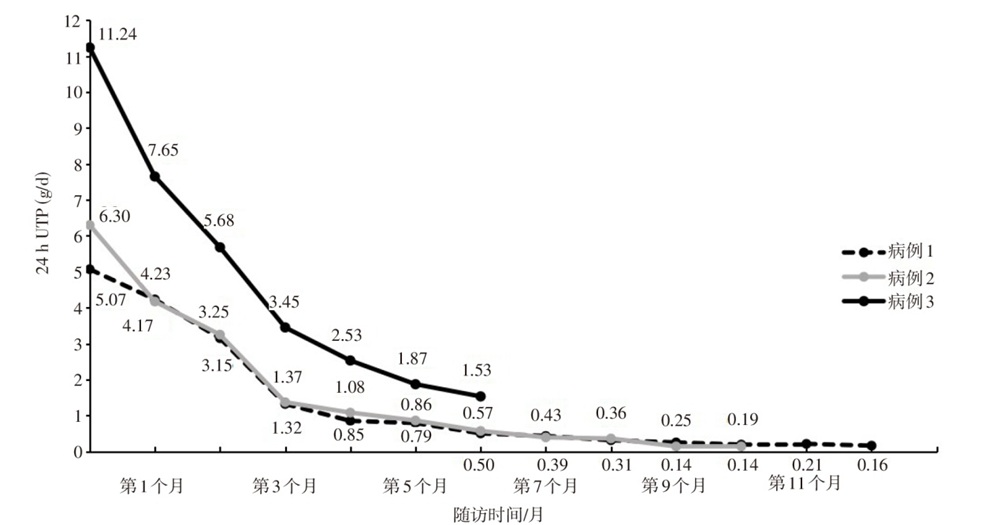
Fig.4 Changes of 24 h UTP in three patients with PGNMID
| [1] | Li M, Xu G. An update of proliferative glomerulonephritis with monoclonal immunoglobulin deposits[J]. Clin Kidney J, 2022, 15(6):1041-1048. doi:10.1093/ckj/sfab269. |
| [2] | Gumber R, Cohen J B, Palmer M B, et al. A clone-directed approach may improve diagnosis and treatment of proliferative glomerulonephritis with monoclonal immunoglobulin deposits[J]. Kidney Int, 2018, 94(1):199-205. doi:10.1016/j.kint.2018.02.020. |
| [3] | Zhou H, Li M, Zeng C, et al. Efficacy of immunomodulatory drugs in combination with dexamethasone in proliferative glomerulonephritis with monoclonal immunoglobulin deposits[J]. Kidney Int Rep, 2022, 7(10):2166-2175. doi:10.1016/j.ekir.2022.07.009. |
| [4] | Bridoux F, Javaugue V, Nasr S H, et al. Proliferative glomerulonephritis with monoclonal immunoglobulin deposits:a nephrologist perspective[J]. Nephrol Dial Transplant, 2021, 36(2):208-215. doi:10.1093/ndt/gfz176. |
| [5] | Hou J, Haas M. Seeing the light(chains):a paradigm shift in PGNMID[J]. Kidney Int, 2025, 108(6):996-998. doi:10.1016/j.kint.2025.09.018. |
| [6] | Fourdinier O, Ulrich M, Karras A, et al. Glomerulonephritis with non-Randall-type,non-cryoglobulinaemic monoclonal immunoglobulin G deposits(PGNMID and ITG)[J]. Clin Kidney J, 2022, 15(9):1727-1736. doi:10.1093/ckj/sfac085. |
| [7] | Kousios A, Duncan N, Tam F W K, et al. Proliferative glomerulonephritis with monoclonal Ig deposits(PGNMID):diagnostic and treatment challenges for the nephrologist![J]. Kidney Int, 2019, 95(2):467-468. doi:10.1016/j.kint.2018.10.016. |
| [8] | Strati P, Nasr S H, Leung N, et al. Renal complications in chronic lymphocytic leukemia and monoclonal B-cell lymphocytosis:the Mayo Clinic experience[J]. Haematologica, 2015, 100(9):1180-1188. doi:10.3324/haematol.2015.128793. |
| [9] | Best Rocha A, Larsen C P. Membranous glomerulopathy with light chain-restricted deposits:A clinicopathological analysis of 28 cases[J]. Kidney Int Rep, 2017, 2(6):1141-1148. doi:10.1016/j.ekir.2017.07.008. |
| [10] | Liu M, Yu X, Wang S, et al. Proliferative glomerulonephritis with monoclonal immunoglobulin deposits:an entity associated with distinct diseases and comparison between IgG1 and IgG3 subtypes[J]. J Nephrol, 2022, 35(9):2363-2372. doi:10.1007/s40620-022-01317-w. |
| [11] | Aucouturier P, D'Agati V D, Ronco P. A fresh perspective on monoclonal gammopathies of renal significance[J]. Kidney Int Rep, 2021, 6(8):2059-2065. doi:10.1016/j.ekir.2021.04.026. |
| [12] | Bu L, Valeri A M, Said S M, et al. IgM variant of proliferative glomerulonephritis with monoclonal immunoglobulin deposits:A case series[J]. Am J Kidney Dis, 2025, 85(6):716-726.e1. doi:10.1053/j.ajkd.2025.01.009. |
| [13] | Javaugue V, Pascal V, Nasr S H, et al. Revisiting proliferative glomerulonephritis with monoclonal immunoglobulin deposits through immunoglobulin repertoire sequencing[J]. Kidney Int, 2025, 108(6):1146-1157. doi:10.1016/j.kint.2025.07.039. |
| [14] | Gowda K K, Nada R, Ramachandran R, et al. Proliferative glomerulonephritis with monoclonal immunoglobulin deposition disease:The utility of routine staining with immunoglobulin light chains[J]. Indian J Nephrol, 2015, 25(6):344-348. doi:10.4103/0971-4065.151354. |
| [15] | Xing G, Gillespie R, Bedri B, et al. Proliferative glomerulonephritis with monoclonal IgG deposits in children and young adults[J]. Pediatr Nephrol, 2018, 33(9):1531-1538. doi:10.1007/s00467-018-3949-8. |
| [16] | Gozzetti A, Guarnieri A, Zamagni E, et al. Monoclonal gammopathy of renal significance(MGRS):Real-world data on outcomes and prognostic factors[J]. Am J Hematol, 2022, 97(7):877-884. doi:10.1002/ajh.26566. |
| [17] | Santana De Roberts R, Batal I, Aljareh A, et al. Proliferative glomerulonephritis with monoclonal immunoglobulin deposits associated with parvovirus B19[J]. BMJ Case Rep, 2021, 14(6):e243061. doi:10.1136/bcr-2021-243061. |
| [18] | Nasr S H, Javaugue V. Insights into proliferative glomerulonephritis with monoclonal immunoglobulin deposits-is it really monoclonal or not?[J]. Curr Opin Nephrol Hypertens, 2025, 34(3):199-205. doi:10.1097/MNH.0000000000001061. |
| [19] | Amaador K, Peeters H, Minnema M C, et al. Monoclonal gammopathy of renal significance(MGRS)histopathologic classification, diagnostic workup, and therapeutic options[J]. Neth J Med, 2019, 77(7):243-254. |
| [20] | Zand L, Rajkumar S V, Leung N, et al. Safety and efficacy of daratumumab in patients with proliferative GN with monoclonal immunoglobulin deposits[J]. J Am Soc Nephrol, 2021, 32(5):1163-1173. doi:10.1681/ASN.2020101541. |
| [21] | Ji Q, Yu S, Zhou X, et al. Proliferative glomerulonephritis with monoclonal immunoglobulin deposits(PGNMID):three case reports and systematic review[J]. Front Med(Lausanne), 2025, 12:1637435. doi:10.3389/fmed.2025.1637435. |
| [22] | Bhutani G, Nasr S H, Said S M, et al. Hematologic characteristics of proliferative glomerulonephritides with nonorganized monoclonal immunoglobulin deposits[J]. Mayo Clin Proc, 2015, 90(5):587-596. doi:10.1016/j.mayocp.2015.01.024. |
| [23] | Fermand J P, Bridoux F, Kyle R A, et al. How I treat monoclonal gammopathy of renal significance(MGRS)[J]. Blood, 2013, 122(22):3583-3590. doi:10.1182/blood-2013-05-495929. |
| [24] | Lin L, Chen N. A Review on the diagnosis and treatment of proliferative glomerulonephritis with monoclonal immunoglobulin deposits[J]. Int J Gen Med, 2022, 15:8577-8582. doi:10.2147/IJGM.S386733. |
| [25] | Oki R, Unagami K, Taneda S, et al. Treatment with bortezomib for recurrent proliferative glomerulonephritis with monoclonal IgG deposits in kidney allograft. Case report and review of the literature[J]. J Nephrol, 2022, 35(4):1289-1293. doi:10.1007/s40620-022-01332-x. |
| [26] | Liu M Y, Yu X J, Wang S X, et al. Characteristics of complement protein deposition in proliferative glomerulonephritis with monoclonal immunoglobulin deposition[J]. Clin J Am Soc Nephrol, 2023, 18(12):1573-1582. doi:10.2215/CJN.0000000000000295. |
| [27] | Guiard E, Karras A, Plaisier E, et al. Patterns of noncryoglobulinemic glomerulonephritis with monoclonal Ig deposits:correlation with IgG subclass and response to rituximab[J]. Clin J Am Soc Nephrol, 2011, 6(7):1609-1616. doi:10.2215/CJN.10611110. |
| [1] | SU Ya, ZHANG Dongwei, YU Minghui, WANG Chunhua, WU Yueyue. Observation on the clinical efficacy of compound kushen injection combined with targeted and immune therapy in the treatment of advanced hepatocellular carcinoma [J]. Tianjin Medical Journal, 2026, 54(3): 324-328. |
| [2] | ZHANG Chao, ZHOU Tiantian, LI Siwen, TANG Weijun, HU Weijun. Epidemiological investigation on diphtheria serum IgG antibody levels in people aged 1-59 years old in Shaanxi province [J]. Tianjin Medical Journal, 2025, 53(10): 1081-1086. |
| [3] | BAI Mengke, YANG Xiaoqing, LI Hang, WANG Long, MA Jiwei. Analysis of laboratory indexes and pathological features of crescent formation in children with allergic purpura nephritis [J]. Tianjin Medical Journal, 2024, 52(8): 820-824. |
| [4] | LIU Xiaoyan, BU Rui, LU Jianfei, DING Yu, ZHANG Xing. Value of Sonazoid contrast-enhanced ultrasound for preoperatively evaluating pathological grade of hepatocellular carcinoma [J]. Tianjin Medical Journal, 2024, 52(6): 658-662. |
| [5] | PING Jing, ZHOU Donghua, ZHU Dajiang, TIAN Jie, CHEN Ying, FAN Juhua. Expression and its clinical significance of Musashi2 in different molecular subtypes of breast invasive ductal carcinoma [J]. Tianjin Medical Journal, 2022, 50(9): 907-911. |
| [6] | HU Jiahai, XUE Song, CHEN Quan. Effects of camrelizumab combined with chemotherapy on serum miR-21 and soluble E-cadherin in patients with advanced esophageal cancer [J]. Tianjin Medical Journal, 2022, 50(8): 873-877. |
| [7] | ZHAO Zilong, ZHANG Meiyun, GAO Hui, DU Wei, BA Yaer, LYU Yihua△. The clinical efficacy and safety of anlotinib and albumin-bound paclitaxel as the third-line therapy in patients with non-small cell lung cancer cancer [J]. Tianjin Medical Journal, 2022, 50(5): 539-543. |
| [8] | LU Jie, ZHANG Xin, WANG Tao, YANG Ning. Effects of circRNAs on atrial fibrillation and its mechanism [J]. Tianjin Medical Journal, 2022, 50(3): 333-336. |
| [9] | LI Xiyuan, ZHU Zhixin, ZHAO Hailong . Recent advances in the mechanisms of drug resistance and treatment of BRAF-mutant melanoma [J]. Tianjin Medical Journal, 2022, 50(2): 214-219. |
| [10] | MUNIRE·Abulimiti, TAN Yao△, WANG Hai-feng, LIU Shu-juan, LU Xi, YISIKANDEER·Abulimiti. Analysis of therapeutic effect and prognostic factors of IMRT combined with sorafenib in the treatment of hepatocellular carcinoma with portal vein thrombosis [J]. Tianjin Medical Journal, 2021, 49(5): 514-519. |
| [11] | LYU Yi-hua, ZHAO Zi-long, HUANG Ge-hong, BA Ya-er, DU Wei, GAO Hui, ZHANG Mei-yun. The clinical efficacy and safety of anlotinib combined with irinotecan as the second-line therapy in patients with small cell lung cancer [J]. Tianjin Medical Journal, 2021, 49(4): 436-440. |
| [12] | LIU Ye, MENG De-wang, YANG Gui-li, SUN Li. Progress in clinical trials of monoclonal antibody therapy for neuromyelitis optica pedigree diseases [J]. Tianjin Medical Journal, 2021, 49(11): 1222-1227. |
| [13] | CHEN Ru-ping, , LIU Rui△. The application of next generation sequencing in the diagnosis and treatment of colorectal cancer#br# [J]. Tianjin Medical Journal, 2020, 48(9): 903-907. |
| [14] | YANG Sheng-nan, ZHAO Yong, LI Yue-chuan, JIA Wei△. The latest research progress of lymphangiomyomatosis [J]. Tianjin Medical Journal, 2020, 48(8): 790-795. |
| [15] | ZHAO Yu, ZHANG Jun-ling, FENG Guo-xing, FAN Sai-jun△. Research progress on the role of STAT5 in tumors [J]. Tianjin Medical Journal, 2020, 48(7): 670-676. |
| Viewed | ||||||
|
Full text |
|
|||||
|
Abstract |
|
|||||
