
Tianjin Medical Journal ›› 2026, Vol. 54 ›› Issue (9): 902-907.doi: 10.11958/20260423
• Experimental Research • Previous Articles Next Articles
LIU Linlin( ), LIANG Dongxue, LIU Lihua, TIAN Ying, SUN Lili△()
Received:2026-02-05
Revised:2026-04-28
Published:2026-09-15
Online:2026-09-14
Contact:
△E-mail:278800539@qq.com
LIU Linlin, LIANG Dongxue, LIU Lihua, TIAN Ying, SUN Lili. Huaiqihuang regulating Jun/SLC7A11-mediated airway epithelial cell ferroptosis to inhibit airway remodeling and collagen deposition in asthmatic rats[J]. Tianjin Medical Journal, 2026, 54(9): 902-907.
CLC Number:
| 组别 | RL/(cmH2O·s·mL-1) | Cdyn/(mL/cmH2O) |
|---|---|---|
| 正常组 | 0.24±0.05 | 0.61±0.13 |
| 哮喘组 | 0.88±0.18a | 0.27±0.06a |
| 低剂量组 | 0.67±0.13b | 0.41±0.09b |
| 高剂量组 | 0.47±0.09bc | 0.56±0.11bc |
| 高剂量+抑制剂组 | 0.72±0.14d | 0.36±0.07d |
| F | 38.473** | 20.841** |
Tab.1 Comparison of pulmonary function indicators between different groups
| 组别 | RL/(cmH2O·s·mL-1) | Cdyn/(mL/cmH2O) |
|---|---|---|
| 正常组 | 0.24±0.05 | 0.61±0.13 |
| 哮喘组 | 0.88±0.18a | 0.27±0.06a |
| 低剂量组 | 0.67±0.13b | 0.41±0.09b |
| 高剂量组 | 0.47±0.09bc | 0.56±0.11bc |
| 高剂量+抑制剂组 | 0.72±0.14d | 0.36±0.07d |
| F | 38.473** | 20.841** |
| 组别 | MDA/(nmol/mg) | GSH/(μmol/g) | ROS |
|---|---|---|---|
| 正常组 | 2.35±0.43 | 12.49±2.27 | 158.46±18.27 |
| 哮喘组 | 6.90±1.12a | 5.19±1.34a | 387.55±42.59a |
| 低剂量组 | 5.21±1.03b | 7.96±1.67b | 265.41±31.56b |
| 高剂量组 | 3.47±0.65bc | 10.65±2.09bc | 209.78±25.92bc |
| 高剂量+抑制剂组 | 4.96±0.93d | 7.17±1.38d | 245.79±40.83d |
| F | 40.011** | 26.007** | 66.379** |
Tab.2 Comparison of MDA, GSH and ROS contents in lung tissue between the five groups
| 组别 | MDA/(nmol/mg) | GSH/(μmol/g) | ROS |
|---|---|---|---|
| 正常组 | 2.35±0.43 | 12.49±2.27 | 158.46±18.27 |
| 哮喘组 | 6.90±1.12a | 5.19±1.34a | 387.55±42.59a |
| 低剂量组 | 5.21±1.03b | 7.96±1.67b | 265.41±31.56b |
| 高剂量组 | 3.47±0.65bc | 10.65±2.09bc | 209.78±25.92bc |
| 高剂量+抑制剂组 | 4.96±0.93d | 7.17±1.38d | 245.79±40.83d |
| F | 40.011** | 26.007** | 66.379** |
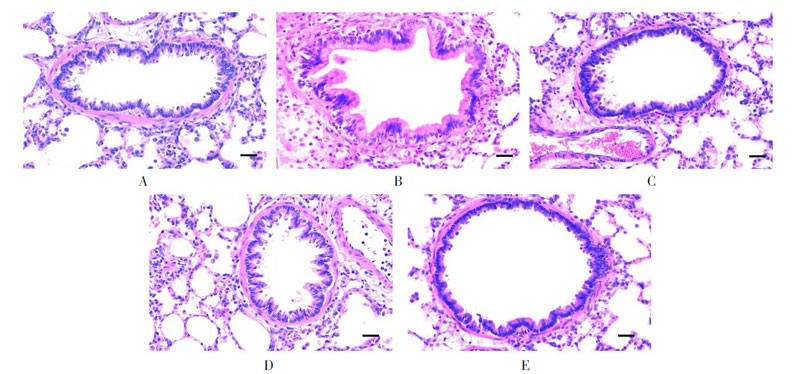
Fig.1 Airway epithelial damage, inflammatory infiltration and airway wall thickening in lung tissue of each group of rats observed by HE staining (×200)
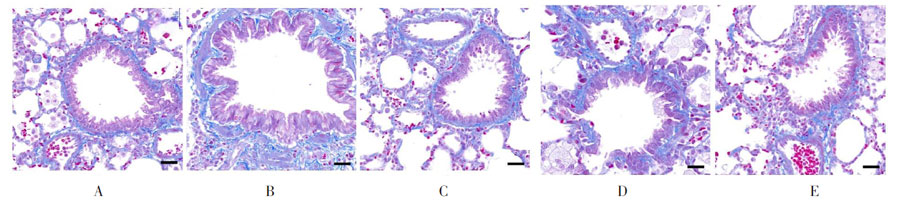
Fig.2 Collagen fiber deposition in lung tissue of each group of rats observed by Masson staining (Masson staining, ×200)
| 组别 | 气道壁 厚度 | 气道 平滑肌厚度 | 胶原纤维 沉积厚度 |
|---|---|---|---|
| 正常组 | 11.49±2.09 | 5.09±0.98 | 3.67±0.69 |
| 哮喘组 | 26.35±4.86a | 7.54±1.37a | 5.82±1.12a |
| 低剂量组 | 19.54±3.41b | 5.97±1.03b | 4.49±0.87b |
| 高剂量组 | 14.36±2.58bc | 4.93±0.98bc | 3.54±0.62bc |
| 高剂量+抑制剂组 | 18.54±3.43d | 5.99±1.04d | 4.38±0.91d |
| F | 27.493** | 8.972** | 11.048** |
Tab.3 Comparison of the deposition thickness of airway walls, airway smooth muscle and collagen fibers between five groups
| 组别 | 气道壁 厚度 | 气道 平滑肌厚度 | 胶原纤维 沉积厚度 |
|---|---|---|---|
| 正常组 | 11.49±2.09 | 5.09±0.98 | 3.67±0.69 |
| 哮喘组 | 26.35±4.86a | 7.54±1.37a | 5.82±1.12a |
| 低剂量组 | 19.54±3.41b | 5.97±1.03b | 4.49±0.87b |
| 高剂量组 | 14.36±2.58bc | 4.93±0.98bc | 3.54±0.62bc |
| 高剂量+抑制剂组 | 18.54±3.43d | 5.99±1.04d | 4.38±0.91d |
| F | 27.493** | 8.972** | 11.048** |
| 组别 | p-Jun/Jun | SLC7A11 | GPX4 |
|---|---|---|---|
| 正常组 | 0.12±0.03 | 0.92±0.08 | 0.98±0.07 |
| 哮喘组 | 0.96±0.07a | 0.16±0.03a | 0.34±0.05a |
| 低剂量组 | 0.79±0.06b | 0.42±0.04b | 0.51±0.06b |
| 高剂量组 | 0.42±0.05bc | 0.56±0.07bc | 0.75±0.08bc |
| 高剂量+抑制剂组 | 0.81±0.07d | 0.21±0.03d | 0.49±0.05d |
| F | 377.516** | 335.744** | 158.349** |
Tab.4 Comparison of protein expression levels of p-Jun/Jun, SLC7A11 and GPX4 in lung tissue between five groups
| 组别 | p-Jun/Jun | SLC7A11 | GPX4 |
|---|---|---|---|
| 正常组 | 0.12±0.03 | 0.92±0.08 | 0.98±0.07 |
| 哮喘组 | 0.96±0.07a | 0.16±0.03a | 0.34±0.05a |
| 低剂量组 | 0.79±0.06b | 0.42±0.04b | 0.51±0.06b |
| 高剂量组 | 0.42±0.05bc | 0.56±0.07bc | 0.75±0.08bc |
| 高剂量+抑制剂组 | 0.81±0.07d | 0.21±0.03d | 0.49±0.05d |
| F | 377.516** | 335.744** | 158.349** |
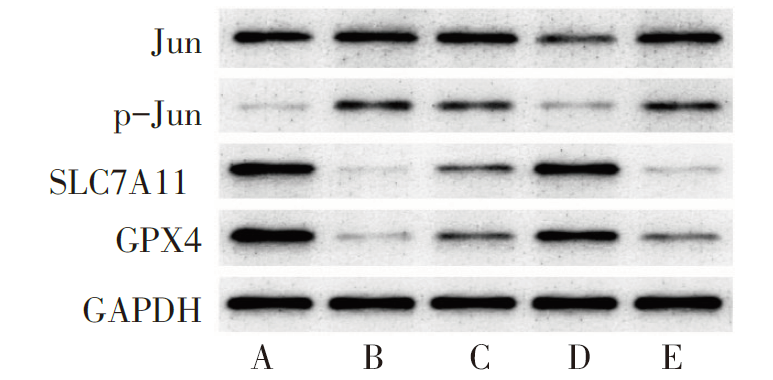
Fig.3 Expression levels of Jun, p-Jun, SLC7A11 and GPX4 proteins in lung tissue between five groups of rats detected by Western blot assay
| [1] | GBD 2021 Asthma and Allergic Diseases Collaborators. Global,regional,and national burden of asthma and atopic dermatitis,1990-2021,and projections to 2050:a systematic analysis of the Global Burden of Disease Study 2021[J]. Lancet Respir Med, 2025, 13(5):425-446. doi:10.1016/S2213-2600(25)00003-7. |
| [2] | Varricchi G, Brightling C E, Grainge C, et al. Airway remodelling in asthma and the epithelium:on the edge of a new era[J]. Eur Respir J, 2024, 63(4):2301619. doi:10.1183/13993003.01619-2023. |
| [3] | Rayner D G, Ferri D M, Guyatt G H, et al. Inhaled reliever therapies for asthma:a systematic review and meta-analysis[J]. JAMA, 2025, 333(2):143-152. doi:10.1001/jama.2024.22700. |
| [4] | Yamada K, St Croix C, Stolz D B, et al. Compartmentalized mitochondrial ferroptosis converges with optineurin-mediated mitophagy to impact airway epithelial cell phenotypes and asthma outcomes[J]. Nat Commun, 2024, 15(1):5818. doi:10.1038/s41467-024-50222-2. |
| [5] | He R, Wei Y, Peng Z, et al. α-Ketoglutarate alleviates osteoarthritis by inhibiting ferroptosis via the ETV4/SLC7A11/GPX4 signaling pathway[J]. Cell Mol Biol Lett, 2024, 29(1):88. doi:10.1186/s11658-024-00605-6. |
| [6] | 曲艳春, 刘贵昌. 槐杞黄颗粒联合小青龙汤对哮喘缓解期肺脾气虚证患儿免疫功能及预后的影响分析[J]. 中华中医药学刊, 2025, 43(5):44-47. |
| Qu Y C, Liu G C. Effect of huaiqihuang granule combined with xiaoqinglong decoction on immune function and prognosis of qi deficiency of lung and spleen syndrome in remission stage of asthma[J]. Chinese Archives of Traditional Chinese Medicine, 2025, 43(5):44-47. doi:10.13193/j.issn.1673-7717.2025.05.010. | |
| [7] | 韦嘉慧, 雷凤英, 黄藓慧, 等. 基于Th1/Th2平衡探讨槐杞黄颗粒对阿霉素致肾病综合征大鼠的治疗作用[J]. 山东医药, 2025, 65(8):42-47. |
| Wei J H, Lei F Y, Huang X H, et al. Therapeutic effect of Huaiqihuang granules on rats with adriamycin-induced nephrotic syndrome based on Th1/Th2 balance[J]. Shandong Medical Journal, 2025, 65(8):42-47. doi:10.3969/j.issn.1002-266X.2025.08.009. | |
| [8] | Varricchi G, Poto R, Lommatzsch M, et al. Biologics and airway remodeling in asthma:early,late,and potential preventive effects[J]. Allergy, 2025, 80(2):408-422. doi:10.1111/all.16382. |
| [9] | Tiotiu A. Airway remodeling in asthma[J]. Open Respir Arch, 2024, 7(1):100384. doi:10.1016/j.opresp.2024.100384. |
| [10] | Agache I, Adcock I M, Baraldi F, et al. Personalized therapeutic approaches for asthma[J]. J Allergy Clin Immunol, 2025, 156(3):503-522. doi:10.1016/j.jaci.2025.03.025. |
| [11] | Tang Y F, Xie W Y, Wu HY, et al. Huaier polysaccharide alleviates dextran sulphate sodium salt-induced colitis by inhibiting inflammation and oxidative stress,maintaining the intestinal barrier,and modulating gut microbiota[J]. Nutrients, 2024, 16(9):1368. doi:10.3390/nu16091368. |
| [12] | 黄伟, 李倩, 朱继田. 基于Nrf2/GPX4通路研究枸杞多糖对缺氧/复氧诱导的心肌细胞铁死亡的影响[J]. 中草药, 2025, 56(10):3568-3576. |
| Huang W, Li Q, Zhu J T. Effect of Lycium barbarum polysaccharides on hypoxia/reoxygenation-induced ferroptosis in cardiomyocytes based on Nrf2/GPX4 pathway[J]. Chinese Traditional and Herbal Drugs, 2025, 56(10):3568-3576. doi:10.7501/j.issn.0253-2670.2025.10.015. | |
| [13] | Qin Y, Zhao G, Wang Z, et al. Polygonatum sibiricum polysaccharide attenuates cyclophosphamide-induced testicular damages and sperm defects in male mice via Nrf2 mediating antioxidant protective mechanisms[J]. Int J Biol Macromol, 2025, 307(Pt3):141968. doi:10.1016/j.ijbiomac.2025.141968. |
| [14] | 尹小梅, 袁珂, 晁爽. 槐杞黄颗粒辅助治疗幼儿及学龄前儿童支气管哮喘的临床研究[J]. 中国临床药理学杂志, 2023, 39(10):1371-1375. |
| Yin X M, Yuan K, Chao S. Clinical trial of Huaiqihuang granules in adjuvant treatment of bronchial asthma in young children and preschool children[J]. Chinese Journal of Clinical Pharmacology, 2023, 39(10):1371-1375. doi:10.13699/j.cnki.1001-6821.2023.10.001. | |
| [15] | Chen J, He Y, Chen R, et al. SLC7A11 in fibrosis:molecular mechanisms and future prospects[J]. Aging Dis, 2025, 17(2):731-759. doi:10.14336/AD.2025.0106. |
| [16] | Zhang M, Zheng H, Zhu X, et al. Synchronously evoking disulfidptosis and ferroptosis via systematical glucose deprivation targeting SLC7A11/GSH/GPX4 antioxidant axis[J]. ACS Nano, 2025, 19(14):14233-14248. doi:10.1021/acsnano.5c00730. |
| [17] | Guo X, Wang C, Yu X, et al. Cold exposure exacerbates allergic airway inflammation via ferroptosis:evidence from a murine model[J]. Antioxidants (Basel), 2025, 15(1):32. doi:10.3390/antiox15010032. |
| [18] | Jiang L, Xu L, Liu H, et al. Rhizoma dioscoreae nipponicae relieves asthma by inducing the ferroptosis of eosinophils and inhibiting the p38 MAPK signaling pathway[J]. Crit Rev Immunol, 2024, 44(2):77-87. doi:10.1615/CritRevImmunol.2023050922. |
| [19] | 王玲, 史晓光, 高爽, 等. 槐耳多糖通过p53/SLC7A11/GPX4信号轴促进三阴乳腺癌细胞铁死亡的机制研究[J]. 现代中西医结合杂志, 2025, 34(8):1023-1028,1056. |
| Wang L, Shi X G, Gao S, et al. Mechanism of Huaier polysaccharide promoting ferroptosis in triple-negative breast cancer cells via the p53/SLC7A11/GPX4 signaling axis[J]. Modern Journal of Integrated Traditional Chinese and Western Medicine, 2025, 34(8):1023-1028,1056. doi:10.3969/j.issn.1008-8849.2025.08.001. | |
| [20] | 邱政皓, 马雅萍, 马昌盛, 等. 枸杞多糖通过SLC7A11/GPX4通路抑制铁死亡减轻小鼠脑缺血再灌注损伤[J]. 神经解剖学杂志, 2024, 40(5):607-612. |
| Qiu Z H, Ma Y P, Ma C S, et al. Lycium barbarum polysaccharide inhibits iron death through SLC7A11/GPX4 pathway to reduce cerebral ischemia-reperfusion injury in mice[J]. Chinese Journal of Neuroanatomy, 2024, 40(5):607-612. doi:10.16557/j.cnki.1000-7547.2024.05.011. | |
| [21] | 曾启航, 常笑语, 刘伦静, 等. 枸杞多糖通过Nrf2/GPX4途径抑制铁死亡改善热射病大鼠结肠损伤[J]. 宁夏医科大学学报, 2024, 46(5):446-452. |
| Zeng Q H, Chang X Y, Liu L J, et al. LBP attenuate heat stroke-induced colonic injury in rats by inhibiting ferroptosis through Nrf2/GPX4 pathway[J]. Journal of Ningxia Medical University, 2024, 46(5):446-452. doi:10.16050/j.cnki.issn1674-6309.2024.05.003. |
| Viewed | ||||||
|
Full text |
|
|||||
|
Abstract |
|
|||||
