
Tianjin Medical Journal ›› 2025, Vol. 53 ›› Issue (9): 910-915.doi: 10.11958/20251781
• Experimental Research • Previous Articles Next Articles
ZHOU Yuke( ), SUN Wei, GAO Qing, HE Jun△()
Received:2025-04-29
Revised:2025-06-17
Published:2025-09-15
Online:2025-09-16
Contact:
△E-mail: ZHOU Yuke, SUN Wei, GAO Qing, HE Jun. The effect of sevoflurane on neuronal inflammation in rats with spinal cord injury by regulating the ROS/TXNIP/NLRP3 pathway[J]. Tianjin Medical Journal, 2025, 53(9): 910-915.
CLC Number:
| 基因名称 | 引物序列(5′→3′) | 产物大小/bp |
|---|---|---|
| TXNIP | 上游:CCGAGCCAGCCAACTCAAGA | 189 |
| 下游:AGACAGACACCCGCCCATCA | ||
| NLRP3 | 上游:GAATTAGACAACTGCAACCTCACG | 195 |
| 下游:GTTTCAGCACTTCACAGAACATCAT | ||
| GAPDH | 上游:GGTGGTCTCCTCTGACTTCAA | 178 |
| 下游:GTTGCTGTAGCCAAATTCGTTGT |
Tab.1 qRT-PCR primer sequences
| 基因名称 | 引物序列(5′→3′) | 产物大小/bp |
|---|---|---|
| TXNIP | 上游:CCGAGCCAGCCAACTCAAGA | 189 |
| 下游:AGACAGACACCCGCCCATCA | ||
| NLRP3 | 上游:GAATTAGACAACTGCAACCTCACG | 195 |
| 下游:GTTTCAGCACTTCACAGAACATCAT | ||
| GAPDH | 上游:GGTGGTCTCCTCTGACTTCAA | 178 |
| 下游:GTTGCTGTAGCCAAATTCGTTGT |
| 组别 | BBB评分 | |
|---|---|---|
| 第7天 | 第14天 | |
| 假手术组 | 21.00±0.00 | 21.00±0.00 |
| 模型组 | 5.23±0.57a | 6.89±0.69a |
| 低浓度七氟醚组 | 6.59±0.66b | 8.53±0.87b |
| 中浓度七氟醚组 | 7.92±0.81bc | 10.05±1.12bc |
| 高浓度七氟醚组 | 9.25±0.93bcd | 11.86±1.26bcd |
| 联合组 | 6.15±0.62e | 7.62±0.79e |
| F | 932.357** | 416.942** |
Tab.2 Comparison of BBB scores between the six groups of rats
| 组别 | BBB评分 | |
|---|---|---|
| 第7天 | 第14天 | |
| 假手术组 | 21.00±0.00 | 21.00±0.00 |
| 模型组 | 5.23±0.57a | 6.89±0.69a |
| 低浓度七氟醚组 | 6.59±0.66b | 8.53±0.87b |
| 中浓度七氟醚组 | 7.92±0.81bc | 10.05±1.12bc |
| 高浓度七氟醚组 | 9.25±0.93bcd | 11.86±1.26bcd |
| 联合组 | 6.15±0.62e | 7.62±0.79e |
| F | 932.357** | 416.942** |
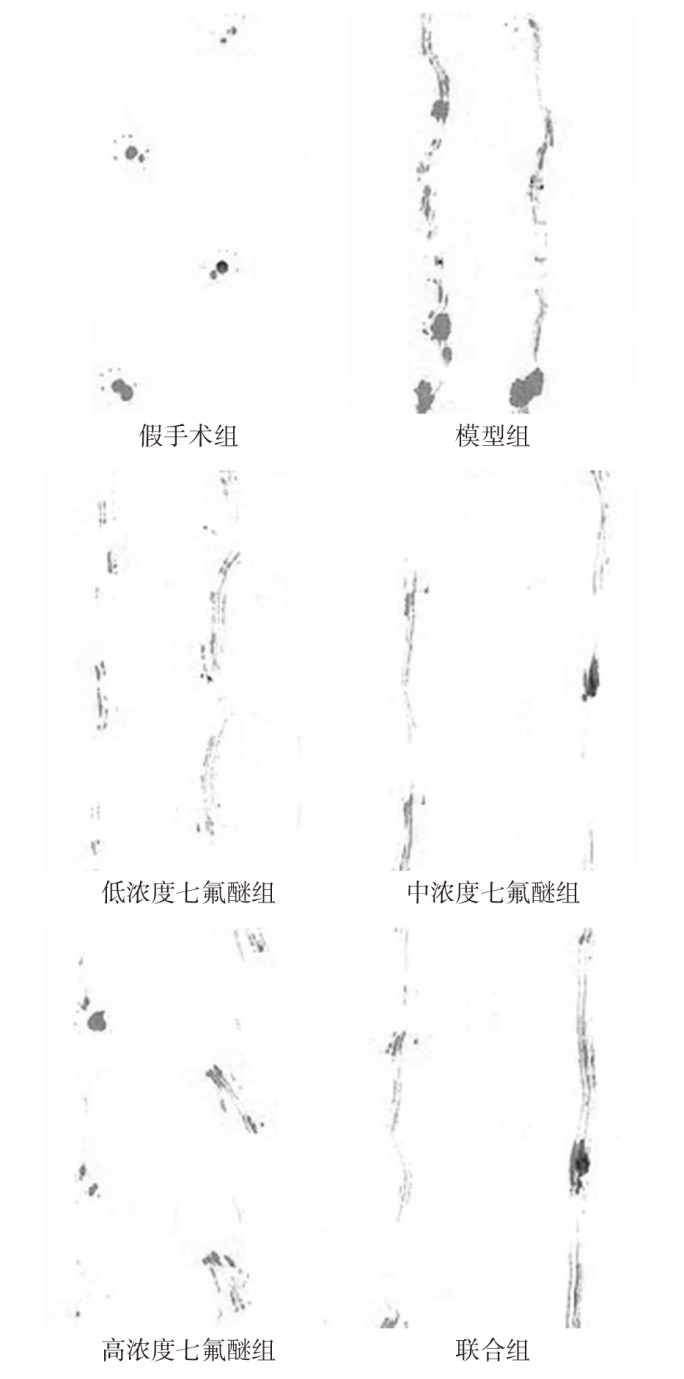
Fig.1 Footprint patterns of rats in each group
| 组别 | IL-18/(ng/L) | TNF-α/(μg/L) | IL-1β/(ng/L) |
|---|---|---|---|
| 假手术组 | 61.28±6.25 | 6.58±0.67 | 101.27±10.35 |
| 模型组 | 151.32±15.27a | 18.32±1.91a | 195.37±20.17a |
| 低浓度七氟醚组 | 121.65±12.33b | 15.47±1.63b | 167.83±17.14b |
| 中浓度七氟醚组 | 104.57±11.57bc | 12.56±1.27bc | 136.42±13.82bc |
| 高浓度七氟醚组 | 85.66±8.72bcd | 9.36±0.95bcd | 119.67±12.17bcd |
| 联合组 | 139.58±14.05e | 16.89±1.72e | 178.69±17.92e |
| F | 49.446** | 61.216** | 32.756** |
Tab.3 Comparison of IL-18, TNF-α and IL-1β levels between the six groups of rats
| 组别 | IL-18/(ng/L) | TNF-α/(μg/L) | IL-1β/(ng/L) |
|---|---|---|---|
| 假手术组 | 61.28±6.25 | 6.58±0.67 | 101.27±10.35 |
| 模型组 | 151.32±15.27a | 18.32±1.91a | 195.37±20.17a |
| 低浓度七氟醚组 | 121.65±12.33b | 15.47±1.63b | 167.83±17.14b |
| 中浓度七氟醚组 | 104.57±11.57bc | 12.56±1.27bc | 136.42±13.82bc |
| 高浓度七氟醚组 | 85.66±8.72bcd | 9.36±0.95bcd | 119.67±12.17bcd |
| 联合组 | 139.58±14.05e | 16.89±1.72e | 178.69±17.92e |
| F | 49.446** | 61.216** | 32.756** |
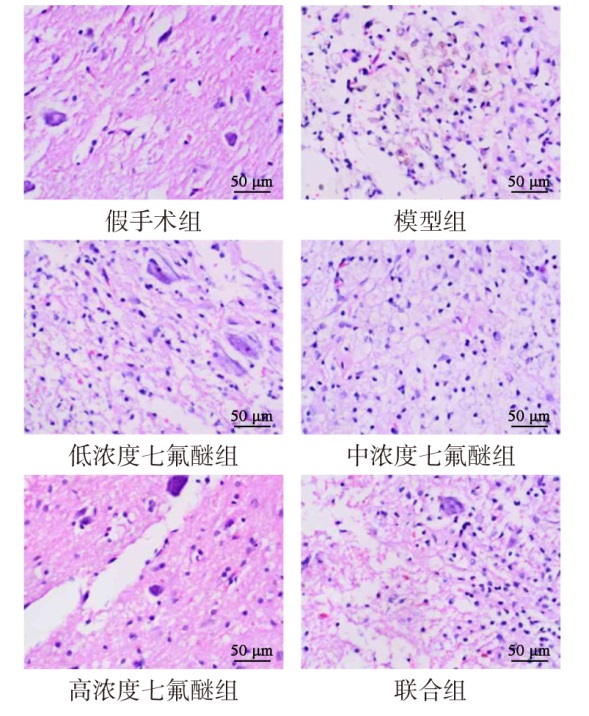
Fig.2 Pathological changes of spinal cord tissue in each group of rats (HE staining, ×200)
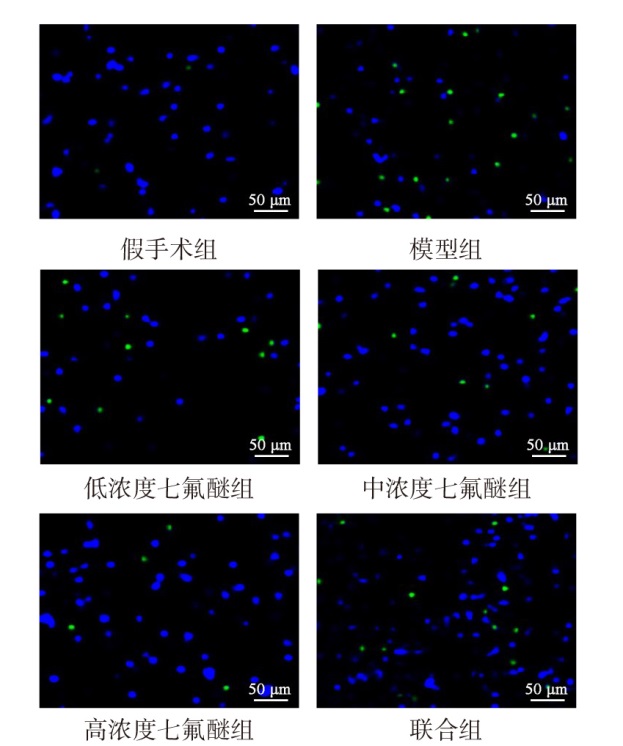
Fig.3 Apoptosis in spinal cord tissue of rats in each group (TUNEL staining, ×200)
| 组别 | 细胞凋亡率/% | TXNIP mRNA | NLRP3 mRNA |
|---|---|---|---|
| 假手术组 | 1.83±0.19 | 0.98±0.11 | 1.02±0.12 |
| 模型组 | 32.17±3.36a | 1.87±0.21a | 2.07±0.23a |
| 低浓度七氟醚组 | 23.36±2.46b | 1.62±0.19b | 1.75±0.19b |
| 中浓度七氟醚组 | 15.28±1.68bc | 1.46±0.16bc | 1.52±0.17bc |
| 高浓度七氟醚组 | 7.66±0.79bcd | 1.21±0.13bcd | 1.25±0.14bcd |
| 联合组 | 25.13±2.63e | 1.73±0.18e | 1.86±0.20e |
| F | 170.013** | 24.007** | 29.021** |
Tab.4 Comparison of cell apoptosis rate and TXNIP, NLRP3 mRNA expression between the six groups of rats
| 组别 | 细胞凋亡率/% | TXNIP mRNA | NLRP3 mRNA |
|---|---|---|---|
| 假手术组 | 1.83±0.19 | 0.98±0.11 | 1.02±0.12 |
| 模型组 | 32.17±3.36a | 1.87±0.21a | 2.07±0.23a |
| 低浓度七氟醚组 | 23.36±2.46b | 1.62±0.19b | 1.75±0.19b |
| 中浓度七氟醚组 | 15.28±1.68bc | 1.46±0.16bc | 1.52±0.17bc |
| 高浓度七氟醚组 | 7.66±0.79bcd | 1.21±0.13bcd | 1.25±0.14bcd |
| 联合组 | 25.13±2.63e | 1.73±0.18e | 1.86±0.20e |
| F | 170.013** | 24.007** | 29.021** |
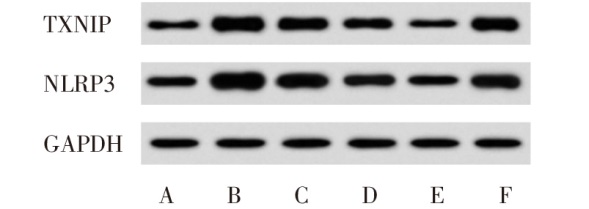
Fig.4 Western blot images of TXNIP and NLRP3 protein expression in spinal cord tissue of rats in each group
| 组别 | ROS活性/(U/mL) | TXNIP/GAPDH | NLRP3/GAPDH |
|---|---|---|---|
| 假手术组 | 142.36±14.63 | 0.86±0.09 | 1.12±0.12 |
| 模型组 | 236.75±24.17a | 2.24±0.23a | 2.69±0.27a |
| 低浓度七氟醚组 | 211.73±22.63b | 1.82±0.19b | 2.35±0.24b |
| 中浓度七氟醚组 | 182.65±18.59bc | 1.39±0.14bc | 1.78±0.18bc |
| 高浓度七氟醚组 | 156.39±16.24bcd | 0.97±0.10bcd | 1.25±0.13bcd |
| 联合组 | 220.58±22.77e | 2.03±0.21e | 2.43±0.25e |
| F | 20.754** | 68.184** | 60.156** |
Tab.5 Comparison of ROS activity and expression levels of TXNIP and NLRP3 proteins in spinal cord tissue between six groups of rats
| 组别 | ROS活性/(U/mL) | TXNIP/GAPDH | NLRP3/GAPDH |
|---|---|---|---|
| 假手术组 | 142.36±14.63 | 0.86±0.09 | 1.12±0.12 |
| 模型组 | 236.75±24.17a | 2.24±0.23a | 2.69±0.27a |
| 低浓度七氟醚组 | 211.73±22.63b | 1.82±0.19b | 2.35±0.24b |
| 中浓度七氟醚组 | 182.65±18.59bc | 1.39±0.14bc | 1.78±0.18bc |
| 高浓度七氟醚组 | 156.39±16.24bcd | 0.97±0.10bcd | 1.25±0.13bcd |
| 联合组 | 220.58±22.77e | 2.03±0.21e | 2.43±0.25e |
| F | 20.754** | 68.184** | 60.156** |
| [1] | 秦晓健, 李子阳, 周鑫, 等. 橄榄苦苷对脊髓损伤大鼠神经细胞凋亡的影响及可能机制[J]. 解剖科学进展, 2024, 30(2):190-192. |
| QIN X J, LI Z Y, ZHOU X, et al. Effect of oleuropein on nerve cell apoptosis in rats with spinal cord injury and its possible mechanism[J]. Progress of Anatomical Sciences, 2024, 30(2):190-192. doi:10.16695/j.cnki.1006-2947.2024.02.021. | |
| [2] | ZHANG H, PIAO M, GUO M, et al. MicroRNA-211-5p attenuates spinal cord injury via targeting of activating transcription factor 6[J]. Tissue Cell, 2021, 68:101459. doi:10.1016/j.tice.2020.101459. |
| [3] | 周孝敏, 鱼丽萍, 李卓伦, 等. 夹脊电针刺激通过PKA/RhoA通路治疗大鼠急性脊髓损伤[J]. 神经解剖学杂志, 2023, 39(3):295-302. |
| ZHOU X M, YU L P, LI Z L, et al. Treatment of acute spinal cord injury in rats with Jiaji electro-acupuncture stimulation via PKA/RhoA pathway[J]. Chin J Neuroanat, 2023, 39(3):295-302. doi:10.16557/j.cnki.1000-7547.2023.03.007. | |
| [4] | LIU X M, XU M, ZHANG H, et al. Effects of electroacpuncture on urodynamics,intramedullary apoptosis and bidirectional regulation of neurotrophic factors in neurogenic bladder rats after supersacral spinal cord injury[J]. World J Acupunct Moxibustion, 2021, 31(2):121-128. |
| [5] | 姜山, 吴超, 马玲. 夹脊穴电针调控TREM2介导的小胶质细胞活化促进脊髓损伤修复的机制研究[J]. 免疫学杂志, 2024, 40(10):761-766. |
| JIANG S, WU C, MA L. Mechanism of electro-acupuncture at jiaji acupoint in regulating TREM2-mediated microglia activation to promote spinal cord injury repair[J]. J Immunol, 2024, 40(10):761-766. doi:10.13431/j.cnki.immunol.j.20240106. | |
| [6] | LI R, HAN J, CHEN B, et al. Homeodomain interacting protein kinase 2-modified rat spinal astrocytes affect neurofunctional recovery after spinal cord injury[J]. Curr Neurovasc Res, 2022, 19(2):171-180. doi:10.2174/1567202619666220601111715. |
| [7] | LIANG T Y, PENG S Y, MA M, et al. Protective effects of sevoflurane in cerebral ischemia reperfusion injury:a narrative review[J]. Med Gas Res, 2021, 11(4):152-154. doi:10.4103/2045-9912.318860. |
| [8] | XU Q, XING H, WU J, et al. miRNA-141 induced pyroptosis in intervertebral disk degeneration by targeting ROS generation and activating TXNIP/NLRP3 signaling in nucleus pulpous cells[J]. Front Cell Dev Biol, 2020, 8:871. doi:10.3389/fcell.2020.00871. |
| [9] | 陈勇, 范军朝, 庞红利, 等. 七氟醚后处理对脑缺血/再灌注损伤大鼠的脑保护作用及对ROS/TXNIP/NLRP3通路的影响[J]. 国际麻醉学与复苏杂志, 2021, 42(1):8-14. |
| CHEN Y, FAN J Z, PANG H L, et al. Protective effect of sevoflurane postconditioning on cerebral ischemia/reperfusion injury in rats and its influence on the ROS/TXNIP/NLRP3 pathway[J]. Int J Anesth Resus, 2021, 42(1):8-14. doi:10.3760/cma.j.cn321761-20200828-00184. | |
| [10] | 杨光, 姚富, 陈永旺, 等. 依托咪酯对脊髓损伤大鼠的脑保护作用及其机制研究[J]. 中国现代医学杂志, 2022, 32(6):32-37. |
| YANG G, YAO F, CHEN Y W, et al. Cerebral protective effect of etomidate in rats with spinal cord injury and its mechanism[J]. Chin J Modern Med, 2022, 32(6):32-37. doi:10.3969/j.issn.1005-8982.2022.06.006. | |
| [11] | 程亮亮, 田毅, 谭义文, 等. 基于PI3K/Akt/mTOR通路探究七氟醚麻醉对大鼠神经细胞凋亡的影响[J]. 西北药学杂志, 2024, 39(2):47-52. |
| CHENG L L, TIAN Y, TAN Y W, et al. Effect of sevoflurane anesthesia on neuronal apoptosis in rats based on PI3K/Akt/mTOR pathway[J]. Northwest Pharm J, 2024, 39(2):47-52. doi:10.3969/j.issn.1004-2407.2024.02.008. | |
| [12] | 田新磊, 朱珊, 赵文锦, 等. 橙皮苷抑制ROS/NLRP3通路改善小鼠急性支气管炎的作用机制研究[J]. 中药新药与临床药理, 2023, 34(4):501-508. |
| TIAN X L, ZHU S, ZHAO W J, et al. Research on the mechanism of hesperidin inhibiting ROS/NLRP3 pathway to improve acute bronchitis in mice[J]. Traditional Chinese Drug Research and Clinical Pharmacology, 2023, 34(4):501-508. doi:10.19378/j.issn.1003-9783.2023.04.010. | |
| [13] | DUAN H Q, WU Q L, YAO X, et al. Nafamostat mesilate attenuates inflammation and apoptosis and promotes locomotor recovery after spinal cord injury[J]. CNS Neurosci Ther, 2018, 24(5):429-438. doi:10.1111/cns.12801. |
| [14] | 黄乔, 李涛, 赵莉莉, 等. 脊髓损伤小鼠通过激活小胶质细胞MyD88通路促进神经元铁死亡[J]. 神经解剖学杂志, 2023, 39(1):71-78. |
| HUANG Q, LI T, ZHAO L L, et al. Activating MyD88 signal pathway in the microglia promotes neuronal ferroptosis after spinal cord injury[J]. Chin J Neur, 2023, 39(1):71-78. doi:10.16557/j.cnki.1000-7547.2023.01.010. | |
| [15] | 史旭, 李瑞语, 张兵, 等. 小胶质细胞极化介导炎症反应在脊髓损伤中的作用[J]. 中国组织工程研究, 2023, 27(1):121-129. |
| SHI X, LI R Y, ZHANG B, et al. Effect of inflammatory reaction mediated by microglia polarization in spinal cord injury[J]. Chin J Tissue Eng Res, 2023, 27(1):121-129. doi:10.12307/2022.731. | |
| [16] | 王领, 赵雪, 王金林. 七氟醚通过p38/MAPK信号通路抑制脂多糖诱导的肺泡巨噬细胞M1型极化[J]. 中国免疫学杂志, 2024, 40(9):1850-1855. |
| WANG L, ZHAO X, WANG J L. Sevoflurane inhibits M1-type polarization of alveolar macrophages induced by lipopolysaccharide through p38/MAPK signaling pathway[J]. Chinese Journal of Immunology, 2024, 40(9):1850-1855. doi:10.3969/j.issn.1000-484X.2024.09.010. | |
| [17] | WANG F, LI C, SHAO J, et al. Sevoflurane induces inflammation of microglia in hippocampus of neonatal rats by inhibiting Wnt/ β-Catenin/CaMKIV pathway[J]. J Pharmacol Sci, 2021, 146(2):105-115. doi:10.1016/j.jphs.2021.02.004. |
| [18] | ZHU Z, MA L. Sevoflurane induces inflammation in primary hippocampal neurons by regulating Hoxa5/Gm5106/miR-27b-3p positive feedback loop[J]. Bioengineered, 2021, 12(2):12215-12226. doi:10.1080/21655979.2021.2005927. |
| [19] | FAN H, TANG H B, CHEN Z, et al. Inhibiting HMGB1-RAGE axis prevents pro-inflammatory macrophages/microglia polarization and affords neuroprotection after spinal cord injury[J]. J Neuroinflammation, 2020, 17(1):295. doi:10.1186/s12974-020-01973-4. |
| [20] | 周雨昕, 马勇, 吴承杰, 等. 基于NLRP3炎症小体途径探究脊髓康促进脊髓损伤大鼠修复的机制[J]. 中华中医药杂志, 2022, 37(9):5385-5389. |
| ZHOU Y X, MA Y, WU C J, et al. Mechanism of Jisui Kang in promoting the repair of spinal cord injury rats based on the NLRP3 inflammasome pathway[J]. CJTCMP, 2022, 37(9):5385-5389. | |
| [21] | 王欣, 束传亮. miR-17-5p调控TXNIP/NLRP3信号通路对牙龈卟啉单胞菌LPS诱导的人牙龈成纤维细胞炎症反应的影响[J]. 中国病原生物学杂志, 2025, 20(4):460-465. |
| WANG X, SHU C L. The effect of miR-17-5p on Porphyromonas gingivalis LPS-induced inflammatory response of human gingival fibroblasts by regulating the TXNIP/NLRP3 signaling pathway[J]. J Path Bio, 2025, 20(4):460-465. doi:10.13350/j.cjpb.250410. | |
| [22] | 朱晶惠, 魏栋敏, 任淑婷, 等. 靶向抑制NLRP3炎性小体在脊髓损伤中的研究进展[J]. 天津医药, 2023, 51(7):781-784. |
| ZHU J H, WEI D M, REN S T, et al. Research progress of targeted inhibition of NLRP3 inflammasome in spinal cord injury[J]. Tianjin Med J, 2023, 51(7):781-784. doi:10.11958/20221718. | |
| [23] | LUO T, ZHOU X, QIN M, et al. Corilagin restrains NLRP3 inflammasome activation and pyroptosis through the ROS/TXNIP/NLRP3 pathway to prevent inflammation[J]. Oxid Med Cell Longev, 2022, 2022:1652244. doi:10.1155/2022/1652244. |
| [24] | LIU Y, WU H, WANG T, et al. Paeonol reduces microbial metabolite α-hydroxyisobutyric acid to alleviate the ROS/TXNIP/NLRP3 pathway-mediated endothelial inflammation in atherosclerosis mice[J]. Chin J Nat Med, 2023, 21(10):759-774. doi:10.1016/S1875-5364(23)60506-0. |
| [25] | ZHAO Q, LIU G, DING Q, et al. The ROS/TXNIP/NLRP3 pathway mediates LPS-induced microglial inflammatory response[J]. Cytokine, 2024, 181(1):156677. doi:10.1016/j.cyto.2024.156677. |
| [1] | LIU Bingyan, HUANG Dongxue, ZHANG Yue, LIU Haiying, XIE Keliang, ZHUANG Shumei, SHEN Yuehao. Effect of hydrogen-rich normal saline on wound repair in rats with stage 3 pressure injury [J]. Tianjin Medical Journal, 2026, 54(8): 802-807. |
| [2] | LIANG Dongge, CAO Huan, ZHANG Ting, HE Qianqian, HUANG Han, TONG Ruifang. Effects of ziyuglycoside I on inflammatory injury in lung tissue of juvenile mice with mycoplasma pneumoniae via regulating the RhoA/ROCK signaling pathway [J]. Tianjin Medical Journal, 2026, 54(8): 808-814. |
| [3] | FU Nannan, LIU Tao, LI Juan, ZHAO Yu. Regulative effect of tripterine on oxidative stress and senescence in hepatocellular carcinoma cells [J]. Tianjin Medical Journal, 2026, 54(7): 681-686. |
| [4] | HE Yu, SUN Yu, ZHANG Yiqiong, XU Yongjie, WANG Shuang, PAN Wei, REN Zhijing. Research on emodin improving high glucose-induced mitophagy impairment in hippocampal neurons [J]. Tianjin Medical Journal, 2026, 54(5): 449-454. |
| [5] | WANG Xueyan, SHANG Gechu, WANG Guan, WANG Huile, ZHANG Qiyang. Comparison of the clinical efficacy between limited craniotomy and standard decompressive craniectomy in the treatment of middle-aged and elderly patients with spontaneous cerebral hemorrhage [J]. Tianjin Medical Journal, 2026, 54(5): 473-477. |
| [6] | ZHANG Jing, WEI Yuying, NING Haihong, WEI Hongmei, WANG Jiawei, CAO Wei, WU Bin. Protective effect and mechanism of dual-specificity phosphatase 9 on myocardial injury in mice with type 2 diabetic cardiomyopathy [J]. Tianjin Medical Journal, 2026, 54(3): 238-244. |
| [7] | KONG Cuiwen, LU Yanshuang, SUN Liping, YU Fenfen. The effect of LncRNA SNHG14 on high glucose induced podocyte injury by targeting miR-30a-5p [J]. Tianjin Medical Journal, 2025, 53(9): 903-909. |
| [8] | LI Shuo, ZHANG Yunpeng, HUANG Yan, CAO Meiran, JIA Lanfang, HU Guicai, HUANG Lan, DUAN Shuzhong. The relationship between the systemic immune-inflammation index and the clinical pathological characteristics of patients with IgA nephropathy [J]. Tianjin Medical Journal, 2025, 53(9): 932-936. |
| [9] | YU Xiaomeng, SUO Rui, DU Xintao, SUO Ying, ASIHAER Ayala, HAO Tianxu, ZHAO Xiaoyun. Effects of human umbilical cord-derived mesenchymal stem cells on chronic intermittent hypoxia in mice [J]. Tianjin Medical Journal, 2025, 53(8): 814-819. |
| [10] | CHEN Hui, ZHAO Kai, LIU Zhenguo, CHANG Ying, JU Kanglu. Study on the mechanism of hypericin improving acute pancreatitis in mice by regulating NLRP3 inflammasome [J]. Tianjin Medical Journal, 2025, 53(8): 820-825. |
| [11] | LI Yingjie, ZHANG Hang, HAO Shaoting, XU Fei, GUO Weichao, SONG Hui, WANG Yanfen. Observation on the therapeutic effect of Sheng Mai San mixed Jiawei Sheng Xian Tang on heart failure with reduced ejection fraction of Qi deficiency blood stasis type [J]. Tianjin Medical Journal, 2025, 53(8): 860-864. |
| [12] | LI Chengcheng, LI Longxiang, YU Liheng. Observation on therapeutic effect of erigeron breviscapus injection combined with atorvastatin calcium in the treatment of acute ischemic stroke [J]. Tianjin Medical Journal, 2025, 53(8): 865-869. |
| [13] | LIU Haiwei, YANG Jie, WANG Li, MENG Shibo, TANG Xusong, LIU Chengren, WANG Yongwang. Luteolin inhibits glioblastoma by regulating ROS levels via the NFE2L2/x-CT/GPX4 signalling axis [J]. Tianjin Medical Journal, 2025, 53(7): 673-678. |
| [14] | DING Yangjuan, XIA Shihai, XU Wei, GAO Qinghong, LIU Taotao. Research progress of oxidative stress and antioxidants in acute pancreatitis [J]. Tianjin Medical Journal, 2025, 53(4): 444-448. |
| [15] | ZHANG Jingjing, XIAO Lili, ZHANG Xinjie. Therapeutic effect of compound kushen injection combined with fentanyl transdermal patch in the treatment of carcinoma pain [J]. Tianjin Medical Journal, 2025, 53(3): 317-320. |
| Viewed | ||||||
|
Full text |
|
|||||
|
Abstract |
|
|||||
