
Tianjin Medical Journal ›› 2025, Vol. 53 ›› Issue (9): 963-966.doi: 10.11958/20250781
• Clinical Research • Previous Articles Next Articles
XU Peilu1( ), QIAO Jianmin1, LI Jing2, LIU Jianrong3, CHEN Shujun1, JI Chunpeng4
Received:2025-03-12
Revised:2025-06-12
Published:2025-09-15
Online:2025-09-16
XU Peilu, QIAO Jianmin, LI Jing, LIU Jianrong, CHEN Shujun, JI Chunpeng. Diagnostic value of epicardial adipose tissue thickness combined with serum ADAM10 and STIM1 for coronary heart disease[J]. Tianjin Medical Journal, 2025, 53(9): 963-966.
CLC Number:
| 组别 | n | 年龄/ 岁 | 性别 (男/女) | BMI/ (kg/m2) | 高血压 | 糖尿病 | 吸烟史 | 酗酒史 | TG/(mmol/L) | TC/(mmol/L) | ||||||||
|---|---|---|---|---|---|---|---|---|---|---|---|---|---|---|---|---|---|---|
| 对照组 | 100 | 58.67±6.11 | 53/47 | 22.65±2.36 | 67(67.00) | 35(35.00) | 31(31.00) | 43(43.00) | 1.52±0.17 | 4.58±0.95 | ||||||||
| 研究组 | 119 | 59.78±6.15 | 64/55 | 22.59±2.37 | 75(63.03) | 46(38.66) | 39(32.77) | 52(43.70) | 2.29±0.25 | 4.67±1.09 | ||||||||
| t或χ2 | 1.336 | 0.013 | 0.187 | 0.377 | 0.312 | 0.079 | 0.011 | 25.254* | 0.641 | |||||||||
| 组别 | LDL-C/ (mmol/L) | HDL-C/ (mmol/L) | 收缩压/ mmHg | 舒张压/ mmHg | CRP/ (mg/L) | 血Cr/(μmol/L) | Fib/ (g/L) | UA/ (μmol/L) | ||||||||||
| 对照组 | 2.75±0.32 | 1.15±0.26 | 136.58±16.35 | 83.95±9.68 | 22.85±3.93 | 65.45±17.33 | 3.19±0.61 | 351.96±65.27 | ||||||||||
| 研究组 | 3.55±0.73 | 1.12±0.23 | 135.47±15.85 | 81.71±9.37 | 23.16±4.01 | 68.54±16.62 | 3.15±0.55 | 358.65±65.33 | ||||||||||
| t或χ2 | 10.746* | 0.656 | 0.509 | 1.733 | 0.575 | 1.344 | 0.507 | 0.754 | ||||||||||
Tab.1 Comparison of general data between the study group and the control group
| 组别 | n | 年龄/ 岁 | 性别 (男/女) | BMI/ (kg/m2) | 高血压 | 糖尿病 | 吸烟史 | 酗酒史 | TG/(mmol/L) | TC/(mmol/L) | ||||||||
|---|---|---|---|---|---|---|---|---|---|---|---|---|---|---|---|---|---|---|
| 对照组 | 100 | 58.67±6.11 | 53/47 | 22.65±2.36 | 67(67.00) | 35(35.00) | 31(31.00) | 43(43.00) | 1.52±0.17 | 4.58±0.95 | ||||||||
| 研究组 | 119 | 59.78±6.15 | 64/55 | 22.59±2.37 | 75(63.03) | 46(38.66) | 39(32.77) | 52(43.70) | 2.29±0.25 | 4.67±1.09 | ||||||||
| t或χ2 | 1.336 | 0.013 | 0.187 | 0.377 | 0.312 | 0.079 | 0.011 | 25.254* | 0.641 | |||||||||
| 组别 | LDL-C/ (mmol/L) | HDL-C/ (mmol/L) | 收缩压/ mmHg | 舒张压/ mmHg | CRP/ (mg/L) | 血Cr/(μmol/L) | Fib/ (g/L) | UA/ (μmol/L) | ||||||||||
| 对照组 | 2.75±0.32 | 1.15±0.26 | 136.58±16.35 | 83.95±9.68 | 22.85±3.93 | 65.45±17.33 | 3.19±0.61 | 351.96±65.27 | ||||||||||
| 研究组 | 3.55±0.73 | 1.12±0.23 | 135.47±15.85 | 81.71±9.37 | 23.16±4.01 | 68.54±16.62 | 3.15±0.55 | 358.65±65.33 | ||||||||||
| t或χ2 | 10.746* | 0.656 | 0.509 | 1.733 | 0.575 | 1.344 | 0.507 | 0.754 | ||||||||||
| 组别 | n | EAT厚度/mm | ADAM10/(ng/L) | STIM1/(ng/L) |
|---|---|---|---|---|
| 对照组 | 100 | 5.67±0.93 | 1 893.42±398.47 | 37.52±7.85 |
| 研究组 | 119 | 6.84±1.25 | 2 327.60±465.73 | 46.14±8.91 |
| t | 7.963* | 7.335* | 7.530* |
Tab.2 Comparison of EAT thickness, serum ADAM102 and STIM1 levels between the study group and the control group
| 组别 | n | EAT厚度/mm | ADAM10/(ng/L) | STIM1/(ng/L) |
|---|---|---|---|---|
| 对照组 | 100 | 5.67±0.93 | 1 893.42±398.47 | 37.52±7.85 |
| 研究组 | 119 | 6.84±1.25 | 2 327.60±465.73 | 46.14±8.91 |
| t | 7.963* | 7.335* | 7.530* |
| 变量 | β | SE | Wald χ2 | P | OR | OR 95%CI |
|---|---|---|---|---|---|---|
| EAT厚度 | 0.618 | 0.239 | 6.695 | 0.010 | 1.856 | 1.162~2.965 |
| ADAM10 | 0.493 | 0.213 | 5.354 | 0.021 | 1.637 | 1.078~2.485 |
| STIM1 | 0.763 | 0.315 | 5.869 | 0.015 | 2.145 | 1.157~3.978 |
| TG | 0.707 | 0.285 | 6.146 | 0.013 | 2.027 | 1.159~3.544 |
| LDL-C | 0.498 | 0.216 | 5.310 | 0.021 | 1.645 | 1.077~2.512 |
| 常数项 | -23.854 | 2.762 | 58.213 | <0.001 | 0.000 |
Tab.3 Multivariate Logistic regression analysis of the related factors affecting the occurrence of CHD
| 变量 | β | SE | Wald χ2 | P | OR | OR 95%CI |
|---|---|---|---|---|---|---|
| EAT厚度 | 0.618 | 0.239 | 6.695 | 0.010 | 1.856 | 1.162~2.965 |
| ADAM10 | 0.493 | 0.213 | 5.354 | 0.021 | 1.637 | 1.078~2.485 |
| STIM1 | 0.763 | 0.315 | 5.869 | 0.015 | 2.145 | 1.157~3.978 |
| TG | 0.707 | 0.285 | 6.146 | 0.013 | 2.027 | 1.159~3.544 |
| LDL-C | 0.498 | 0.216 | 5.310 | 0.021 | 1.645 | 1.077~2.512 |
| 常数项 | -23.854 | 2.762 | 58.213 | <0.001 | 0.000 |
| 变量 | AUC | 95%CI | 截断值 | 敏感度/ % | 特异度/ % | 约登 指数 |
|---|---|---|---|---|---|---|
| EAT厚度 | 0.801 | 0.741~0.851 | 6.50 mm | 57.98 | 89.00 | 0.520 |
| ADAM10 | 0.750 | 0.687~0.806 | 2 174.62 ng/L | 64.71 | 78.00 | 0.427 |
| STIM1 | 0.799 | 0.740~0.850 | 40.68 ng/L | 75.63 | 71.00 | 0.466 |
| 三者联合 | 0.864 | 0.811~0.907 | - | 82.35 | 83.00 | 0.654 |
Tab.4 Diagnostic value of EAT thickness combined with serum ADAM10 and STIM1 levels in CHD
| 变量 | AUC | 95%CI | 截断值 | 敏感度/ % | 特异度/ % | 约登 指数 |
|---|---|---|---|---|---|---|
| EAT厚度 | 0.801 | 0.741~0.851 | 6.50 mm | 57.98 | 89.00 | 0.520 |
| ADAM10 | 0.750 | 0.687~0.806 | 2 174.62 ng/L | 64.71 | 78.00 | 0.427 |
| STIM1 | 0.799 | 0.740~0.850 | 40.68 ng/L | 75.63 | 71.00 | 0.466 |
| 三者联合 | 0.864 | 0.811~0.907 | - | 82.35 | 83.00 | 0.654 |
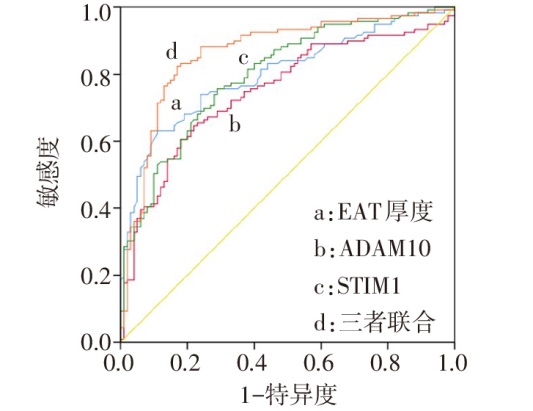
Fig.1 ROC curve of EAT thickness combined with serum ADAM10 and STIM1 levels in diagnosis of CHD
| [1] | ZHANG H, JING L, ZHAI C, et al. Intestinal flora metabolite trimethylamine oxide is inextricably linked to coronary heart disease[J]. J Cardiovasc Pharmacol, 2023, 81(3):175-182. doi:10.1097/FJC.0000000000001387. |
| [2] | ZHU W, LI X. Liquid biopsy in coronary heart disease[J]. Methods Mol Biol, 2023, 2695(1):279-293. doi:10.1007/978-1-0716-3346-5_19. |
| [3] | SARASTE A, KNUUTI J. ESC 2019 guidelines for the diagnosis and management of chronic coronary syndromes:recommendations for cardiovascular imaging[J]. Herz, 2020, 45(5):409-420. doi:10.1007/s00059-020-04935-x. |
| [4] | PARK S S, JUNG J, MINTZ G S, et al. Epicardial adipose tissue thickness is related to plaque composition in coronary artery disease[J]. Diagnostics(Basel), 2022, 12(11):2836. doi:10.3390/diagnostics12112836. |
| [5] | WANG J N, CAO X J. Targeting ADAM10 in renal diseases[J]. Curr Mol Med, 2023, 23(10):1037-1045. doi:10.2174/1566524023666221020142504. |
| [6] | ZHANG Q, HE Y, XU H, et al. Modulation of STIM1 by a risk insertion/deletion polymorphism underlying genetics susceptibility to sudden cardiac death originated from coronary artery disease[J]. Forensic Sci Int, 2021, 328(1):111010. doi:10.1016/j.forsciint.2021.111010. |
| [7] | 中华医学会心血管病学分会, 中华心血管病杂志编辑委员会, 中国医师协会循证专业委员会, 等. 无症状成年人心血管病危险评估中国专家共识[J]. 中华心血管病杂志, 2013, 41(10):820-825. |
| Chinese Society of Cardiology, Editorial Committee of Chinese Journal of Cardiology, Evidence-based Medicine Committee of Chinese Medical Doctor Association, et al. Chinese expert consensus on cardiovascular disease risk assessment inasymptomatic adults[J]. Chin J Cardiol, 2013, 41(10):820-825. doi:10.3760/cma.j.issn.0253-3758.2013.10.003. | |
| [8] | NAVAS-ACIEN A, DOMINGO-RELLOSO A, SUBEDI P, et al. Blood DNA methylation and incident coronary heart disease:evidence from the strong heart study[J]. JAMA Cardiol, 2021, 6(11):1237-1246. doi:10.1001/jamacardio.2021.2704. |
| [9] | XIA Y, BREWER A, BELL J T. DNA methylation signatures of incident coronary heart disease:findings from epigenome-wide association studies[J]. Clin Epigenetics, 2021, 13(1):186. doi:10.1186/s13148-021-01175-6. |
| [10] | KATTA N, LOETHEN T, LAVIE C J, et al. Obesity and coronary heart disease:epidemiology,pathology,and coronary artery imaging[J]. Curr Probl Cardiol, 2021, 46(3):100655. doi:10.1016/j.cpcardiol.2020.100655. |
| [11] | LEO S, TREMOLI E, FERRONI L, et al. Role of epicardial adipose tissue secretome on cardiovascular diseases[J]. Biomedicines, 2023, 11(6):1653. doi:10.3390/biomedicines11061653. |
| [12] | BRAESCU L, STURZA A, ABUREL O M, et al. Assessing the relationship between indexed epicardial adipose tissue thickness,oxidative stress in adipocytes,and coronary artery disease complexity in open-heart surgery patients[J]. Medicina(Kaunas), 2024, 60(1):177. doi:10.3390/medicina60010177. |
| [13] | WANG Q, CHI J, WANG C, et al. Epicardial adipose tissue in patients with coronary artery disease:a meta-analysis[J]. J Cardiovasc Dev Dis, 2022, 9(8):253. doi:10.3390/jcdd9080253. |
| [14] | QIAN C, SUN Y, JIANG J. Diagnostic values of epicardial adipose tissue thickness with right common carotid artery elasticity and intima-media thickness for middle-aged and elderly patients with coronary heart disease[J]. Int J Gen Med, 2021, 14(1):633-639. doi:10.2147/IJGM.S292426. |
| [15] | HARRISON N, KOO C Z, TOMLINSON M G. Regulation of ADAM10 by the tspanc8 family of tetraspanins and their therapeutic potential[J]. Int J Mol Sci, 2021, 22(13):6707. doi:10.3390/ijms22136707. |
| [16] | MAAS S L, DONNERS M M P C, VAN DER VORST E P C. ADAM10 and ADAM17,major regulators of chronic kidney disease induced atherosclerosis[J]. Int J Mol Sci, 2023, 24(8):7309. doi:10.3390/ijms24087309. |
| [17] | 李洪峰, 李敏, 吴亚, 等. 血清MMP9、ADAM10联合对类风湿关节炎患者颈动脉粥样硬化的诊断价值[J]. 标记免疫分析与临床, 2023, 30(8):1393-1397,1430. |
| LI H F, LI M, WU Y, et al. The diagnostic value of serum MMP9 and ADAM10 in patients with rheumatoid arthritis[J]. Lab Immun Clin Med, 2023, 30(8):1393-1397,1430. doi:10.11748/bjmy.issn.1006-1703.2023.08.024. | |
| [18] | 赵茜, 杜思成, 高宇, 等. 血清ADAM10与2型糖尿病、冠状动脉粥样硬化的相关性研究[J]. 医学研究杂志, 2020, 49(12):49-52,56. |
| ZHAO Q, DU S C, GAO Y, et al. Study on the correlation between serum ADAM10 and type 2 diabetes mellitus and coronary atherosclerosis[J]. Journal of Medical Research, 2020, 49(12):49-52,56. doi:10.11969/j.issn.1673-548X.2020.12.013. | |
| [19] | LU T, ZHANG Y, SU Y, et al. Role of store-operated Ca2+ entry in cardiovascular disease[J]. Cell Commun Signal, 2022, 20(1):33. doi:10.1186/s12964-022-00829-z. |
| [20] | BERNA-ERRO A, SANCHEZ-COLLADO J, NIETO-FELIPE J, et al. The Ca2+ sensor stim in human diseases[J]. Biomolecules, 2023, 13(9):1284. doi:10.3390/biom1309128. |
| [21] | MA G, BI S, ZHANG P. Long non-coding RNA MIAT regulates ox-LDL-induced cell proliferation,migration and invasion by miR-641/STIM1 axis in human vascular smooth muscle cells[J]. BMC Cardiovasc Disord, 2021, 2(1):248. doi:10.1186/s12872-021-02048. |
| [22] | 郑荣, 南京柱, 高艳红. UA、TG、LDL-C、Plip对冠心病二级预防降脂治疗患者的危险因素研究[J]. 标记免疫分析与临床, 2021, 28(10):1770-1775. |
| ZHENG R, NAN J Z, GAO Y H. Study on risk factors of UA,TG,LDL-C and Plip in patients with coronary heart disease after secondary prevention and lipid-lowering therapy[J]. Lab Immun Clin Med, 2021, 28(10):1770-1775. doi:10.11748/bjmy.issn.1006-1703.2021.10.029. |
| Viewed | ||||||
|
Full text |
|
|||||
|
Abstract |
|
|||||
