
Tianjin Medical Journal ›› 2026, Vol. 54 ›› Issue (10): 1071-1074.doi: 10.11958/20252826
• Clinical Research • Previous Articles Next Articles
WU Yong1( ), MEI Chengqing1, LIU Shangxiang1, YUAN Ting2,△()
Received:2025-12-20
Revised:2026-05-22
Published:2026-10-15
Online:2026-10-10
Contact:
△E-mail:382204680@qq.com
WU Yong, MEI Chengqing, LIU Shangxiang, YUAN Ting. Predictive value of age-adjusted BIG score for in-hospital mortality in patients with traumatic brain injury[J]. Tianjin Medical Journal, 2026, 54(10): 1071-1074.
CLC Number:
| 组别 | n | 性别(男/女) | 年龄/岁 | 高血压 | 糖尿病 | 冠心病 | 高脂血症 | SBP/mmHg | DBP/mmHg | HR/(次/min) | RR/(次/min) | SpO2/% | ||||||||||||
|---|---|---|---|---|---|---|---|---|---|---|---|---|---|---|---|---|---|---|---|---|---|---|---|---|
| 生存组 | 161 | 99/62 | 64.8±6.7 | 53(32.9) | 52(32.3) | 52(32.3) | 42(26.1) | 129.0±13.6 | 78.1±11.7 | 84.1±10.4 | 18.4±2.7 | 97.1±1.3 | ||||||||||||
| 死亡组 | 48 | 27/21 | 68.1±8.0 | 17(35.4) | 14(29.2) | 7(14.6) | 12(25.0) | 128.3±13.3 | 77.1±10.7 | 82.7±9.4 | 19.7±3.5 | 96.2±1.4 | ||||||||||||
| χ2或t | 0.424 | 2.930** | 0.104 | 0.168 | 0.076 | 0.023 | 0.317 | 0.510 | 0.860 | 2.637** | 4.529** | |||||||||||||
| 组别 | Hb/ (g/L) | WBC/ (×109/L) | PLT/ (×109/L) | FBG/ (mmol/L) | BE/ (mmol/L) | INR | 手术治疗 | 输血 | GCS/ 分 | BIG评分/ 分 | RTS/ 分 | |||||||||||||
| 生存组 | 122.9±13.7 | 7.8±2.1 | 179.5±44.2 | 7.6±0.8 | 0.0(-1.0,2.0) | 1.1±0.2 | 49(30.4) | 83(51.6) | 11.0(8.0,13.0) | 7.0(4.5,9.9) | 11.0(9.0,12.0) | |||||||||||||
| 死亡组 | 125.2±14.2 | 7.5±1.5 | 182.5±39.4 | 8.1±0.8 | 0.0(-1.0,1.8) | 1.2±0.3 | 13(27.1) | 26(54.2) | 7.0(6.0,9.0) | 10.8(9.1,13.0) | 10.0(8.0,11.0) | |||||||||||||
| t或Z | 0.991 | 1.135 | 0.420 | 3.702** | 0.296 | 3.109** | 0.199 | 0.101 | 6.196** | 5.787** | 2.681** | |||||||||||||
Tab.1 Comparison of clinical data between the two groups of patients
| 组别 | n | 性别(男/女) | 年龄/岁 | 高血压 | 糖尿病 | 冠心病 | 高脂血症 | SBP/mmHg | DBP/mmHg | HR/(次/min) | RR/(次/min) | SpO2/% | ||||||||||||
|---|---|---|---|---|---|---|---|---|---|---|---|---|---|---|---|---|---|---|---|---|---|---|---|---|
| 生存组 | 161 | 99/62 | 64.8±6.7 | 53(32.9) | 52(32.3) | 52(32.3) | 42(26.1) | 129.0±13.6 | 78.1±11.7 | 84.1±10.4 | 18.4±2.7 | 97.1±1.3 | ||||||||||||
| 死亡组 | 48 | 27/21 | 68.1±8.0 | 17(35.4) | 14(29.2) | 7(14.6) | 12(25.0) | 128.3±13.3 | 77.1±10.7 | 82.7±9.4 | 19.7±3.5 | 96.2±1.4 | ||||||||||||
| χ2或t | 0.424 | 2.930** | 0.104 | 0.168 | 0.076 | 0.023 | 0.317 | 0.510 | 0.860 | 2.637** | 4.529** | |||||||||||||
| 组别 | Hb/ (g/L) | WBC/ (×109/L) | PLT/ (×109/L) | FBG/ (mmol/L) | BE/ (mmol/L) | INR | 手术治疗 | 输血 | GCS/ 分 | BIG评分/ 分 | RTS/ 分 | |||||||||||||
| 生存组 | 122.9±13.7 | 7.8±2.1 | 179.5±44.2 | 7.6±0.8 | 0.0(-1.0,2.0) | 1.1±0.2 | 49(30.4) | 83(51.6) | 11.0(8.0,13.0) | 7.0(4.5,9.9) | 11.0(9.0,12.0) | |||||||||||||
| 死亡组 | 125.2±14.2 | 7.5±1.5 | 182.5±39.4 | 8.1±0.8 | 0.0(-1.0,1.8) | 1.2±0.3 | 13(27.1) | 26(54.2) | 7.0(6.0,9.0) | 10.8(9.1,13.0) | 10.0(8.0,11.0) | |||||||||||||
| t或Z | 0.991 | 1.135 | 0.420 | 3.702** | 0.296 | 3.109** | 0.199 | 0.101 | 6.196** | 5.787** | 2.681** | |||||||||||||
| 变量 | B | SE | Wald χ2 | P | OR(95%CI) |
|---|---|---|---|---|---|
| 年龄 | 0.069 | 0.028 | 5.896 | 0.015 | 1.072(1.013~1.133) |
| SpO2 | -0.469 | 0.163 | 8.313 | 0.004 | 0.626(0.455~0.861) |
| FBG | 0.466 | 0.213 | 4.767 | 0.029 | 1.593(1.049~2.419) |
| RR | 0.151 | 0.067 | 4.994 | 0.025 | 1.162(1.019~1.327) |
| BIG评分 | 0.246 | 0.056 | 19.349 | <0.001 | 1.279(1.146~1.428) |
| 常数项 | 30.793 | 16.012 | 3.698 | 0.054 | 2.36×10¹³ |
Tab.2 The results of the multivariate Logistic regression analysis of factors of in-hospital mortality in patients with TBI
| 变量 | B | SE | Wald χ2 | P | OR(95%CI) |
|---|---|---|---|---|---|
| 年龄 | 0.069 | 0.028 | 5.896 | 0.015 | 1.072(1.013~1.133) |
| SpO2 | -0.469 | 0.163 | 8.313 | 0.004 | 0.626(0.455~0.861) |
| FBG | 0.466 | 0.213 | 4.767 | 0.029 | 1.593(1.049~2.419) |
| RR | 0.151 | 0.067 | 4.994 | 0.025 | 1.162(1.019~1.327) |
| BIG评分 | 0.246 | 0.056 | 19.349 | <0.001 | 1.279(1.146~1.428) |
| 常数项 | 30.793 | 16.012 | 3.698 | 0.054 | 2.36×10¹³ |
| 指标 | AUC(95%CI) | 截断值/ 分 | 约登 指数 | 敏感度/ % | 特异度/ % |
|---|---|---|---|---|---|
| BIG评分 | 0.775(0.712~0.830) | 7.4 | 0.505 | 95.8 | 54.7 |
| RTS | 0.625(0.533~0.710) | 8.5 | 0.215 | 33.3 | 88.2 |
| aaBIG评分 | 0.810(0.743~0.876) | 29.6 | 0.536 | 72.9 | 80.7 |
Tab.3 ROC analysis results of BIG score,RTS and aaBIG score for predicting in-hospital mortality
| 指标 | AUC(95%CI) | 截断值/ 分 | 约登 指数 | 敏感度/ % | 特异度/ % |
|---|---|---|---|---|---|
| BIG评分 | 0.775(0.712~0.830) | 7.4 | 0.505 | 95.8 | 54.7 |
| RTS | 0.625(0.533~0.710) | 8.5 | 0.215 | 33.3 | 88.2 |
| aaBIG评分 | 0.810(0.743~0.876) | 29.6 | 0.536 | 72.9 | 80.7 |
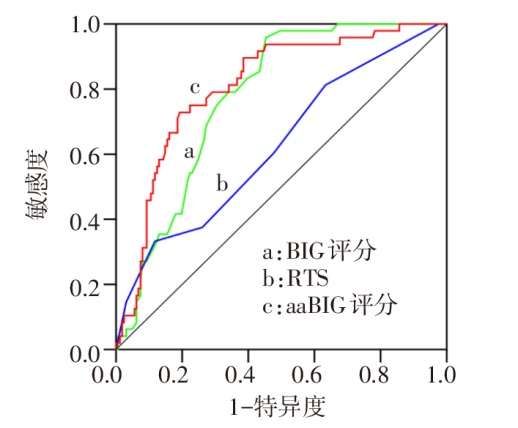
Fig.1 ROC curves for BIG score,RTS and aaBIG score in predicting in-hospital mortality
| [1] | Dewan M C, Rattani A, Gupta S, et al. Estimating the global incidence of traumatic brain injury[J]. J Neurosurg, 2019, 130(4):1080-1097. doi:10.3171/2017.10.JNS17352. |
| [2] | Aguilar-Fuentes V, Orozco-Puga P, Jiménez-Ruiz A. The Glasgow Coma Scale:50-year anniversary[J]. Neurol Sci, 2024, 45(6):2899-2901. doi:10.1007/s10072-024-07432-9. |
| [3] | Karaca B, Emem M K, Çelik B, et al. Evaluation of emergency department admissions of mass casualty patients using the revised trauma score,injury severity score, and trauma and injury severity score[J]. Ulus Travma Acil Cerrahi Derg, 2024, 30(3):192-202. doi:10.14744/tjtes.2024.73531. |
| [4] | Borgman M A, Maegele M, Wade C E, et al. Pediatric trauma BIG score: predicting mortality in children after military and civilian trauma[J]. Pediatrics, 2011, 127(4):e892-e897. doi:10.1542/peds.2010-2439. |
| [5] | Villarreal E G, Patel R D, Farias J S, et al. Predicting inpatient mortality in pediatric traumatic brain injury:insights from a national database[J]. Childs Nerv Syst, 2023, 39(12):3521-3530. doi:10.1007/s00381-023-06010-2. |
| [6] | Bai X, Wang R, Zhang C, et al. The prognostic value of an age-adjusted BIG score in adult patients with traumatic brain injury[J]. Front Neurol, 2023, 14:1272994. doi:10.3389/fneur.2023.1272994. |
| [7] | Maas A, Menon D K, Manley G T, et al. Traumatic brain injury:progress and challenges in prevention, clinical care, and research[J]. Lancet Neurol, 2022, 21(11):1004-1060. doi:10.1016/S1474-4422(22)00309-X. |
| [8] | Zander R. Base excess(BE):reloaded[J]. Eur J Med Res, 2024, 29(1):281. doi:10.1186/s40001-024-01796-6. |
| [9] | Savioli G, Ceresa I F, Macedonio S, et al. Trauma coagulopathy and its outcomes[J]. Medicina(Kaunas), 2020, 56(4):205. doi:10.3390/medicina56040205. |
| [10] | Böhm J K, Güting H, Thorn S, et al. Global characterisation of coagulopathy in isolated traumatic brain injury(iTBI):A CENTER-TBI analysis[J]. Neurocrit Care, 2021, 35(1):184-196. doi:10.1007/s12028-020-01151-7. |
| [11] | Li K, Wu H, Pan F, et al. A machine learning-based model to predict acute traumatic coagulopathy in trauma patients upon emergency hospitalization[J]. Clin Appl Thromb Hemost, 2020, 26:1076029619897827. doi:10.1177/1076029619897827. |
| [12] | Davis A L, Hochstadter E, Daya T, et al. The base deficit,international normalized ratio,and Glasgow Coma Scale(BIG)Score,and functional outcome at hospital discharge in children with traumatic brain injury[J]. Pediatr Crit Care Med, 2019, 20(10):970-979. doi:10.1097/PCC.0000000000002050. |
| [13] | Zoghi S, Ansari A, Azad T D, et al. Early hypocoagulable state in traumatic brain injury patients:incidence,predisposing factors,and outcomes in a retrospective cohort study[J]. Neurosurg Rev, 2024, 47(1):297. doi:10.1007/s10143-024-02523-9. |
| [14] | Takayama W, Endo A, Koguchi H, et al. Age-related differences in the impact of coagulopathy in patients with isolated traumatic brain injury:An observational cohort study[J]. J Trauma Acute Care Surg, 2020, 89(3):523-528. doi:10.1097/TA.0000000000002796. |
| [15] | Yuan Q, Yu J, Wu X, et al. Prognostic value of coagulation tests for in-hospital mortality in patients with traumatic brain injury[J]. Scand J Trauma Resusc Emerg Med, 2018, 26(1):3. doi:10.1186/s13049-017-0471-0. |
| [16] | Solla D, de Amorim R, Kolias A G, et al. Incremental prognostic value of coagulopathy in addition to the CRASH score in traumatic brain injury patients[J]. Neurocrit Care, 2021, 34(1):130-138. doi:10.1007/s12028-020-00991-7. |
| [17] | Manley G T, Maas A I. The Glasgow Coma Scale at 50:looking back and forward[J]. Lancet, 2024, 404(10454):734-735. doi:10.1016/S0140-6736(24)01596-4. |
| [18] | Bodien Y G, Barra A, Temkin N R, et al. Diagnosing level of consciousness:the limits of the glasgow coma scale total score[J]. J Neurotrauma, 2021, 38(23):3295-3305. doi:10.1089/neu.2021.0199. |
| [19] | Cheng W H, Anwer M, Fan J, et al. Age at injury as a modifier of preclinical TBI behavioral,neuropathological, and inflammatory outcomes[J]. Adv Neurobiol, 2024, 42:263-283. doi:10.1007/978-3-031-69832-3_13. |
| [20] | 陈天喜, 姜岱山, 王伶俐, 等. 不同评分方法对急性创伤性脑损伤患者早期死亡风险的预测价值[J]. 中华创伤杂志, 2022, 38(5):407-412. |
| Chen T X, Jiang D S, Wang L L, et al. Predictive value of different scoring systems for early mortality risk in patients with acute traumatic brain injury[J]. Chinese Journal of Trauma, 2022, 38(5):407-412. doi:10.3760/cma.j.cn501098-20211123-00608. | |
| [21] | Jiang D, Chen T, Yuan X, et al. Predictive value of the trauma rating index in age,Glasgow Coma Scale,respiratory rate and systolic blood pressure score(TRIAGES)and revised trauma score (RTS)for the short-term mortality of patients with isolated traumatic brain injury[J]. Am J Emerg Med, 2023, 71:175-181. doi:10.1016/j.ajem.2023.06.030. |
| [22] | Gabbe B J, Cameron P A, Finch C F. Is the revised trauma score still useful?[J]. ANZ J Surg, 2003, 73(11):944-948. doi:10.1046/j.1445-1433.2003.02833.x. |
| [23] | Koepsell H. Glucose transporters in brain in health and disease[J]. Pflugers Arch, 2020, 472(9):1299-1343. doi:10.1007/s00424-020-02441-x. |
| [24] | Gribnau A, van Zuylen M L, Coles J P, et al. Cerebral glucose metabolism following TBI:changes in plasma glucose,glucose transport and alternative pathways of glycolysis-a translational narrative review[J]. Int J Mol Sci, 2024, 25(5):2513. doi:10.3390/ijms25052513. |
| Viewed | ||||||
|
Full text |
|
|||||
|
Abstract |
|
|||||
