
Tianjin Medical Journal ›› 2026, Vol. 54 ›› Issue (8): 790-795.doi: 10.11958/20260416
• Cell and Molecular Biology • Previous Articles Next Articles
MA Yuexiang1( ), FENG Zhanwang2, WANG Qianyu2, PENG Jinwen2, WANG Wenying2, ZHU Zhenhua1, BIN Ji1,△()
Received:2026-02-05
Revised:2026-03-24
Published:2026-08-15
Online:2026-08-07
Contact:
△E-mail: MA Yuexiang, FENG Zhanwang, WANG Qianyu, PENG Jinwen, WANG Wenying, ZHU Zhenhua, BIN Ji. The effects of daphnetin regulating the Src/FAK pathway on the proliferation, migration and epithelial-mesenchymal transition of nasopharyngeal carcinoma cells[J]. Tianjin Medical Journal, 2026, 54(8): 790-795.
CLC Number:
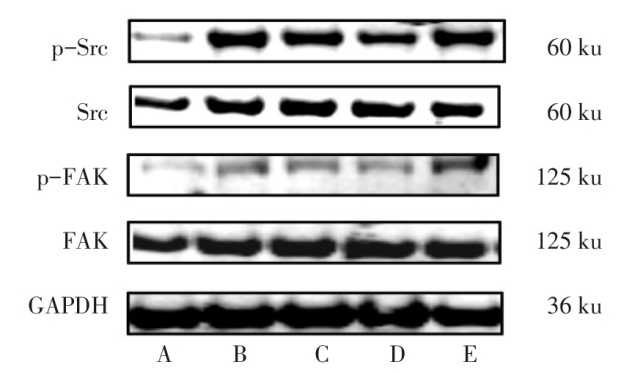
Fig.1 Western blot analysis of p-Src and p-FAK protein expression in various cell lines
| 细胞 | p-Src/Src | p-FAK/FAK |
|---|---|---|
| NP69 | 0.32±0.05 | 0.27±0.04 |
| 5-8F | 0.86±0.09a | 0.82±0.09a |
| HNE1 | 0.74±0.08a | 0.68±0.08ab |
| C666-1 | 0.57±0.07ab | 0.52±0.06ab |
| NPC/HK1 | 0.78±0.09a | 0.70±0.06ab |
| F | 46.080** | 52.356** |
Tab.1 Comparison of p-Src and p-FAK protein expression between various cell lines (n=6,$\bar{x}±s$)
| 细胞 | p-Src/Src | p-FAK/FAK |
|---|---|---|
| NP69 | 0.32±0.05 | 0.27±0.04 |
| 5-8F | 0.86±0.09a | 0.82±0.09a |
| HNE1 | 0.74±0.08a | 0.68±0.08ab |
| C666-1 | 0.57±0.07ab | 0.52±0.06ab |
| NPC/HK1 | 0.78±0.09a | 0.70±0.06ab |
| F | 46.080** | 52.356** |
| 组别 | OD450值 | 集落形成数/个 |
|---|---|---|
| 对照组 | 1.96±0.21 | 152.27±18.39 |
| L-瑞香素组 | 1.64±0.19a | 126.38±15.87a |
| M-瑞香素组 | 1.32±0.15ab | 99.64±11.92ab |
| H-瑞香素组 | 1.01±0.12abc | 74.46±9.84abc |
| H-瑞香素+激活剂组 | 1.89±0.20d | 148.64±17.16d |
| F | 30.330** | 29.310** |
| 组别 | 凋亡率/% | 划痕愈合率/% |
| 对照组 | 2.59±0.34 | 41.28±4.83 |
| L-瑞香素组 | 9.85±1.18a | 33.73±3.96a |
| M-瑞香素组 | 16.57±2.06ab | 26.32±3.21ab |
| H-瑞香素组 | 23.64±2.84abc | 18.95±2.34abc |
| H-瑞香素+激活剂组 | 4.76±0.62d | 39.67±4.65d |
| F | 158.761** | 34.402** |
Tab.2 Comparison of OD450 values, colony-forming numbers, apoptosis rates and scratch healing rates between the five groups of 5-8F cells (n=6,$\bar{x}±s$)
| 组别 | OD450值 | 集落形成数/个 |
|---|---|---|
| 对照组 | 1.96±0.21 | 152.27±18.39 |
| L-瑞香素组 | 1.64±0.19a | 126.38±15.87a |
| M-瑞香素组 | 1.32±0.15ab | 99.64±11.92ab |
| H-瑞香素组 | 1.01±0.12abc | 74.46±9.84abc |
| H-瑞香素+激活剂组 | 1.89±0.20d | 148.64±17.16d |
| F | 30.330** | 29.310** |
| 组别 | 凋亡率/% | 划痕愈合率/% |
| 对照组 | 2.59±0.34 | 41.28±4.83 |
| L-瑞香素组 | 9.85±1.18a | 33.73±3.96a |
| M-瑞香素组 | 16.57±2.06ab | 26.32±3.21ab |
| H-瑞香素组 | 23.64±2.84abc | 18.95±2.34abc |
| H-瑞香素+激活剂组 | 4.76±0.62d | 39.67±4.65d |
| F | 158.761** | 34.402** |

Fig.2 Determination of 5-8F cell colony formation in each group
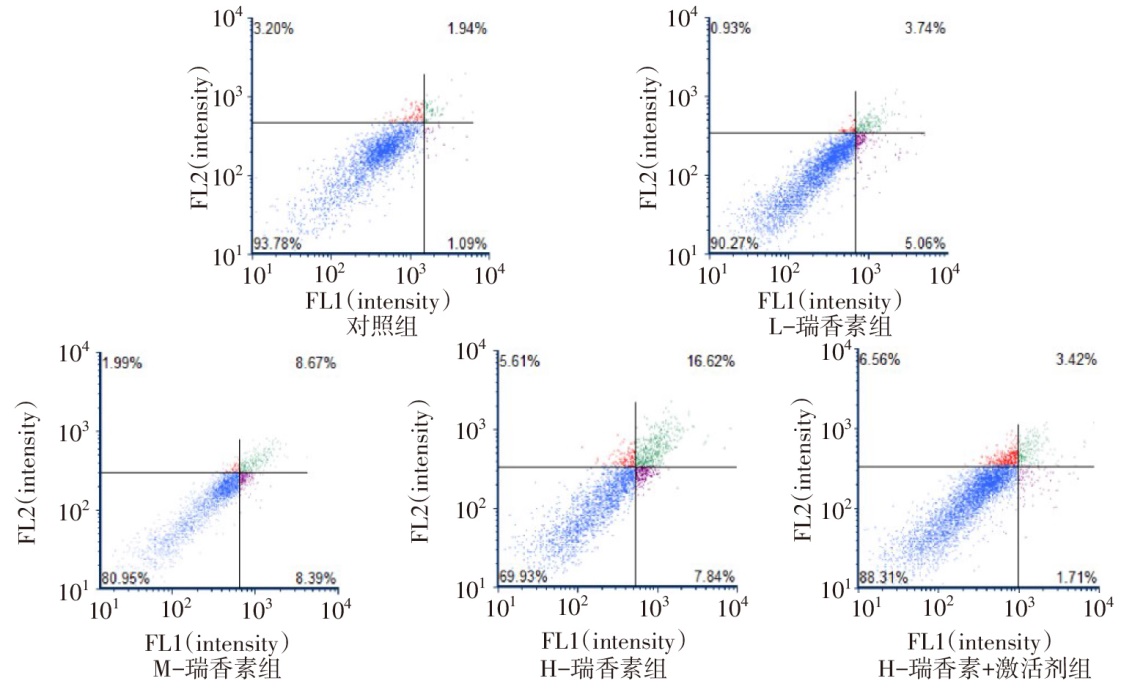
Fig.3 Apoptosis of 5-8F cells in each group
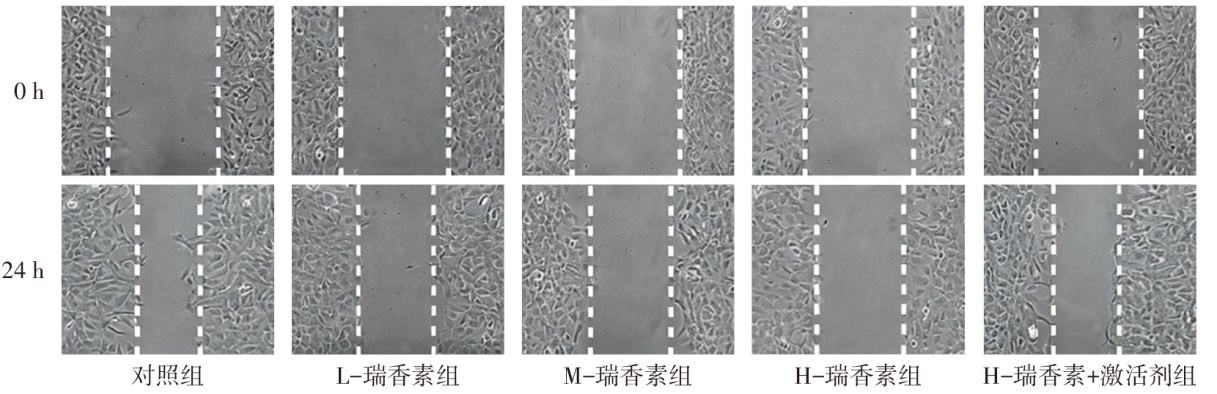
Fig.4 Scratch healing images of 5-8F cells in each group (×100)
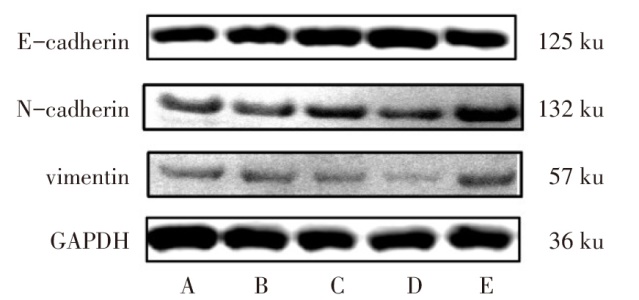
Fig.5 Western blot detection of E-cadherin, N-cadherin and vimentin protein expression in 5-8F cells
| 组别 | E-cadherin | N-cadherin | vimentin |
|---|---|---|---|
| 对照组 | 1.01±0.11 | 1.06±0.11 | 1.07±0.12 |
| L-瑞香素组 | 1.29±0.15a | 0.81±0.09a | 0.83±0.10a |
| M-瑞香素组 | 1.56±0.17ab | 0.56±0.08ab | 0.59±0.07ab |
| H-瑞香素组 | 1.89±0.20abc | 0.31±0.05abc | 0.35±0.05abc |
| H-瑞香素+激活剂组 | 1.09±0.12d | 0.95±0.12d | 0.99±0.13d |
| F | 33.135** | 63.566** | 54.012** |
Tab.3 Comparison of E-cadherin, N-cadherin and vimentin protein expression between five groups of 5-8F cells (n=6,$\bar{x}±s$)
| 组别 | E-cadherin | N-cadherin | vimentin |
|---|---|---|---|
| 对照组 | 1.01±0.11 | 1.06±0.11 | 1.07±0.12 |
| L-瑞香素组 | 1.29±0.15a | 0.81±0.09a | 0.83±0.10a |
| M-瑞香素组 | 1.56±0.17ab | 0.56±0.08ab | 0.59±0.07ab |
| H-瑞香素组 | 1.89±0.20abc | 0.31±0.05abc | 0.35±0.05abc |
| H-瑞香素+激活剂组 | 1.09±0.12d | 0.95±0.12d | 0.99±0.13d |
| F | 33.135** | 63.566** | 54.012** |
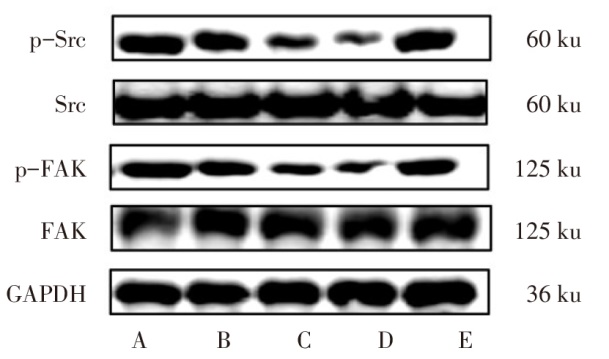
Fig.6 Western blot detection of protein expression of p-Src and p-FAK in 5-8F cells
| 组别 | p-Src/Src | p-FAK/FAK |
|---|---|---|
| 对照组 | 0.86±0.11 | 0.78±0.09 |
| L-瑞香素组 | 0.67±0.09a | 0.59±0.08a |
| M-瑞香素组 | 0.49±0.07ab | 0.41±0.06ab |
| H-瑞香素组 | 0.32±0.04abc | 0.23±0.04abc |
| H-瑞香素+激活剂组 | 0.81±0.10d | 0.74±0.09d |
| F | 41.403** | 57.356** |
Tab.4 Comparison of p-Src and p-FAK protein expression between five groups of 5-8F cells (n=6,$\bar{x}±s$)
| 组别 | p-Src/Src | p-FAK/FAK |
|---|---|---|
| 对照组 | 0.86±0.11 | 0.78±0.09 |
| L-瑞香素组 | 0.67±0.09a | 0.59±0.08a |
| M-瑞香素组 | 0.49±0.07ab | 0.41±0.06ab |
| H-瑞香素组 | 0.32±0.04abc | 0.23±0.04abc |
| H-瑞香素+激活剂组 | 0.81±0.10d | 0.74±0.09d |
| F | 41.403** | 57.356** |
| [1] | Su Z Y, Siak P Y, Lwin Y Y, et al. Epidemiology of nasopharyngeal carcinoma:current insights and future outlook[J]. Cancer Metastasis Rev, 2024, 43(3):919-939. doi:10.1007/s10555-024-10176-9. |
| [2] | Huang H, Yao Y, Deng X, et al. Immunotherapy for nasopharyngeal carcinoma:current status and prospects (review)[J]. Int J Oncol, 2023, 63(2):97. doi:10.3892/ijo.2023.5545. |
| [3] | Wei X, Chen B, Wang Z, et al. Nasopharyngeal cancer risk assessment by country or region worldwide from 1990 to 2019[J]. BMC Public Health, 2024, 24(1):1931. doi:10.1186/s12889-024-19228-9. |
| [4] | Wei Z, Wei N, Su L, et al. The molecular effects underlying the pharmacological activities of daphnetin[J]. Front Pharmacol, 2024, 15:1407010. doi:10.3389/fphar.2024.1407010. |
| [5] | Pei Q, Hu P, Zhang H, et al. Daphnetin exerts an anticancer effect by attenuating the pro-inflammatory cytokines[J]. J Biochem Mol Toxicol, 2021, 35(6):1-8. doi:10.1002/jbt.22759. |
| [6] | Li T, Yang G, Hao Q, et al. Daphnetin ameliorates the expansion of chemically induced hepatocellular carcinoma via reduction of inflammation and oxidative stress[J]. J Oleo Sci, 2022, 71(4):575-585. doi:10.5650/jos.ess21415. |
| [7] | Li J, Zhang Z, Feng X, et al. Stanniocalcin-2 promotes cell EMT and glycolysis via activating ITGB2/FAK/SOX6 signaling pathway in nasopharyngeal carcinoma[J]. Cell Biol Toxicol, 2022, 38(2):259-272. doi:10.1007/s10565-021-09600-5. |
| [8] | Xiao L, Qijin P, Yimei L, et al. In silico analysis and experimental validation to exhibit anti-nasopharyngeal carcinoma effects of plumbagin,an anti-cancer compound[J]. J Sci Food Agric, 2022, 102(12):5460-5467. doi:10.1002/jsfa.11900. |
| [9] | Jie L, Lan H, Wenqing Z, et al. Evodiamine inhibits proliferation and induces apoptosis of nasopharyngeal carcinoma cells via the SRC/ERBB2-mediated MAPK/ERK signaling pathway[J]. J Transl Med, 2024, 22(1):859. doi:10.1186/s12967-024-05656-z. |
| [10] | Lv Z, Du Y, Zhang H, et al. Inhibition of JNK/STAT3/NF-KB pathway-mediated migration and clonal formation of lung adenocarcinoma A549 cells by daphnetin[J]. Cell Adh Migr, 2024, 18(1):27-37. doi:10.1080/19336918.2024.2418049. |
| [11] | 韩江红, 王文翔, 罗欢欢, 等. 淫羊藿苷调控Src/FAK通路影响卵巢癌细胞顺铂耐药性的作用机制[J]. 中药新药与临床药理, 2025, 36(6):852-858. |
| Han J H, Wang W X, Luo H H, et al. Mechanism of icariin regulating Src/FAK pathway affecting cisplatin resistance in ovarian cancer cells[J]. Chinese Journal of New Drugs and Clinical Pharmacology, 2025, 36(6):852-858. doi:10.19378/j.issn.1003-9783.2025.06.002. | |
| [12] | 朱文鹏, 韩梦琦, 王雨欣, 等. 1990—2019年中国鼻咽癌发病与死亡的趋势及预测研究[J]. 中国全科医学, 2023, 26(34):4269-4276. |
| Zhu W P, Han M Q, Wang Y X, et al. Trends and predictions of incidence and mortality of nasopharyngeal carcinoma in China from 1990 to 2019[J]. Chinese General Practice, 2023, 26(34):4269-4276. doi:10.12114/j.issn.1007-9572.2023.0247. | |
| [13] | 黄丽珍, 龙泉先, 李国余, 等. 卡瑞利珠单抗联合卡培他滨用于一线治疗复发转移鼻咽癌患者维持治疗疗效及对患者免疫功能的影响[J]. 现代生物医学进展, 2024, 24(4):724-728. |
| Huang L Z, Long Q X, Li G Y, et al. Effect of carelizumab combined with capecitabine on maintenance therapy efficacy and immune function in first-line treatment of patients with recurrent metastatic nasopharyngeal carcinoma[J]. Advances in Modern Biomedicine, 2024, 24(4):724-728. doi:10.13241/j.cnki.pmb.2024.04.024. | |
| [14] | Deng Q, Wu L, Li Y, et al. Chemoprotective effect of daphnetin in doxorubicin treated esophageal cancer stem cell xenograft tumor mouse[J]. Dokl Biochem Biophys, 2021, 499(1):273-281. doi:10.1134/S1607672921040128. |
| [15] | Liu C, Pan J, Liu H, et al. Daphnetin inhibits the survival of hepatocellular carcinoma cells through regulating Wnt/β-catenin signaling pathway[J]. Drug Dev Res, 2022, 83(4):952-960. doi:10.1002/ddr.21920. |
| [16] | Gong S, Liu H, Wu J, et al. Effects of daphnetin on the mechanism of epithelial-mesenchymal transition induced by HMGB1 in human lung adenocarcinoma cells (A549 cell line)[J]. Biotechnol Genet Eng Rev, 2024, 40(3):1489-1510. doi:10.1080/02648725.2023.2194092. |
| [17] | Fan X, Xie M, Zhao F, et al. Daphnetin triggers ROS-induced cell death and induces cytoprotective autophagy by modulating the AMPK/Akt/mTOR pathway in ovarian cancer[J]. Phytomedicine, 2021, 82:153465. doi:10.1016/j.phymed.2021.153465. |
| [18] | Katoh K. Focal adhesion kinase (FAK) and c-Src dependent signal transduction in cell adhesion[J]. Discov Med, 2024, 36(189):1998-2012. doi:10.24976/Discov.Med.202436189.184. |
| [19] | Raji L, Tetteh A, Amin A R M R. Role of c-Src in carcinogenesis and drug resistance[J]. Cancers (Basel), 2023, 16(1):32. doi:10.3390/cancers16010032. |
| [20] | Huang Y H, Chen H K, Hsu Y F, et al. Src-FAK signaling mediates interleukin 6-induced HCT116 colorectal cancer epithelial-mesenchymal transition[J]. Int J Mol Sci, 2023, 24(7):6650. doi:10.3390/ijms24076650. |
| [21] | Pan R, Yu Y, Zhu H, et al. RSPO2 promotes progression of ovarian cancer through dual receptor-mediated FAK/Src signaling activation[J]. iScience, 2022, 25(10):105184. doi:10.1016/j.isci.2022.105184. |
| Viewed | ||||||
|
Full text |
|
|||||
|
Abstract |
|
|||||
