
Tianjin Medical Journal ›› 2025, Vol. 53 ›› Issue (9): 916-922.doi: 10.11958/20252251
• Experimental Research • Previous Articles Next Articles
LIN Yiwei1( ), WEI Tanjun1,△(), CHEN Fei1, XIAO Cheng1, YUAN Lie2, WANG Yi1
Received:2025-06-13
Revised:2025-07-09
Published:2025-09-15
Online:2025-09-16
Contact:
△E-mail: LIN Yiwei, WEI Tanjun, CHEN Fei, XIAO Cheng, YUAN Lie, WANG Yi. The in vivo and in vitro effects of Eriodictyol on metabolic dysfunction-associated steatotic liver disease by regulating UBA52 expression[J]. Tianjin Medical Journal, 2025, 53(9): 916-922.
CLC Number:
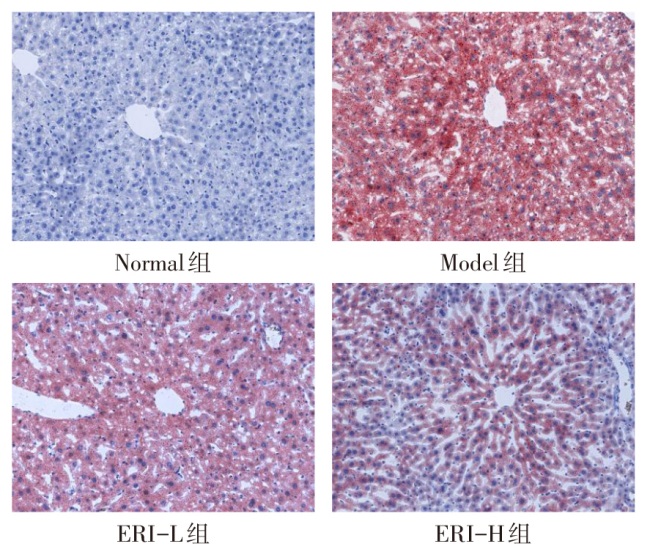
Fig.1 Lipid deposition in mouse liver observed by oil red O staining (×200)
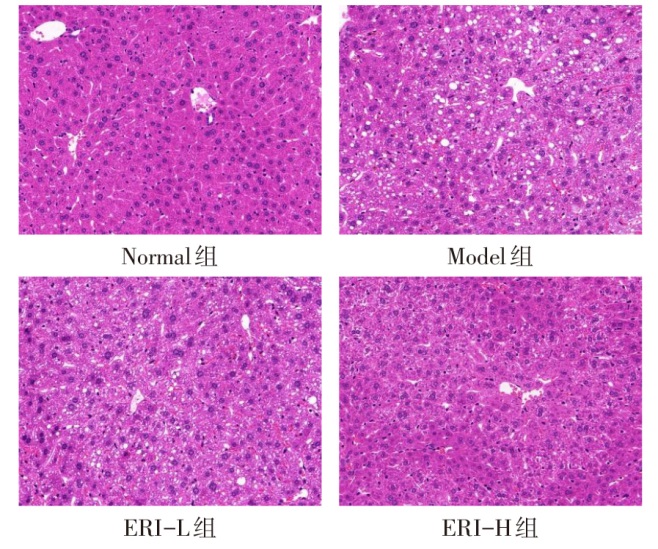
Fig.2 Histopathological changes of liver tissue in mice observed by HE staining (×200)
| 组别 | ALT/(U/L) | AST/(U/L) | ||
|---|---|---|---|---|
| Normal组 | 22.38±2.17 | 104.72±8.82 | ||
| Model组 | 79.58±6.20a | 158.12±12.64a | ||
| ERI-L组 | 60.26±5.54b | 134.49±10.43b | ||
| ERI-H组 | 34.69±3.05bc | 109.28±7.65bc | ||
| F | 380.091** | 72.496** | ||
| 组别 | LDL-C/(mmol/L) | TC/(mmol/L) | TG/(mmol/L) | |
| Normal组 | 0.31±0.03 | 3.04±0.22 | 0.96±0.07 | |
| Model组 | 0.98±0.10a | 6.32±0.56a | 1.72±0.15a | |
| ERI-L组 | 0.73±0.07b | 5.10±0.43b | 1.48±0.15b | |
| ERI-H组 | 0.45±0.05bc | 3.35±0.31bc | 1.10±0.10bc | |
| F | 233.158** | 177.107** | 97.095** | |
Tab.1 Comparison of serum ALT, AST, LDL-C, TC and TG levels between the four group of mice
| 组别 | ALT/(U/L) | AST/(U/L) | ||
|---|---|---|---|---|
| Normal组 | 22.38±2.17 | 104.72±8.82 | ||
| Model组 | 79.58±6.20a | 158.12±12.64a | ||
| ERI-L组 | 60.26±5.54b | 134.49±10.43b | ||
| ERI-H组 | 34.69±3.05bc | 109.28±7.65bc | ||
| F | 380.091** | 72.496** | ||
| 组别 | LDL-C/(mmol/L) | TC/(mmol/L) | TG/(mmol/L) | |
| Normal组 | 0.31±0.03 | 3.04±0.22 | 0.96±0.07 | |
| Model组 | 0.98±0.10a | 6.32±0.56a | 1.72±0.15a | |
| ERI-L组 | 0.73±0.07b | 5.10±0.43b | 1.48±0.15b | |
| ERI-H组 | 0.45±0.05bc | 3.35±0.31bc | 1.10±0.10bc | |
| F | 233.158** | 177.107** | 97.095** | |
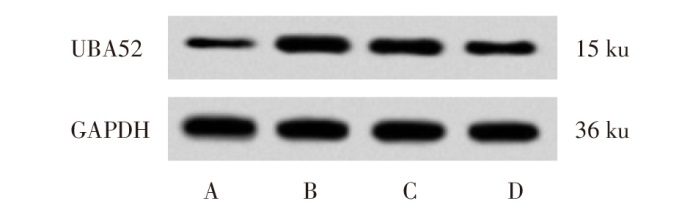
Fig.3 The expression of UBA52 protein in mouse liver tissue detected by Western blot assay
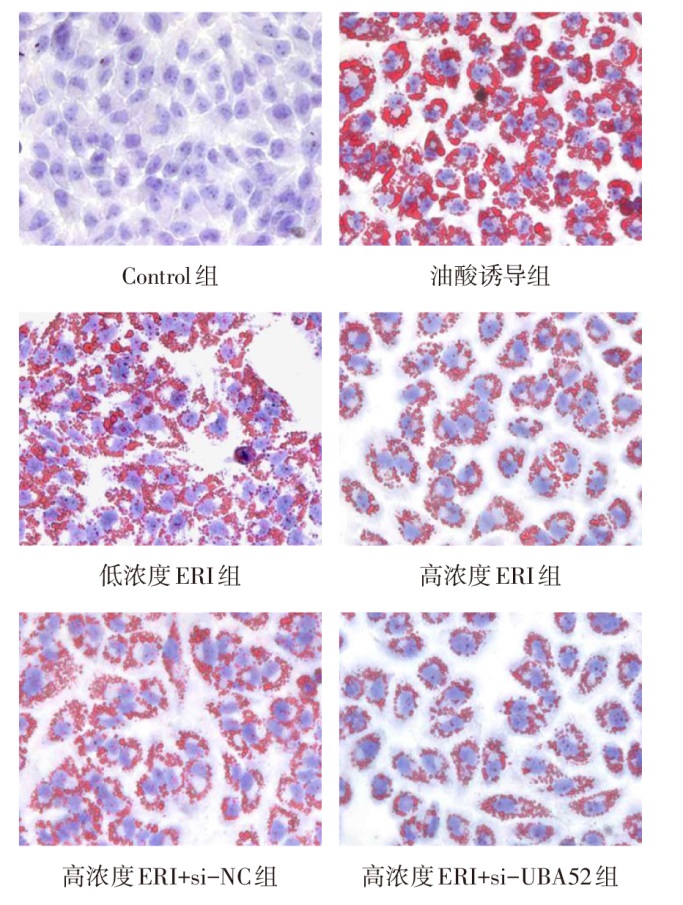
Fig.4 Lipid deposition in HepG2 cells observed by oil red O staining (×400)
| 组别 | TG(mmol/g) | TC(mmol/g) | SOD(U/mg) | MDA(μmol/g) |
|---|---|---|---|---|
| Control组 | 0.12±0.01 | 0.18±0.02 | 52.65±4.27 | 1.02±0.08 |
| 油酸诱导组 | 0.40±0.04a | 0.43±0.04a | 16.15±1.86a | 2.84±0.20a |
| 低浓度ERI组 | 0.29±0.03b | 0.35±0.03b | 27.22±2.36b | 2.38±0.20b |
| 高浓度ERI组 | 0.19±0.01bc | 0.27±0.02bc | 38.49±3.50bc | 1.71±0.17bc |
| 高浓度ERI+ si-NC组 | 0.19±0.02 | 0.26±0.03 | 39.02±3.88 | 1.69±0.17 |
| 高浓度ERI+ si-UBA52组 | 0.13±0.01de | 0.19±0.02de | 50.31±4.75de | 1.24±0.12de |
| F | 128.700** | 72.000** | 89.447** | 107.098** |
Tab.2 Comparison of TG, TC, SOD and MDA levels between six groups of HepG2 cells
| 组别 | TG(mmol/g) | TC(mmol/g) | SOD(U/mg) | MDA(μmol/g) |
|---|---|---|---|---|
| Control组 | 0.12±0.01 | 0.18±0.02 | 52.65±4.27 | 1.02±0.08 |
| 油酸诱导组 | 0.40±0.04a | 0.43±0.04a | 16.15±1.86a | 2.84±0.20a |
| 低浓度ERI组 | 0.29±0.03b | 0.35±0.03b | 27.22±2.36b | 2.38±0.20b |
| 高浓度ERI组 | 0.19±0.01bc | 0.27±0.02bc | 38.49±3.50bc | 1.71±0.17bc |
| 高浓度ERI+ si-NC组 | 0.19±0.02 | 0.26±0.03 | 39.02±3.88 | 1.69±0.17 |
| 高浓度ERI+ si-UBA52组 | 0.13±0.01de | 0.19±0.02de | 50.31±4.75de | 1.24±0.12de |
| F | 128.700** | 72.000** | 89.447** | 107.098** |
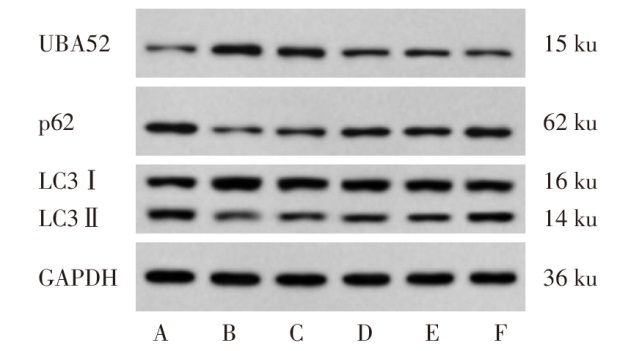
Fig.5 The expression levels of UBA52, p62, LC3Ⅰ and LC3Ⅱ proteins in HepG2 cells detected by Western blot assay
| 组别 | UBA52 | p62 | LC3Ⅱ/LC3Ⅰ |
|---|---|---|---|
| Control组 | 0.20±0.02 | 0.93±0.09 | 0.89±0.09 |
| 油酸诱导组 | 0.86±0.09a | 0.23±0.02a | 0.26±0.03a |
| 低浓度ERI组 | 0.70±0.07b | 0.42±0.04b | 0.46±0.05b |
| 高浓度ERI组 | 0.48±0.05bc | 0.63±0.06bc | 0.68±0.07bc |
| 高浓度ERI+si-NC组 | 0.47±0.05 | 0.62±0.06 | 0.70±0.07 |
| 高浓度ERI+si-UBA52组 | 0.25±0.03de | 0.82±0.08de | 0.86±0.09de |
| F | 120.547** | 99.489** | 71.727** |
Tab.3 Comparison of UBA52, p62, LC3Ⅰ and LC3Ⅱ proteins between six groups of HepG2 cells
| 组别 | UBA52 | p62 | LC3Ⅱ/LC3Ⅰ |
|---|---|---|---|
| Control组 | 0.20±0.02 | 0.93±0.09 | 0.89±0.09 |
| 油酸诱导组 | 0.86±0.09a | 0.23±0.02a | 0.26±0.03a |
| 低浓度ERI组 | 0.70±0.07b | 0.42±0.04b | 0.46±0.05b |
| 高浓度ERI组 | 0.48±0.05bc | 0.63±0.06bc | 0.68±0.07bc |
| 高浓度ERI+si-NC组 | 0.47±0.05 | 0.62±0.06 | 0.70±0.07 |
| 高浓度ERI+si-UBA52组 | 0.25±0.03de | 0.82±0.08de | 0.86±0.09de |
| F | 120.547** | 99.489** | 71.727** |
| [1] | ZEIGERER A. NAFLD-A rising metabolic disease[J]. Mol Metab, 2021, 50:101274. doi:10.1016/j.molmet.2021.101274. |
| [2] | 王莲, 肖继椿, 田垚, 等. 柿叶黄酮通过激活自噬与抗氧化应激协同作用改善NAFLD大鼠肝脏脂肪变性[J]. 天津医药, 2023, 51(11):1211-1216. |
| WANG L, XIAO J C, TIAN Y, et al. Study of persimmon leaf flavonoids ameliorates liver steatosis by activating autophagy and antioxidant stress in NAFLD rats[J]. Tianjin Med J, 2023, 51(11):1211-1216. doi:10.11958/20230145. | |
| [3] | GUO X, YIN X, LIU Z, et al. Non-alcoholic fatty liver disease(NAFLD)pathogenesis and natural products for prevention and treatment[J]. Int J Mol Sci, 2022, 23(24):15489. doi:10.3390/ijms232415489. |
| [4] | 郑少阳, 智慧, 王曼, 等. 酒精性肝病患者外周血sTim-3、sST2水平与疾病严重程度的相关性[J]. 天津医药, 2025, 53(4):383-388. |
| ZHENG S Y, ZHI H, WANG M, et al. Correlation between levels of sTim-3 and sST2 in peripheral blood and disease severity in patients with alcoholic liver disease[J]. Tianjin Med J, 2025, 53(4):383-388. doi:10.11958/20241794. | |
| [5] | ISLAM A, ISLAM M S, RAHMAN M K, et al. The pharmacological and biological roles of eriodictyol[J]. Arch Pharm Res, 2020, 43(6):582-592. doi:10.1007/s12272-020-01243-0. |
| [6] | DENG Z, HASSAN S, RAFIQ M, et al. Pharmacological activity of eriodictyol:the major natural polyphenolic flavanone[J]. Evid Based Complement Alternat Med, 2020, 2020:6681352. doi:10.1155/2020/6681352. |
| [7] | 杨敏, 张锋, 付姣, 等. 圣草酚对高脂饮食诱导的糖尿病大鼠肝损伤的保护作用及机制探讨[J]. 天津中医药大学学报, 2022, 41(3):355-360. |
| YANG M, ZHANG F, FU J, et al. The protective effect and mechanism of eriodictyol on the liver injury in diabetic rats induced by high-fat diet[J]. Journal of Traditional Tianjin University of Traditional Chinese Medicine, 2022, 41(3):355-360. doi:10.11656/j.issn.1673-9043.2022.03.17. | |
| [8] | 王楷扬, 袁烈, 宋燚, 等. 圣草酚调控MAPK和Nrf2/HO-1信号通路缓解非酒精性脂肪肝的作用及机制[J]. 中国药房, 2023, 34(23):2880-2885. |
| WANG K Y, YUAN L, SONG Y, et al. Effect and mechanism of eriodictyol on non-alcoholic fatty liver disease by regulating MAPK and Nrf2/HO-1 signaling pathway[J]. China Pharmacy, 2023, 34(23):2880-2885. doi:10.6039/j.issn.1001-0408.2023.23.11. | |
| [9] | XU X, DONG Y, LIU M, et al. Clinical significance of UbA52 level in the urine of patients with type 2 diabetes mellitus and diabetic kidney disease[J]. Nefrologia(Engl Ed), 2021, 41(5):548-555. doi:10.1016/j.nefroe.2021.11.009. |
| [10] | TONG L, ZHENG X, WANG T, et al. Inhibition of UBA52 induces autophagy via EMC6 to suppress hepatocellular carcinoma tumorigenesis and progression[J]. J Cell Mol Med, 2024, 28(6):e18164. doi:10.1111/jcmm.18164. |
| [11] | 张潘, 汪磊, 陈洁, 等. 刺梨多糖对非酒精性脂肪肝小鼠回肠黏膜屏障功能的影响[J]. 食品科学, 2023, 44(3):127-136. |
| ZHANG P, WANG L, CHEN J, et al. Effects of polysaccharides from rosa roxburghii tratt fruit on ileal mucosal barrier function in mice with non-alcoholic fatty[J]. Liver Food Science, 2023, 44(3):127-136. doi:10.7506/spkx1002-6630-20220301-003. | |
| [12] | FLESSA C M, NASIRI-ANSARI N, KYROU I, et al. Genetic and diet-induced animal models for non-alcoholic fatty liver disease(NAFLD)research[J]. Int J Mol Sci, 2022, 23(24):15791. doi:10.3390/ijms232415791. |
| [13] | RIVES C, FOUGERAT A, ELLERO-SIMATOS S, et al. Oxidative stress in NAFLD:role of nutrients and food contaminants[J]. Biomolecules, 2020, 10(12):1702. doi:10.3390/biom10121702. |
| [14] | JAHN D, KIRCHER S, HERMANNS H M, et al. Animal models of NAFLD from a hepatologist's point of view[J]. Biochim Biophys Acta Mol Basis Dis, 2019, 1865(5):943-953. doi:10.1016/j.bbadis.2018.06.023. |
| [15] | ZHANG N, LIU T, WANG J, et al. Si-Ni-San reduces hepatic lipid deposition in rats with metabolic associated fatty liver disease by AMPK/SIRT1 pathway[J]. Drug Des Devel Ther, 2023, 17:3047-3060. doi:10.2147/DDDT.S417378. |
| [16] | 印国良, 梁鸿艺, 梁朋朋, 等. 薯蓣皂苷元对非酒精性脂肪肝病模型大鼠mTOR/FASN/HIF-1α/VEGFA表达的影响[J]. 中国中药杂志, 2023, 48(7):1760-1769. |
| YIN G L, LIANG H Y, LIANG P P, et al. Effect of diosgenin on mTOR/FASN/HIF-1α/VEGFA expression in rats with non-alcoholic fatty liver disease[J]. China Journal of Chinese Materia Medica, 2023, 48(7):1760-1769. doi:10.19540/j.cnki.cjcmm.20221123.401. | |
| [17] | LI J, WANG T, LIU P, et al. Hesperetin ameliorates hepatic oxidative stress and inflammation via the PI3K/AKT-Nrf2-ARE pathway in oleic acid-induced HepG2 cells and a rat model of high-fat diet-induced NAFLD[J]. Food Funct, 2021, 12(9):3898-3918. doi:10.1039/d0fo02736g. |
| [18] | AN X, LIU J, LI Y, et al. Chemerin/CMKLR1 ameliorates nonalcoholic steatohepatitis by promoting autophagy and alleviating oxidative stress through the JAK2-STAT3 pathway[J]. Peptides, 2021, 135:170422. doi:10.1016/j.peptides.2020.170422. |
| [19] | HE Y, YANG W, GAN L, et al. Silencing HIF-1α aggravates non-alcoholic fatty liver disease in vitro through inhibiting PPAR-α/ANGPTL4 singling pathway[J]. Gastroenterol Hepatol, 2021, 44(5):355-365. doi:10.1016/j.gastrohep.2020.09.014. |
| [20] | 王楷扬. 圣草酚缓解非酒精性脂肪肝的作用及机制研究[D]. 重庆: 陆军军医大学, 2024. |
| WANG K Y. Study on the effect and mechanism of eriodictyol on nonalcoholic fatty liver disease[D]. Chongqing: Army Medical University, 2024. doi:10.27001/d.cnki.gtjyu.2024.000244. | |
| [21] | LEE S O, KELLIHER J L, SONG W, et al. UBA80 and UBA52 fine-tune RNF168-dependent histone ubiquitination and DNA repair[J]. J Biol Chem, 2023, 299(8):105043. doi:10.1016/j.jbc.2023.105043. |
| [22] | ZHOU Q, HOU Z, ZUO S, et al. LUCAT1 promotes colorectal cancer tumorigenesis by targeting the ribosomal protein L40-MDM2-p53 pathway through binding with UBA52[J]. Cancer Sci, 2019, 110(4):1194-1207. doi:10.1111/cas.13951. |
| [23] | 周娟. HSPA8/AUTOPHAGY调节铁死亡在利福平诱发肝细胞损伤中的作用与机制[D]. 长沙: 中南大学, 2024. |
| ZHOU J. Ferroptosis regulated by HSPA8/AUTOPHAGY contributes to the mechanism of rifampicin-induced liver injury[D]. Changsha: Central South University, 2024. doi:10.27661/d.cnki.gzhnu.2022.006449. | |
| [24] | SUN D Y, FU J T, LI G Q, et al. iTRAQ- and LC-MS/MS-based quantitative proteomics reveals Pqlc2 as a potential regulator of hepatic glucose metabolism and insulin signalling pathway during fasting[J]. Clin Exp Pharmacol Physiol, 2021, 48(2):238-249. doi:10.1111/1440-1681.13419. |
| [1] | AMANGULI Sulitang, TIE Ling, MA Jing, MA Li. Wentong Huoxue Cream alleviating diabetic peripheral neuropathy by inhibiting the mTOR/4E-BP1 pathway [J]. Tianjin Medical Journal, 2026, 54(8): 796-801. |
| [2] | LIU Bingyan, HUANG Dongxue, ZHANG Yue, LIU Haiying, XIE Keliang, ZHUANG Shumei, SHEN Yuehao. Effect of hydrogen-rich normal saline on wound repair in rats with stage 3 pressure injury [J]. Tianjin Medical Journal, 2026, 54(8): 802-807. |
| [3] | FU Nannan, LIU Tao, LI Juan, ZHAO Yu. Regulative effect of tripterine on oxidative stress and senescence in hepatocellular carcinoma cells [J]. Tianjin Medical Journal, 2026, 54(7): 681-686. |
| [4] | HE Yu, SUN Yu, ZHANG Yiqiong, XU Yongjie, WANG Shuang, PAN Wei, REN Zhijing. Research on emodin improving high glucose-induced mitophagy impairment in hippocampal neurons [J]. Tianjin Medical Journal, 2026, 54(5): 449-454. |
| [5] | LIU Rong, XIANG Yanzeng, MA Lijuan, ZHANG Peng. The effect of adenovirus-mediated SPRY1 overexpression on apoptosis and autophagy in hepatocellular carcinoma [J]. Tianjin Medical Journal, 2026, 54(4): 337-343. |
| [6] | HUANG Huiqi, WU Qiuyuan, ZHANG Kun, LI Peixian, XIONG Yaming, YE Guolin, ZHOU Dan. Research on the anti-tumor mechanism of toosendanin combined with olaparib in triple negative breast cancer [J]. Tianjin Medical Journal, 2025, 53(9): 897-902. |
| [7] | MA Chunmei, YU Peng, ZHANG Qicheng, YANG Lei, LI Dihua, TAN Jian, MENG Zhaowei. Mechanism study of benzyl isothiocyanate combined with sorafenib in the treatment of anaplastic thyroid cancer [J]. Tianjin Medical Journal, 2025, 53(5): 449-455. |
| [8] | DING Yangjuan, XIA Shihai, XU Wei, GAO Qinghong, LIU Taotao. Research progress of oxidative stress and antioxidants in acute pancreatitis [J]. Tianjin Medical Journal, 2025, 53(4): 444-448. |
| [9] | LI Bingxin, XU Junying, ZHANG Yaru, ZHOU Xiaobing. Effect of Cordyceps sinensis on podocyte damage induced by high glucose by regulating the AMPK/mTOR pathway [J]. Tianjin Medical Journal, 2025, 53(3): 225-229. |
| [10] | WU Bin, YANG Zigeng, ZHANG Jing, LI Shuhong, YU Feng, WANG Jiawei, LI Cailing. Effect of naringenin on right ventricular remodeling induced by hypoxic pulmonary hypertension [J]. Tianjin Medical Journal, 2025, 53(2): 129-134. |
| [11] | Hudagula , MA Zhenhua, LU Yan, DUAN Chunlan, LI Kai. The effect of perindopril on the NOX4/NLRP3 signaling pathway in TAA-induced liver fibrosis in rats [J]. Tianjin Medical Journal, 2025, 53(10): 1027-1032. |
| [12] | FANG Jie, HUANG Rui, ZHENG Honghui, JIA Qianqian, BAO Jing. miR-9-5p-induced autophagy and apoptosis in multiple myeloma cells by targeting TIMP2 [J]. Tianjin Medical Journal, 2024, 52(8): 785-790. |
| [13] | LI Daqiang, LI Jian, LU Zheming, CAO Yang. Effects of calycosin on neuronal autophagy and apoptosis in rats with spinal cord injury [J]. Tianjin Medical Journal, 2024, 52(8): 798-803. |
| [14] | WANG Xinshuang, AN Yajuan, GUAN Xiuju, LI Jiao, LIU Yue, WEI Liping, QI Xin. Study of magnesium isoglycyrrhizinate in ameliorating cisplatin induced myocardial injury in rats [J]. Tianjin Medical Journal, 2024, 52(8): 809-814. |
| [15] | WU Bo, ZHU Zhuonong, ZHENG Lijuan, CHEN Junru. Effects of matrine on inflammation, oxidative stress and wound healing in atopic dermatitis [J]. Tianjin Medical Journal, 2024, 52(6): 566-571. |
| Viewed | ||||||
|
Full text |
|
|||||
|
Abstract |
|
|||||
