
Tianjin Medical Journal ›› 2026, Vol. 54 ›› Issue (8): 808-814.doi: 10.11958/20260535
• Experimental Research • Previous Articles Next Articles
LIANG Dongge( ), CAO Huan, ZHANG Ting, HE Qianqian, HUANG Han, TONG Ruifang△()
Received:2026-03-05
Revised:2026-04-07
Published:2026-08-15
Online:2026-08-07
Contact:
△E-mail: LIANG Dongge, CAO Huan, ZHANG Ting, HE Qianqian, HUANG Han, TONG Ruifang. Effects of ziyuglycoside I on inflammatory injury in lung tissue of juvenile mice with mycoplasma pneumoniae via regulating the RhoA/ROCK signaling pathway[J]. Tianjin Medical Journal, 2026, 54(8): 808-814.
CLC Number:
| 组别 | 咳嗽潜伏期/s | 咳嗽次数/次 |
|---|---|---|
| 对照组 | 88.67±7.04 | 14.23±0.95 |
| MP组 | 34.46±2.09a | 53.68±3.18a |
| 地榆皂苷Ⅰ小剂量组 | 45.73±4.06b | 44.76±4.09b |
| 地榆皂苷Ⅰ大剂量组 | 73.65±5.21bc | 25.66±2.28bc |
| 阿奇霉素组 | 74.22±6.08bc | 27.15±3.07bc |
| 地榆皂苷Ⅰ大剂量+溶血磷脂酸组 | 61.22±4.05d | 35.26±4.03d |
| F | 192.200** | 248.200** |
Tab.1 Comparison of cough latency and cough frequency between different groups of mice (n=12,$\bar{x}±s$)
| 组别 | 咳嗽潜伏期/s | 咳嗽次数/次 |
|---|---|---|
| 对照组 | 88.67±7.04 | 14.23±0.95 |
| MP组 | 34.46±2.09a | 53.68±3.18a |
| 地榆皂苷Ⅰ小剂量组 | 45.73±4.06b | 44.76±4.09b |
| 地榆皂苷Ⅰ大剂量组 | 73.65±5.21bc | 25.66±2.28bc |
| 阿奇霉素组 | 74.22±6.08bc | 27.15±3.07bc |
| 地榆皂苷Ⅰ大剂量+溶血磷脂酸组 | 61.22±4.05d | 35.26±4.03d |
| F | 192.200** | 248.200** |
| 组别 | 二氧化碳分压/ mmHg | 动脉血氧分压/ mmHg | 肺指数/ % |
|---|---|---|---|
| 对照组 | 40.67±3.01 | 105.23±6.93 | 0.43±0.05 |
| MP组 | 98.85±6.12a | 51.67±3.28a | 1.05±0.12a |
| 地榆皂苷Ⅰ小剂量组 | 81.73±5.03b | 63.78±5.02b | 0.89±0.09b |
| 地榆皂苷Ⅰ大剂量组 | 54.67±3.41bc | 97.64±6.26bc | 0.61±0.07bc |
| 阿奇霉素组 | 55.21±3.52bc | 98.22±6.08bc | 0.63±0.08bc |
| 地榆皂苷Ⅰ大剂量+ 溶血磷脂酸组 | 68.27±4.51d | 81.61±5.02d | 0.73±0.09d |
| F | 274.700** | 178.200** | 78.530** |
Tab.2 Comparison of carbon dioxide partial pressure,arterial blood oxygen partial pressure and lung index between different groups of mice (n=12,$\bar{x}±s$)
| 组别 | 二氧化碳分压/ mmHg | 动脉血氧分压/ mmHg | 肺指数/ % |
|---|---|---|---|
| 对照组 | 40.67±3.01 | 105.23±6.93 | 0.43±0.05 |
| MP组 | 98.85±6.12a | 51.67±3.28a | 1.05±0.12a |
| 地榆皂苷Ⅰ小剂量组 | 81.73±5.03b | 63.78±5.02b | 0.89±0.09b |
| 地榆皂苷Ⅰ大剂量组 | 54.67±3.41bc | 97.64±6.26bc | 0.61±0.07bc |
| 阿奇霉素组 | 55.21±3.52bc | 98.22±6.08bc | 0.63±0.08bc |
| 地榆皂苷Ⅰ大剂量+ 溶血磷脂酸组 | 68.27±4.51d | 81.61±5.02d | 0.73±0.09d |
| F | 274.700** | 178.200** | 78.530** |
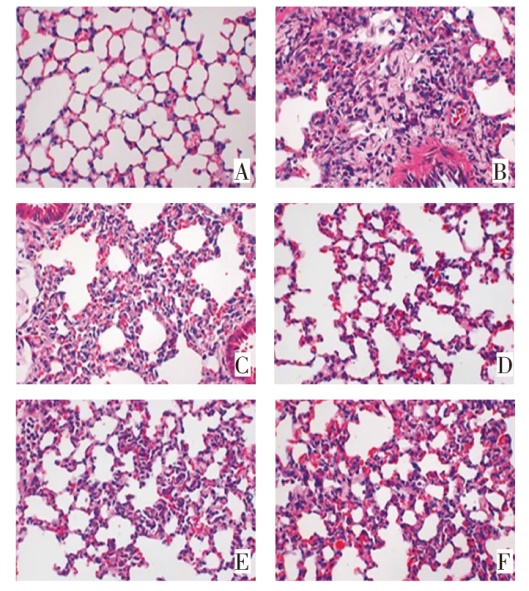
Fig.1 HE staining result of lung tissue in each group (×200)
| 组别 | CXCL1 | IL-1β |
|---|---|---|
| 对照组 | 20.68±1.57 | 17.23±1.09 |
| MP组 | 196.88±14.13a | 145.67±9.02a |
| 地榆皂苷Ⅰ小剂量组 | 161.72±10.06b | 118.73±7.15b |
| 地榆皂苷Ⅰ大剂量组 | 76.62±5.47bc | 42.69±3.27bc |
| 阿奇霉素组 | 71.21±5.09bc | 40.28±3.11bc |
| 地榆皂苷Ⅰ大剂量+溶血磷脂酸组 | 131.26±10.55d | 79.67±5.08d |
| F | 325.500** | 500.800** |
| 组别 | TNF-α | IL-10 |
| 对照组 | 40.47±3.05 | 97.45±5.17 |
| MP组 | 234.06±15.12a | 21.22±1.45a |
| 地榆皂苷Ⅰ小剂量组 | 200.84±11.07b | 36.19±2.71b |
| 地榆皂苷Ⅰ大剂量组 | 98.65±5.04bc | 80.64±5.11bc |
| 阿奇霉素组 | 95.77±5.08bc | 81.23±5.09bc |
| 地榆皂苷Ⅰ大剂量+溶血磷脂酸组 | 143.74±12.04d | 55.75±3.01d |
| F | 336.500** | 321.500** |
Tab.3 Comparison of CXCL1,IL-1β,TNF-α and IL-10 levels in lung tissue between different groups of mice (n=6,ng/L,$\bar{x}±s$)
| 组别 | CXCL1 | IL-1β |
|---|---|---|
| 对照组 | 20.68±1.57 | 17.23±1.09 |
| MP组 | 196.88±14.13a | 145.67±9.02a |
| 地榆皂苷Ⅰ小剂量组 | 161.72±10.06b | 118.73±7.15b |
| 地榆皂苷Ⅰ大剂量组 | 76.62±5.47bc | 42.69±3.27bc |
| 阿奇霉素组 | 71.21±5.09bc | 40.28±3.11bc |
| 地榆皂苷Ⅰ大剂量+溶血磷脂酸组 | 131.26±10.55d | 79.67±5.08d |
| F | 325.500** | 500.800** |
| 组别 | TNF-α | IL-10 |
| 对照组 | 40.47±3.05 | 97.45±5.17 |
| MP组 | 234.06±15.12a | 21.22±1.45a |
| 地榆皂苷Ⅰ小剂量组 | 200.84±11.07b | 36.19±2.71b |
| 地榆皂苷Ⅰ大剂量组 | 98.65±5.04bc | 80.64±5.11bc |
| 阿奇霉素组 | 95.77±5.08bc | 81.23±5.09bc |
| 地榆皂苷Ⅰ大剂量+溶血磷脂酸组 | 143.74±12.04d | 55.75±3.01d |
| F | 336.500** | 321.500** |
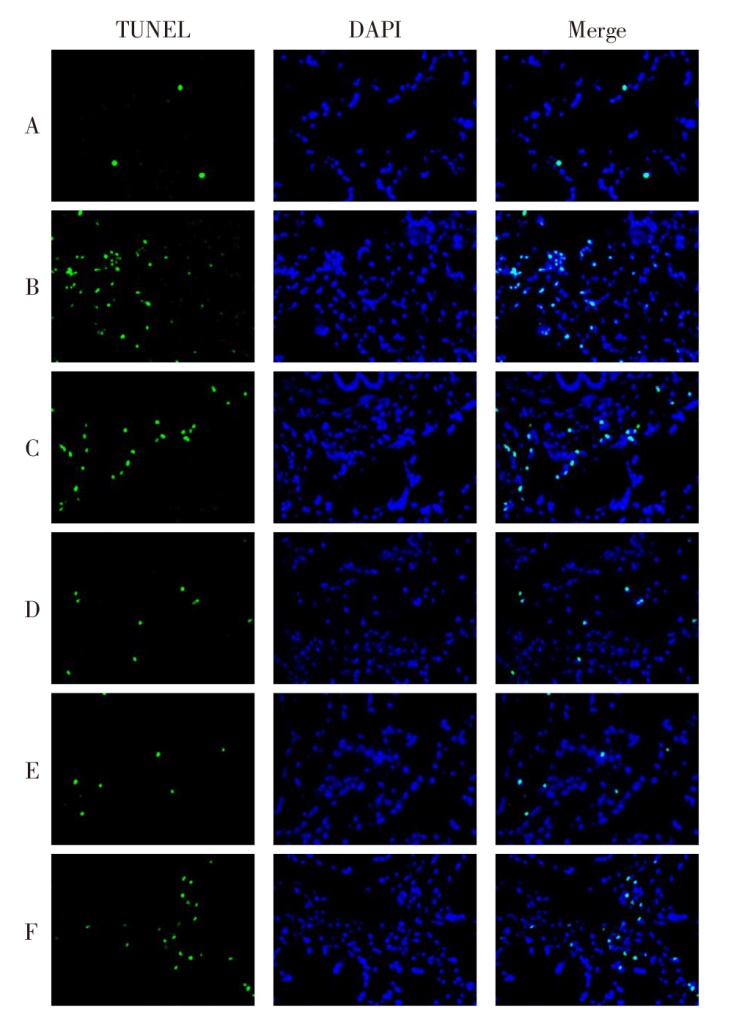
Fig.2 Detection of apoptosis in lung tissue by TUNEL staining (×200)
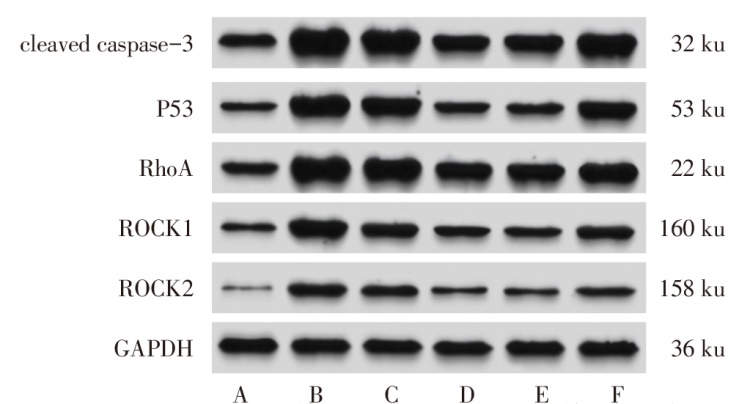
Fig.3 Western blot analysis of cleaved caspase-3,P53,RhoA,ROCK1 and ROCK2 proteins in lung tissue
| 组别 | cleaved caspase-3 | P53 | |||
|---|---|---|---|---|---|
| 对照组 | 0.69±0.09 | 0.37±0.05 | |||
| MP组 | 2.88±0.26a | 1.76±0.21a | |||
| 地榆皂苷Ⅰ小剂量组 | 2.41±0.24b | 1.43±0.18b | |||
| 地榆皂苷Ⅰ大剂量组 | 1.16±0.22bc | 0.69±0.08bc | |||
| 阿奇霉素组 | 1.19±0.25bc | 0.71±0.09bc | |||
| 地榆皂苷Ⅰ大剂量+ 溶血磷脂酸组 | 1.75±0.18d | 1.23±0.19d | |||
| F | 90.280** | 77.030** | |||
| 组别 | RhoA | ROCK1 | ROCK2 | ||
| 对照组 | 0.87±0.09 | 0.34±0.06 | 0.12±0.03 | ||
| MP组 | 2.57±0.24a | 1.27±0.13a | 0.88±0.10a | ||
| 地榆皂苷Ⅰ小剂量组 | 2.08±0.21b | 1.01±0.16b | 0.69±0.07b | ||
| 地榆皂苷Ⅰ大剂量组 | 1.26±0.19bc | 0.61±0.08bc | 0.28±0.04bc | ||
| 阿奇霉素组 | 1.28±0.20bc | 0.63±0.08bc | 0.26±0.03bc | ||
| 地榆皂苷Ⅰ大剂量+ 溶血磷脂酸组 | 1.65±0.17d | 0.94±0.10d | 0.45±0.06d | ||
| F | 64.450** | 58.640** | 136.900** | ||
Tab.4 Comparison of cleaved caspase-3,P53,RhoA,ROCK1 and ROCK2 proteins in lung tissue between six groups (n=6,$\bar{x}±s$)
| 组别 | cleaved caspase-3 | P53 | |||
|---|---|---|---|---|---|
| 对照组 | 0.69±0.09 | 0.37±0.05 | |||
| MP组 | 2.88±0.26a | 1.76±0.21a | |||
| 地榆皂苷Ⅰ小剂量组 | 2.41±0.24b | 1.43±0.18b | |||
| 地榆皂苷Ⅰ大剂量组 | 1.16±0.22bc | 0.69±0.08bc | |||
| 阿奇霉素组 | 1.19±0.25bc | 0.71±0.09bc | |||
| 地榆皂苷Ⅰ大剂量+ 溶血磷脂酸组 | 1.75±0.18d | 1.23±0.19d | |||
| F | 90.280** | 77.030** | |||
| 组别 | RhoA | ROCK1 | ROCK2 | ||
| 对照组 | 0.87±0.09 | 0.34±0.06 | 0.12±0.03 | ||
| MP组 | 2.57±0.24a | 1.27±0.13a | 0.88±0.10a | ||
| 地榆皂苷Ⅰ小剂量组 | 2.08±0.21b | 1.01±0.16b | 0.69±0.07b | ||
| 地榆皂苷Ⅰ大剂量组 | 1.26±0.19bc | 0.61±0.08bc | 0.28±0.04bc | ||
| 阿奇霉素组 | 1.28±0.20bc | 0.63±0.08bc | 0.26±0.03bc | ||
| 地榆皂苷Ⅰ大剂量+ 溶血磷脂酸组 | 1.65±0.17d | 0.94±0.10d | 0.45±0.06d | ||
| F | 64.450** | 58.640** | 136.900** | ||
| [1] | He J, Tian W, Feng P, et al. Nasal delivery of Lacticaseibacillus rhamnosus GG modulates respiratory immune responses and attenuates Mycoplasma pneumoniae pneumonia in a murine model[J]. Microbiol Spectr, 2026, 14(1):e00771-e00725. doi:10.1128/spectrum.00771-25. |
| [2] | Zhou Y, Su X, Wang C, et al. Toosendanin attenuates Mycoplasma pneumonia induced pneumonia (MPP) in mice via inhibiting NF-κb-mediated inflammatory response:in vivo and silico studies[J]. Dose Response, 2025, 23(3):15593258251367619. doi:10.1177/15593258251367619. |
| [3] | Kim K, Jung S, Kim M, et al. Global trends in the proportion of macrolide-resistant Mycoplasma pneumoniae infections:a systematic review and meta-analysis[J]. JAMA Netw Open, 2022, 5(7):e2220949. doi:10.1001/jamanetworkopen.2022.20949. |
| [4] | Song Z, Han C, Luo G, et al. Yinqin Qingfei granules alleviate Mycoplasma pneumoniae pneumonia via inhibiting NLRP3 inflammasome-mediated macrophage pyroptosis[J]. Front Pharmacol, 2024, 15:1437475. doi:10.3389/fphar.2024.1437475. |
| [5] | Hossen F, Geng X, Sun G Y, et al. Oligomeric amyloid-β and tau alter cell adhesion properties and induce inflammatory responses in cerebral endothelial cells through the RhoA/ROCK pathway[J]. Mol Neurobiol, 2024, 61(11):8759-8776. doi:10.1007/s12035-024-04138-z. |
| [6] | 严娅芬, 陆光兵, 田良东, 等. 橄榄苦苷调节RhoA/ROCK信号通路对肺炎链球菌感染导致的肺泡上皮细胞损伤的影响[J]. 中国细胞生物学学报, 2024, 46(9):1663-1671. |
| Yan Y F, Lu G B, Tian L D, et al. Effect of oleuropein on alveolar epithelial cell injury induced by streptococcus pneumoniae infection by regulating the RhoA/ROCK signaling pathway[J]. Chinese Journal of Cell Biology, 2024, 46(9):1663-1671. doi:10.11844/cjcb.2024.09.0006. | |
| [7] | 包代琴, 刘奕言, 张紫森, 等. 地榆皂苷Ⅰ对脓毒症大鼠急性肺损伤的保护作用及机制研究[J]. 中国药房, 2023, 34(5):537-543. |
| Bao D Q, Liu Y Y, Zhang Z S, et al. Study on protective effects and mechanism of ziyuglycoside Ⅰ on acute lung injury in sepsis rats[J]. China Pharmacy, 2023, 34(5):537-543. doi:10.6039/j.issn.1001-0408.2023.05.05. | |
| [8] | 林杉, 王云, 刘哲, 等. 圣草酚调节IL-6/STAT3信号通路对支原体肺炎幼鼠肺组织的保护作用[J]. 中国细胞生物学学报, 2025, 47(8):1992-2000. |
| Lin S, Wang Y, Liu Z, et al. The protective effect of eriodictyol on lung tissue of young mice with mycoplasma pneumonia by regulating IL-6/STAT3 signaling pathway[J]. Chinese Journal of Cell Biology, 2025, 47(8):1992-2000. doi:10.11844/cjcb.2025.08.0022. | |
| [9] | 马鸿菲, 唐静, 尹俪桥, 等. 发酵桔梗调控EGFR/MAPK/ERK信号通路修复支原体肺炎肺损伤[J]. 中药药理与临床, 2026, 42(2):90-97. |
| Ma H F, Tang J, Yin L Q, et al. Fermented jiegeng regulates EGFR/MAPK/ERK signaling pathway to repair lung injury causedby mycoplasmal pneumonia[J]. Pharmacology and Clinics of Chinese Materia Medica, 2026, 42(2):90-97. doi:10.13412/j.cnki.zyyl.20250522.002. | |
| [10] | 张涛, 毛治尉, 豆倩云, 等. 基于RhoA/ROCK通路探讨赤芍总苷对心肌梗死大鼠心肌凋亡的影响[J]. 中国老年学杂志, 2023, 43(5):1138-1142. |
| Zhang T, Mao Z W, Dou Q Y, et al. Effect of total glucosides of red peony on myocardial apoptosis in rats with myocardial infarction based on the RhoA/ROCK pathway[J]. Chinese Journal of Gerontology, 2023, 43(5):1138-1142. doi:10.3969/j.issn.1005-9202.2023.05.033. | |
| [11] | Yuan Y, Zhou Y. NNT-AS1,a long non-coding RNA with therapeutic promise in mycoplasma pneumoniae pneumonia via the miR-410-3p/TMEM14A/Wnt/β-catenin signalling pathway[J]. Iran J Biotechnol, 2025, 23(1):e4034. doi:10.30498/ijb.2025.492048.4034. |
| [12] | Long H, He G, He J, et al. The protective effect and immunomodulatory ability of orally administrated Lacticaseibacillus rhamnosus GG against Mycoplasma pneumoniae infection in BALB/c mice[J]. PLoS One, 2024, 19(10):e0312318. doi:10.1371/journal.pone.0312318. |
| [13] | Sang M, Wang J, Jiang X, et al. A study on the influencing factors of chronic cough caused by Mycoplasma pneumoniae[J]. Pediatr Pulmonol, 2025, 60(10):e71284. doi:10.1002/ppul.71284. |
| [14] | Sun X, Xiang H, Liu Z, et al. Jingfang Granules alleviates bleomycin-induced acute lung injury through regulating PI3K/Akt/mTOR signaling pathway[J]. J Ethnopharmacol, 2024, 318(Pt A):116946. doi:10.1016/j.jep.2023.116946. |
| [15] | Jin S, Huang B, Kong Y, et al. Effect of neuromuscular electrical stimulation combined with respiratory rehabilitation training on pulmonary rehabilitation in patients with chronic obstructive pulmonary disease[J]. J Cardiothorac Surg, 2025, 20(1):79. doi:10.1186/s13019-024-03329-y. |
| [16] | Zhu M, Lu Y, Wei Y, et al. The NLRP3 inflammasome activation boosts lung injury,inflammation,and macrolide resistance in Mycoplasma pneumoniae pneumonia[J]. Cytokine, 2025, 195:157014. doi:10.1016/j.cyto.2025.157014. |
| [17] | Song D, Wei W, Zhang J, et al. The mechanism of baicalin in improving pulmonary inflammatory response and injury and regulating intestinal flora in Mycoplasma pneumoniae pneumonia mice[J]. Cell Signal, 2025, 126:111530. doi:10.1016/j.cellsig.2024.111530. |
| [18] | Chen C, Hu J, Guo M, et al. LncNFYC-AS1 ameliorates Mycoplasma pneumoniae pneumonia via regulating miR-1323[J]. BMC Pulm Med, 2025, 25(1):457. doi:10.1186/s12890-025-03926-0. |
| [19] | Zeng Q, Sun P, Li W, et al. Protective immunity induced by a novel P1 adhesin C-terminal anchored mRNA vaccine against Mycoplasma pneumoniae infection in BALB/c mice[J]. Microbiol Spectr, 2025, 13(3):e02140-e02124. doi:10.1128/spectrum.02140-24. |
| [20] | Wang L, Liu L, Cheng S, et al. In vitro and in vivo study of andrographolide nanoparticles for the treatment of Mycoplasma pneumoniae pneumonia[J]. Biochem Biophys Res Commun, 2024, 698:149540. doi:10.1016/j.bbrc.2024.149540. |
| [21] | Yan H, Li H, Yin D H, et al. The PIWI-interacting RNA CRAPIR alleviates myocardial ischemia-reperfusion injury by reducing p53-mediated apoptosis via binding to SRSF1[J]. Acta Pharmacol Sin, 2025, 46(9):2393-2406. doi:10.1038/s41401-025-01534-6. |
| [22] | Sun H, Wang M, Su T, et al. Ziyuglycoside I attenuates collagen-induced arthritis through inhibiting plasma cell expansion[J]. J Ethnopharmacol, 2022, 294:115348. doi:10.1016/j.jep.2022.115348. |
| [23] | Wang H, Chen L, Li R, et al. Polydopamine-coated mesoporous silica nanoparticles co-loaded with Ziyuglycoside Ⅰand Oseltamivir for synergistic treatment of viral pneumonia[J]. Int J Pharm, 2023, 645:123412. doi:10.1016/j.ijpharm.2023.123412. |
| [24] | Lv Y, Chen Y, Gao Z, et al. Diesel exhaust particles induced blood-brain barrier dysfunction through inflammation,oxidative stress,and activation of the RhoA/ROCK signaling pathway[J]. Neurotoxicology, 2025, 110:122-131. doi:10.1016/j.neuro.2025.08.002. |
| Viewed | ||||||
|
Full text |
|
|||||
|
Abstract |
|
|||||
