
Tianjin Medical Journal ›› 2025, Vol. 53 ›› Issue (11): 1191-1196.doi: 10.11958/20252115
• Clinical Research • Previous Articles Next Articles
SONG Kang( ), DONG Yu, DAI Yongwen, ZHAO Deyuan, SONG Tienan, SONG Bo, XU Gang△()
Received:2025-05-27
Revised:2025-07-03
Published:2025-11-15
Online:2025-11-19
Contact:
△E-mail:SONG Kang, DONG Yu, DAI Yongwen, ZHAO Deyuan, SONG Tienan, SONG Bo, XU Gang. The efficacy analysis of arthroscopic reduction combined with percutaneous screw technique in the treatment of Sanders type Ⅱ and type Ⅲ calcaneal fractures[J]. Tianjin Medical Journal, 2025, 53(11): 1191-1196.
CLC Number:
| 组别 | n | 性别 (男/女) | 年龄/ 岁 | BMI/ (kg/m2) | 致伤原因(高处 坠落/车祸) |
|---|---|---|---|---|---|
| 跗骨窦入路组 | 25 | 17/8 | 41.7±11.4 | 21.9±2.13 | 14/11 |
| 关节镜组 | 23 | 16/7 | 41.5±11.7 | 22.1±2.62 | 13/10 |
| t或χ2 | 0.014 | 0.059 | 0.825 | 0.001 | |
| 组别 | 受伤腿侧 (左/右) | Sanders分型 (Ⅱ型/Ⅲ型) | 伤后至 手术时间/d | ||
| 跗骨窦入路组 | 16/9 | 16/9 | 4.0(4.0,5.0) | ||
| 关节镜组 | 15/8 | 16/7 | 4.0(3.5,5.0) | ||
| Z或χ2 | 0.016 | 0.193 | 0.940 | ||
Tab.1 Comparison of baseline characteristics before surgery between the two groups
| 组别 | n | 性别 (男/女) | 年龄/ 岁 | BMI/ (kg/m2) | 致伤原因(高处 坠落/车祸) |
|---|---|---|---|---|---|
| 跗骨窦入路组 | 25 | 17/8 | 41.7±11.4 | 21.9±2.13 | 14/11 |
| 关节镜组 | 23 | 16/7 | 41.5±11.7 | 22.1±2.62 | 13/10 |
| t或χ2 | 0.014 | 0.059 | 0.825 | 0.001 | |
| 组别 | 受伤腿侧 (左/右) | Sanders分型 (Ⅱ型/Ⅲ型) | 伤后至 手术时间/d | ||
| 跗骨窦入路组 | 16/9 | 16/9 | 4.0(4.0,5.0) | ||
| 关节镜组 | 15/8 | 16/7 | 4.0(3.5,5.0) | ||
| Z或χ2 | 0.016 | 0.193 | 0.940 | ||
| 组别 | n | 切口 长度/cm | 手术 时间/min | 内固定二次取出情况 | 并发症 | |||
|---|---|---|---|---|---|---|---|---|
| 因附骨窦疼痛取出 | 要求取出 | 伤口延迟愈合 | 跗骨窦区疼痛 | 足背外侧麻木 | ||||
| 跗骨窦入路组 | 25 | 4.99±0.80 | 72.06±8.52 | 6 | 3 | 0 | 6 | 2 |
| 关节镜组 | 23 | 1.24±0.17 | 87.65±6.48 | 1 | 3 | 0 | 1 | 0 |
| t、χ2或P | 22.916** | 7.094** | 2.304 | 0.000 | 0.024▲ | |||
Tab.2 Comparison of general surgical data between the two groups
| 组别 | n | 切口 长度/cm | 手术 时间/min | 内固定二次取出情况 | 并发症 | |||
|---|---|---|---|---|---|---|---|---|
| 因附骨窦疼痛取出 | 要求取出 | 伤口延迟愈合 | 跗骨窦区疼痛 | 足背外侧麻木 | ||||
| 跗骨窦入路组 | 25 | 4.99±0.80 | 72.06±8.52 | 6 | 3 | 0 | 6 | 2 |
| 关节镜组 | 23 | 1.24±0.17 | 87.65±6.48 | 1 | 3 | 0 | 1 | 0 |
| t、χ2或P | 22.916** | 7.094** | 2.304 | 0.000 | 0.024▲ | |||
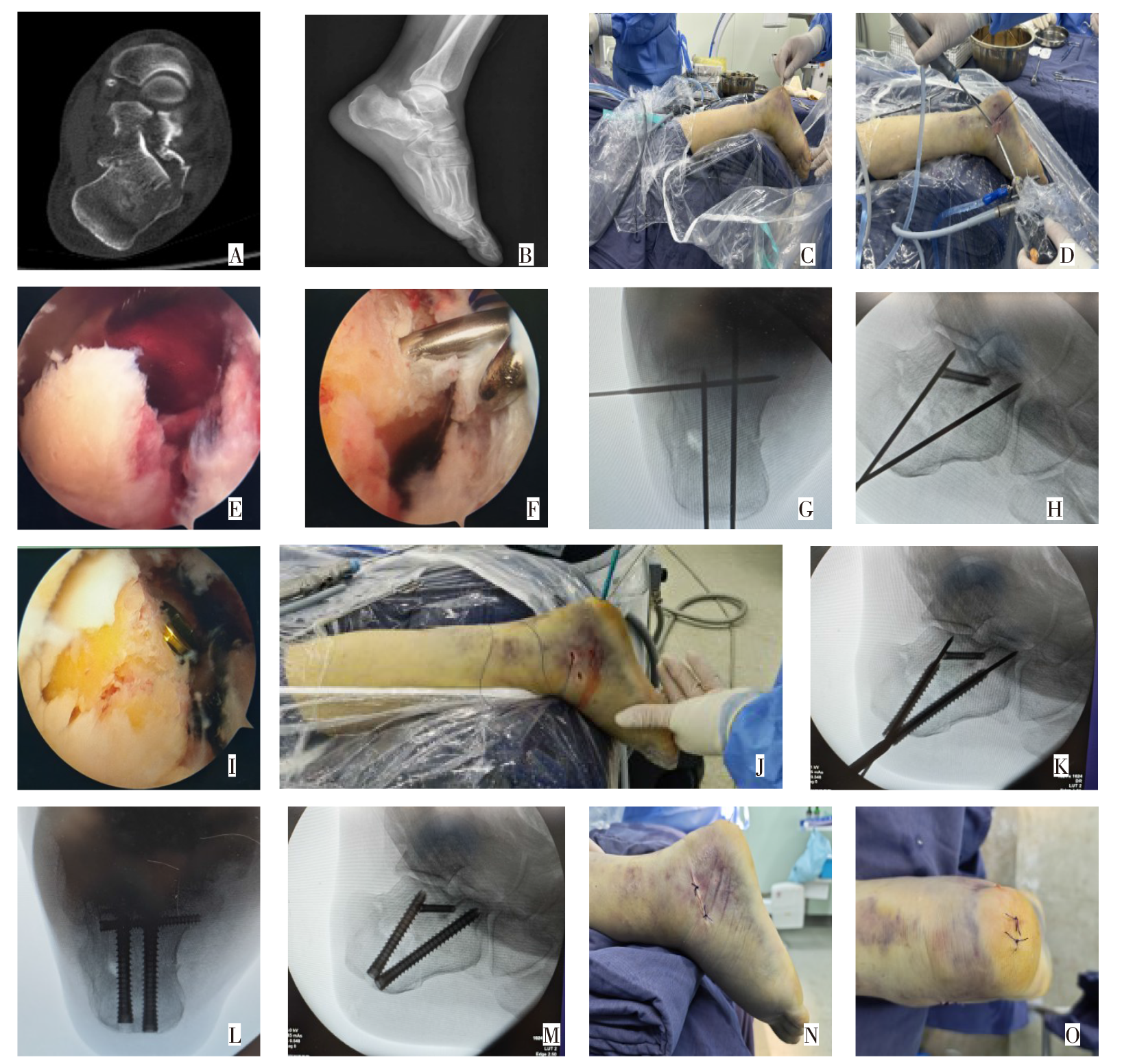
Fig.1 The treatment process and postoperative effect of patients with Sanders type III calcaneal fracture in the arthroscopic group
| 组别 | n | B?hler角/° | ||
|---|---|---|---|---|
| 3个月 | 6个月 | 末次随访 | ||
| 跗骨窦入路组 | 25 | 28.2±3.5 | 26.9±4.1 | 25.9±5.8 |
| 关节镜组 | 23 | 27.4±3.1 | 26.3±4.5 | 24.4±5.7 |
| t | 0.840 | 0.481 | 0.904 | |
| 组别 | Gissanes角/° | |||
| 3个月 | 6个月 | 末次随访 | ||
| 跗骨窦入路组 | 122.5±3.1 | 119.6±3.8 | 116.5±3.7 | |
| 关节镜组 | 121.2±2.9 | 118.2±3.0 | 115.2±3.6 | |
| t | 1.501 | 1.423 | 1.233 | |
Tab.3 Comparison of B?hler’s angle and Gissane’s angle between patients of the two groups at 3 months, 6 months and the last follow-up
| 组别 | n | B?hler角/° | ||
|---|---|---|---|---|
| 3个月 | 6个月 | 末次随访 | ||
| 跗骨窦入路组 | 25 | 28.2±3.5 | 26.9±4.1 | 25.9±5.8 |
| 关节镜组 | 23 | 27.4±3.1 | 26.3±4.5 | 24.4±5.7 |
| t | 0.840 | 0.481 | 0.904 | |
| 组别 | Gissanes角/° | |||
| 3个月 | 6个月 | 末次随访 | ||
| 跗骨窦入路组 | 122.5±3.1 | 119.6±3.8 | 116.5±3.7 | |
| 关节镜组 | 121.2±2.9 | 118.2±3.0 | 115.2±3.6 | |
| t | 1.501 | 1.423 | 1.233 | |
| 组别 | n | 疼痛VAS/评分 | ||
|---|---|---|---|---|
| 3个月 | 6个月 | 末次随访 | ||
| 跗骨窦入路组 | 25 | 2(2,3) | 2(1,3) | 1(1,1) |
| 关节镜组 | 23 | 2(2,3) | 2(1,3) | 1(1,1) |
| Z | 0.292 | 0.974 | 0.545 | |
| 组别 | AOFAS/分 | |||
| 3个月 | 6个月 | 末次随访 | ||
| 跗骨窦入路组 | 85.4±1.1 | 87.2±1.7 | 90.8±2.7 | |
| 关节镜组 | 85.7±1.4 | 87.8±1.9 | 91.3±2.9 | |
| t | 0.821 | 1.149 | 0.617 | |
Tab.4 Comparison of AOFAS and VAS scores at 3 months, 6 months after surgery and the last follow-up between the two groups
| 组别 | n | 疼痛VAS/评分 | ||
|---|---|---|---|---|
| 3个月 | 6个月 | 末次随访 | ||
| 跗骨窦入路组 | 25 | 2(2,3) | 2(1,3) | 1(1,1) |
| 关节镜组 | 23 | 2(2,3) | 2(1,3) | 1(1,1) |
| Z | 0.292 | 0.974 | 0.545 | |
| 组别 | AOFAS/分 | |||
| 3个月 | 6个月 | 末次随访 | ||
| 跗骨窦入路组 | 85.4±1.1 | 87.2±1.7 | 90.8±2.7 | |
| 关节镜组 | 85.7±1.4 | 87.8±1.9 | 91.3±2.9 | |
| t | 0.821 | 1.149 | 0.617 | |
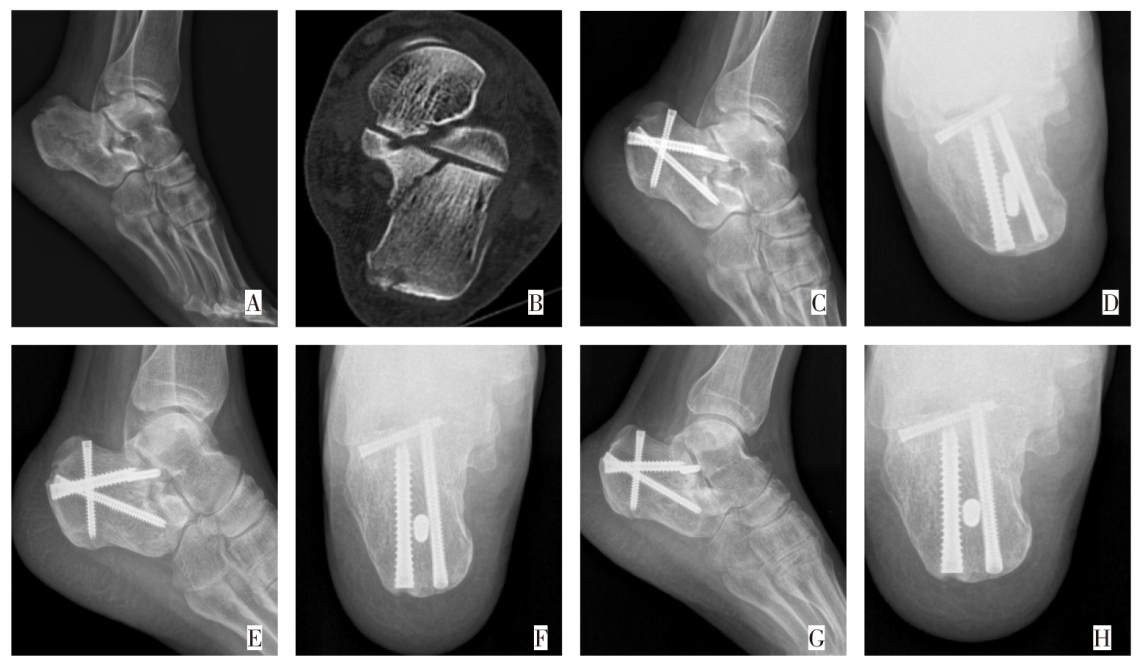
Fig.2 Preoperative and postoperative follow-up imaging findings in a patients with Sanders type Ⅱ calcaneal fracture
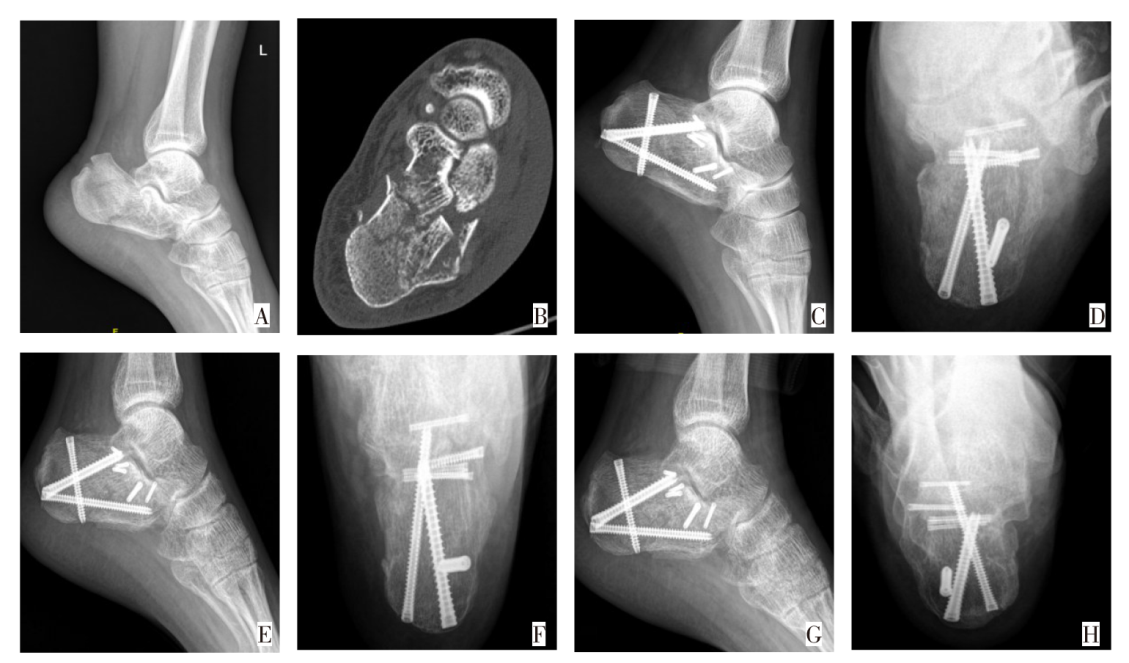
Fig.3 Preoperative and postoperative follow-up imaging findings in the patient with Sanders type Ⅲ calcaneal fracture
| [1] | WILKINSON B G, MARSH J L. Minimally invasive treatment of displaced intra-articular calcaneal fractures[J]. Orthopedic Clinics, 2020, 51(3):325-338. doi:10.1016/j.ocl.2020.02.007. |
| [2] | 张博禹, 张俊国, 谢文勇, 等. 跟骨骨折术后距下关节炎与足部功能预后的危险因素分析[J]. 中华骨与关节外科杂志, 2022, 15(12):958-963. |
| ZHANG B Y, ZHANG J G, XIE W Y, et al. Risk factors of subtalar arthritis and the prognosis of foot function after calcaneal fracture surgery[J]. JBJS, 2022, 15(12):958-963. doi:10.3969/j.issn.2095-9958.2022.12.11. | |
| [3] | EBRAHEIM N A, ELGAFY H, SABRY F F, et al. Sinus tarsi approach with trans-articular fixation for displaced intra-articular fractures of the calcaneus[J]. Foot Ankle Int, 2000, 21(2):105-113. doi:10.1177/107110070002100203. |
| [4] | MAROUBY S, CELLIER N, MARES O, et al. Percutaneous arthroscopic calcaneal osteosynthesis for displaced intra-articular calcaneal fractures:systematic review and surgical technique[J]. Foot and Ankle Surgery, 2020, 26(5):503-508. doi:10.1016/j.fas.2019.07.002. |
| [5] | 马昕, 施忠民, 陈亦轩. 跟骨骨折微创手术治疗进展及展望[J]. 中华骨与关节外科杂志, 2024, 17(4):289-293. |
| MA X, SHI Z M, CHEN Y X. Progress and prospects of minimally invasivesurgery for calcaneal fractures[J]. Chin J Bone Joint Surg, 2024, 17(4):289-293. doi:10.3969/j.issn.2095-9958.2024.04.01. | |
| [6] | 吕红芝, 秦士吉, 李文静, 等. 跟骨骨折术后功能恢复的相关因素分析[J]. 中华创伤骨科杂志, 2022, 24(5):402-408. |
| LV H Z, QIN S J, LI W J, et al. Analysis of factors related to postoperative funetional recovery after surgery of calcaneal fracture[J]. Chin J Orhep Trauma, 2022, 24(5):402-408. doi:10.3760/cma.j.cn115530-20220323-00161. | |
| [7] | 郝云甲, 王爱国, 吕泽祥, 等. 全后足关节镜下距下关节融合治疗成人疼痛性跟距骨桥的临床效果[J]. 中华外科杂志, 2023, 61(11):976-981. |
| HAO Y J, WANG A G, LV Z X, et al. Posterior arthroscopic subtalar arthrodesis for symptomatic adult talocalcaneal coalition[J]. Chin J Surg, 2023, 61(11):976-981. doi:10.3760/cma.j.cn112139-20230621-00241. | |
| [8] | SANGEORZAN A, SANGEORZAN B. Subtalar joint biomechanics:from normal to pathologic[J]. Foot Ankle Clin, 2018, 23(3):341-352. doi:10.1016/j.fcl.2018.04.002. |
| [9] | JOVENIAUX P, HARISBOURE A, OHL X, et al. Long-term results of in situ subtalar arthrodesis[J]. Int Orthop, 2010, 34:1199-1205. doi:10.1007/s00264-010-1041-5. |
| [10] | 胡晓伟, 孙开强, 厉运收, 等. 跗骨窦撬拨复位经皮钉中钉内固定微创治疗跟骨骨折[J]. 实用手外科杂志, 2023, 37(1):76-79. |
| HU X W, SUN K Q, LI Y S, et al. Sinus tarsi minimal invasive approach and percutaneous reduction by leverage with Nail--in-nailinternal fixation in the treatment of calcaneal fractures[J]. Journal of Practical Hand Surgery, 2023, 37(1):76-79. doi:10.3969/j.issn.1671-2722.2023.01.022. | |
| [11] | 陈佳, 余鹏钧, 张剑, 等. 跗骨窦切口微创钢板联合经皮空心螺钉固定治疗跟骨骨折[J]. 中华骨科杂志, 2024, 44(12):825-832. |
| CHEN J, YU P J, ZHANG J, et al. Effectiveness analysis of minimally invasive sinus tarsi incision with steel plate combined with percutaneous hollow nail in the treatment of calcaneal fractures[J]. Chin J Orthep, 2024, 44(12):825-832. doi:10.3760/cma.j.cn121113-20231121-00323. | |
| [12] | 冯仕明, 赵家举, 马超, 等. 三通道全内距下关节镜排钉技术在 SandersⅡ、Ⅲ型跟骨骨折治疗中的应用[J]. 中华外科杂志, 2022, 60(6):546-551. |
| FENG S M, ZHAO J J, MA C, et al. All-inside subtalar arthroscopy through three portals combined with rafting screws technique for the treatment ofthe calcaneal fractures of Sanders l and Ⅲ[J]. Chin J Surg, 2022, 60(6):546-551. doi:10.3760/cma.j.cn112139-20211008-00475. | |
| [13] | 焦福德, 庄云强, 应霁翀, 等. 经跗骨窦切口应用可吸收棒联合克氏针治疗SandersⅡ、Ⅲ型跟骨骨折的疗效分析[J]. 中华创伤骨科杂志, 2022, 24(1):73-77. |
| JIAO F D, ZHUANG Y Q, YING J C, et al. Treatment of SandersⅡ &Ⅲ calcaneal fractures with an absorbable stick plus Kirschner wire through the tarsal sinus incision[J]. Chin J Orthop Trauma, 2022, 24(1):73-77. doi:10.3760/cma.j.cn115530-20210602-00254. | |
| [14] | LI L H, GUO Y Z, WANG H, et al. Less wound complications of a sinus tarsi approach compared to an extended lateral approach for the treatment of displaced intraarticular calcaneal fracture:a randomized clinical trial in 64 patients[J]. Medicine(Baltimore), 2016, 95(36):e4628. doi:10.1097/md.0000000000004628. |
| [15] | KIKUCHI C, CHARLTON T P, THORDARSON D B. Limited sinus tarsi approach for intra-articular calcaneus fractures[J]. Foot Ankle Int, 2013, 34(12):1689-1694. doi:10.1177/1071100713510267. |
| [16] | MAT RODI M S, VASEENON T, PHANPHAISARN A, et al. A windows technique for sustentaculum tali screw fixation using the sinus tarsi approach for calcaneal fractures:a cadaveric study[J]. Arch Orthop Trauma Surg, 2023, 143(2):637-643. doi:10.1007/s00402-021-04102-9. |
| [17] | RAMMELT S, GAVLIK J M, BARTHEL S, et al. The value of subtalar arthroscopy in the management of intra-articular calcaneus fractures[J]. Foot Ankle Int, 2002, 23(10):906-916. doi:10.1177/107110070202301004. |
| [18] | LIN J, XIE C, CHEN K, et al. Comparison of sinus tarsi approach versus extensile lateral approach for displaced intra-articular calcaneal fractures Sanders type IV[J]. Int Orthop, 2019, 43(9):2141-2149. doi:10.1007/s00264-019-04318-w. |
| [19] | REN W, ZHANG K, ZHAO Z, et al. Biomechanical characteristics of Sanders type Ⅱ and Ⅲ calcaneal fractures fixed by open reduction and internal fixation and percutaneous minimally invasive fixation[J]. J Orthop Surg Res, 2024, 19(1):166. doi:10.1186/s13018-024-04606-1. |
| Viewed | ||||||
|
Full text |
|
|||||
|
Abstract |
|
|||||
